News lessonNovember 2025
What Can a Walk in Nature Actually Change?
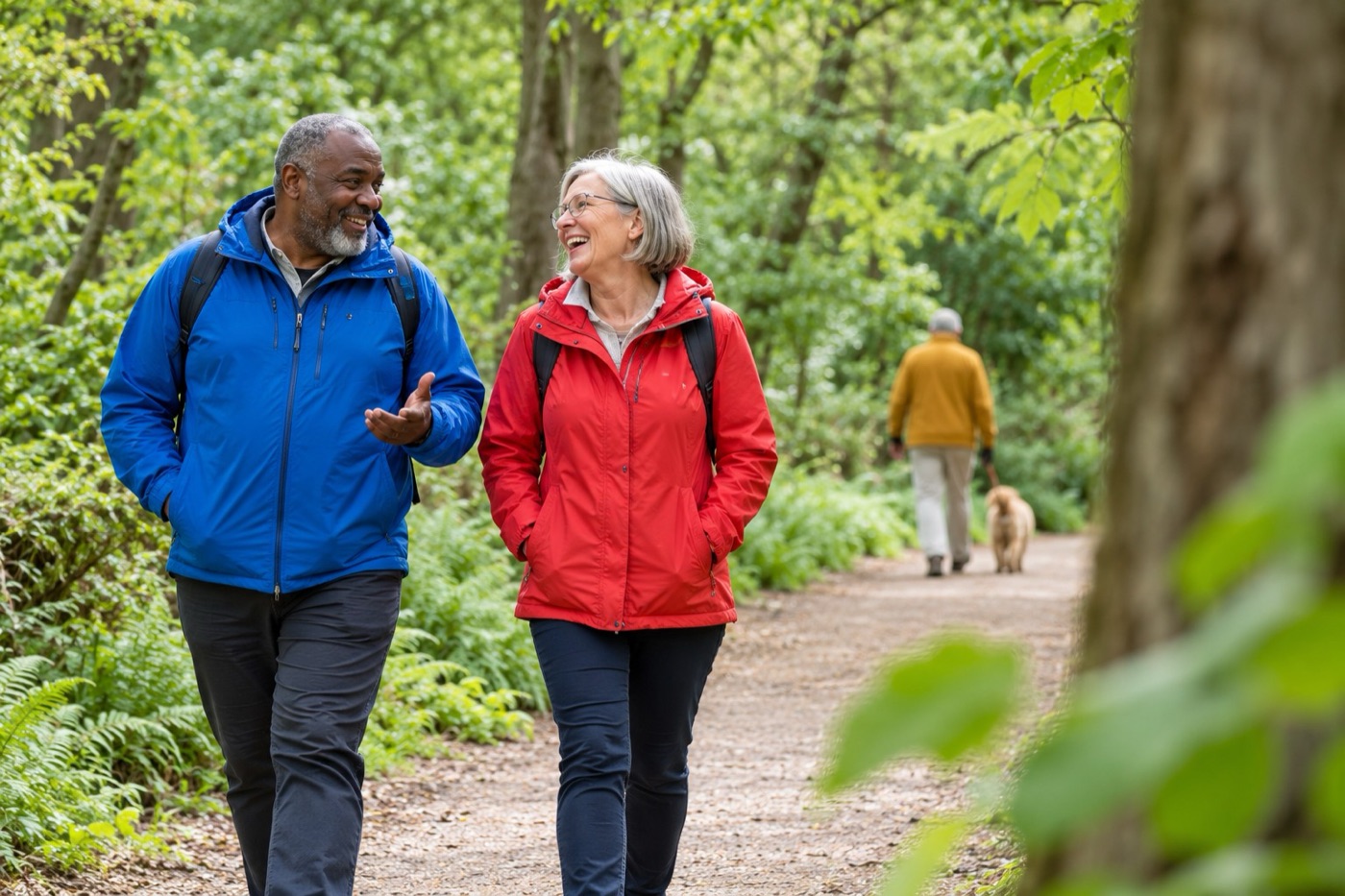
A 2025 review found the strongest results for mood and mixed ones for attention and stress. Access to a decent park is not shared equally.
Before you read
1Warm up3 questions
Talk about these questions with a partner.
- Where would you go for a walk if you had twenty minutes?
- Would you rather walk somewhere familiar or explore a new route?
- What helps you notice your surroundings?
2Key words8 words
These words are in the article. Choose the letter of the meaning for each one.
- evidence
- review
- access
- disability
- opportunity
- experiments
- concerns
- concentration
- Agiving all your attention to one thing
- Btests that scientists do to learn something
- Cfacts or signs that show something is true
- Da way to reach or use something
- Ea careful study of what other people have found
- Fworries about something
- Ga chance to do something good
- Ha condition that makes some activities harder for a person
1Warm up3 questions
Talk about these questions with a partner.
- Where would you go for a walk if you had twenty minutes?
- Would you rather walk somewhere familiar or explore a new route?
- What helps you notice your surroundings?
2Key words8 words
These words are in the article. Choose the letter of the meaning for each one.
- genuinely
- systematic
- randomised
- outcomes
- factors
- straightforward
- mobility
- neighbourhood
- Athings that help to cause a result
- Bdone in an organised way, using a clear method
- Cthe area around where you live
- Dsimple and not complicated
- Eresults of something
- Fin a real and honest way
- Gthe ability to move around easily
- Hchosen by chance, not by a person's decision
1Warm up3 questions
Talk about these questions with a partner.
- Where would you go for a walk if you had twenty minutes?
- Would you rather walk somewhere familiar or explore a new route?
- What helps you notice your surroundings?
2Key words8 words
These words are in the article. Choose the letter of the meaning for each one.
- randomised
- systematic
- cognitive
- guarantees
- obstacles
- policymakers
- justice
- exposed
- Adone in an organised way, following a clear method
- Bpromises that something will definitely happen
- Cpeople who decide official plans and rules
- Dchosen or arranged by chance, not by choice
- Ethings that block your way or make progress hard
- Ffair treatment of everyone
- Gconnected with thinking and understanding
- Hopen and not protected from wind or weather
Read
3Read the article
The paragraphs are numbered. Look out for the key words from task 2.
Core version
Imagine that you have had a stressful morning. You could sit inside and scroll through your phone, or you could go for a short walk through a park. Many people believe that fresh air and trees will make them feel better. But is there any science behind this idea?
Researchers have studied how time in nature affects our minds. A review published in the Journal of Environmental Psychology in 2025 examined experiments with adults. It found good evidence that natural places can improve people's mood. People may feel calmer or experience fewer negative emotions after spending time outside.
However, the results were not the same for everything. The evidence that nature improves memory and concentration was much weaker. Studies of stress also produced mixed results. This means a walk in the woods may help someone feel happier without automatically making them better at difficult mental tasks.
There are many possible reasons why a walk feels good. Moving the body can be enjoyable, and getting away from noise and traffic may help people relax. Trees, birds and water also give our attention something different to focus on. Not everyone needs a mountain or a large forest to experience these things.
Of course, access to nature is not equal. Some people live beside beautiful parks, while others have to put up with busy roads and few green spaces nearby. Bad weather, disability and safety concerns can make outdoor activities harder too.
It is also worth remembering that we do not all experience nature in the same way. One person may feel happy beside the sea. Another may prefer a peaceful garden or a mountain path. Someone who lives in a crowded city might enjoy a small local park because it is easy to visit every day.
Nature can be a shared experience too. Walking with a friend gives people time to catch up without being distracted by phones or loud music. If a park is nearby, you do not need expensive equipment to use it. But towns and cities must take care of these spaces so that they are welcoming to children, older adults and people with disabilities.
Nature is not a cure for every problem, but it may offer a simple opportunity to feel better. Perhaps the next time a day feels difficult, a short walk is worth trying. You do not need to count every step or turn the experience into another task.
Intermediate version
After a stressful morning, many people feel better following a walk among trees or beside the sea. The experience is familiar, but researchers have been trying to work out how much of the benefit comes from nature itself and which aspects of our wellbeing are most affected.
There is a difference between exercising because you feel you should and going outside because you genuinely enjoy it. The second may be easier to keep up in the long run.
A systematic review published in the Journal of Environmental Psychology in November 2025 examined randomised experiments involving adults and natural environments. The evidence was strongest for improvements in mood, such as feeling calmer and experiencing fewer negative emotions. Findings for attention and memory were less consistent, while results relating to stress depended partly on how stress was measured.
This matters because articles about nature sometimes promise too much. A pleasant afternoon outdoors is not necessarily a treatment for a mental health condition, and a single walk will not transform everybody's concentration. Research suggests useful benefits, but their size and reliability vary between outcomes and studies.
The effect may involve several factors working together. Natural surroundings can offer a change from traffic, screens and crowded indoor spaces. Walking adds physical movement, while parks or beaches may create opportunities to spend time with other people. Separating these influences scientifically is not always straightforward. Access matters, too. A peaceful woodland path is a luxury if you live beside a busy road, have limited mobility or cannot spare the time to travel to a park.
The gap is a practical one. Someone living near a safe, attractive park has more opportunities for regular outdoor time than a person in a neighbourhood with poor facilities. Weather, mobility and the demands of work can further limit people's choices. Telling individuals to 'go outside more' ignores these practical differences.
The surroundings people choose may also influence whether outdoor time feels restorative. A crowded park beside a busy road can offer a very different experience from a quiet woodland path, and preferences vary according to mobility, safety and personal interests. Social contact may be another part of the benefit.
Meeting a friend for a walk combines movement, conversation and a change of environment, making it difficult to isolate one factor. This complexity should not put cities off creating accessible green spaces. It suggests that good design matters: places need safe paths, seating, maintenance and suitable transport links. A healthy environment is most useful when people can visit it regularly, not only on occasional trips to distant countryside.
The reasonable conclusion is neither that nature works miracles nor that its benefits are imaginary. Spending time in green or coastal spaces can support mood, and cities may have good reasons to look after such places. A walk is not a replacement for medical care, but it can be a valuable part of ordinary life.
Advanced version
A walk outdoors can change the feel of a day. The difficult question is what does the helping: the movement, the company, the time away from a screen or the surroundings themselves? Researchers have tried to separate those effects. The results are more useful than the promise that nature fixes everything.
A systematic review published in the Journal of Environmental Psychology in November 2025 assessed randomised studies of natural environments and adult wellbeing. Researchers found relatively strong evidence that exposure to nature improved mood, while findings concerning memory and attention were inconsistent. Measures of stress produced mixed results. The contrast is important: feeling emotionally better after a walk does not necessarily imply improved performance on a cognitive test.
There are plausible explanations for why natural places feel restorative. They can reduce exposure to some urban demands, invite gentle physical activity and encourage a different relationship with our surroundings. Yet experiments struggle to tease apart these ingredients. Is the benefit produced by greenery, walking, social company, reduced noise or a combination of all four? Still, research findings are averages, not guarantees. A crowded park, unsafe footpaths or unpleasant weather can change the experience considerably, while mental-health difficulties rarely have one straightforward solution.
A second 2025 review also suggested modest attention-restoration benefits in some settings, with substantial variation across studies. These differences underline why headlines should not present scientific uncertainty as failure. It is entirely possible for an activity to improve mood while offering less predictable effects on other aspects of cognition.
There is an environmental justice dimension too. Advice to visit nature assumes that attractive, safe spaces are available and accessible. Residents of neighbourhoods dominated by traffic, poor maintenance or limited public transport may come up against obstacles that personal motivation cannot solve. That raises a wider policy question. If accessible green space contributes to wellbeing, its availability should not depend entirely on someone's income, neighbourhood or ability to travel.
The uneven availability of nature also illustrates why wellbeing cannot be reduced to personal choice. Residents of affluent neighbourhoods may have access to maintained parks and quiet walking routes, while others must negotiate traffic, pollution or unsafe public spaces. The potential benefits of exposure are therefore partly determined by decisions about urban planning, funding and transport.
Moreover, the type of environment matters: a crowded urban park, an exposed coastline and a remote forest provide different experiences, and there is no one-size-fits-all setting. Rather than interpreting the research as another instruction to individuals, policymakers might regard it as evidence supporting accessible, well-designed public spaces. A recommendation to spend time outdoors is more meaningful when the outdoors offers somewhere pleasant and safe to go.
The evidence therefore supports a measured conclusion. Natural environments can contribute to wellbeing, especially emotional wellbeing, but they are neither a guaranteed psychological treatment nor a substitute for healthcare. Protecting accessible parks and public green spaces may be a sensible social investment, even without promising that every visitor will emerge healthier, calmer and more intelligent.
After you read
4True, false or not given5 statements
Choose T (true), F (false) or NG (the article does not say).
- The evidence for memory and concentration was equally strong.
The text says the opposite: "The evidence that nature improves memory and concentration was much weaker."
- Not everybody can reach good green spaces easily.
The text says: "Of course, access to nature is not equal."
- The review suggested that time in nature can lift people's mood.
The text says: "It found good evidence that natural places can improve people's mood."
- The review was paid for by a government.
Not stated. The text does not say who paid for the review.
- The writer says people must count every step for a walk to help.
The text says: "You do not need to count every step."
5Vocabulary5 gaps
Complete the sentences with words from the box. Two words are not needed.
crowdedcuredistractedequipmentnoisyroutewelcoming
- There is no magic for a bad mood, but a walk can help.
- It is hard to read a book when you are by loud music.
- The beach was so that there was no space to put down a towel.
- The new library is bright and , so everyone wants to visit.
- Swimming is cheap, but some sports need special .
6Verb forms5 gaps
Write the correct form of the verb in brackets.
- Researchers how time in nature affects our minds for many years. (STUDY)
- A review in 2025 examined experiments with adults. (PUBLISH)
- People may feel calmer after time outside. (SPEND)
- Last week, a friend me to a small park near her house. (TAKE)
- You do not need every step. (COUNT)
7Language focuscollocations
Complete the sentences with words from the box. Two words are not needed. Collocations are words that go together naturally. Learn the pair, not just the single word.
airemotionsfriendsroadsspacestasksweather
- Open a window to let in some fresh .
- I try to avoid walking along busy with lots of traffic.
- Hiking is difficult in bad , especially when it rains all day.
- Many cities are planting trees to create more green for residents.
- Shouting at people rarely helps you deal with negative .
4True, false or not given5 statements
Choose T (true), F (false) or NG (the article does not say).
- All the studies in the review measured stress in the same way.
The text says results for stress "depended partly on how stress was measured".
- The writer thinks cities should stop creating green spaces because the benefits are unclear.
The text says the complexity "should not put cities off creating accessible green spaces".
- Someone near a safe park has more chances to go outside regularly than a person in a neighbourhood with no safe park.
The text compares someone near "a safe, attractive park" with a person in a neighbourhood with poor facilities.
- The researchers who wrote the review work at a university.
Not stated. The text does not say where the researchers work.
- Walking with a friend makes it easy to say which part of the walk helps most.
The text says a walk with a friend makes it "difficult to isolate one factor".
5Vocabulary6 gaps
Complete the sentences with words from the box. Two words are not needed.
complexityfacilitieshospitalityluxurymaintenancepreferencesreliabilitytransport
- A good experiment must give similar results each time it is repeated, so scientists always test its .
- For many families, a holiday abroad is a rather than something they can afford every year.
- The hotel is cheap, but its are poor, with no gym, pool or lift.
- Hotel guests have different for food, so the menu offers several choices.
- Because of the of the human mind, no single study can explain how people feel.
- The old footpath needs regular to stay safe in winter.
6Verb forms5 gaps
Write the correct form of the verb in brackets.
- By the time the review came out, researchers dozens of studies. (EXAMINE)
- Many city parks more than a hundred years ago. (BUILD)
- She the park every day since she moved here. (VISIT)
- If I more free time, I would walk every morning. (HAVE)
- Telling individuals outside more ignores practical differences. (GO)
7Language focuscollocations
Complete the sentences with words from the box. Two words are not needed. Fixed pairs are often a verb plus noun or an adjective plus noun. Ask which word people usually choose, not only which word fits the meaning.
energylifepromisereasonableroadtrafficwalk
- Some headlines too much and then disappoint readers.
- A park beside a busy can feel noisy and stressful.
- A single will not change your life, but regular exercise might.
- Many people want to get back to ordinary after a long illness.
- After comparing both studies, the conclusion is that the evidence is still limited.
4True, false or not given5 statements
Choose T (true), F (false) or NG (the article does not say).
- Both 2025 reviews gave strong support to the idea that nature improves attention.
The first review found attention findings inconsistent, and the second suggested only "modest" benefits.
- The writer argues that the research should mainly be used to urge individuals to spend more time outdoors.
The writer says policymakers should treat it as evidence for accessible public spaces, "rather than" another instruction to individuals.
- Advice to visit nature would be harder to follow in a neighbourhood with heavy traffic and few public transport links.
Residents of such areas "may come up against obstacles that personal motivation cannot solve".
- The reviews included studies carried out in more than one country.
Not stated. The text does not say where the studies took place.
- The two reviews appeared in the same month.
Only the first review's month (November 2025) is given; the second is just "a second 2025 review".
5Vocabulary6 gaps
Complete the sentences with words from the box. Two words are not needed.
dominatedexposuremodestnegotiateplausiblesubstantialunderlineundermine
- Several explanations were put forward, but none could be proved.
- The scandal served to how little oversight the industry had.
- Wheelchair users often have to broken pavements and steep kerbs.
- The new tax produced a increase in revenue, far more than had been forecast.
- The skyline was by a vast glass tower.
- Prolonged to loud noise can damage hearing.
6Word forms5 gaps
Use the word in brackets to make a word that fits the gap.
- The effects of the treatment proved far less than the doctors had hoped. (PREDICT)
- The council was criticised for years of cuts that left the footpaths in poor condition. (MAINTAIN)
- The of the old canal took nearly a decade. (RESTORE)
- Critics questioned the of conclusions drawn from one small sample. (RELIABLE)
- The scheme's success is wholly on volunteers. (DEPEND)
7Language focuscollocations
Complete the sentences with words from the box. Two words are not needed. Test each pair for register as well as meaning. Fluent writers expect a particular adjective, verb or noun in formal phrases.
investmentmeasuredmotivationplanningraisessolutionuncertainty
- The article an important question about who gets to use parks.
- The minister gave a response, neither dismissing nor welcoming the report.
- Many economists regard early childhood education as a sound social .
- City councils employ specialists in urban to decide where new homes and parks should go.
- There is rarely a straightforward to complex social problems.
Speak
8Talk about it3 questions
Discuss in pairs or small groups. Give reasons for your answers.
- What would make it easier for more people to spend time outdoors?
- Does a walk need to be somewhere beautiful to be worthwhile?
- Would you protect a daily walk if it meant leaving another task unfinished?
8Talk about it3 questions
Discuss in pairs or small groups. Give reasons for your answers.
- What would make it easier for more people to spend time outdoors?
- Does a walk need to be somewhere beautiful to be worthwhile?
- Would you protect a daily walk if it meant leaving another task unfinished?
8Talk about it3 questions
Discuss in pairs or small groups. Give reasons for your answers.
- What would make it easier for more people to spend time outdoors?
- Does a walk need to be somewhere beautiful to be worthwhile?
- Would you protect a daily walk if it meant leaving another task unfinished?
9Role-play: our local park
Work in pairs. Read your card, then have the conversation. Swap roles and do it again.
Student A · the council officer
You have money for one job in the park this year: new lights, new benches or a new path. Ask the resident two questions, then decide what to offer. You can say yes, no, or yes to part of the request.
Student B · the resident
The park near your home is hard to enjoy. The path is broken and there are no benches. Ask the council to fix it, explain who needs it most, and try to get a date.
Useful phrases
- I'd like to talk about the park near my house.
- It's hard for older people to use it.
- We've only got money for one thing this year.
- What matters most to you?
- I'm afraid I can't promise a date.
- Could we agree on a small first step?
Afterwards, tell the class what the council decided and whether you think it was fair.
Your words
Highlights0 saved
Highlights0 saved
Highlights0 saved
Was this lesson useful? Support johnplusnews on Ko-fi
Continue reading
Psychology
The Way You Think About Being Alone Changes How It Feels
Researchers read 144 newspaper articles about solitude and found them overwhelmingly gloomy. They also found that what you believe about time alone predicts how lonely it makes you.
Travel
What Happens When One of the World's Quietest Places Gets Easier to Visit?
Greenland now has three new airports and more visitors than ever, but tourism is still a small part of its economy. Some residents worry about what a rush of visitors could do to a quiet place with a fragile environment.
Health
Is Social Media Making Wellness Too Hard to Escape?
Eating disorder experts in Australia say online wellness content can blur the line between helpful health advice and old-fashioned diet culture, and they are asking one question: who really benefits?