News lesson13 October 2026
The Charity-Shop Bag Nobody Wants
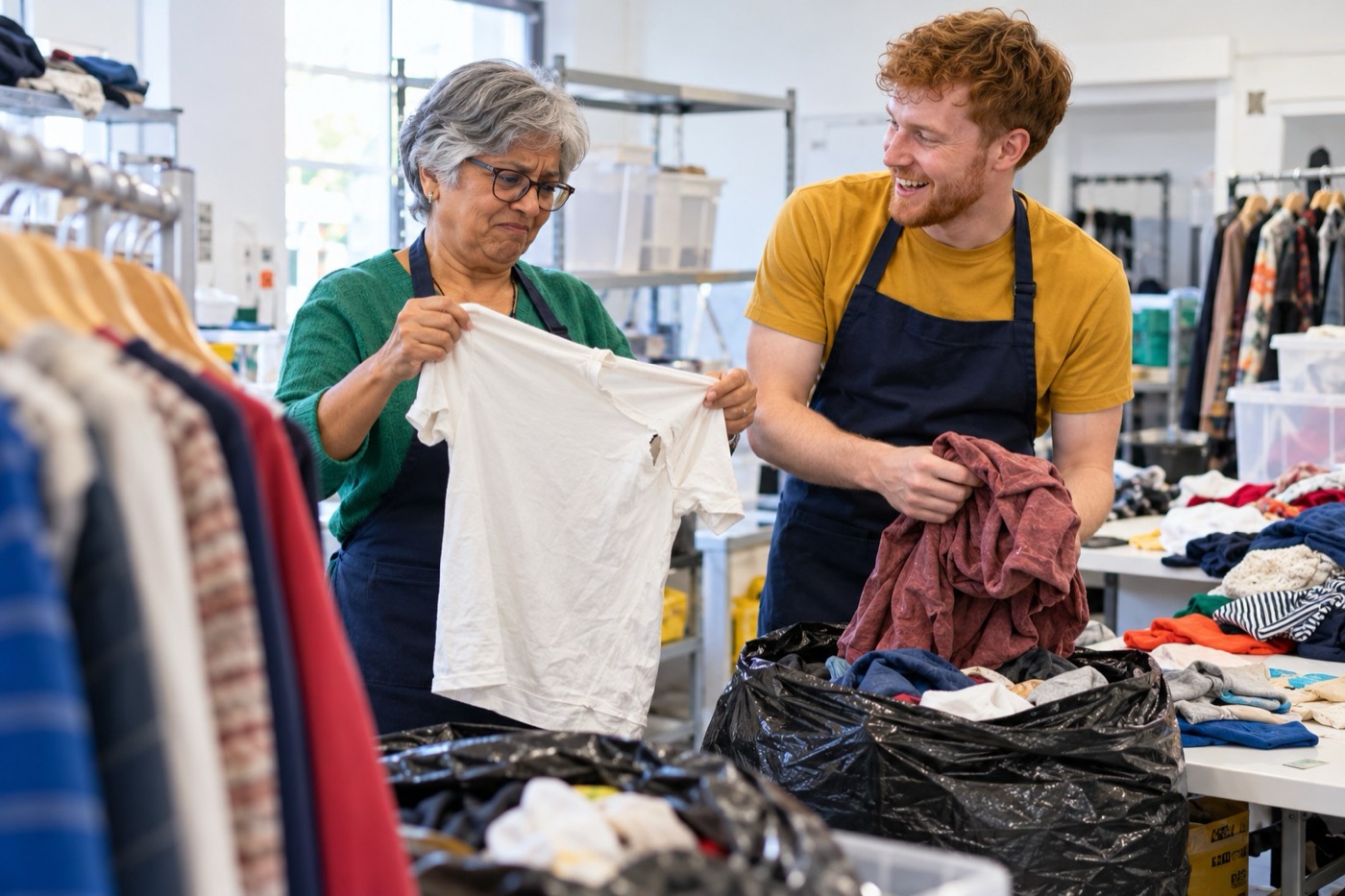
The bag outside the shop carries a comforting promise. In the sorting room, staff find clothes too worn or too cheap to sell to anyone.
Before you read
1Warm up3 questions
Talk about these questions with a partner.
- What makes you stop wearing something that still fits?
- Would you buy fewer clothes if each one cost more?
- What do you imagine happens after you donate clothes?
2Key words8 words
These words are in the article. Choose the letter of the meaning for each one.
- resale
- trends
- encouraged
- recycling
- exceptions
- budgets
- wardrobes
- destroying
- Abreaking or ruining something completely
- Bselling something again after someone else owned it
- Cthings that are not included in a rule
- Dbig cupboards where people keep their clothes
- Enew styles that many people like for a short time
- Fusing old things to make new things
- Gthe money people have to spend
- Hmade someone want to do something
1Warm up3 questions
Talk about these questions with a partner.
- What makes you stop wearing something that still fits?
- Would you buy fewer clothes if each one cost more?
- What do you imagine happens after you donate clothes?
2Key words8 words
These words are in the article. Choose the letter of the meaning for each one.
- garments
- resale
- impulse
- fibres
- recycling
- exceptions
- responsibility
- affordable
- Aa sudden wish to do something without thinking
- Bpieces of clothing
- Ca duty to deal with something and its results
- Dselling something again after someone else owned it
- Ethin threads that cloth is made from
- Fcases that a rule does not cover
- Gusing old materials to make new things
- Hnot too expensive for ordinary people
1Warm up3 questions
Talk about these questions with a partner.
- What makes you stop wearing something that still fits?
- Would you buy fewer clothes if each one cost more?
- What do you imagine happens after you donate clothes?
2Key words8 words
These words are in the article. Choose the letter of the meaning for each one.
- overproduction
- algorithmic
- durable
- disposal
- footwear
- synthetic
- complicate
- substantial
- Amade by people from chemicals, not from natural materials
- Blarge in amount
- Cshoes, boots and similar things
- Dthe act of getting rid of something
- Eable to last a long time without being damaged
- Fchosen by computer rules that learn what a person likes
- Gto make something harder to deal with
- Hmaking more of something than people need
Read
3Read the article
The paragraphs are numbered. Look out for the key words from task 2.
Core version
You fill a bag with clothes you no longer wear and leave it at a charity shop. It feels like a good ending: the shop can raise money and someone else can enjoy the clothes. Then the bag is opened. One top is damaged, another is made from poor material and a third is unlikely to sell. Instead of earning money for the charity, some of your donation may cost it money to remove.
That is happening more often as charity shops receive more clothes than they can sell. In October 2026, one charity operation in south London said it received as many as 100 bags a day. Only about one quarter of the items were suitable for resale. Staff still had to sort through everything, using time and money that could have supported the charity's main work.
This problem is connected to fast fashion, which means producing inexpensive new clothing styles very quickly. Social media helps trends catch on, and shoppers are encouraged to buy things they may not need. Research by Oxfam in 2026 found that 32% of clothes in British wardrobes were never worn. Making all those clothes requires water, energy and materials, even if they are hardly ever used.
There are ways to reduce waste. People can buy fewer clothes, choose items that last longer, repair small problems and use second-hand shops. But recycling clothes is often difficult, especially when different materials are mixed together. From July 2026, large companies in the European Union were also banned from destroying most unsold clothing and shoes, with some exceptions.
Affordable clothes are important, especially for families on limited budgets. The answer cannot simply be to tell everyone to buy expensive brands. Clothing companies also need to make better products and avoid creating more waste than necessary. Before buying something new, it may help to ask whether you will still want to wear it next year, though that is easier for some households than others.
Intermediate version
A bag left outside a charity shop carries a comforting promise: these clothes will find new owners and help a good cause. Inside the sorting room, the story can be very different. Staff open the bag and discover damaged seams, weak fabric and garments with almost no resale value. The donation has not removed the waste. It has transferred the difficult decision, and sometimes the disposal bill, to the charity.
A hospice charity in south London told a reporter that up to 100 bags can arrive in a single day. Only around a quarter of the items inside were suitable for sale. Every item still had to be checked and handled. Meanwhile, resale apps allow people to sell their most desirable pieces directly, potentially leaving charity shops with a greater share of the clothes nobody wants. A generous gesture can therefore become an unexpected expense.
The situation reflects the growth of fast fashion, an industry built around low prices and rapidly changing trends. Clothing can be advertised online, bought within seconds and replaced before it has worn out. Social media encourages impulse purchases by showing shoppers a constant stream of new looks. In its 2026 State of Style report, Oxfam found that 64% of people surveyed in Britain had bought clothes they were not actively looking for after seeing something online. The charity also estimated that nearly a third of clothing in British wardrobes was never worn.
That creates an enormous environmental cost. Producing garments requires water, energy and raw materials. Transport and packaging add to the impact, while synthetic fabrics may cause further problems when washed or discarded. Recycling is not always possible because many garments contain combinations of fibres that are difficult to separate. Donating unwanted clothing is better than throwing away usable items, but it does not undo the resources used to manufacture them.
Governments have begun to respond. Since July 2026, large companies in the EU have been prohibited from destroying most unsold clothes and shoes, with limited exceptions for goods that cannot safely be reused or sold. The rules encourage businesses to repair, donate or resell products instead. However, preventing destruction does not necessarily reduce the number of cheap garments being produced in the first place.
Consumers can make a difference by cutting back on new purchases, repairing clothes and choosing second-hand items, but it would be unfair to place all responsibility on shoppers. Affordable clothing matters, and not everyone can pay more for supposedly sustainable brands. Retailers must also consider durability and the volume of new products they put out. The simplest question may be one we rarely ask while shopping: will this still be worth wearing after the excitement of buying it has disappeared?
Advanced version
The donation bag provides a reassuring ending to the story of an unwanted garment. The wardrobe is clearer, the clothes avoid the bin and a charity may earn money. In the sorting room, that neat narrative can collapse. British charity shops report being inundated with clothing that is too damaged or too poor in quality to sell. The consumer has passed the garment on, but the social and environmental cost has not disappeared; it has simply arrived at somebody else's door.
The pressure is visible at St Raphael's Hospice in south London, where reporting in October 2026 described as many as 100 bags arriving each day and only a minority of their contents being fit for sale. Disposal costs eat into charitable income. At the same time, resale platforms encourage people to sell desirable pieces themselves, leaving shops to inherit more of the garments with little value. The charity sector is absorbing part of the cost of fast fashion's constant replacement cycle. Charities, in effect, are picking up the bill for decisions taken long before the bag reached their door.
Oxfam's 2026 State of Style report illustrates how consumption has become entwined with digital influence. Nearly two-thirds of people surveyed had purchased clothing they had not intended to buy after encountering it online, and 32% of items in British wardrobes were reportedly never worn. Among younger adults, algorithmic recommendations exerted an especially strong influence. Clothing is increasingly marketed not as a durable possession but as a quick response to a passing mood, event or online trend. Durability, on that model, is close to irrelevant.
The environmental consequences extend well beyond household clutter. Textile production consumes substantial water, energy and raw materials, while synthetic fibres and complex fabric blends complicate recycling. A garment may move from retailer to wardrobe to donation bag within months, despite having required extensive resources to manufacture and transport. Resale and donation can prolong the useful life of clothing, but they cannot make excessive production environmentally harmless. Every additional garment carries a cost that no amount of reselling can write off.
European policymakers have begun to intervene. Since July 2026, large companies have faced a prohibition on destroying most unsold apparel and footwear, with defined exceptions. The measure is intended to encourage resale, repair and reuse rather than disposal of perfectly serviceable goods. It marks a shift towards holding businesses responsible for what happens after products fail to sell, although it does not directly challenge the relentless pace at which new collections are launched.
Cheap clothes meet a real need, and buying fewer, more expensive items is not an option for every household. Shoppers also have limited control over how well clothes are made. Manufacturers choose materials, shops encourage purchases and governments decide which disposal costs businesses bear. Charity shops are dealing with the result. They cannot solve overproduction on their own.
After you read
4True, false or not given5 statements
Choose T (true), F (false) or NG (the article does not say).
- According to Oxfam, nearly a third of clothes in British wardrobes were never worn.
The text says: "Research by Oxfam in 2026 found that 32% of clothes in British wardrobes were never worn."
- All donated clothes can be sold in the shop.
The text says the opposite: "Only about one quarter of the items were suitable for resale."
- Charity shop donations have fallen since 2025.
Not stated. The text does not say whether charity shop donations have gone up or down over time.
- A charity in London says it can get up to 100 donation bags in one day.
The text says: "In October 2026, one charity operation in south London said it received as many as 100 bags a day."
- Oxfam found that most clothes in British wardrobes were never worn.
The text says the figure was 32%, which is less than half: "32% of clothes in British wardrobes were never worn."
5Vocabulary5 gaps
Complete the sentences with words from the box. Two words are not needed.
affordabledonationfashionablematerialrecyclerepairsuitable
- Families with little money need clothes at prices.
- This jacket is made from a warm called wool.
- If a button falls off your coat, you can it with a needle and thread.
- She left a of old coats at the charity shop on Saturday.
- A torn T-shirt with a big mark is not for the shop to sell.
6Verb forms5 gaps
Write the correct form of the verb in brackets.
- Last Saturday, Maria a bag of old clothes to the shop. (TAKE)
- Then the bag . (OPEN)
- In October 2026, one charity said it as many as 100 bags a day. (RECEIVE)
- Research by Oxfam in 2026 that 32% of clothes were never worn. (FIND)
- Large EU companies from destroying most unsold clothing. (BAN)
7Language focusprepositions
Complete the sentences with words from the box. Two words are not needed. Some words always go with the same small word, such as good at or rely on. Learn the pair together, not just the word.
atforinofontowith
- Maria paid ten pounds a second-hand coat.
- Some people are addicted buying new clothes every week.
- Few teenagers are interested repairing old clothes.
- Many shoppers are afraid missing a new trend.
- Many families rely cheap clothes because money is tight.
4True, false or not given5 statements
Choose T (true), F (false) or NG (the article does not say).
- Most of the British people Oxfam surveyed had bought clothes they were not looking for after seeing them online.
The text says: "In its 2026 State of Style report, Oxfam found that 64% of people surveyed in Britain had bought clothes they were not actively looking for after seeing something online."
- Charity shops in Scotland report the same problem.
Not stated. The text does not say whether charity shops in Scotland report the same problem.
- The EU rules prevent cheap garments from being produced.
The text says the opposite: "However, preventing destruction does not necessarily reduce the number of cheap garments being produced in the first place."
- Some clothes cannot easily be recycled because of the mix of fibres they contain.
The text says: "Recycling is not always possible because many garments contain combinations of fibres that are difficult to separate."
- Staff at the south London hospice charity could sell most of the items in the bags.
The text says: "Only around a quarter of the items inside were suitable for sale."
5Vocabulary6 gaps
Complete the sentences with words from the box. Two words are not needed.
comfortingdesirabledisposalprohibitedreducedreliablesynthetictransferred
- The doctor's calm voice had a effect on the nervous patient.
- When the company moved abroad, it most of its production to a cheaper country.
- A phone in a limited colour can become , so fans queue to buy it.
- Many councils charge a small fee for the of large items such as old sofas.
- Since the new law, shops have been from selling knives to children.
- Clothes made from fibres such as polyester can release tiny pieces of plastic when washed.
6Verb forms5 gaps
Write the correct form of the verb in brackets.
- By the time staff opened the bag, the donor the shop. (LEAVE)
- Clothes so cheaply now that people buy far more of them. (PRODUCE)
- A charity shop the problem of overproduction alone. (CAN / NOT / SOLVE)
- Oxfam that nearly a third of clothes in British wardrobes were never worn. (ESTIMATE)
- If shoppers fewer items, the charity would receive less rubbish. (BUY)
7Language focusprepositions
Complete the sentences with words from the box. Two words are not needed. Many verbs, nouns and adjectives take a fixed preposition. After it, use a noun or an -ing form, for example object to paying.
atforinofontowith
- Retailers should take responsibility the waste their products create.
- Constant new releases often result clothes being thrown away after a few wears.
- Many young shoppers depend social media to find new styles.
- Some people object paying more for clothes that last longer.
- Few shoppers are aware how much water a T-shirt needs.
4True, false or not given5 statements
Choose T (true), F (false) or NG (the article does not say).
- The text suggests that selling clothes on resale platforms leaves charity shops worse off.
The text says platforms encourage people to sell desirable pieces themselves, "leaving shops to inherit more of the garments with little value."
- The EU rule on unsold stock leaves the speed at which new clothes appear largely unchallenged.
The text says: "It marks a shift towards holding businesses responsible for what happens after products fail to sell, although it does not directly challenge the relentless pace at which new collections are launched."
- Britain plans to copy the EU rules on unsold clothing.
Not stated. The text does not say whether Britain plans to introduce similar rules.
- The writer blames individual shoppers alone for the problem.
The text says the opposite: "Shoppers also have limited control over how well clothes are made."
- Oxfam's figures suggest that fewer than one in five items in British wardrobes goes unworn.
The text says 32% of items were never worn, and that is nearly one in three.
5Vocabulary6 gaps
Complete the sentences with words from the box. Two words are not needed.
apparelentwinedexemptionexertedinterveneprohibitionprolongrefrain
- Years of shared investment had left the two families so that separating their businesses took lawyers months.
- Retailers of sportswear and other often slash prices sharply when a season ends.
- Regular repairs can the life of a coat by several winters.
- Regulators were reluctant to in the market until the damage became obvious.
- Campaigners are calling for a total on single-use plastic bags.
- Online reviews have considerable sway over how people shop.
6Word forms5 gaps
Use the word in brackets to make a word that fits the gap.
- The company's to admit the fault damaged its reputation. (RELUCTANT)
- Buying a third identical coat just in case is an rather than a need. (EXTRAVAGANT)
- Campaigners want companies to be held for the waste they create. (ACCOUNT)
- The of a brand's promises is hard for shoppers to judge. (SINCERE)
- Replacing a coat every winter is environmentally . (SUSTAINABLE)
7Language focusprepositions
Complete the sentences with words from the box. Two words are not needed. These are fixed, formal pairings. Learn the whole phrase, and expect a noun or an -ing form after the preposition, not a clause.
atforinofontowith
- Dumping unsold stock is tantamount admitting that the business model has failed.
- Any attempt to regulate fashion is fraught difficulty because supply chains cross dozens of borders.
- The success of such schemes is contingent shoppers changing their habits.
- Brands that ignore the waste are arguably complicit the problem they claim to deplore.
- Cheap production often comes at the expense workers' safety.
Speak
8Talk about it3 questions
Discuss in pairs or small groups. Give reasons for your answers.
- What should someone check before putting clothes in a donation bag?
- Would you rather own ten reliable outfits or lots of cheap choices?
- Who could make the biggest difference to clothing waste?
8Talk about it3 questions
Discuss in pairs or small groups. Give reasons for your answers.
- What should someone check before putting clothes in a donation bag?
- Would you rather own ten reliable outfits or lots of cheap choices?
- Who could make the biggest difference to clothing waste?
8Talk about it3 questions
Discuss in pairs or small groups. Give reasons for your answers.
- What should someone check before putting clothes in a donation bag?
- Would you rather own ten reliable outfits or lots of cheap choices?
- Who could make the biggest difference to clothing waste?
9Role-play: what to do with the old clothes
Work in pairs. Read your card, then have the conversation. Swap roles and do it again.
Student A · the housemate who wants to donate
You and your housemate have six bags of old clothes. You want to give everything to a charity shop this weekend. Explain why, and listen to your housemate's idea.
Student B · the housemate who wants to sell
You want to sell the best clothes online and give the rest to charity. Explain why, and ask what the charity shop will do with damaged items. Try to agree on a plan.
Useful phrases
- I'd like to give everything to the charity shop.
- That's a fair point, but it'll take a lot of time.
- What if we sell the best pieces online?
- I'm not keen on that, because it's a lot of work.
- How about we split the bags in two?
- Let's check every item before we decide.
Afterwards, tell the class: what did you decide to do with the clothes, and why?
Your words
Highlights0 saved
Highlights0 saved
Highlights0 saved
Was this lesson useful? Support johnplusnews on Ko-fi
Continue reading
Work
Could a Better Job Be About Time, Not Money?
A global survey of 40,500 workers found that work-life balance has overtaken salary as the main reason people would consider leaving a job. What does that tell us about how people want to live?
Lifestyle
Can You Learn a Better Life from an Italian Grandmother?
Two friends in their late eighties bake bread in a small Italian town. The internet has decided they are the answer to something.
Travel
What Happens When One of the World's Quietest Places Gets Easier to Visit?
Greenland now has three new airports and more visitors than ever, but tourism is still a small part of its economy. Some residents worry about what a rush of visitors could do to a quiet place with a fragile environment.