News lesson30 August 2026
The Case for an Extra Hour in Bed
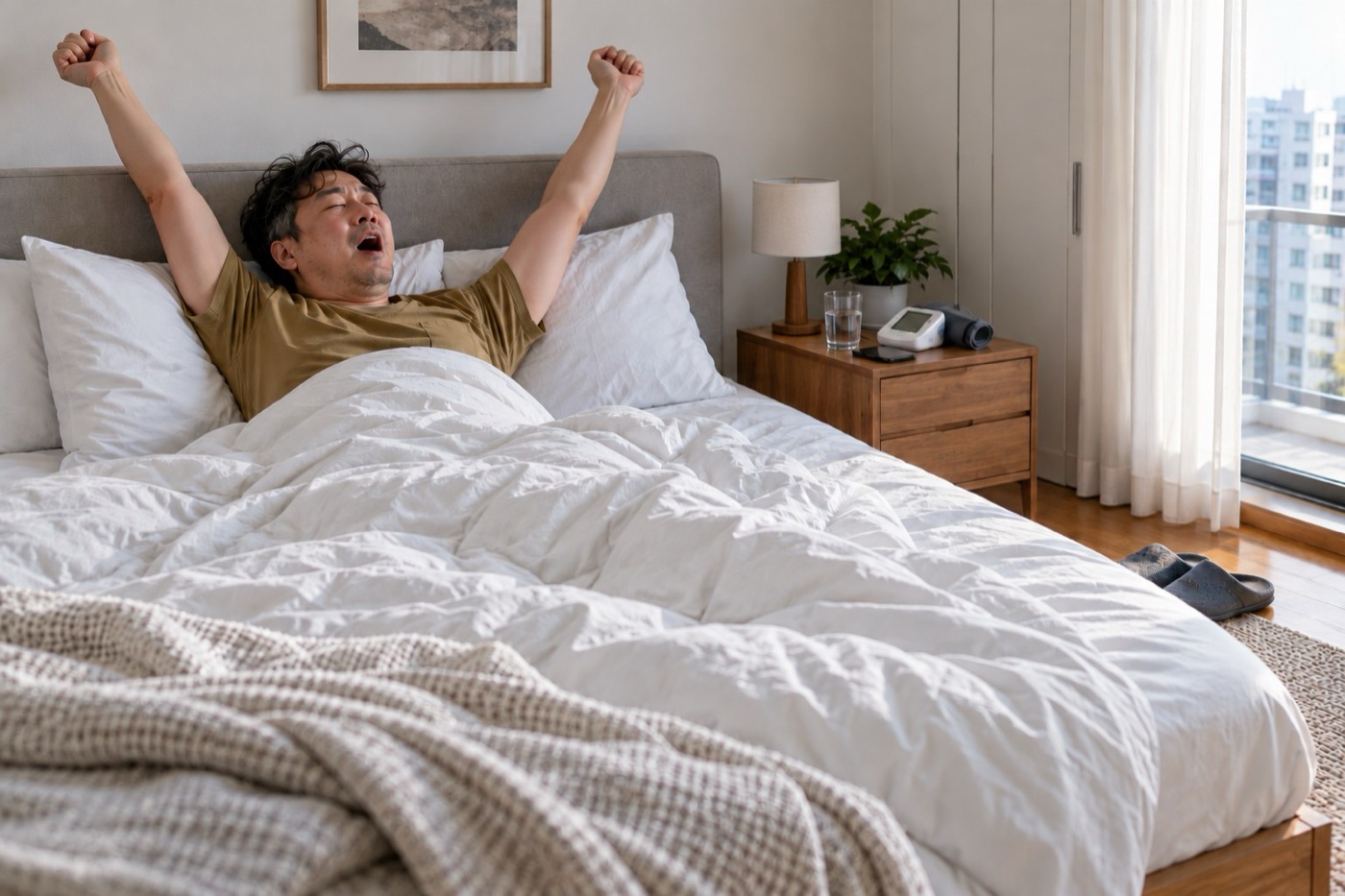
Catch-up sleep was linked to slightly lower odds of high blood pressure. The best figure was about eighty-seven minutes, not a whole morning.
Before you read
1Warm up3 questions
Talk about these questions with a partner.
- What makes a weekend morning feel well spent?
- Would you choose an extra hour in bed or an unhurried breakfast?
- Can a day off become another thing to organise perfectly?
2Key words8 words
These words are in the article. Choose the letter of the meaning for each one.
- lie-in
- recover
- benefits
- routine
- connection
- upset
- risk
- affect
- Aa link between two things
- Bgood things that you get from something
- Cstaying in bed later than usual in the morning
- Dget better, or get your energy back
- Ethe chance that something bad will happen
- Fthe things you do in the same way every day
- Gchange something, or have an effect on it
- Hmake something go wrong
1Warm up3 questions
Talk about these questions with a partner.
- What makes a weekend morning feel well spent?
- Would you choose an extra hour in bed or an unhurried breakfast?
- Can a day off become another thing to organise perfectly?
2Key words8 words
These words are in the article. Choose the letter of the meaning for each one.
- duvet
- guilt
- association
- hypertension
- straightforward
- commute
- shifts
- permanently
- Aperiods of work at set times, such as nights
- Ba thick, soft cover that you sleep under
- Cthe bad feeling when you think you did something wrong
- Deasy to understand, with nothing difficult in it
- Efor always, without ending
- Fanother name for high blood pressure
- Ga connection between two things
- Htravel regularly between home and work
1Warm up3 questions
Talk about these questions with a partner.
- What makes a weekend morning feel well spent?
- Would you choose an extra hour in bed or an unhurried breakfast?
- Can a day off become another thing to organise perfectly?
2Key words8 words
These words are in the article. Choose the letter of the meaning for each one.
- physiological
- burden
- correlation
- causation
- prescription
- justification
- proposition
- irresistible
- Aa good reason that explains why something is acceptable
- Bconnected with how the body works
- Cso attractive that you cannot say no
- Da suggestion or situation that you have to consider
- Ea link where two things change together
- Fsomething heavy or difficult that you have to deal with
- Gthe fact that one thing makes another happen
- Han exact instruction about what someone should do
Read
3Read the article
The paragraphs are numbered. Look out for the key words from task 2.
Core version
It's Saturday morning. Your alarm does not ring, and you stay in bed for another hour. When you finally get up, you feel wonderful. But then you remember something you have heard many times: doctors say we should wake up at the same time every day. Have you done something unhealthy by enjoying a lie-in? New research suggests that the answer may not be so simple.
In August 2026, scientists presented a study about weekend sleep and blood pressure. They looked at information from around 40,000 adults in South Korea over seven years. People who slept a little longer at weekends were less likely to have high blood pressure than people who did not catch up on sleep. The researchers found that about an extra hour and a half was linked to a particularly positive result.
High blood pressure can be dangerous because it increases the risk of heart disease and stroke. Not getting enough sleep may put extra pressure on the body. Many adults have to get up early during the working week, even after a late night. By Friday, they feel exhausted. An extra hour in bed may help them recover from some of that lost sleep.
But the study does not mean that everyone should sleep until lunchtime on Sunday. People who slept much longer than usual did not appear to get the same benefits. Changing your sleeping times too much can also upset your body clock. The research found a connection, but it did not prove that a weekend lie-in directly prevents high blood pressure.
Sleep experts still recommend a regular routine. Going to bed at a sensible time and waking up at similar hours helps your body know when to feel sleepy. Exercise, food and stress also affect health. A lie-in cannot make up for every unhealthy habit. And people who regularly sleep badly may need to work out what is causing the problem rather than simply sleep longer at weekends.
So should you feel guilty about a lie-in? The study cannot answer that for every person. It suggests that a little extra sleep at the weekend is not necessarily harmful, and that it may help tired adults. A good night's sleep during the week still matters most.
Intermediate version
Saturday morning arrives, and for the first time all week there is no alarm. You could get up at your usual time, make coffee and start being productive. Or you could stay under the duvet for another hour. For years, people have heard that sleeping late at weekends is bad for the body clock, so even a pleasant lie-in can come with a feeling of guilt. However, research discussed at a European heart conference in August 2026 suggests that a modest amount of catch-up sleep may be helpful.
Scientists examined data from approximately 40,000 adults in South Korea, collected over seven years. They compared people's sleep on weekdays and weekends with the likelihood of having high blood pressure. Participants who caught up on sleep at weekends had slightly lower odds of hypertension overall. The most favourable association was found around an extra hour and twenty-seven minutes of sleep. That sounds wonderfully precise, but it should not be treated as a magic number that suits everybody.
The possible explanation is straightforward. Too little sleep can put stress on the cardiovascular system and interfere with the normal drop in blood pressure during the night. People who work early shifts, commute long distances or look after children may struggle to get enough rest from Monday to Friday. By the weekend, they are running on empty. Sleeping a little longer might give the body an opportunity to recover from some of the strain.
There are important limits to the findings. The study showed an association, not proof that staying in bed directly reduces the risk of hypertension. People who sleep longer may differ in other ways, including their working hours or general health. Researchers also warned that very long weekend lie-ins could disturb regular sleep patterns. Sleeping four extra hours is not necessarily better than sleeping one, and it may make Sunday night harder when Monday's alarm is waiting.
Experts therefore continue to recommend consistent bedtimes and waking times where possible. Catch-up sleep should not become an excuse for repeatedly cutting back on rest during the week. Nor can extra time in bed replace exercise, a balanced diet or medical care for high blood pressure. The new research simply challenges the idea that every variation in sleep timing must be harmful. Real life rarely allows people to follow a perfect routine.
One study does not cancel the advice to keep regular hours. It does suggest that a moderate lie-in after an exhausting week is not necessarily harmful. If you are permanently tired, it is worth looking at the wider pattern: when you go to bed, how well you sleep and what keeps you awake. Rest is not a reward for finishing every task.
Advanced version
Saturday morning offers a small but surprisingly complicated choice. The alarm is off, and another hour under the duvet sounds irresistible. Yet years of advice about consistent sleep schedules may leave you wondering whether a lie-in is harming your health. Recent findings add some nuance. For people who miss sleep during the working week, a modest weekend lie-in may help. The findings are more limited than a rule that sleeping late is always good or always bad.
At the European Society of Cardiology congress in August 2026, researchers presented an analysis of roughly 40,000 adults in South Korea whose data had been collected over seven years. Weekend catch-up sleep was associated with slightly lower odds of hypertension, or high blood pressure. The strongest favourable association was reported at approximately one hour and twenty-seven minutes of additional sleep. That specific figure makes an irresistible headline, but it would be misleading to interpret it as an exact prescription for every tired adult.
There is a plausible physiological explanation. Insufficient sleep can interfere with the body's usual night-time reduction in blood pressure, leaving the cardiovascular system under greater strain. For someone getting up before dawn, juggling childcare or working long hours, the weekend may be the only realistic opportunity to make up some of the shortfall. A little additional rest might help reduce the burden of accumulated sleep loss. It is a reassuring possibility for people whose lives make perfectly regular sleep difficult to achieve.
Yet the distinction between correlation and causation is crucial. The researchers did not assign people different amounts of weekend sleep and then prove that a lie-in prevented illness. Other influences, such as occupation, stress or existing health conditions, may help explain the pattern. Nor did the findings suggest that more sleep is always better. Very substantial differences between weekday and weekend routines can disrupt the body clock, potentially cancelling out some of the benefits. A Sunday morning spent sleeping until midday may therefore be a very different proposition from an extra hour in bed.
For this reason, sleep specialists still emphasise the importance of adequate, consistent rest throughout the week. Catch-up sleep should not become a convenient justification for five nights of deprivation, any more than one healthy breakfast can compensate for an otherwise poor diet. Physical activity, nutrition, stress management and appropriate treatment remain central to cardiovascular health. What the study offers is a more realistic view of how bodies respond when everyday responsibilities make an ideal routine impossible.
The most refreshing aspect of the research may be its challenge to the moral language surrounding rest. A person who sleeps late is often described as lazy, while somebody who rises early is praised for discipline. Neither judgement tells us much about how tired those people actually are. If your week has left you exhausted, getting a little more sleep may be sensible rather than self-indulgent. The larger goal is not to win a contest over who gets up earliest, but to build a life in which proper rest is possible most nights.
After you read
4True, false or not given5 statements
Choose T (true), F (false) or NG (the article does not say).
- Most South Korean adults sleep later at weekends than on weekdays.
Not stated. The text does not say how many South Korean adults sleep later at weekends.
- The researchers used information from around 40,000 adults in South Korea.
The text says: "They looked at information from around 40,000 adults in South Korea over seven years."
- People who slept much longer than usual did not get the same benefits.
The text says: "People who slept much longer than usual did not appear to get the same benefits."
- The research proved that a weekend lie-in prevents high blood pressure.
The text says the opposite: "The research found a connection, but it did not prove that a weekend lie-in directly prevents high blood pressure."
- The study says that everyone should sleep until lunchtime on Sunday.
The text says: "the study does not mean that everyone should sleep until lunchtime on Sunday."
5Vocabulary5 gaps
Complete the sentences with words from the box. Two words are not needed.
anxiouscarelessexhaustedhabitharmfulpositivesensible
- After running a marathon, he was completely and went straight to bed.
- It is to check the weather before you plan a long walk.
- Too much sun can be to your skin.
- The doctor had some news: the test results were good.
- Biting your nails is a bad that many people find hard to stop.
6Verb forms5 gaps
Write the correct form of the verb in brackets.
- In August 2026, scientists a study about weekend sleep. (PRESENT)
- But then you remember something you have many times. (HEAR)
- The adults in the survey more at weekends than on weekdays. (SLEEP)
- Not enough sleep may put extra pressure on the body. (GET)
- High blood pressure the risk of heart disease and stroke. (INCREASE)
7Language focuslinking words
Complete the sentences with words from the box. Two words are not needed. Think about the idea each word brings: a reason, a result, a contrast, a condition or a choice.
althoughbecauseifmoreoverorsotherefore
- The doctor says sleep is important it helps the body recover.
- It was Saturday, Maria stayed in bed for an extra hour.
- the alarm was off, Tom woke up at seven.
- you want a calm Sunday, try switching off your phone.
- Go to bed earlier tonight, you will feel tired tomorrow.
4True, false or not given5 statements
Choose T (true), F (false) or NG (the article does not say).
- The study proved that staying in bed directly lowers blood pressure.
The text says the opposite: "The study showed an association, not proof that staying in bed directly reduces the risk of hypertension."
- The research was discussed at a European heart conference in August 2026.
The text says: "However, research discussed at a European heart conference in August 2026 suggests that a modest amount of catch-up sleep may be helpful."
- Researchers warned that very long weekend lie-ins could disturb sleep patterns.
The text says: "Researchers also warned that very long weekend lie-ins could disturb regular sleep patterns."
- The study found that women benefited more than men.
Not stated. The text does not compare the results for women and men.
- The most favourable amount of extra sleep was less than ninety minutes.
An extra hour and twenty-seven minutes is eighty-seven minutes, which is less than ninety.
5Vocabulary6 gaps
Complete the sentences with words from the box. Two words are not needed.
disturbexcuseinterferemodestopportunityprecisestrainstruggle
- The company made only a profit this year, far less than expected.
- Many students to find quiet places to study in noisy cities.
- Carrying heavy bags every day can put a on your back.
- Rain is not a good for missing the meeting.
- Please do not him while he is working, because he needs to concentrate.
- A year abroad is a great to practise a language.
6Verb forms5 gaps
Write the correct form of the verb in brackets.
- The bridge in 1998 and still carries traffic today. (BUILD)
- When she got to the station, the train already. (LEAVE)
- I to bed earlier; now I feel terrible. (SHOULD / GO)
- She suggested a short walk after lunch. (TAKE)
- If I more time, I would learn the piano. (HAVE)
7Language focuslinking words
Complete the sentences with words from the box. Two words are not needed. Decide if the idea is contrast, reason or result. Some of these words join two sentences and some need a noun.
despitehowevernorotherwisethereforeunlesswhereas
- The new phone is expensive. , many people think it is worth the money.
- My sister enjoys early mornings, I prefer to sleep late.
- the long hours, she still finds time to exercise.
- Take a break now; , you will be too tired to finish the work.
- The roads were closed; , the buses were late.
4True, false or not given5 statements
Choose T (true), F (false) or NG (the article does not say).
- The conclusions rest on observing people's habits rather than controlling them.
The researchers "did not assign people different amounts of weekend sleep", so they observed existing habits.
- The text suggests that sleeping until midday may bring the same benefits as an extra hour.
Very large differences in routine can disrupt the body clock, so midday is called "a very different proposition".
- The study found that desk workers benefited more than manual workers.
Occupation is mentioned only as a possible influence; no groups are compared.
- The writer implies that early risers are not necessarily less tired than late risers.
Neither being called lazy nor being praised for discipline "tells us much about how tired those people actually are".
- The writer treats the figure of one hour and twenty-seven minutes as an exact instruction for everyone.
The text says it would be misleading to interpret it "as an exact prescription for every tired adult".
5Vocabulary6 gaps
Complete the sentences with words from the box. Two words are not needed.
adequateassigncompensatedisruptemphasisenuanceshortfallsubstantial
- The headline was blunt, but the full report contained far more than the press coverage suggested.
- The charity launched an urgent appeal to cover a of nearly half its budget.
- Strikes on the railways are likely to travel plans across the region.
- No amount of money can fully for the loss of a family home.
- The firm reported a increase in profits, far beyond what analysts had predicted.
- The hotel was merely : clean and quiet enough, but nothing special.
6Word forms5 gaps
Use the word in brackets to make a word that fits the gap.
- The scientists were careful to avoid any when describing the results. (EXAGGERATE)
- The of the findings is limited because other factors were not checked. (RELIABLE)
- It would be to assume that one study settles the question. (WISE)
- The between sleep and mood is hard to measure precisely. (CONNECT)
- He is a highly athlete who trains every morning. (DISCIPLINE)
7Language focuslinking words
Complete the sentences with words from the box. Two words are not needed. Some of these words take a noun, some a clause, and some mark a concession or a result. Check the punctuation before the gap.
albeithencelestnotwithstandingprovidedwhereaswhereby
- The pilot scheme was a success, a modest one.
- the objections of local residents, the council approved the plan.
- The sample was small; , the findings should be treated with caution.
- In the first town rents have soared, in the second they have barely moved.
- The scheme will go ahead, the funding is secured by March.
Speak
8Talk about it3 questions
Discuss in pairs or small groups. Give reasons for your answers.
- Should people feel bad about sleeping late on a free day?
- Would a simple sleep routine make your weekend easier or less free?
- What would a restful Sunday look like without tracking anything?
8Talk about it3 questions
Discuss in pairs or small groups. Give reasons for your answers.
- Should people feel bad about sleeping late on a free day?
- Would a simple sleep routine make your weekend easier or less free?
- What would a restful Sunday look like without tracking anything?
8Talk about it3 questions
Discuss in pairs or small groups. Give reasons for your answers.
- Should people feel bad about sleeping late on a free day?
- Would a simple sleep routine make your weekend easier or less free?
- What would a restful Sunday look like without tracking anything?
9Role-play: a quiet Saturday morning
Work in pairs. Read your card, then have the conversation. Swap roles and do it again.
Student A · the flatmate who wants to sleep late
It's Saturday and you've had a long, tiring week. You want to stay in bed until ten. Explain why, and suggest a plan that works for both of you.
Student B · the flatmate who wants an early start
You want to go out for breakfast at eight and then tidy the flat. Ask your flatmate to join you. Listen to their reasons and try to agree on a compromise.
Useful phrases
- I'd really like to stay in bed this morning.
- It's been a long week and I'm exhausted.
- Could we go for breakfast a bit later?
- I'd rather start early, if that's okay.
- That's fair, so how about we meet at nine?
- Let's compromise: you tidy now and I'll cook later.
Afterwards, tell the class: what did you agree, and was it a fair compromise?
Your words
Highlights0 saved
Highlights0 saved
Highlights0 saved
Was this lesson useful? Support johnplusnews on Ko-fi
Continue reading
Work
Could a Better Job Be About Time, Not Money?
A global survey of 40,500 workers found that work-life balance has overtaken salary as the main reason people would consider leaving a job. What does that tell us about how people want to live?
Psychology
The Way You Think About Being Alone Changes How It Feels
Researchers read 144 newspaper articles about solitude and found them overwhelmingly gloomy. They also found that what you believe about time alone predicts how lonely it makes you.
Lifestyle
Can You Learn a Better Life from an Italian Grandmother?
Two friends in their late eighties bake bread in a small Italian town. The internet has decided they are the answer to something.