News lesson24 September 2026
The Message That Turned a Catch-Up into a Transaction
Payment apps have made settling up effortless. They have also made it easier to put a price on moments that once passed without comment.
Before you read
1Warm up3 questions
Talk about these questions with a partner.
- Would you ask a friend to repay the price of a coffee?
- What makes splitting a bill awkward?
- Do you prefer taking turns or paying exactly your share?
2Key words8 words
These words are in the article. Choose the letter of the meaning for each one.
- unexpected
- loan
- coins
- offering
- invented
- treat
- split
- penny
- Amade up, not real
- Bto share between people
- Ca very small amount of money
- Dsomething nice that you buy for another person
- Esaying that you will give something
- Fmoney that you borrow and must give back
- Gsmall round pieces of metal money
- Hnot what you thought would happen
1Warm up3 questions
Talk about these questions with a partner.
- Would you ask a friend to repay the price of a coffee?
- What makes splitting a bill awkward?
- Do you prefer taking turns or paying exactly your share?
2Key words8 words
These words are in the article. Choose the letter of the meaning for each one.
- transaction
- awkward
- tab
- favour
- calculations
- effortless
- misunderstanding
- annoyance
- Athe work of adding or dividing numbers
- Buncomfortable and difficult to deal with
- Cneeding no effort at all
- Da small disagreement because someone did not understand
- Ethe bill in a cafe or bar
- Fa feeling of being a little angry
- Ga kind thing you do to help someone
- Ha payment or exchange of money
1Warm up3 questions
Talk about these questions with a partner.
- Would you ask a friend to repay the price of a coffee?
- What makes splitting a bill awkward?
- Do you prefer taking turns or paying exactly your share?
2Key words8 words
These words are in the article. Choose the letter of the meaning for each one.
- acquaintances
- goodwill
- obligation
- boundary
- spontaneous
- explicit
- independence
- resentment
- Asomething you feel you must do
- Bpeople you know but are not close to
- Cdone naturally, without planning
- Dstated clearly, not just suggested
- Ea limit that shows what you will accept
- Fbeing able to manage without help from others
- Gfriendly and helpful feelings between people
- Ha bitter feeling about something unfair
Read
3Read the article
The paragraphs are numbered. Look out for the key words from task 2.
Core version
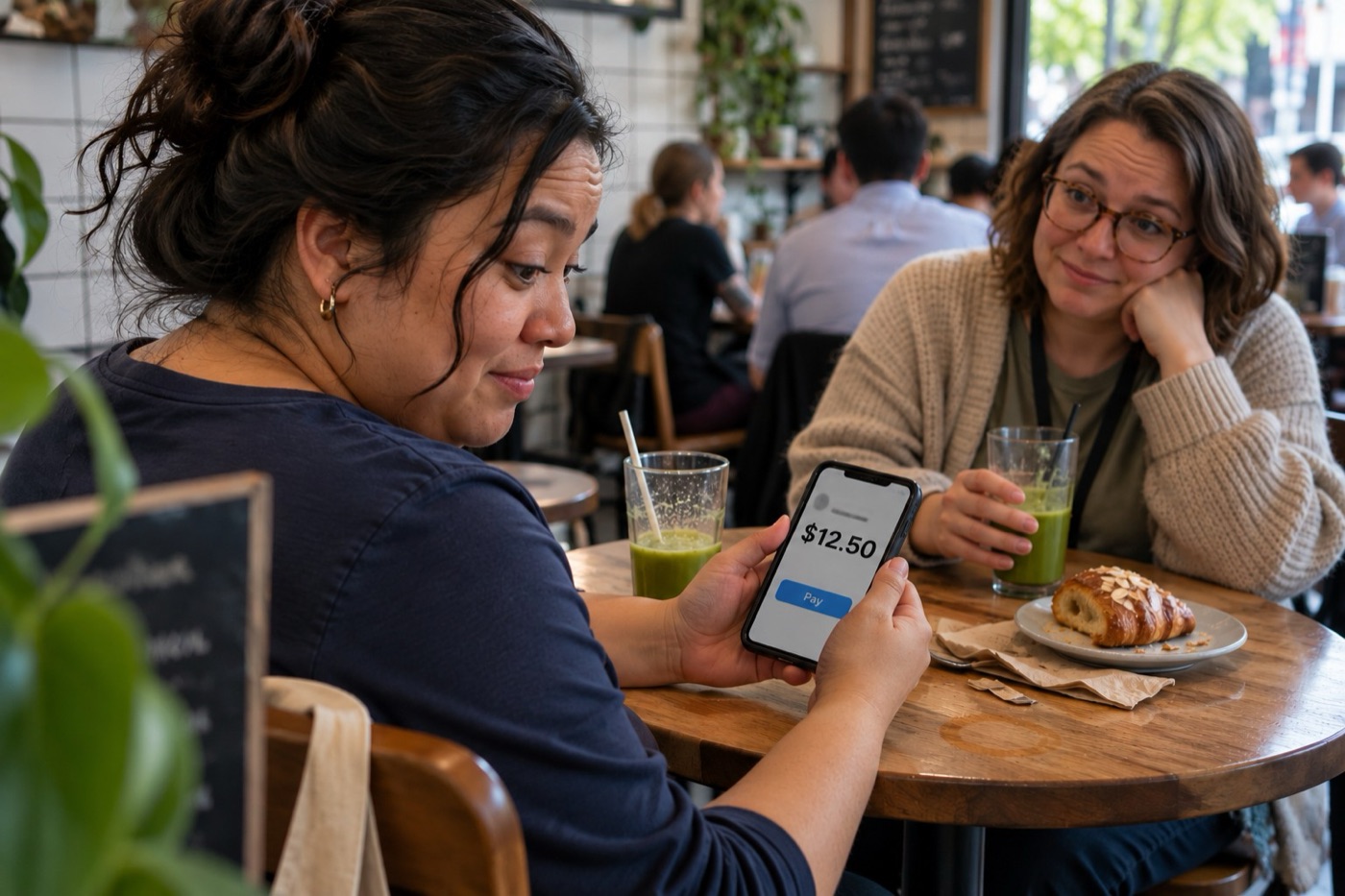
Johanna Cosgrove was sitting on a train in Australia when her phone lit up. She had just met a friend for a green juice. They had talked and said goodbye. Then came an unexpected message: her friend wanted A$12.50 for the drink. It was not much money, but Cosgrove felt uncomfortable. Wasn't it easier to buy a friend a drink and forget about the money?
In an article published in September 2026, the New Zealand-born writer described why the message had upset her. She believes that when a friend picks up the bill for something small, it should be a treat, not a loan. Next time, the other person can pay. To her, this is part of being kind. You give a little, and one day someone gives something back.
Yet not everybody sees it that way. Some friends prefer to split the bill each time. They don't want to owe anyone money, or make somebody else pay more than their fair share. Payment apps make this simple. You can send a small amount in seconds, while walking home. What seems cold to one person may seem perfectly fair to another.
Money is also a sensitive subject. Prices have gone up in many places, and a drink that looks cheap to one person may be expensive to another. A student watching every penny may not be able to buy several coffees each week. If a friend always forgets to pay, small costs soon add up. Nobody wants to feel that somebody is taking advantage of them.
Think about two invented friends, Anna and Sam, who always meet on Saturday. One week, Anna buys the coffees. The next week, Sam pays. They never write the amounts down, and neither worries about being owed a few coins. But if Anna always pays and Sam never offers, the arrangement may start to feel unfair. A small problem can turn into a much bigger argument when nobody speaks up.
So what should you do next time you meet a friend for coffee? There is no one-size-fits-all answer. If you say, 'It's on me,' make it clear you are offering. If you would rather share the cost, say so before you order. If somebody pays for you, a simple 'Thanks, I'll get the next one' may keep both the money and the friendship in good shape. Sometimes the smallest bills cause the biggest arguments.
Intermediate version
A message arrived as Johanna Cosgrove travelled home by train. The New Zealand-born writer had just caught up with a colleague over green juice in Australia. But on the journey, her friend asked her to transfer A$12.50 to cover the drink. The amount was small; the feeling it left behind was not. For Cosgrove, a casual catch-up had suddenly turned into a transaction, and what should have been a pleasant memory became an awkward question about money and friendship.
Writing in the Guardian in September 2026, Cosgrove argued that friends should be able to treat each other without keeping a running total. If one person picks up the tab for a modest purchase, the other can return the favour another day. No reminders or uncomfortable calculations are necessary. Her personal rule is that expenses below A$15 should generally be left alone. It was her opinion, not a universal law, but it raises a question: where does fairness end and generosity begin?
One reason the argument strikes a nerve is that people have different ideas about what paying for a friend means. To some, splitting every bill is a sign of respect: nobody feels indebted and everything is above board. Others see the offer of a coffee as a small gesture of affection, something that loses its warmth when an automatic payment request appears. The rise of instant transfers has made settling up effortless, and it can make a small favour feel like a bill.
There is a practical side too. With household budgets under pressure, A$12.50 may be insignificant to one person and a real expense to another. A generous friend who repeatedly pays for everyone might eventually feel taken for granted. Equally, someone who insists on returning every penny may simply be trying to avoid owing money. What seems selfish in one culture can seem considerate in another. Assuming that one approach is naturally kinder than the other can turn a harmless difference in habits into a lasting misunderstanding.
Imagine three friends meeting each Friday. One likes paying for the whole table, another immediately sends a bank transfer, and the third rarely offers anything. At first, everyone laughs it off. Over time, however, the person who keeps paying may begin to resent the arrangement. The problem is not necessarily the amount of money involved, but the growing sense that nobody has agreed on the rules. An honest conversation could clear the air before annoyance builds up.
Perhaps the best approach is to spell things out without making a fuss. If you mean to treat somebody, say, 'This one's on me.' If you'd prefer to share the cost, suggest it before reaching the till. And if a friend consistently leaves you out of pocket, raise the issue rather than letting resentment build. Friendship works best when nobody has to keep score, but neither person feels they are always the one paying.
Advanced version
Johanna Cosgrove was travelling home by train when a message took the shine off an enjoyable afternoon. The New Zealand-born writer had been catching up with a colleague over green juice in Australia. Instead of simply remembering their conversation, she was being asked to transfer A$12.50 for her drink. The sum left her uncomfortable. She had understood the drink as a friendly treat. The message made it feel like an unpaid bill.
In a September 2026 column for the Guardian, Cosgrove made the case for financial looseness between friends. Her informal threshold was A$15: below that, she felt, one person ought to pick up the tab and trust that the favour would eventually be returned. The next coffee or small kindness could settle things without anyone checking a banking app. It was a deliberately personal argument, but it touched a nerve. Have we become so concerned with paying our exact share that we have forgotten the pleasure of treating someone?
Of course, the same gesture can carry entirely different meanings. For one friend, an immediate transfer is a considerate way of avoiding an obligation; for another, it reduces warmth to bookkeeping. Digital payments have made settling up almost frictionless, encouraging us to divide costs down to the last penny. That precision can be reassuring, particularly among acquaintances. Between close friends, however, it may come across as oddly formal, as though the relationship were subject to a running audit. Neither side necessarily realises the other follows different unwritten rules, and those differences can quickly lead to resentment.
Not everyone can afford to be relaxed about money. A modest drink might represent loose change to one person and a carefully considered expense to another. Someone who regularly covers the bill could find the costs mounting up, particularly if their companions seldom offer to take a turn. At the other extreme, someone who insists on repaying every penny might be protecting their independence, not rejecting generosity. It's easy to mistake a financial boundary for a personal slight when the expectations haven't been made explicit.
Think of three people meeting every Friday. One enjoys treating the group, another immediately repays whatever they owe, while the third rarely offers to contribute. Nothing is said because nobody wants to spoil the mood over a few pounds. Yet the silence creates its own problem. Over time, an arrangement that looked generous can start to feel exploitative. This is where the language of friendship becomes important: a quiet conversation about expectations may preserve goodwill more effectively than an elaborate system of repayment requests.
Cosgrove's irritated train journey therefore points to a familiar paradox: we want friendships to feel spontaneous, yet we also want fairness. The solution may be less about setting a universal price limit than about reading the room. Offer a treat only when you genuinely mean it; agree to split costs when necessary; and speak up if you repeatedly feel short-changed. A coffee should not require a financial summit. But a little clarity might stop a tiny payment becoming a much bigger problem. Both people may believe they are acting reasonably.
After you read
4True, false or not given5 statements
Choose T (true), F (false) or NG (the article does not say).
- Most Australians now use payment apps to split restaurant bills.
Not stated. The text does not say how many Australians use payment apps.
- Cosgrove believes every bill between friends should be split exactly.
The text says the opposite: "She believes that when a friend picks up the bill for something small, it should be a treat, not a loan."
- Payment apps let people send small amounts in seconds.
The text says: "You can send a small amount in seconds, while walking home."
- Cosgrove's friend asked her for A$12.50 after they met.
The text says: "Then came an unexpected message: her friend wanted A$12.50 for the drink."
- Anna and Sam keep a record of every coffee they buy.
The text says: "They never write the amounts down."
5Vocabulary5 gaps
Complete the sentences with words from the box. Two words are not needed.
arrangementdiscountowereceiptsensitivetransferuncomfortable
- He felt when the whole table started staring at him.
- Please the money to my bank account by tomorrow.
- Salaries are a subject, so many people never discuss them.
- I don't want to anyone money, so I pay straight away.
- Our is simple: I cook on Mondays and she cooks on Tuesdays.
6Verb forms5 gaps
Write the correct form of the verb in brackets.
- Johanna Cosgrove on a train when her phone lit up. (SIT)
- In an article in September 2026, she described why the message upset her. (PUBLISH)
- Prices up in many places in recent years. (GO)
- Payment apps this very simple. (MAKE)
- She had just a friend for a green juice. (MEET)
7Language focusphrasal verbs
Complete the sentences with words from the box. Two words are not needed. A phrasal verb is a verb plus a small word like up or back. The small word changes the meaning, so learn them as a pair.
alongawaybackdownintooutup
- My brother always picks the bill when we eat out.
- I wrote the price so I would not forget it.
- Can you pay me on Friday?
- One small argument can turn a big problem.
- Let's work who owes what before we leave.
4True, false or not given5 statements
Choose T (true), F (false) or NG (the article does not say).
- Cosgrove's friend apologised after reading the article.
Not stated. The text does not say whether Cosgrove's friend apologised.
- Cosgrove's personal rule concerns expenses below A$15.
The text says: "Her personal rule is that expenses below A$15 should generally be left alone."
- Cosgrove presents her rule as a law that everybody should follow.
The text says the opposite: "It was her opinion, not a universal law, but it raises a question: where does fairness end and generosity begin?"
- Instant transfers have made settling up easier than before.
The text says: "The rise of instant transfers has made settling up effortless, and it can make a small favour feel like a bill."
- The drink Cosgrove was asked to pay for was cheaper than the limit in her personal rule.
The drink cost A$12.50, and her rule is that expenses "below A$15 should generally be left alone".
5Vocabulary6 gaps
Complete the sentences with words from the box. Two words are not needed.
consistentlyexpensesgestureindebtedmodestremindersresentselfish
- Receiving a card from my colleagues was a lovely that I will always remember.
- She felt to her neighbour, who had helped her for years, and wanted to repay the kindness.
- A salary can still be enough if you budget carefully.
- The shop has offered lower prices than its rivals.
- I would it if my colleagues forgot to say thank you every single time.
- After the trip, we divided the equally between the four of us.
6Verb forms5 gaps
Write the correct form of the verb in brackets.
- By the time we reached the till, my friend for everything. (PAY)
- At the end of the meal, the bill equally between the four of us. (SPLIT)
- Small favours quickly when nobody mentions them. (FORGET)
- If her friend hadn't sent the message, the afternoon perfect. (BE)
- While she home by train, a message arrived. (TRAVEL)
7Language focusphrasal verbs
Complete the sentences with words from the box. Two words are not needed. Some phrasal verbs are idiomatic: the meaning is not clear from the two parts. Ask what the whole expression means in the sentence.
apartasidebackinonoutup
- If the group is short of cash, we can all chip and share the cost.
- She decided to sleep it before replying to the message.
- She offered to pay her friend the next day.
- He didn't want to fall with his flatmate over a few pounds.
- Small costs quickly mount if nobody keeps track.
4True, false or not given5 statements
Choose T (true), F (false) or NG (the article does not say).
- Two friends can follow different rules about money without either of them being aware of it.
The text says neither side "necessarily realises the other follows different unwritten rules".
- The amount Cosgrove was asked for fell below her own limit for leaving small sums unclaimed.
The request was for A$12.50, and her informal limit was A$15, "below that" one person should pick up the tab.
- The writer believes a system of repayment requests works better than a quiet conversation.
The text says a quiet conversation "may preserve goodwill more effectively than an elaborate system of repayment requests".
- Cosgrove's colleague had behaved in a similar way on previous occasions.
The text gives no history of the colleague's behaviour.
- In the Friday group, the friend who treats everyone is also the one who repays immediately.
The text describes two different people: one "enjoys treating the group, another immediately repays whatever they owe".
5Vocabulary6 gaps
Complete the sentences with words from the box. Two words are not needed.
bookkeepingelaboratemountingparadoxpreserveseldomthresholdunwritten
- Any purchase above a certain needs the finance team's approval.
- As the costs kept , the group finally had to discuss who was paying.
- Diplomats worked quietly to the fragile peace between the two sides.
- The scheme was so that few employees could be bothered to follow every stage.
- It is a that people who value independence often resent offers of help.
- Keeping a spreadsheet of who owes what turns friendship into .
6Word forms5 gaps
Use the word in brackets to make a word that fits the gap.
- The in her voice made it clear she was upset. (IRRITATE)
- Her meant nobody ever left the table hungry. (GENEROUS)
- Prompt of even tiny sums can seem cold between old friends. (REPAY)
- A over who had ordered what ended the evening. (AGREE)
- His on his friends to pay was becoming obvious. (RELY)
7Language focusphrasal verbs
Complete the sentences with words from the box. Two words are not needed. At this level the verb often carries the meaning. Read the particle that is already printed and ask which verb it partners with.
cavefizzleheldironrackstumptone
- When the bill arrived, nobody was keen to up first.
- A frank conversation might help the friends out their differences.
- Small, thoughtless purchases soon up a surprising total.
- Generosity is often up as the sign of a good friend.
- He tried to down his disappointment so as not to offend her.
Speak
8Talk about it3 questions
Discuss in pairs or small groups. Give reasons for your answers.
- When does keeping things fair start to feel unfriendly?
- What money rule could friends agree before a trip?
- Is generosity easier when nobody is keeping score?
8Talk about it3 questions
Discuss in pairs or small groups. Give reasons for your answers.
- When does keeping things fair start to feel unfriendly?
- What money rule could friends agree before a trip?
- Is generosity easier when nobody is keeping score?
8Talk about it3 questions
Discuss in pairs or small groups. Give reasons for your answers.
- When does keeping things fair start to feel unfriendly?
- What money rule could friends agree before a trip?
- Is generosity easier when nobody is keeping score?
9Role-play: who pays for the coffee?
Work in pairs. Read your card, then have the conversation. Swap roles and do it again.
Student A · the friend who paid
You bought coffee and cake for you both yesterday. It came to 14 pounds, and money is tight this month. Ask your friend to pay you back, but stay polite.
Student B · the other friend
You thought your friend's payment was a treat. Now you have a message asking for money. Explain how you feel and suggest a fair rule for next time.
Useful phrases
- I'm sorry to bring it up, but could you send me half?
- I thought it was a treat, to be honest.
- It's not about the money, it's about being fair.
- Let's take turns from now on.
- Shall we split the bill next time?
- I didn't mean to upset you.
Afterwards, tell the class: what rule did you agree, and was it fair for both of you?
Your words
Highlights0 saved
Highlights0 saved
Highlights0 saved
Was this lesson useful? Support johnplusnews on Ko-fi
Continue reading
Business
Can One Video Game Be Worth More Than a Hollywood Blockbuster?
Grand Theft Auto VI launched on 19 November 2026, and its publisher says shoppers spent about US$3.79 billion on the first day. The figure is a company estimate, and comparing a game with a film is harder than it sounds.
Technology
Can You Be Emotionally Close to Someone Who Is Not Human?
A survey of 463 adults in the United States found that people in relationships with AI chatbots can feel as emotionally close as other couples, but the link between closeness and loneliness looked different.
Relationships
Would You Sign a Contract Before Getting Married?
More young Americans are signing prenuptial agreements before their weddings. Is planning for a divorce unromantic, or is it honest and sensible?