News lesson22 May 2026
When the Pictures Are Easier Than the Building
The Line promised mirrored walls, rapid transport and homes within easy reach. Semafor reported in May 2026 that further work would wait until after 2030.
Before you read
1Warm up3 questions
Talk about these questions with a partner.
- Would you live in a city with no private cars?
- What would you want within ten minutes of your front door?
- Would a completely planned city make everyday life simpler?
2Key words8 words
These words are in the article. Choose the letter of the meaning for each one.
- shiny
- residents
- supporters
- industries
- services
- ordinary
- extremely
- depend
- Aneed something else to live or work well
- Bvery, very much
- Cthings like water and electricity that a city provides
- Dpeople who like an idea and want it to succeed
- Etypes of business, such as farming or car making
- Fbright and smooth, so that it reflects light
- Gpeople who live in a place
- Hnormal, not special
1Warm up3 questions
Talk about these questions with a partner.
- Would you live in a city with no private cars?
- What would you want within ten minutes of your front door?
- Would a completely planned city make everyday life simpler?
2Key words8 words
These words are in the article. Choose the letter of the meaning for each one.
- radically
- stacked
- promotional
- infrastructure
- investment
- innovation
- realistically
- slips
- Aa new idea or way of doing something
- Bbasic systems such as roads, power and water
- Cmade to advertise something
- Dput one on top of another in a pile
- Emoney put into something to make a profit later
- Fmoves later than planned
- Gin a way that is sensible about what can really happen
- Hin a very large and complete way
1Warm up3 questions
Talk about these questions with a partner.
- Would you live in a city with no private cars?
- What would you want within ten minutes of your front door?
- Would a completely planned city make everyday life simpler?
2Key words8 words
These words are in the article. Choose the letter of the meaning for each one.
- megaprojects
- trade-offs
- rendering
- re-emerges
- scaled-back
- revised
- spectacular
- interpretations
- Amade smaller than first planned
- Bvery impressive to look at
- Ca computer picture showing how something will look
- Dchanged after more thought
- Eappears again after being away
- Fthings you give up in order to get something else
- Gdifferent ways of understanding something
- Hextremely large and expensive building schemes
Read
3Read the article
The paragraphs are numbered. Look out for the key words from task 2.
Core version
Imagine a city that is 170 kilometres long but only a short distance across. Its buildings have shiny outside walls, and people travel from one end to the other without needing ordinary cars. This was the idea behind The Line, one of Saudi Arabia's most famous building projects, and for a while it was everywhere online.
The Line was introduced as part of NEOM, a large plan to develop an area in the north-west of the country. Designers imagined a completely new way of life, with homes, shops and workplaces close together. Fast transport would carry residents from one part of the city to another in minutes, so nobody would spend an hour stuck in traffic.
The pictures of the planned city looked like something from a science-fiction film. Supporters believed the project could show the world a different way to build cities. They also hoped it would attract workers, tourists and businesses, and help Saudi Arabia build up industries that do not depend on oil.
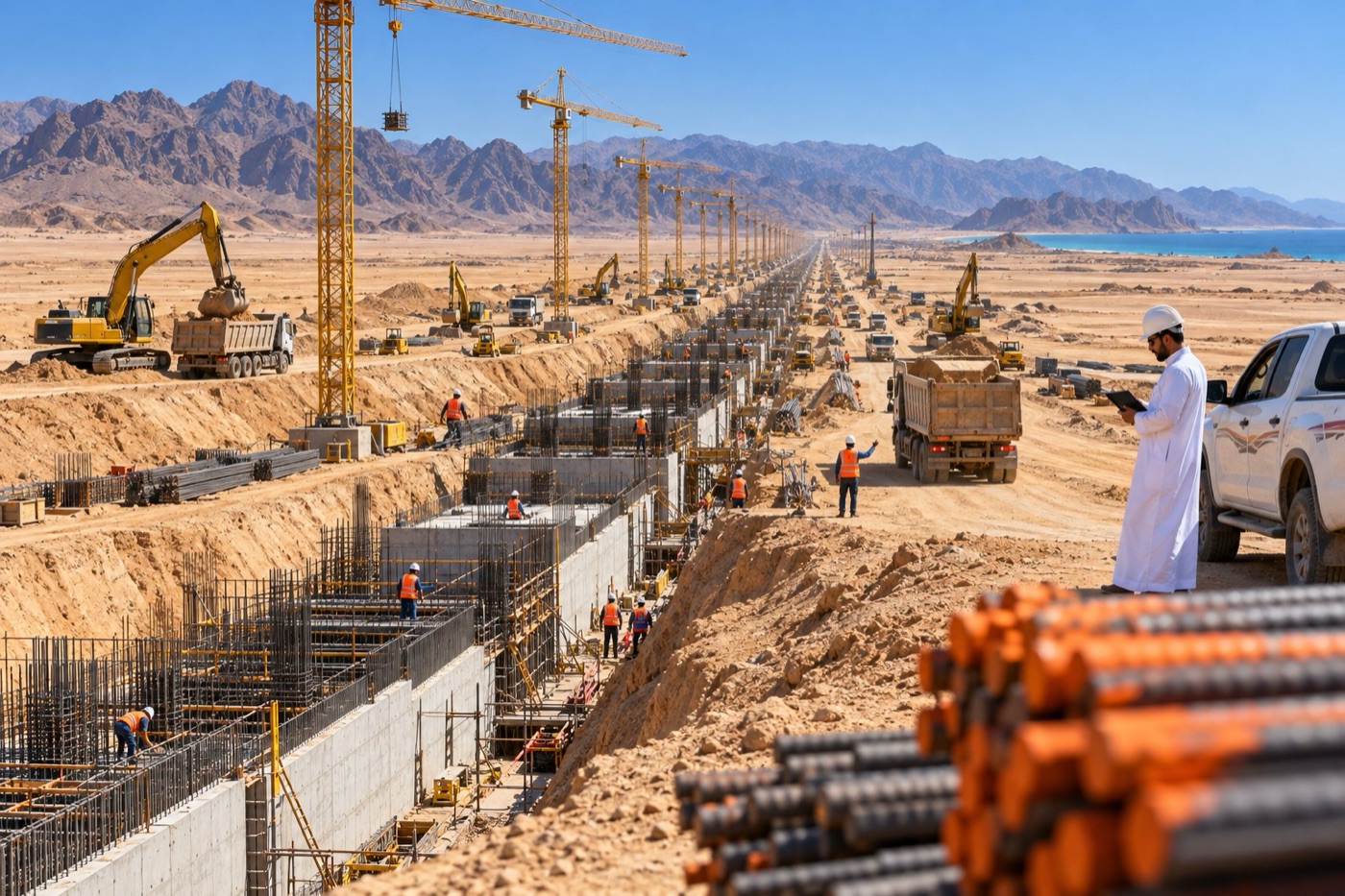
But turning a beautiful picture into a real city is extremely difficult. Builders need huge quantities of materials, electricity and water. The desert creates extra challenges, and every part of the project has to be connected to services that work every single day, not just on the day the photographs are taken. Nobody has built a city of this size in a straight line before, so there are no older projects to copy and learn from.
In May 2026, Semafor reported that major work on The Line had been put off until after 2030. That did not mean the entire project had officially been cancelled. However, it raised new questions about whether the original 170-kilometre plan would ever be finished in the way it was announced.
The story is about more than one country or one expensive project. It asks what should happen when an exciting idea turns out to be too costly or too complicated. Costs can also go up while the work goes on, so a plan that looked affordable at the start may become impossible later. Is it better to make a dream smaller, or to keep trying to build something nobody has ever built before?
Intermediate version
Saudi Arabia once presented The Line as a radically different answer to urban life. Instead of spreading outwards like an ordinary city, it would stretch for 170 kilometres through the desert, with homes and services stacked into a narrow, high-density structure. Promotional images showed two enormous mirrored walls cutting across the landscape, and they travelled around the world within days.
The Line forms part of NEOM, a development project intended to attract international investment and support Saudi Arabia's effort to diversify its economy away from oil. Its promoters imagined neighbourhoods linked by rapid transport, with daily necessities within easy reach and far less dependence on private cars. On paper, it solved problems that older cities have struggled with for a century.
The promise was extraordinary, but so were the practical obstacles. A city on this scale would call for vast amounts of construction material, energy and water, as well as complicated transport and infrastructure systems. Creating comfortable public spaces inside such an unusual structure presents challenges that cannot be solved by dramatic computer images alone, and the desert environment makes every one of them harder. There is no existing city of this shape to learn from either, so even routine engineering decisions have to be worked out from scratch.
In May 2026, Semafor reported that further work on The Line had been put back until after 2030 as Saudi authorities reconsidered their spending priorities. The report did not establish that every element of the plan had been permanently abandoned. It did, however, point to a widening gap between the early promotional vision and what might realistically get off the ground in the near future. Governments rarely announce a change of heart loudly, which is why a reported delay can say more than an official statement.
Large projects often change as costs rise and governments face competing demands on their budgets. Supporters argue that ambitious experiments can drive innovation even when their original scale is scaled back, and that a few useful ideas may survive. Critics question whether the money would be better invested in housing, public transport and infrastructure that communities can actually use within a decade. There is also a question of timing, because a project that slips by ten years loses the technology and much of the enthusiasm it was designed around.
The Line is a particularly dramatic example of a familiar dilemma. An impressive design can persuade people that the future is already visible and more or less paid for. Construction forces them to confront far less glamorous questions: how much will it cost, who will live there, and what happens if the financial plan no longer adds up?
Advanced version
A city 170 kilometres long, built in a straight line through the Saudi desert: The Line was designed to make people look twice. The NEOM proposal promised mirrored buildings and little need for conventional roads. Turning that image into a place where people could live would demand something less spectacular to show: transport, water, power and a workable budget.
The proposal was inseparable from a broader national ambition: reducing economic dependence on oil by attracting investment, tourism and high-value industries. Its striking visual identity helped turn an infrastructure plan into an international symbol of technological optimism, which was itself a considerable achievement. Yet the same unprecedented scale that made the project so compelling also complicated any credible assessment of whether it could be delivered.
A city in a line would need transport, water, energy and waste systems that work reliably in an extreme environment, where failure is rarely a minor inconvenience. Construction costs and labour requirements add further difficulties, none of which can be resolved by enthusiasm alone. Even where a concept is technically possible, it must still answer a more ordinary question: would people choose to live there, and on what terms?
In May 2026, Semafor reported that further work on The Line had been put on hold until after 2030, amid a shift in Saudi investment priorities. That report should not be confused with an official declaration that the project has been permanently cancelled. It does, however, illustrate the uncertainty surrounding the original timetable and the persistent gap between announced ambitions and confirmed delivery, a gap that is hardly unique to Saudi Arabia. Megaprojects elsewhere have been quietly pared back in much the same way, long after the launch films stopped circulating.
There are competing interpretations. Advocates of experimental design argue that new solutions need risk, and that even a scaled-back project can produce useful ideas. Sceptics reply that spectacular promises hide difficult trade-offs, especially where public money could improve cities that already exist. Timing matters too: a scheme deferred by a decade re-emerges into a world whose technologies, costs and priorities have all moved on.
Ultimately, The Line raises a question of political as well as architectural judgement. Should a government be praised for pursuing an extraordinary vision, or held to account if that vision proves financially unsustainable? Perhaps the real test of a futuristic city is not how impressive it looks in a rendering, but how responsibly its promises are revised once they come into contact with reality, and how honestly that revision is explained to the people paying for it.
After you read
4True, false or not given5 statements
Choose T (true), F (false) or NG (the article does not say).
- Construction workers have been sent home.
Not stated. The text does not say what happened to the builders or workers.
- The Line forms part of a larger plan called NEOM.
The text says: "The Line was introduced as part of NEOM, a large plan to develop an area in the north-west of the country."
- The Line was planned to be 170 kilometres long.
The text says: "Imagine a city that is 170 kilometres long but only a short distance across."
- The project was officially cancelled in May 2026.
The text says the opposite: "That did not mean the entire project had officially been cancelled."
- Fast transport would take residents from one part of the city to another in about an hour.
The text says transport would carry residents across the city "in minutes".
5Vocabulary5 gaps
Complete the sentences with words from the box. Two words are not needed.
affordableattractcancelledchallengesdistancequantitiesrepair
- A new stadium would thousands of visitors to the town.
- Most families can buy these homes because the prices are .
- Building a city needs huge of cement and steel.
- The concert was because of the storm.
- Learning a new language brings many for adults.
6Verb forms5 gaps
Write the correct form of the verb in brackets.
- Imagine a city that 170 kilometres long. (BE)
- The Line as part of NEOM. (INTRODUCE)
- Designers a completely new way of life. (IMAGINE)
- Nobody a city of this size in a straight line before. (BUILD)
- In May 2026, a report that major work had been put off. (SAY)
7Language focuslinking words
Complete the sentences with words from the box. Two words are not needed. A linking word joins two ideas. Use but for a difference, so for a result, and because for a reason.
becausebutdespitehoweverorsounless
- The pictures looked wonderful, building the real city is very hard.
- The old road to the site was closed, the workers took the train.
- Work was put off the cost was too high.
- The project was not cancelled. , people asked if it would ever be finished.
- In the new city, people can walk take a fast train.
4True, false or not given5 statements
Choose T (true), F (false) or NG (the article does not say).
- The Line's promoters expected most residents to depend on private cars.
The text says the plan offered "far less dependence on private cars".
- The report established that the plan had been permanently abandoned.
The text says: "The report did not establish that every element of the plan had been permanently abandoned."
- The delay was linked to a change in the Saudi authorities' spending priorities.
The text says further work was put back "as Saudi authorities reconsidered their spending priorities".
- Investors have asked for their money back.
Not stated. The text does not say whether investors have asked for their money back.
- The writer suggests that a very long delay can weaken the idea behind a project.
The text says a project that slips by ten years "loses the technology and much of the enthusiasm it was designed around".
5Vocabulary6 gaps
Complete the sentences with words from the box. Two words are not needed.
dilemmadiversifyexpansionglamorousnecessitiesobstaclesreconsideredreluctant
- The team overcame several before the bridge was finally opened.
- After the flood, the charity gave families food, water and other basic .
- After the protest, the council its decision and agreed to keep the library open.
- Countries that rely on one product often try to their economies.
- Choosing between a high salary and more free time is a real for many people.
- The magazine's covers look , but daily life for the staff was far from exciting.
6Verb forms5 gaps
Write the correct form of the verb in brackets.
- By the time the report was published, the early images around the world. (TRAVEL)
- Details of the new budget yet. (NOT / PUBLISH)
- Critics say the money on housing instead. (SHOULD / SPEND)
- While the engineers the materials, the budget was cut. (TEST)
- When costs rose sharply, officials to wait. (DECIDE)
7Language focuslinking words
Complete the sentences with words from the box. Two words are not needed. Despite takes a noun phrase. Whereas introduces a contrast clause. Otherwise, therefore and unless each begin a new clause or sentence.
despiteotherwiseprovidedthereforeunlessunlikewhereas
- the enormous costs, the government kept the project going for years.
- Some people see the project as a bold risk, others see it as a waste of money.
- Costs must be controlled; , the budget will run out.
- The first phase took longer than planned. , the opening date was moved back.
- The project will not go ahead the government finds extra funding.
4True, false or not given5 statements
Choose T (true), F (false) or NG (the article does not say).
- The writer treats the gap between announced ambitions and delivery as a problem found in other countries too.
The text calls it "a gap that is hardly unique to Saudi Arabia" and mentions megaprojects elsewhere.
- The writer expects a project delayed by ten years to return to the same technologies and costs.
The text says such a scheme "re-emerges into a world whose technologies, costs and priorities have all moved on".
- The cost of the project has risen by more than half since it was announced.
Not stated. The text gives no figures for the cost.
- The text suggests that Semafor's report and an official cancellation amount to the same thing.
The text says the report "should not be confused with an official declaration" of cancellation.
- The text treats the project's striking image as an achievement that did not settle whether it could be delivered.
It calls the image "a considerable achievement", but says the scale "complicated any credible assessment" of delivery.
5Vocabulary6 gaps
Complete the sentences with words from the box. Two words are not needed.
Advocatesconventionalcredibledeferredinseparableoptimismpersistentsceptics
- The minister's explanation was so full of gaps that few economists found it .
- The two companies had become so that nobody could say where one role ended and the other began.
- She tried to ignore the cough that had lasted for months.
- The vote was until the autumn, when fuller figures would be available.
- Unwilling to follow methods, the team built the bridge in an entirely new way.
- of the plan argue that its benefits will outweigh the cost, while their opponents disagree.
6Word forms5 gaps
Use the word in brackets to make a word that fits the gap.
- A growing sense of surrounds the original timetable. (CERTAIN)
- The sheer scale of the scheme was in modern planning. (PRECEDENT)
- Having to queue was a minor for the tourists. (CONVENIENT)
- Critics doubt that the plan is viable. (FINANCE)
- An independent of the risks needs evidence from outside the project. (ASSESS)
7Language focuslinking words
Complete the sentences with words from the box. Two words are not needed. Notwithstanding and hence are followed by a noun phrase; albeit introduces a small concession. Nonetheless and whereas work across clauses or sentences.
albeithencelestnonethelessnotwithstandingtherebywhereas
- The design was praised for its ambition, with some reservations.
- its enormous cost, the scheme kept strong political backing for years.
- Some officials defend the original scale, others favour a more modest first phase.
- The first phase proved far costlier than forecast; the decision to scale it back.
- The project has not been formally cancelled. , few observers expect it to be built as announced.
Speak
8Talk about it3 questions
Discuss in pairs or small groups. Give reasons for your answers.
- What would you ask the people behind a huge new city before moving there?
- Can a city designed on paper leave room for unexpected ways of living?
- Would you rather improve an existing city or build a new one?
9Role-play: shrink the city or keep the dream
Work in pairs. Read your card, then have the conversation. Swap roles and do it again.
Student A · the government adviser
You want to keep the full 170-kilometre plan. Explain why the idea is important. Answer your partner's worries and try to agree a plan.
Student B · the finance officer
You think the city is too costly. You want to make it smaller or wait until after 2030. Ask about the cost and offer a compromise.
Useful phrases
- I'm worried about the cost.
- We can't give up on this dream now.
- What would that mean for the people who live there?
- Could we start with a smaller version?
- I'd rather wait than waste the money.
- Let's agree on a plan we can both support.
Afterwards, tell the class: did you keep the big plan, shrink it or put it off, and why?
Your words
Highlights0 saved
Highlights0 saved
Highlights0 saved
Was this lesson useful? Support johnplusnews on Ko-fi
Continue reading
Business
Can One Video Game Be Worth More Than a Hollywood Blockbuster?
Grand Theft Auto VI launched on 19 November 2026, and its publisher says shoppers spent about US$3.79 billion on the first day. The figure is a company estimate, and comparing a game with a film is harder than it sounds.
Technology
Can You Be Emotionally Close to Someone Who Is Not Human?
A survey of 463 adults in the United States found that people in relationships with AI chatbots can feel as emotionally close as other couples, but the link between closeness and loneliness looked different.
Work
They Still Have Their Jobs. They Are Leaving Anyway
Nobody made these workers redundant. AI changed what their work felt like, and they walked out on careers they had spent a decade building.