News lesson13 October 2026
Twenty-Eight Years, One Journey Home
Karl Bushby left the bottom of Chile in 1998 and refused to take a lift. He is now a few hundred kilometres from his own front door.
Before you read
1Warm up3 questions
Talk about these questions with a partner.
- What is the longest journey you would willingly make on foot?
- Would you enjoy travelling without a fixed return date?
- What would you miss most on a very long journey?
2Key words8 words
These words are in the article. Choose the letter of the meaning for each one.
- vehicle
- route
- expedition
- pandemic
- permission
- jungle
- strangers
- childhood
- Athe way you go from one place to another
- Bthe time when you are a child
- Cpeople you do not know
- Da machine such as a car or bus that carries people
- Ea long, organised journey to a faraway place
- Fa sickness that spreads to many countries
- Gwhen someone says that you are allowed to do something
- Ha thick forest in a hot country
1Warm up3 questions
Talk about these questions with a partner.
- What is the longest journey you would willingly make on foot?
- Would you enjoy travelling without a fixed return date?
- What would you miss most on a very long journey?
2Key words8 words
These words are in the article. Choose the letter of the meaning for each one.
- expedition
- conditions
- estimate
- paperwork
- delays
- generosity
- achievement
- adjustment
- Asomething good that you succeed in doing
- Ba guess about how long or how much
- Crules or things that must happen first
- Dofficial documents that you have to complete
- Etimes when something happens later than planned
- Fa long, organised journey with a clear purpose
- Gbeing kind by giving things freely
- Ha small change you make to get used to something
1Warm up3 questions
Talk about these questions with a partner.
- What is the longest journey you would willingly make on foot?
- Would you enjoy travelling without a fixed return date?
- What would you miss most on a very long journey?
2Key words8 words
These words are in the article. Choose the letter of the meaning for each one.
- undertaking
- negotiated
- mechanised
- geopolitical
- hospitality
- pedestrian
- consumed
- stubborn
- Aa big, serious task that someone decides to do
- Bused up all of someone's time or energy
- Cconnected with politics between countries
- Da person who travels on foot
- Erefusing to change your mind or give up
- Ffound a way through something difficult
- Gkind and generous treatment of guests or visitors
- Hmoved or powered by a machine
Read
3Read the article
The paragraphs are numbered. Look out for the key words from task 2.
Core version
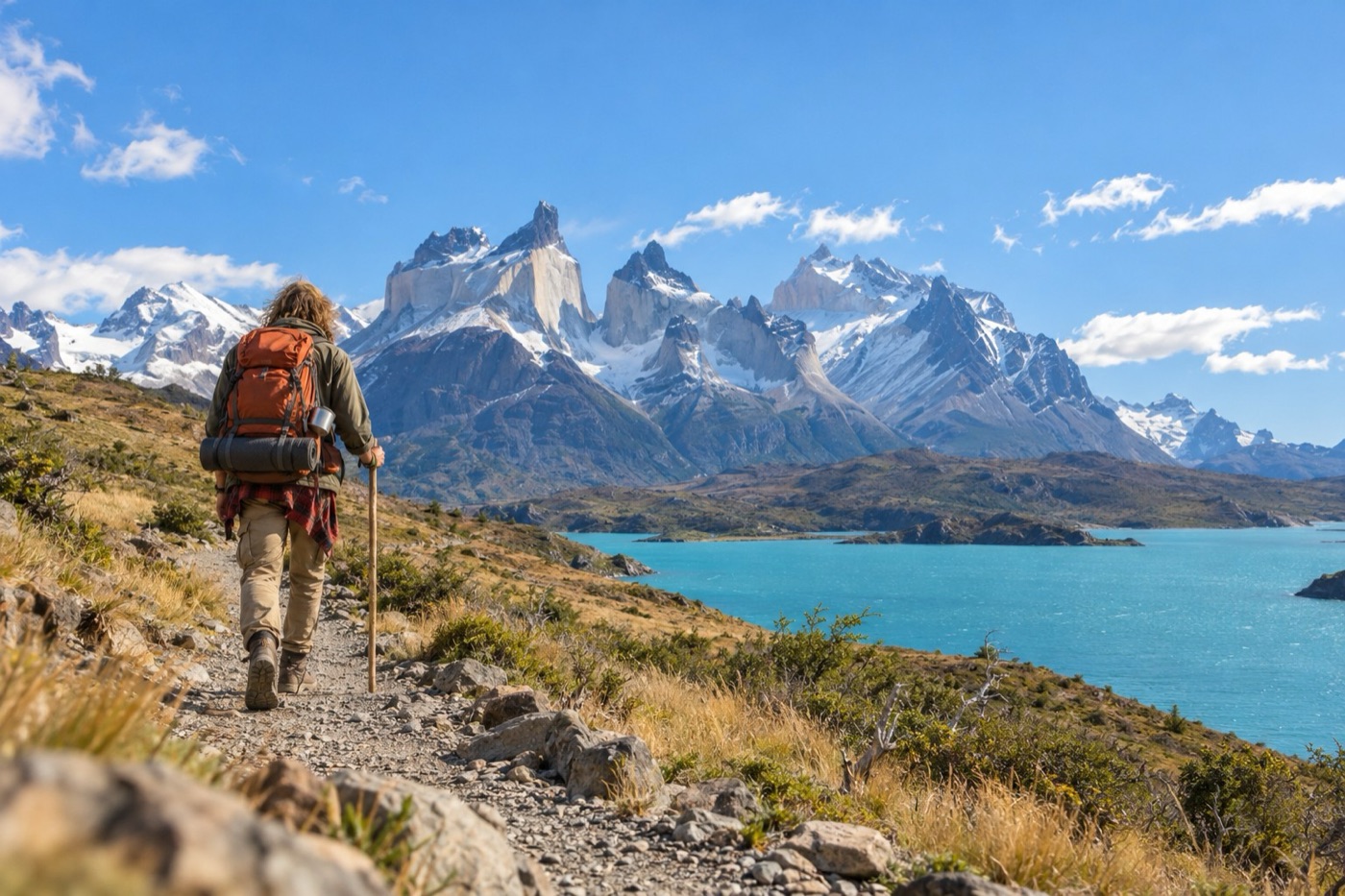
In November 1998, Karl Bushby set off from the southern tip of Chile with a small amount of money and a very unusual plan. He wanted to walk home to Hull, in northern England. The journey would take him through the Americas, across the sea ice between Alaska and Russia, and eventually across Europe. He thought it might take 12 years. Almost 28 years later, he finally reached Britain. Walking is the short way to describe it: he also had to swim, and he was often stopped for months or years along the way.
Karl had two rules. He would not use a vehicle to move forwards along his route, and he would not return home until he had completed the journey. The former British soldier called his adventure the Goliath Expedition. At first, he walked north through South America. He travelled through hot deserts, mountains and dangerous jungle. In the Darién Gap, between Colombia and Panama, he had to deal with the threat of armed groups.
After reaching North America, Karl carried on towards Alaska. In 2006, he and another explorer crossed the Bering Strait on moving sea ice. It was one of the most dangerous parts of the whole journey. They finally reached Russia, but the authorities arrested them because they had not entered the country at an official border point. Problems with visas and permission to travel would continue for years.
Money, closed borders and the pandemic all held up Karl's progress. In 2024, he made a long swim across the Caspian Sea with support from a team. He then travelled through Azerbaijan, Georgia and Turkey before continuing into Europe. On 5 October 2026, he reached Dover after swimming across the English Channel. He was finally back in Britain, although he still had around 400 kilometres left to walk to Hull.
The adventure has been exciting, but it has also cost him a great deal. Karl has missed years with his family, including much of his son's childhood. He has also depended on the kindness of strangers for food, shelter and help. These experiences have made him more positive about people. After nearly three decades on the road, one question remains. When he finally arrives home, how will he get used to ordinary life again?
Intermediate version
For most people, getting home is a matter of catching a bus, train or plane. For Karl Bushby, it has taken almost 28 years. The former British soldier left southern Chile in 1998 with a few hundred dollars. He wanted to reach his hometown of Hull without using transport to move forwards along his route. This October, after crossing continents and swimming the English Channel, he finally set foot on British soil.
Bushby began in Punta Arenas, near the southern tip of South America. He planned to walk north through the Americas, cross the Bering Strait into Russia and continue west towards Europe. He set himself two strict conditions. He could not take transport to advance, and he could not go home until the expedition was complete. He originally expected it to take about 12 years. That estimate turned out to be wildly optimistic.
Physical dangers came early. In South America, he faced extreme weather and crossed the Darién Gap, a difficult jungle region where travellers can encounter armed groups. In 2006, he and fellow explorer Dimitri Kieffer spent roughly two weeks crossing the frozen Bering Strait from Alaska into Russia. Their progress depended on unstable sea ice, and entering Russia led to their arrest because they had not arrived through an official border crossing.
Surprisingly, paperwork became as much of an obstacle as the wilderness. Bushby spent years working around visa restrictions, financial setbacks and international borders that were closed or difficult to cross. The pandemic caused further delays. When his route reached the Caspian Sea, he ran into another seemingly impossible problem. In 2024, he completed a lengthy swim across it with a support team, then continued through Azerbaijan, Georgia and Turkey.
On 5 October 2026, Bushby landed near Dover after swimming across the English Channel. He was back in Britain for the first time under his own expedition rules, but the walk was not yet over. About 400 kilometres remained between the landing point and Hull. The final stretch is small compared with the thousands of kilometres behind him, yet it carries an enormous emotional weight.
The journey has come at a personal cost. Bushby missed much of his son's childhood, important family occasions and the ordinary routines that shape most people's lives. At the same time, he says that the generosity of strangers has changed his view of humanity. People with very little often offered him food or somewhere to sleep. Soon the mission that has organised almost all his adult life will be complete. Reaching home will be an achievement. Discovering what comes next may be the bigger adjustment.
Advanced version
When Karl Bushby emerged from the English Channel at Dover on 5 October, he had already walked, and occasionally swum, a route that had consumed almost three decades of his life. He was back on British soil, but not quite home. Hull, where his extraordinary undertaking began as an idea, still lay roughly 400 kilometres away. It was an almost absurdly small distance after everything that had preceded it.
The Goliath Expedition began on 1 November 1998 in Punta Arenas, southern Chile. Bushby, a former British paratrooper, intended to travel through the Americas, cross into Siberia and return to England across Eurasia. His rules were uncompromising: no mechanised transport to advance along the route and no return home until he had completed it under his own power. He envisaged a 12-year challenge. In practice, geographical hazards proved only one part of the ordeal.
The route carried him through Patagonia, the Andes and the Darién Gap, the dangerous stretch of jungle between Colombia and Panama. In 2006, Bushby and fellow adventurer Dimitri Kieffer negotiated the shifting ice of the Bering Strait to reach Russia. Instead of celebrating a successful crossing, they ran afoul of immigration authorities and were detained. The incident foreshadowed years in which consular complications, restrictive borders and a shortage of funds would set progress back more effectively than bad weather ever could. Walking, it turned out, was the straightforward part; persuading officials to let him carry on walking was not.
The pandemic and subsequent geopolitical tensions compounded those difficulties. Having made his way across parts of Asia, Bushby confronted the formidable barrier of the Caspian Sea. In 2024 he crossed it by swimming, assisted by a support team, before continuing through Azerbaijan, Georgia and Turkey. Even the final approach to Britain demanded improvisation. Unable to secure permission for a pedestrian passage through the Channel Tunnel, he ended up swimming the Channel instead.
There is a temptation to treat the expedition as a triumph of stubborn determination and leave it at that. Yet its human costs resist such a tidy conclusion. Bushby has been absent for much of his son's life and has given up relationships, stability and countless ordinary family occasions. Along the way, though, strangers in isolated places repeatedly gave him shelter, food and help, often with little expectation of anything in return. Much of that hospitality came from people with very little to spare.
The public celebration of extraordinary endurance can gloss over a more difficult question: what happens when the pursuit of a goal becomes a person's identity? Bushby has spent nearly all his adult life moving towards a destination that was always both literal and symbolic. Completing the final miles may require less physical stamina than the previous thousands, but the transition from expedition to everyday life offers no marked trail. For a man who has spent 28 years trying to get home, staying there could prove the most unfamiliar adventure.
After you read
4True, false or not given5 statements
Choose T (true), F (false) or NG (the article does not say).
- In 2006, Karl and another explorer went across the Bering Strait on ice.
The text says: "In 2006, he and another explorer crossed the Bering Strait on moving sea ice."
- He reached Hull on 5 October 2026.
The text says he reached Dover on that date and still had around 400 kilometres left to walk to Hull.
- Karl and the other explorer were arrested when they arrived in Russia.
The text says the authorities arrested them because they had not entered at an official border point.
- His son has joined him for part of the walk.
Not stated. The text does not say whether Karl's son has walked with him.
- Karl has missed much of his son's childhood.
The text says: "Karl has missed years with his family, including much of his son's childhood."
5Vocabulary5 gaps
Complete the sentences with words from the box. Two words are not needed.
arrestedauthoritiesexploredshelterthreatunusualvisa
- Walking across a continent is a very plan, because most people take a plane.
- The of bad weather made the hikers turn back.
- Police two men after the robbery at the bank.
- When the storm began, we found in an old barn.
- You must ask the local before you camp in the park.
6Verb forms5 gaps
Write the correct form of the verb in brackets.
- He wanted home to Hull, in northern England. (WALK)
- He thought the journey about 12 years. (TAKE)
- In October 2026 he across the English Channel. (SWIM)
- The authorities arrested them because they had not at an official border. (ENTER)
- He has years with his family. (MISS)
7Language focusphrasal verbs
Complete the sentences with words from the box. Two words are not needed. A phrasal verb is a verb plus a small word. The small word changes the meaning, so learn the two words together.
acrossafterbeyonddownonoutup
- We were tired, but we carried walking until dark.
- The engine broke in the middle of the desert.
- He finally gave smoking after twenty years.
- Her grandmother looked her when her parents travelled.
- Watch for snakes on the path.
4True, false or not given5 statements
Choose T (true), F (false) or NG (the article does not say).
- According to the text, paperwork delayed Bushby about as much as the wild landscapes did.
The text says paperwork "became as much of an obstacle as the wilderness".
- When he landed in Britain, the distance still to walk was much smaller than the distance already behind him.
The text says about 400 kilometres remained, compared with "the thousands of kilometres behind him".
- Bushby's original estimate of 12 years was close to the real time.
The text calls the estimate "wildly optimistic" and the walk has taken almost 28 years.
- A film company is making a documentary about the expedition.
Not stated. The text does not mention any documentary about the expedition.
- Bushby and Kieffer needed about two days to cross the Bering Strait.
The text says they "spent roughly two weeks crossing the frozen Bering Strait".
5Vocabulary6 gaps
Complete the sentences with words from the box. Two words are not needed.
ambitionhumanityobstacleoptimisticoutcomeroutinessetbacksunstable
- Our guide was about the weather, so we packed only light clothes.
- Losing his passport was the biggest to the trip, but he found a way to continue.
- After several , including a broken ankle, the team still finished the race.
- The bridge looked after the flood, so nobody was allowed to cross it.
- Travel breaks everyday , such as cooking at home and going to work.
- After seeing so much generosity, he felt his faith in had returned.
6Verb forms5 gaps
Write the correct form of the verb in brackets.
- By the time he reached Dover, he for almost 28 years. (WALK)
- Bushby and Kieffer after they entered Russia. (ARREST)
- If he had used a vehicle, he his own rules. (BREAK)
- Bushby spent years around visa restrictions. (WORK)
- He originally expected the walk about 12 years. (TAKE)
7Language focusphrasal verbs
Complete the sentences with words from the box. Two words are not needed. Many phrasal verbs have more than one meaning, so read the whole sentence before you choose the small word.
alongbeyonddownforwardoffoutup
- The long walk turned to be harder than the hikers had expected.
- If you don't plan your route, you may end in the wrong town.
- The hikers put their start by a day because of the storm.
- Many travellers try to cut on the weight of their rucksacks.
- She is looking to seeing her family again.
4True, false or not given5 statements
Choose T (true), F (false) or NG (the article does not say).
- The writer implies that officials were harder for Bushby to deal with than the terrain.
The text says walking was the straightforward part, while "persuading officials" to let him continue was not.
- Bushby swam the Caspian Sea before the pandemic began.
The text mentions the pandemic first and dates the Caspian swim to 2024.
- Bushby's son has criticised his father's decision to keep walking.
Not stated. The text only says Bushby has been absent for much of his son's life.
- The writer suggests the end of the walk may be harder personally than physically.
The text says the final miles may need less stamina, but the transition to everyday life offers "no marked trail".
- The writer presents the expedition as a straightforward success with no real costs.
The text says its human costs "resist such a tidy conclusion".
5Vocabulary6 gaps
Complete the sentences with words from the box. Two words are not needed.
compoundeddetainedenvisagedformidableordealpredicamentrelinquishedstamina
- The delays were when the shipping line cancelled its only crossing that month.
- The journalists were put through an exhausting at the border that lasted nine hours.
- The activists were for hours at the airport because their papers were incomplete.
- When she started the company, she a small team of five, not hundreds of employees.
- The team faced the task of rebuilding the bridge before winter.
- Running a marathon in desert heat demands extraordinary .
6Word forms5 gaps
Use the word in brackets to make a word that fits the gap.
- The first border incident years of legal and bureaucratic difficulty. (SHADOW)
- Even a well-planned expedition may demand when permits are refused. (IMPROVISE)
- Visa often cost travellers more time than bad weather does. (COMPLICATE)
- Ultra-runners are admired for their physical rather than their speed. (ENDURE)
- For many hikers, reaching the summit is more than practical. (SYMBOL)
7Language focusphrasal verbs
Complete the sentences with words from the box. Two words are not needed. At this level the verb often carries the main meaning and the small word changes it. Compare fall through with fall apart.
backedbrushedfellplayedpressedruledwound
- Officials aside the explorers' objections without reading them.
- The ministry out any chance of a special permit.
- The organisers down the dangers so that sponsors would not withdraw.
- Their plan to cross the border through when the permit was refused.
- Despite the storm, the crew on and reached the village by dark.
Speak
8Talk about it3 questions
Discuss in pairs or small groups. Give reasons for your answers.
- When does sticking to a plan become harder to admire?
- Would you rather finish a huge challenge or enjoy every stage of it?
- What could make arriving home feel strange after years away?
8Talk about it3 questions
Discuss in pairs or small groups. Give reasons for your answers.
- When does sticking to a plan become harder to admire?
- Would you rather finish a huge challenge or enjoy every stage of it?
- What could make arriving home feel strange after years away?
8Talk about it3 questions
Discuss in pairs or small groups. Give reasons for your answers.
- When does sticking to a plan become harder to admire?
- Would you rather finish a huge challenge or enjoy every stage of it?
- What could make arriving home feel strange after years away?
9Role-play: a very long trip
Work in pairs. Read your card, then have the conversation. Swap roles and do it again.
Student A · the traveller
You want to leave your job and walk across a whole country. You will be away for a year. Explain why it matters to you and answer your friend's worries.
Student B · the friend
You are worried about your friend's plan. Ask about money, safety and family. Try to agree on a plan, or a shorter trip.
Useful phrases
- I've always wanted to do something like this.
- What if you run out of money?
- I'd miss my family, but I can't give up now.
- Have you thought about the risks?
- We could split the trip into two parts.
- That's a fair point, I hadn't thought of that.
Afterwards, tell the class: did you agree on a plan, and who gave way?
Your words
Highlights0 saved
Highlights0 saved
Highlights0 saved
Was this lesson useful? Support johnplusnews on Ko-fi
Continue reading
Work
Could a Better Job Be About Time, Not Money?
A global survey of 40,500 workers found that work-life balance has overtaken salary as the main reason people would consider leaving a job. What does that tell us about how people want to live?
Lifestyle
Can You Learn a Better Life from an Italian Grandmother?
Two friends in their late eighties bake bread in a small Italian town. The internet has decided they are the answer to something.
Travel
What Happens When One of the World's Quietest Places Gets Easier to Visit?
Greenland now has three new airports and more visitors than ever, but tourism is still a small part of its economy. Some residents worry about what a rush of visitors could do to a quiet place with a fragile environment.