News lesson11 October 2026
Why Kipchoge Keeps Coming Back to Race
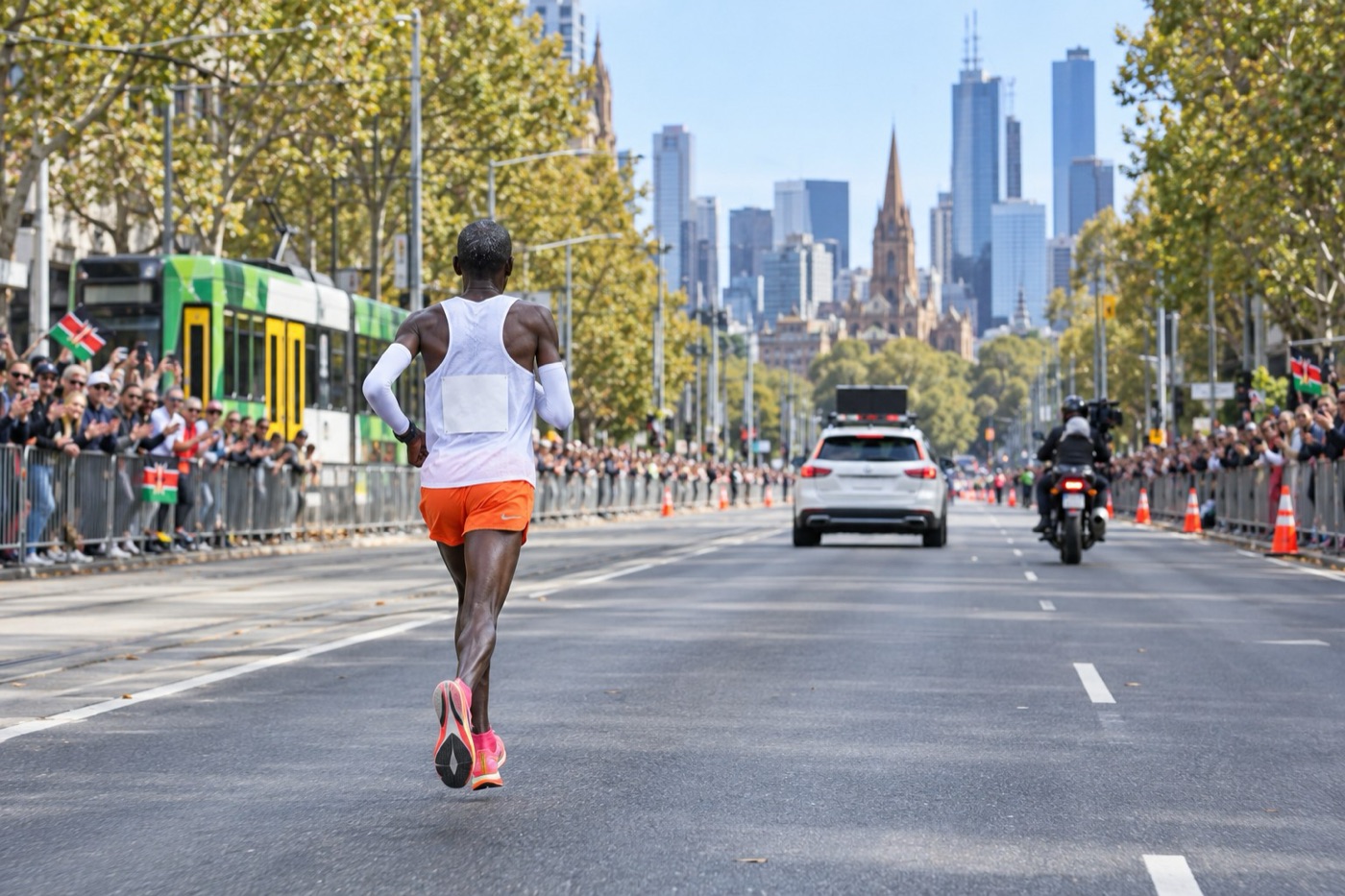
He won in 2:09:10, some way short of his personal best, pulling clear in the last ten kilometres. Other runners reported shortages of water.
Before you read
1Warm up3 questions
Talk about these questions with a partner.
- At what age do people start telling others to slow down?
- Would you rather beat your own record or win a race?
- What makes a sports comeback exciting?
2Key words8 words
These words are in the article. Choose the letter of the meaning for each one.
- career
- record
- victory
- participants
- achievement
- discipline
- limits
- crowd
- Athe habit of doing hard things every day
- Ba win
- Csomething good that you did with a lot of effort
- Da large group of people in one place
- Epeople who take part in something
- Fthe best result that anyone has ever had
- Gthe work or sport that someone does for many years
- Hthe most that someone can do
1Warm up3 questions
Talk about these questions with a partner.
- At what age do people start telling others to slow down?
- Would you rather beat your own record or win a race?
- What makes a sports comeback exciting?
2Key words8 words
These words are in the article. Choose the letter of the meaning for each one.
- rivals
- retire
- recovery
- joints
- amateurs
- instincts
- ambitions
- pressure
- Apeople who do a sport for fun, not as a job
- Bthe time it takes to feel strong again after effort
- Ca strong force or strain on something
- Dnatural feelings that tell you what to do
- Estrong wishes to achieve something
- Fthe parts of the body where bones meet, like the knee
- Gto stop working or playing a sport for good
- Hpeople or teams you compete against
1Warm up3 questions
Talk about these questions with a partner.
- At what age do people start telling others to slow down?
- Would you rather beat your own record or win a race?
- What makes a sports comeback exciting?
2Key words8 words
These words are in the article. Choose the letter of the meaning for each one.
- endurance
- physiology
- setbacks
- exertion
- congestion
- spectacle
- recreational
- longevity
- Adone for enjoyment, not as a profession
- Bhow the body works
- Ca long life or a long career
- Da situation where too many people are in one place
- Eproblems that stop you from making progress
- Fthe ability to keep going for a long time
- Ghard physical effort
- Ha big, impressive public event
Read
3Read the article
The paragraphs are numbered. Look out for the key words from task 2.
Core version
At 41, Eliud Kipchoge was still winning. On 11 October 2026, the Kenyan runner won the Melbourne Marathon in 2 hours, 9 minutes and 10 seconds, a new record for the race. The marathon is 42.2 kilometres long. Thousands of people had come to watch one of the most famous runners in the world, and he gave them another reason to cheer.
Kipchoge has enjoyed an extraordinary career. He won Olympic marathon gold medals in 2016 and 2021 and held the official world record for several years. In 2019, he also ran a marathon distance in under two hours during a specially organised event. That performance was remarkable, although it did not count as an official world record because the conditions were different from a normal race.
In recent years, however, things have not always gone his way. He has experienced disappointing results, and some people have suggested that his best days are behind him. Running at the highest level is hard on the body. Younger athletes recover more quickly and often find it easier to maintain their speed. Kipchoge's victory in Melbourne was therefore important, even though it was not one of the fastest times of his career.
The race itself offered a reminder of his experience. He stayed with the leading runners for much of the course before breaking away during the final ten kilometres. Australian runners Thomas Do Canto and Reece Edwards finished behind him. The athletes ended their race at the Melbourne Cricket Ground, where a large crowd was waiting.
There was another side to the day. Some ordinary participants complained that water stations ran out of drinks and that the event was overcrowded. Their experiences showed the difference between watching an elite athlete win and taking part in a huge public race. For many runners, simply reaching the finish line was a major achievement.
Kipchoge's latest win does not mean that age has stopped affecting him. It does show that an athlete can remain competitive, and keep testing their limits, after the years when most people expect them to slow down. He has often spoken about the importance of discipline and enjoying the process of running.
Intermediate version
By the time most runners reach their forties, their fastest races are usually behind them. Eliud Kipchoge has never been particularly interested in following the usual timetable. On 11 October 2026, the Kenyan athlete won the Melbourne Marathon in 2:09:10, breaking the course record at the age of 41. He pulled away from his closest rivals during the final ten kilometres and crossed the finish line at the Melbourne Cricket Ground.
Kipchoge is already one of the most successful distance runners in history. He won Olympic marathon titles in Rio and Tokyo, set world records and, in a specially arranged event in Vienna in 2019, became the first person to complete the distance in under two hours. That run was not eligible for an official record because it used special conditions, including rotating pacemakers.
More recently, the story has become less straightforward. There have been difficult races and results that did not match his earlier dominance. Inevitably, questions followed about whether he should retire. Elite marathon running demands more than strong lungs and determination. Training places enormous pressure on muscles and joints, while recovery generally becomes harder with age. There comes a point in almost every sporting career when experience can no longer make up for lost speed.
Melbourne suggested that Kipchoge has not reached that point just yet. He ran a controlled race, kept himself among the leaders and made his decisive move late on. Australians Thomas Do Canto and Reece Edwards were unable to stay with him. His winning time was some way short of his personal best, but that is partly what made the victory interesting. He did not need to reproduce the fastest performance of his life to win convincingly.
Not everybody had such an enjoyable race. Other participants reported shortages of drinking water, crowded sections of the course and problems after the finish. Those complaints became a separate story about the organisation of a mass participation event. They also underlined something easy to forget when the cameras focus on a champion: the thousands of amateurs attempting the same distance have their own very different challenges.
For Kipchoge, the Melbourne result is unlikely to silence every question about retirement. Nor should one race be treated as proof that athletes can simply ignore ageing. What it does challenge is the idea that sporting achievement has a fixed expiry date. His pace has changed, but his competitive instincts remain intact. For anyone whose own ambitions have been written off as unrealistic, that may be the most compelling part of his story.
Advanced version
At 41, Eliud Kipchoge was still breaking records. The Kenyan runner won the Melbourne Marathon on 11 October 2026 in 2:09:10, a course record. He pulled away over the final ten kilometres and headed for the finish at the Melbourne Cricket Ground. For a champion facing questions about retirement, it was a forceful answer.
Kipchoge's reputation scarcely requires another trophy. The two-time Olympic marathon champion transformed expectations about endurance, lowering the official world record and completing the distance in under two hours at a carefully staged Vienna event in 2019. The latter was not a recognised world record, because the assistance and pacing arrangements differed from those permitted in ordinary competition. Nevertheless, it became an extraordinary demonstration of what preparation, physiology and technology might achieve when brought together for a single purpose.
Yet sporting greatness rarely provides immunity from sporting decline. Recent years have brought setbacks, inconsistent performances and speculation about whether his formidable consistency had finally deserted him. Marathon running exposes the body's limitations with particular cruelty. Even the best-prepared athlete must contend with accumulated training stress, the difficulty of maintaining speed and the increasingly delicate balance between exertion and recovery. Kipchoge's victory in Australia was therefore noteworthy precisely because it did not require a return to his former, world-record-breaking pace.
His success rested instead on judgement and control. He remained patient while the leading group stayed together, then accelerated decisively late in the race, leaving Australian competitors Thomas Do Canto and Reece Edwards behind. It was a performance that drew on years of experience rather than the illusion of everlasting physical youth. There is an important distinction between remaining competitive and remaining unchanged, one that discussions about ageing athletes frequently overlook.
The spectacle also had an uncomfortable counterpoint. Numerous recreational runners complained of water shortages, congestion and inadequate facilities at an event whose appeal had extended well beyond its elite field. Their accounts raised legitimate questions about the responsibilities of organisers when participation grows faster than provision. A record-breaking winner may dominate the headlines, but a marathon's success is also measured by what happens to the less celebrated people behind him. For those runners, adequate drinking water is rather more pressing than the philosophy of longevity.
The question of when he ought to stop remains open. The competitive landscape has changed, his own performances have fluctuated and one result cannot erase the consequences of age. What he has challenged is the assumption that decline must make achievement meaningless. There is a quieter kind of excellence in adapting to circumstances without surrendering ambition. Kipchoge is no longer being asked whether he can run faster than any man in history. For now, he is showing that he can still outrun the people standing beside him.
After you read
4True, false or not given5 statements
Choose T (true), F (false) or NG (the article does not say).
- His 2019 sub-two-hour run counted as an official world record.
The text says it "did not count as an official world record because the conditions were different from a normal race."
- Kipchoge's winning time in Melbourne was a record for the race.
The text says: "a new record for the race."
- Kipchoge has said he will retire after this season.
Not stated. The text does not say whether he plans to retire.
- Some people taking part said the event was too crowded.
The text says: "Some ordinary participants complained that water stations ran out of drinks and that the event was overcrowded."
- His Melbourne time was one of the fastest of his career.
The text says the win "was not one of the fastest times of his career."
5Vocabulary5 gaps
Complete the sentences with words from the box. Two words are not needed.
competitivedisappointingextraordinaryofficialovercrowdedslipperytiring
- She hoped to win the race, so finishing in fourth place was .
- The train was so that many people had to stand for the whole journey.
- Only an time can be accepted as a national record.
- Swimming across a wide lake in one day would be an achievement for anyone.
- He is 41, but he is still against much younger runners.
6Verb forms5 gaps
Write the correct form of the verb in brackets.
- On 11 October 2026, the Kenyan runner the Melbourne Marathon. (WIN)
- In 2019, he a marathon in under two hours. (RUN)
- Younger athletes often find it easier their speed. (MAINTAIN)
- So far, Kipchoge a long and successful career. (ENJOY)
- Kipchoge's win does not mean that age has stopped him. (AFFECT)
7Language focusprepositions
Complete the sentences with words from the box. Two words are not needed. Some words go with one small word. Learn them together: proud of, worry about, depend on.
aboutforfrominintoofon
- She is very proud her son's medal.
- Many runners worry the weather before a race.
- Many older people are interested running a marathon.
- A marathon runner depends good training.
- He is famous his speed.
4True, false or not given5 statements
Choose T (true), F (false) or NG (the article does not say).
- Kipchoge has won the Olympic marathon more than once.
The text says: "He won Olympic marathon titles in Rio and Tokyo"
- His Melbourne time was a personal best.
The text says: "His winning time was some way short of his personal best"
- The organisers have apologised for the water shortages.
Not stated. The text does not say whether the organisers apologised.
- The 2019 Vienna run took place under the same conditions as an ordinary race.
The text says it "used special conditions, including rotating pacemakers."
- The two Australian runners could not keep up with the winner.
The text says: "Australians Thomas Do Canto and Reece Edwards were unable to stay with him."
5Vocabulary6 gaps
Complete the sentences with words from the box. Two words are not needed.
compellingdecisiveeligibleintactobsoletestraightforwardunrealisticvague
- Runners must be over eighteen to be to enter the race.
- The online form was so that it took me only two minutes to fill in.
- The captain's action in the last minute won the match for the team.
- The documentary was so that nobody in the room could look away.
- The old bridge was damaged but still after the storm; no part of it had fallen.
- Winning every race in a season is an target for most athletes.
6Verb forms5 gaps
Write the correct form of the verb in brackets.
- By the time the amateurs arrived, the champion and gone home. (FINISH)
- Many complaints about the water supply after the race. (MAKE)
- Runners plenty of water before a long race. (SHOULD / DRINK)
- Kipchoge two Olympic marathon titles. (WIN)
- If the organisers had ordered more water, fewer runners . (COMPLAIN)
7Language focusprepositions
Complete the sentences with words from the box. Two words are not needed. Many verbs and adjectives need one fixed preposition. Learn the whole pair, such as cope with, rely on, specialise in.
atforfrominontowith
- Experience cannot always compensate a loss of speed.
- Some critics object the idea that older athletes should retire.
- Athletes have to cope the pressure of competing at a high level.
- He specialises long-distance races.
- Marathon training relies patience and routine.
4True, false or not given5 statements
Choose T (true), F (false) or NG (the article does not say).
- The writer implies that the amateur runners' difficulties deserve as much attention as the winner's result.
The text says a marathon's success "is also measured by what happens to the less celebrated people behind him."
- The writer argues that the Melbourne win proves Kipchoge's decline has ended.
The text says "one result cannot erase the consequences of age."
- Kipchoge's coach advised him to stay with the leading group in Melbourne.
Not stated. The text mentions no coach or instructions.
- Kipchoge's Melbourne time was slower than his best marks.
The text says the win "did not require a return to his former, world-record-breaking pace."
- Both the Vienna run and the Melbourne race took place under conditions allowed in ordinary competition.
The text says the Vienna "assistance and pacing arrangements differed from those permitted in ordinary competition."
5Vocabulary6 gaps
Complete the sentences with words from the box. Two words are not needed.
accumulateddeserteddwindledextendedfluctuatedprevailedstagedtransformed
- The invention of the carbon-plated shoe has the way distance runners train.
- His form has wildly this season, with a brilliant win followed by a poor finish.
- As the storm worsened, the crowds the stadium and left the pitch empty.
- The protest looked spontaneous, but it was in fact carefully by the party's press team.
- Her savings had so much interest over ten years that she could retire.
- The deadline was by a week after complaints from applicants.
6Word forms5 gaps
Use the word in brackets to make a word that fits the gap.
- There was widespread about whether the champion would ever race again. (SPECULATE)
- The coach praised the squad's in a season of unpredictable results. (CONSISTENT)
- Fame rarely brings from criticism. (IMMUNE)
- Spectators described the first-aid arrangements at the finish as woefully . (ADEQUATE)
- Only a handful of athletes sustain such over two decades. (EXCEL)
7Language focusprepositions
Complete the sentences with words from the box. Two words are not needed. At C1, learn fixed phrases as a block: tantamount to, contingent on, fraught with, wary of, exempt from.
atbyfromofontowith
- Retiring now would be tantamount admitting defeat.
- The success of the event is contingent the weather.
- Any attempt to break the record is fraught risk.
- She was wary announcing a retirement that she might regret.
- Athletes are rarely exempt the effects of ageing.
Speak
8Talk about it3 questions
Discuss in pairs or small groups. Give reasons for your answers.
- Who should decide when an athlete has had enough?
- Can a slower performance still be someone's greatest achievement?
- Which ambition would you like people to stop putting an age limit on?
8Talk about it3 questions
Discuss in pairs or small groups. Give reasons for your answers.
- Who should decide when an athlete has had enough?
- Can a slower performance still be someone's greatest achievement?
- Which ambition would you like people to stop putting an age limit on?
8Talk about it3 questions
Discuss in pairs or small groups. Give reasons for your answers.
- Who should decide when an athlete has had enough?
- Can a slower performance still be someone's greatest achievement?
- Which ambition would you like people to stop putting an age limit on?
9Role-play: am I too old to race?
Work in pairs. Read your card, then have the conversation. Swap roles and do it again.
Student A · the worried friend
Your friend is 45 and wants to run a marathon in six months. You think it's too hard on the body. Ask at least two questions, then say what you really think.
Student B · the keen runner
You're 45 and you want to run your first marathon. Explain why it matters to you and how you'll train safely. Try to get your friend's support.
Useful phrases
- I'm worried that it's too much for you.
- I've always wanted to do it.
- How are you going to train?
- I'll start slowly and build up.
- Age is just a number, isn't it?
- I'll support you, but please be careful.
Afterwards, tell the class: did the friend agree to support the plan, and was that a good decision?
Your words
Highlights0 saved
Highlights0 saved
Highlights0 saved
Was this lesson useful? Support johnplusnews on Ko-fi
Continue reading
Work
Could a Better Job Be About Time, Not Money?
A global survey of 40,500 workers found that work-life balance has overtaken salary as the main reason people would consider leaving a job. What does that tell us about how people want to live?
Lifestyle
Can You Learn a Better Life from an Italian Grandmother?
Two friends in their late eighties bake bread in a small Italian town. The internet has decided they are the answer to something.
Language
Is It Time to Stop Improving Everything?
“Maxxing” is Dictionary.com's word of the year. One columnist has had enough of it and wants 2027 to be the year we do less.