News lesson13 October 2026
The Side-Hustle Trap: What the Videos Leave Out
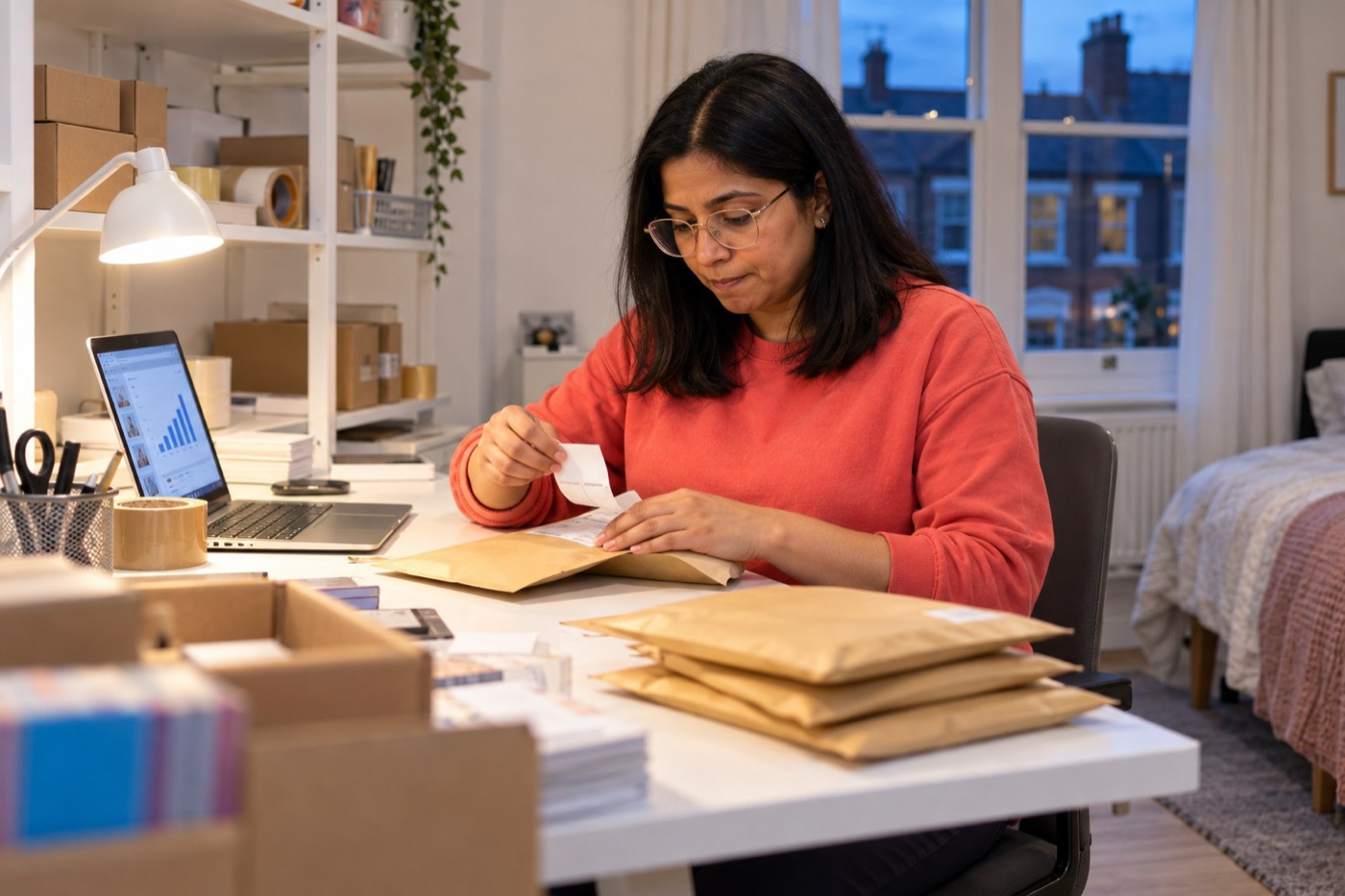
The video opens with coffee and a payment notification. It rarely shows the months of unpaid work, or the thousands of people selling the same thing.
Before you read
1Warm up3 questions
Talk about these questions with a partner.
- What makes an online money-making promise sound believable?
- Would you rather earn extra money from a hobby or keep it just for fun?
- What would you ask someone who claimed their business ran itself?
2Key words8 words
These words are in the article. Choose the letter of the meaning for each one.
- influencer
- income
- attractive
- customers
- tutoring
- promise
- digital
- trust
- Amoney that you get from work or other sources
- Bto believe that someone is honest and good
- Cteaching one student or a small group
- Dinteresting and nice to look at
- Epeople who buy things from a shop or business
- Fto say that something will definitely happen
- Gstored and used on a computer or phone
- Ha person with many followers online who recommends things
1Warm up3 questions
Talk about these questions with a partner.
- What makes an online money-making promise sound believable?
- Would you rather earn extra money from a hobby or keep it just for fun?
- What would you ask someone who claimed their business ran itself?
2Key words8 words
These words are in the article. Choose the letter of the meaning for each one.
- squeezed
- legitimate
- profitable
- audience
- initial
- respondents
- investigation
- returns
- Amoney you get back from something you paid for
- Bthe people who watch, read or follow what you make
- Ca careful search to find out the facts
- Dput under pressure because you have too little money
- Ehonest and allowed by the law
- Fhappening at the beginning
- Gpeople who answer questions in a survey
- Hmaking more money than it costs
1Warm up3 questions
Talk about these questions with a partner.
- What makes an online money-making promise sound believable?
- Would you rather earn extra money from a hobby or keep it just for fun?
- What would you ask someone who claimed their business ran itself?
2Key words8 words
These words are in the article. Choose the letter of the meaning for each one.
- counterweight
- aspiration
- gulf
- complication
- undermines
- modest
- prominent
- documented
- Aweakens something gradually
- Bfairly small in size or amount
- Cwell known and important
- Da strong hope of achieving something
- Esomething that balances or reduces the effect of another thing
- Fa very large difference between two things
- Gsomething that makes a situation harder or more confusing
- Hrecorded in detail with evidence
Read
3Read the article
The paragraphs are numbered. Look out for the key words from task 2.
Core version
Imagine a video that begins like this: an influencer makes breakfast, looks at her phone and smiles. Another payment has arrived from a business she says almost runs itself. There is no boss, no journey to work, and money arrives while she sleeps. It is easy to see why such a video is attractive when rent and food are getting more expensive. But the camera shows the payment, not the hours spent designing, advertising and searching for the first customer.
A side hustle is work you do alongside your job or studies. It might involve tutoring, walking dogs, selling second-hand clothes or running a small online shop. These can be useful ways to earn extra cash.
The problem begins when people suggest that making money takes almost no effort. Some talk about passive income, which means money that keeps arriving after the first work is finished. But somebody still has to make the product, answer customers and find new buyers. Setting up a shop is one thing; finding customers is another. Yet many people are trying because they want more control over their money and working lives.
The figures tell a less exciting story. In a 2026 Save the Student survey, 29% of students said they had a business or side hustle. Of those, 79% had earned less than £500 in the previous year. Some gained useful skills or enough money to cover small expenses. But those earnings are far below the thousands promised in some videos.
Take digital products, such as planners or invitations sold online. You don't need to store boxes or post parcels, but you still need good designs and customers willing to pay for them. There are already thousands of similar products available. Software, advertising and selling fees can also reduce your profits, particularly when you are just starting out. And good reviews rarely appear overnight when nobody knows you.
Affiliate marketing is another popular option. People earn a small payment when someone buys a product using their special link. This can work if followers trust their recommendations. However, sharing a link doesn't mean people will buy anything. Some influencers make their own money by selling expensive courses that promise to teach others how to succeed.
None of this means side hustles are a bad idea. They can build confidence, teach business skills and sometimes turn into full-time work. Before starting, ask yourself: Who will buy what I'm selling? How much will it cost? What will I actually earn after expenses? Making money online is possible. Doing it without working hard is much less likely.
Intermediate version
The video begins with coffee and a payment notification. Its creator says a small online business covers the bills while leaving plenty of time for family, travel and sleep. What the camera does not show is the crowded marketplace, the advertising costs or the weeks when nobody buys anything. For anyone squeezed by the cost of living, the promise is powerful. The missing work is exactly what deserves attention.
A side hustle is simply an activity that brings in income alongside a job or studies. Some people tutor languages, repair bicycles or walk dogs. Others sell digital products, run small online shops or earn commissions by recommending products. These can be legitimate businesses. Yet there is a growing industry built around the promise of passive income, money that supposedly keeps coming in after the initial work has been done. The trouble is that setting something up is rarely the same as making it profitable.
The difference between ambition and earnings is clear in recent research. Save the Student's 2026 survey found that 29% of respondents had a side hustle or business. Of those, 79% had made less than £500 over the previous year. Other surveys produce different figures because they question different groups and define side hustles differently. Even so, the evidence suggests that spectacular earnings are far from typical. Small amounts of extra money can make a genuine difference, but that is not the same as being able to quit your job.
Consider digital products such as online invitations or printable planners. There is no warehouse to rent, and the same file can be sold more than once. But the costs are real: crowded marketplaces, software subscriptions, listing fees and hours spent promoting products. Affiliate marketing is different. A company pays you a commission when a reader buys something using your link, but first you need people to trust your recommendations. Building an audience is often the hardest part of the job. Earnings are the money that comes in. Profit is what remains after costs, and many beginners forget the difference.
Perhaps the most awkward question concerns the influencers themselves. If a particular online business is so profitable, why do so many people spend their time selling courses about how to start one? Some are experienced entrepreneurs who offer valuable advice. Others appear to earn more from hopeful beginners than from the businesses they are recommending. In a recent Guardian investigation, a journalist tested several popular online money-making methods and found that the costs and effort quickly undermined the promise of easy profits.
It would be a mistake to dismiss side hustles altogether. They can provide flexibility, teach commercial skills and give people more control over their income. But a healthy dose of scepticism is useful when an opportunity promises big returns for little work. Before paying for software or a training course, calculate the likely costs, research your competitors and work out where your customers would come from. Financial independence may begin with a good idea, but it rarely begins with doing nothing.
Advanced version
The pitch usually starts with an ordinary morning: breakfast, a phone and another payment arriving. The creator says the business almost runs itself. What the video leaves outside the frame is harder to price: making the product, finding customers and keeping them happy. Before envying the income, it is worth asking what work produced it.
The term side hustle covers an enormous range of activity, from private tutoring and weekend catering to online shops and affiliate marketing. There is nothing inherently dubious about earning money beyond one's main occupation. What deserves scrutiny is the way certain online ventures are presented as largely effortless sources of passive income. A product that can be sold repeatedly without being manufactured again may be inexpensive to distribute, but somebody still has to design it, market it, answer customer questions and persuade strangers to part with their money.
The gulf between social-media aspiration and ordinary earnings is revealing. In Save the Student's 2026 survey, 29% of respondents reported running a business or side hustle, yet 79% of that group had earned less than £500 in the previous twelve months. These figures describe a particular student sample, not every entrepreneur, but they provide a useful counterweight to the extraordinary success stories filling online feeds. Commercial surveys of British side hustlers similarly suggest that modest, inconsistent earnings are considerably more common than the life-changing sums advertised by prominent creators.
Digital marketplaces offer a useful illustration. Selling printable planners or design templates removes the need to hold physical stock, but low barriers to entry also attract competitors, and products that need little specialist knowledge are easy to imitate.
Affiliate marketing has its own difficulties: a commission link is worthless without attention, credibility and a customer willing to buy. Costs add up in both cases. Profit is what remains after platform charges, subscriptions and advertising, and it also has to cover the value of the hours the owner puts in.
A further complication is the business of teaching other people to make money. Some experienced creators sell genuinely useful training; others market expensive courses supported by carefully selected testimonials and vague income claims. The incentive is worth examining. A person may find it more lucrative to sell the prospect of entrepreneurship than to pursue the activity supposedly generating their wealth. A Guardian investigation published in October 2026 documented how difficult several fashionable online ventures proved in practice, reinforcing the need to distinguish exceptional cases from representative outcomes.
None of this undermines the value of entrepreneurship. Small ventures can create opportunities, top up low wages and develop skills that later become commercially valuable. The danger lies in presenting genuine enterprise as a shortcut around effort, risk and uncertainty. A prospective founder needs to know the customer, the competition, the likely costs and the time required before the first sale. Perhaps the most useful question is not whether a business can produce income while its owner sleeps, but how much work was necessary to get it there in the first place.
After you read
4True, false or not given5 statements
Choose T (true), F (false) or NG (the article does not say).
- About three in ten students said they had a business or side hustle.
The text says: "In a 2026 Save the Student survey, 29% of students said they had a business or side hustle."
- A side hustle can eventually become a full-time job.
The text says: "They can build confidence, teach business skills and sometimes turn into full-time work."
- Selling digital products means you must store boxes at home.
The text says: "You don't need to store boxes or post parcels"
- Most students start a side hustle while still at school.
Not stated. The text does not say when students start their side hustles.
- Most students with a side hustle earned thousands of pounds.
The text says the opposite: "Of those, 79% had earned less than £500 in the previous year."
5Vocabulary5 gaps
Complete the sentences with words from the box. Two words are not needed.
borrowedcheapearnedexpensesexpensivereviewssurvey
- Food and rent are getting more every year, so many students want extra money.
- A asked hundreds of students whether they had a side hustle.
- She about £200 last year by selling her old clothes online.
- Before you start, write down all your , such as software and postage.
- Good help new customers to trust a small shop.
6Verb forms5 gaps
Write the correct form of the verb in brackets.
- An influencer breakfast, looks at her phone and smiles. (MAKE)
- The camera shows the payment, not the hours on designing. (SPEND)
- In a 2026 survey, 29% of students said they a side hustle. (HAVE)
- Last month she twenty planners, but she still lost money. (SELL)
- Making money online is possible, but it without hard work is unlikely. (DO)
7Language focusphrasal verbs
Complete the sentences with words from the box. Two words are not needed. A phrasal verb is a verb plus a small word, like up or out. The small word is already in the sentence. Choose the verb.
carryfindgivehandpaysignstart
- Before you buy a course, out who else is selling the same thing.
- Many beginners up after a month because nobody buys their products.
- She hopes to off her laptop in six months.
- You can up for a free account on most selling websites.
- Most people out with a small idea and a laptop.
4True, false or not given5 statements
Choose T (true), F (false) or NG (the article does not say).
- All surveys of side hustles produce the same figures.
The text says the opposite: "Other surveys produce different figures because they question different groups and define side hustles differently."
- The writer says that building an audience is easy.
The text says: "Building an audience is often the hardest part of the job."
- A journalist from the Guardian tried out several popular online money-making methods.
The text says: "In a recent Guardian investigation, a journalist tested several popular online money-making methods and found that the costs and effort quickly undermined the promise of easy profits."
- Most side hustles fail within the first year.
Not stated. The text does not say how many side hustles fail in their first year.
- Roughly four in five of those with a side hustle made under £500 in a year.
The text says: "Of those, 79% had made less than £500 over the previous year."
5Vocabulary6 gaps
Complete the sentences with words from the box. Two words are not needed.
ambitionawkwardcommissioncompetitorsscepticismspectacularsubscriptionsundermined
- Online claims of effortless riches were met with by many readers.
- Monthly payments for software, known as , can quietly reduce a seller's earnings.
- Before launching an online shop, find out what your charge for similar products.
- Affiliate marketers earn a of ten per cent each time someone buys through their link.
- Several bad reviews her confidence in the new shop.
- A few influencers post results, but their experience is far from typical.
6Verb forms5 gaps
Write the correct form of the verb in brackets.
- By the time she saw her first sale, she three months designing her products. (SPEND)
- Most of these courses on social media every day. (PROMOTE)
- If you the market first, you could lose money. (NOT RESEARCH)
- She on the shop for six months and has only made £80. (WORK)
- Nobody anything from the shop last week, so she changed her photos. (BUY)
7Language focusphrasal verbs
Complete the sentences with words from the box. Two words are not needed. Some phrasal verbs take an object (turn down an offer). Think about the tense, because the verb must fit the sentence.
buildcameendholdrulestandturned
- Many beginners up spending more on software than they earn.
- She down the offer of a paid course because the price was too high.
- It takes months to up an audience that trusts your recommendations.
- While scrolling late at night, he across a video promising easy money.
- Careful research may out ideas that would never make money.
4True, false or not given5 statements
Choose T (true), F (false) or NG (the article does not say).
- A seller who brings in £4,000 but pays £4,500 in subscriptions, advertising and fees has made no profit.
The text defines profit as what remains after platform charges, subscriptions and advertising, so costs above income leave nothing.
- The writer treats every creator who sells training as dishonest.
The text says: "Some experienced creators sell genuinely useful training", so the criticism is limited to some.
- Most respondents who earned under £500 planned to give up their ventures.
The text gives their earnings but says nothing about their plans.
- The writer implies that easy entry to digital marketplaces is both an advantage and a weakness for sellers.
No stock is needed, but low barriers attract competitors and products are easy to imitate.
- The writer says commercial surveys of British side hustlers contradict the student survey.
The text says they "similarly suggest" that modest, inconsistent earnings are common.
5Vocabulary6 gaps
Complete the sentences with words from the box. Two words are not needed.
endorsementimitateincentiveinconsistentostensiblescrutinytestimonialsvague
- Any claim that promises guaranteed returns deserves close before a single pound is paid.
- A seller whose monthly takings are , soaring one month and collapsing the next, cannot plan around them.
- Adverts that boast of life-changing results without a single figure are deliberately about what buyers will actually earn.
- Glowing from satisfied customers are easy to select, edit or even invent.
- The financial is clear: a seller may earn more from enrolments than from the product the course describes.
- A design that needs no specialist skill is easy for rivals to .
6Word forms5 gaps
Use the word in brackets to make a word that fits the gap.
- A pitch can make an average product seem irresistible. (PERSUADE)
- There is nothing dubious about earning extra money. (INHERENT)
- A commission link is worthless without attention and . (CREDIBLE)
- None of this undermines the value of . (ENTREPRENEUR)
- A founder needs to know the customer and the competition. (PROSPECT)
7Language focusphrasal verbs
Complete the sentences with words from the box. Two words are not needed. At this level, many phrasal verbs are fixed with a preposition too (hold up as, shell out for). Check the grammar after the gap, then choose the verb.
brushcashheldpanshelltideweed
- Occasional outliers are up as proof that anyone can succeed.
- Cautious buyers should not aside the lack of verifiable income figures.
- Few ventures out as smoothly as the videos suggest.
- Some marketers in on the hype by selling courses rather than products.
- Beginners are often persuaded to out for software they barely use.
Speak
8Talk about it3 questions
Discuss in pairs or small groups. Give reasons for your answers.
- Which part of an online success story would you most want to see?
- When does useful advice become a sales pitch?
- Could turning a hobby into a business change how you feel about it?
8Talk about it3 questions
Discuss in pairs or small groups. Give reasons for your answers.
- Which part of an online success story would you most want to see?
- When does useful advice become a sales pitch?
- Could turning a hobby into a business change how you feel about it?
8Talk about it3 questions
Discuss in pairs or small groups. Give reasons for your answers.
- Which part of an online success story would you most want to see?
- When does useful advice become a sales pitch?
- Could turning a hobby into a business change how you feel about it?
9Role-play: should we buy the course?
Work in pairs. Read your card, then have the conversation. Swap roles and do it again.
Student A · the excited friend
You've seen an online course that costs £300 and promises money while you sleep. You want your friend to join you. Explain why it looks like a good chance and answer your friend's worries.
Student B · the cautious friend
You're not sure the course is worth £300. Ask at least two questions about the costs, the customers and who is really making money. Suggest a cheaper way to test the idea.
Useful phrases
- I've just seen a course that teaches you to earn money online.
- That's a lot of money for something we can't try first.
- Who's actually making money from it?
- I'd feel better if we checked the reviews together.
- What would you do if it didn't work?
- Let's find a compromise.
Afterwards, tell the class: did you buy the course, and what made you decide?
Your words
Highlights0 saved
Highlights0 saved
Highlights0 saved
Was this lesson useful? Support johnplusnews on Ko-fi
Continue reading
Business
Can One Video Game Be Worth More Than a Hollywood Blockbuster?
Grand Theft Auto VI launched on 19 November 2026, and its publisher says shoppers spent about US$3.79 billion on the first day. The figure is a company estimate, and comparing a game with a film is harder than it sounds.
Games
Would You Miss Work to Play a Video Game?
Grand Theft Auto VI fans around the world skipped work, stayed up all night and helped the game to a record first day. Is taking time off for a hobby ever a good idea?
Work
Could a Better Job Be About Time, Not Money?
A global survey of 40,500 workers found that work-life balance has overtaken salary as the main reason people would consider leaving a job. What does that tell us about how people want to live?