What Makes a Bad Photo a Good Memory?
Some people are going back to older digital cameras. What can a blurry photo give you that a perfect one can't?
Warm up3 questions
- Would you keep a blurry photo if it captured a great moment?
- Who should get to choose which group photo is shared?
- Does checking every photo make taking pictures less fun?
Sentence help (optional): I'd choose ... because ... · For me, ... · I think ... because ...
Warm up3 questions
- Would you keep a blurry photo if it captured a great moment?
- Who should get to choose which group photo is shared?
- Does checking every photo make taking pictures less fun?
Warm up3 questions
- Would you keep a blurry photo if it captured a great moment?
- Who should get to choose which group photo is shared?
- Does checking every photo make taking pictures less fun?
Core version
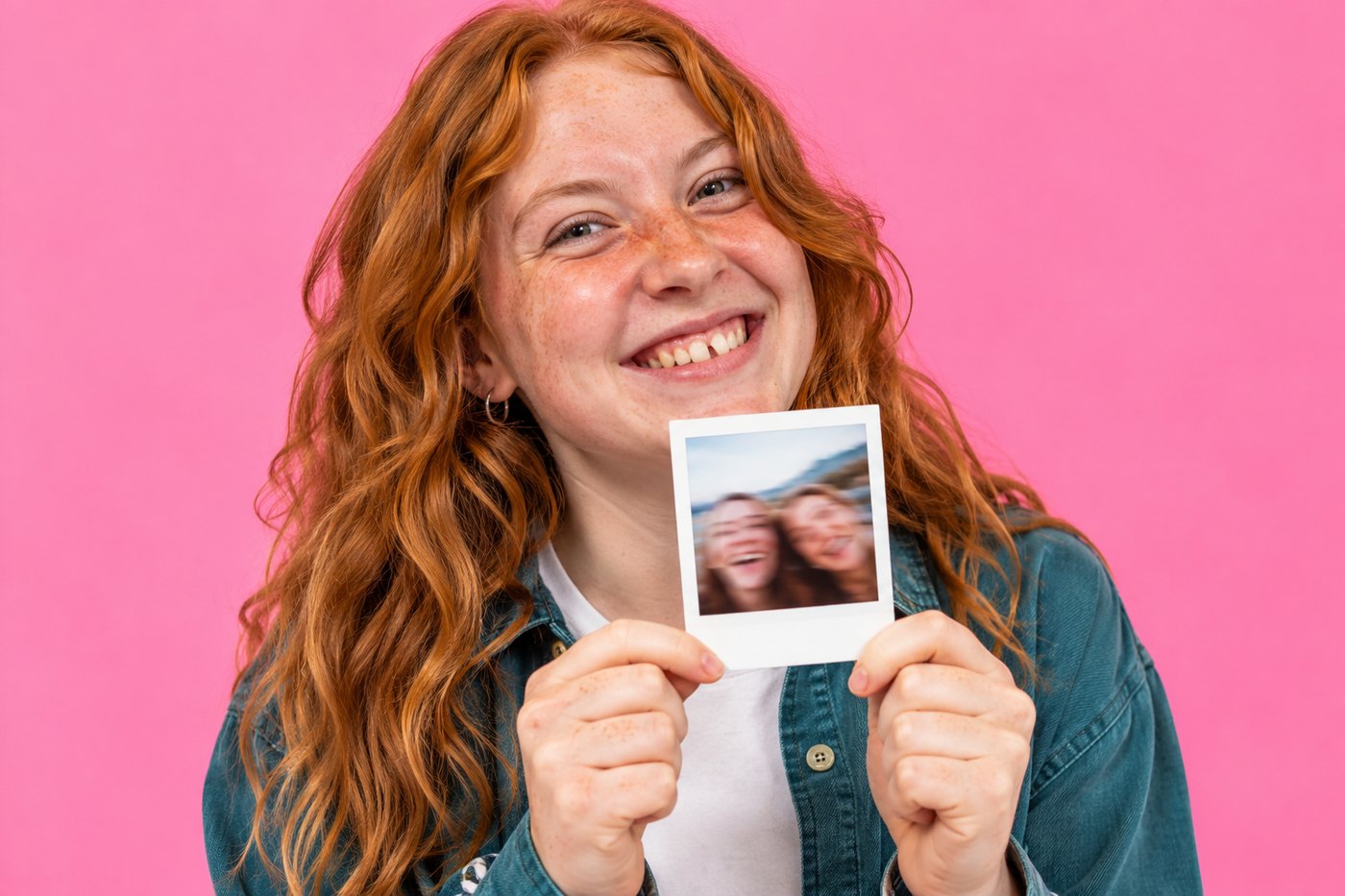
Imagine two photos of the same birthday party. In the first, everyone looks at the camera, the light is perfect and every face is clear. In the second, the picture is a little blurry. Your friend is laughing so hard that her eyes are closed, and someone's hand is in front of the lens. Which photo would you keep?
In August 2026, the BBC reporter Annabel Rackham tried something different. She took a digital camera to a DJ set with her best friend. It was the camera she last used 15 years ago, on a family holiday. She nearly forgot the battery. People looked at it and said they hadn't seen one for years.
Rackham says that older technology is "having a moment". On social media, some people are going back to digital cameras, wired headphones and old music players.
Lily Redman, a 26-year-old content creator from South Wales, says her digital camera gives a look her phone can't copy. She thinks phone flash can look grainy and too sharp. She says people want something that feels "a bit more real".
Redman also likes the surprise. She waits until she puts the memory card into a computer to see her photos, so she doesn't know exactly what she got. That is her own habit. A digital camera does not have to work that way, and on a phone you can check at once and try again.
Remember who is in this story. The people are adults in their twenties and thirties, not school students. It's one article with a few voices, so it doesn't prove that most young people prefer old cameras. It's also about digital cameras, not film cameras, and it doesn't say that an old camera makes anyone happier.
So back to the two photos. A perfect picture can show how a party looked. A blurry one might show how it felt. If you could keep only one photo from your last trip, which would it be, and why?
Intermediate version
Two photos were taken at the same party. In the first, everyone is posing, the light is flattering and every face is sharp. In the second, the picture is slightly blurred, one person has their eyes closed because they're laughing, and a hand is covering part of the lens. Years from now, which one will you want to open?
In August 2026, the BBC culture reporter Annabel Rackham took a digital camera to a DJ set as an experiment. It was the camera she last used 15 years ago on a family holiday, and she nearly fell at the first hurdle by leaving the battery charging at home. Strangers noticed the camera, and one man said he hadn't seen one in years. Rackham reports that social media is full of people going back to basics with digital cameras, wired headphones and early MP3 players.
Her main voice is Lily Redman, a 26-year-old content creator from South Wales. Redman says a digital camera captures a quality her phone can't replicate. In her view, phone flash looks grainy and too high definition, and people are looking for "a bit of grit" or something that feels more real. She also likes the element of surprise: you only see the results when you plug the memory card into a computer at home.
Redman makes a bigger claim too. She says that photos her mother took when she was two look very old, while photos she took herself five years ago look as if they were taken yesterday. She believes phone photos have "warped our perception of time". That's her opinion, not a proven fact, but it's an interesting idea about how pictures help us remember.
Andrew Przybylski, a professor at the University of Oxford, offers a different angle. He argues that simpler technology appeals because people want to be in control of their experiences. When you have endless options, he says, you can suffer from "decision paralysis", but when you choose to switch on a camera and play with its settings, you move towards something you want.
It's important to remember the limits. This is one article with a few voices, and it can't show what most young people think. The experiment is about digital cameras rather than film cameras, and the piece doesn't claim that old technology makes people happier.
So imagine you can keep only three photos from a class trip. Would you pick the best-looking ones, or the ones that bring the day back?
Advanced version
Two photographs survive from the same evening. One is the picture everybody agreed on: posed, well lit, every face in focus. The other is slightly blurred, with a hand across the corner of the lens and one friend laughing so hard her eyes are shut. If you could keep only one, the answer depends on a question you may never have asked: who is the photograph for?
In August 2026, the BBC culture reporter Annabel Rackham took a digital camera to a DJ set, a camera she had last used 15 years earlier. Her piece belongs to a wider mood, which she describes as older technology having a bit of a moment, with people online explaining why they are returning to digital cameras, wired headphones and early MP3 players. It is a feature, not a study, and its evidence is a handful of interviews and a few company sales figures.
The most interesting of those voices is Lily Redman, a 26-year-old content creator from South Wales. Redman says a digital camera captures a quality her phone cannot replicate, and she finds phone flash grainy and too high definition. People, she suggests, are looking for a bit of grit or something that feels more real. Redman enjoys waiting until she transfers the pictures to a computer to see what she has captured. That delay is part of her routine, rather than something every digital camera requires.
Redman's most provocative claim is that phone photos have warped our perception of time. Pictures her mother took when she was two look very old, she says, while her own from five years ago look as if they were taken yesterday. That is a personal observation, not a finding, and it could have several explanations. But it raises a real question about what a photograph is supposed to preserve.
Andrew Przybylski, a professor of technology and human behaviour at the University of Oxford, offers a wider explanation. He argues that fondness for simpler devices reflects a deep wish to be in control of one's experiences. Endless choice can produce decision paralysis, he says, whereas choosing to turn on a camera and adjust its settings means moving towards something you want rather than having it come at you.
The limits matter. The people quoted are in their twenties and thirties, not at school, and a few interviews can't establish what any generation prefers. The experiment concerns digital cameras, not film, and the piece does not claim that older devices make anyone happier or that smartphones are being abandoned.
What it does offer is a useful distinction. A photograph can serve a public image, which is the picture you would post, or a private memory, which is the picture that brings the evening back. They are often different pictures. So which of the two would you keep?
Study this story
Save the words you want to keep, talk about the story, then practise the language.
Highlights0 saved
Highlights0 saved
Highlights0 saved
Talk about it3 questions
- Would you rather have three great trip photos or hundreds of ordinary ones?
- What makes a photo feel like a real memory?
- Could using a separate camera change how much you enjoyed a day?
Sentence help (optional): I think ... because ... · One reason is ... · For me, ...
You can talk about people in general instead of yourself, and you can pass on any question.
Talk about it3 questions
- Would you rather have three great trip photos or hundreds of ordinary ones?
- What makes a photo feel like a real memory?
- Could using a separate camera change how much you enjoyed a day?
You can talk about people in general instead of yourself, and you can pass on any question.
Try it
Read these descriptions of two photos from the same invented school trip. Photo A: everyone is smiling at the camera, the light is perfect and nobody is moving. Photo B: the picture is blurry, two people are laughing, one has their eyes closed and the bus is in the background. In pairs, choose one photo for a private memory album and one for a poster advertising next year's trip. Explain why your choices may be different. You don't need real photos or any devices.
Exercises4 exercises
1. Complete the sentences
Drag a word into each gap, or tap a word and then tap a gap. Tap a filled gap to put the word back. Two words are not needed.
- In the second photo, the picture is a little .
- Someone's hand is in front of the .
- Rackham nearly forgot to charge the .
- Redman also likes the of seeing the photos later.
- People said they hadn't one for years.
2. Match the meaning
Choose the meaning of each word or phrase as it is used in the article.
- habit
- lens
- grainy
- surprise
Write the letter of the meaning next to each word.
- A looking rough, as if made of tiny dots
- B something you did not expect
- C something you do regularly, often without thinking
- D the glass part of a camera that light goes through
3. Put the verb in the right form
Write the correct form of the verb in brackets.
- Rackham a digital camera to a DJ set. (take)
- It was the camera she last 15 years ago. (use)
- These days, some people back to digital cameras and wired headphones. (go)
- A perfect picture can how a party looked. (show)
- Her friend is laughing so hard that her eyes closed. (be)
4. True, false or not given
Choose Not given if the article does not say, even when you think the statement is probably true.
- The reporter took an old digital camera to a DJ set with a friend.
The text says: "She took a digital camera to a DJ set with her best friend."
- The camera was new.
The text says the opposite: "It was the camera she last used 15 years ago, on a family holiday."
- Lily Redman is 26 years old.
The text says: "Lily Redman, a 26-year-old content creator from South Wales"
- The article proves that most young people prefer old cameras.
The text says the opposite: "so it doesn't prove that most young people prefer old cameras"
- Rackham sold her digital camera after the DJ set.
Not stated. This version does not give this information.
Your score
Do all four, then add them up.
Answer key
- Complete the sentences1 blurry · 2 lens · 3 battery · 4 surprise · 5 seen
- Match the meaning1 habit = C · 2 lens = D · 3 grainy = A · 4 surprise = B
- Put the verb in the right form1 took · 2 used · 3 are going or go · 4 show · 5 are
- True, false or not given1 True · 2 False · 3 True · 4 False · 5 Not given
1. Complete the sentences
Drag a word into each gap, or tap a word and then tap a gap. Tap a filled gap to put the word back. Two words are not needed.
- In the first photo, everyone is and the light is flattering.
- Redman says a digital camera captures a quality her phone can't .
- She believes phone photos have our perception of time.
- Endless options can cause decision .
- People want to be in of their own experiences.
2. Match the meaning
Choose the meaning of each word or phrase as it is used in the article.
- flattering
- replicate
- decision paralysis
- grit
Write the letter of the meaning next to each word.
- A to copy something exactly
- B making someone or something look attractive
- C a rough, real quality that is not polished
- D being unable to choose because there are too many options
3. Put the verb in the right form
Write the correct form of the verb in brackets.
- In August 2026, Annabel Rackham a digital camera to a DJ set as an experiment. (take)
- She nearly at the first hurdle by leaving the battery at home. (fall)
- One man said he hadn't one in years. (see)
- In her view, phone flash grainy and too high definition. (look)
- He that simpler technology appeals to many people. (argue)
4. True, false or not given
Choose Not given if the article does not say, even when you think the statement is probably true.
- Rackham had not used the camera for about 15 years before the DJ set.
The text says: "It was the camera she last used 15 years ago on a family holiday"
- Redman says phone flash looks soft and flattering.
The text says the opposite: "phone flash looks grainy and too high definition"
- Redman's idea about time is described as her opinion, not a proven fact.
The text says: "That's her opinion, not a proven fact"
- The article says old technology makes people happier.
The text says the opposite: "the piece doesn't claim that old technology makes people happier"
- The article says digital cameras are cheaper than phones.
Not stated. This version does not give this information.
Your score
Do all four, then add them up.
Answer key
- Complete the sentences1 posing · 2 replicate · 3 warped · 4 paralysis · 5 control
- Match the meaning1 flattering = B · 2 replicate = A · 3 decision paralysis = D · 4 grit = C
- Put the verb in the right form1 took · 2 fell · 3 seen · 4 looks · 5 argues or argued
- True, false or not given1 True · 2 False · 3 True · 4 False · 5 Not given
1. Complete the sentences
Drag a word into each gap, or tap a word and then tap a gap. Tap a filled gap to put the word back. Two words are not needed.
- Redman makes a claim that many people would argue with.
- It raises a real question about what a photograph is supposed to .
- A few interviews can't what any generation prefers.
- What the piece does offer is a useful .
- Endless choice can produce decision .
2. Match the meaning
Choose the meaning of each word or phrase as it is used in the article.
- public image
- feature
- perception
- grainy
Write the letter of the meaning next to each word.
- A a long article about a subject, not a news report
- B the way you want other people to see you
- C looking rough, as if made of tiny dots
- D the way you notice and understand something
3. Make the right word
Use the word in brackets to make a word that fits the gap.
- She says phone photos have warped our of time. (PERCEIVE)
- He argues that for simpler devices reflects a deep wish to be in control. (FOND)
- That is a personal observation, not a finding, and it could have several . (EXPLAIN)
- It does not claim that older devices bring more . (HAPPY)
- A few interviews can't prove what a generation's are. (PREFER)
4. True, false or not given
Choose Not given if the article does not say, even when you think the statement is probably true.
- Rackham's piece is a feature article, not a piece of research.
The text says: "It is a feature, not a study"
- Rackham used a camera she bought for the experiment.
The text says the opposite: "a camera she had last used 15 years earlier"
- Redman's idea about time is described as a personal observation.
The text says: "That is a personal observation, not a finding"
- The piece claims that smartphones are being abandoned.
The text says the opposite: "the piece does not claim that older devices make anyone happier or that smartphones are being abandoned"
- Redman has been taking photos since she was a child.
Not stated. This version does not give this information.
- Przybylski says endless choice can lead to decision paralysis.
The text says: "Endless choice can produce decision paralysis, he says"
Your score
Do all four, then add them up.
Answer key
- Complete the sentences1 provocative · 2 preserve · 3 establish · 4 distinction · 5 paralysis
- Match the meaning1 public image = B · 2 feature = A · 3 perception = D · 4 grainy = C
- Make the right word1 perception · 2 fondness · 3 explanations · 4 happiness · 5 preferences
- True, false or not given1 True · 2 False · 3 True · 4 False · 5 Not given · 6 True
Continue reading
Games & online life
Can a Game Be a Place to Meet Friends?
A US survey found that most teenage players play with other people, and almost half have made an online friend through a game. What does that tell us?
Music & style
Why a Great Song Doesn't Need Your Language
Songs in 16 languages reached a streaming service's global top 50 in 2025. What makes a song travel, and what gets lost on the way?
Games & online life
Who Makes the Rules in a Group Chat?
A UNICEF guide for teenagers in Argentina came with a glossary of more than 100 expressions that young people use online. Chat messages can mean different things in different groups.



Read this article online: johnplusnews.com/articles/what-makes-a-bad-photo-a-good-memory/