News lesson1 July 2026
A Test Drive at Somebody Else's Wedding
Prospective customers want to see a hall under real pressure, with guests arriving and staff working. The couple paying for the day never agreed to the inspection.
Before you read
1Warm up3 questions
Talk about these questions with a partner.
- Would you enjoy an event if you knew nobody there?
- What makes a celebration feel welcoming?
- Who should get to decide the guest list at a wedding?
2Key words8 words
These words are in the article. Choose the letter of the meaning for each one.
- venue
- strangers
- uninvited
- critics
- supporters
- polite
- practice
- lighting
- Apeople you do not know
- Bsomething that people do often
- Cpeople who say something is good and agree with it
- Dthe lamps and light in a room
- Enot asked to come
- Fpeople who say something is bad or wrong
- Gthe place where an event happens
- Hkind and careful with other people's feelings
1Warm up3 questions
Talk about these questions with a partner.
- Would you enjoy an event if you knew nobody there?
- What makes a celebration feel welcoming?
- Who should get to decide the guest list at a wedding?
2Key words8 words
These words are in the article. Choose the letter of the meaning for each one.
- prospective
- layout
- reveals
- consumer
- observer
- marketed
- assessing
- unfamiliar
- Ajudging how good or bad something is
- Ba person who buys things or services
- Cshows something that was hidden or not clear
- Dthe way things are arranged in a place
- Enot known to you
- Fadvertised and sold in a particular way
- Glikely to become something in the future
- Ha person who watches something without taking part
1Warm up3 questions
Talk about these questions with a partner.
- Would you enjoy an event if you knew nobody there?
- What makes a celebration feel welcoming?
- Who should get to decide the guest list at a wedding?
2Key words8 words
These words are in the article. Choose the letter of the meaning for each one.
- polished
- firsthand
- premises
- commitment
- confronted
- milestone
- phenomenon
- intentions
- Aa building and the land around it
- Bsomething unusual that happens or is noticed
- Cmade to look smooth and impressive
- Dmade to face something difficult
- Elearned by seeing or doing it yourself
- Fthe plans or reasons in someone's mind
- Gan important event in a person's life
- Ha serious promise to spend money or time
Read
3Read the article
The paragraphs are numbered. Look out for the key words from task 2.
Core version
Choosing a wedding venue is a big decision. In South Korea, some couples have started visiting other people's weddings to look around the venue. They want to see the room when it is full of guests, check the lighting and find out how everything works. They may look at the parking area, the tables and the way the staff organise the event. A photograph on a website cannot tell them any of that.
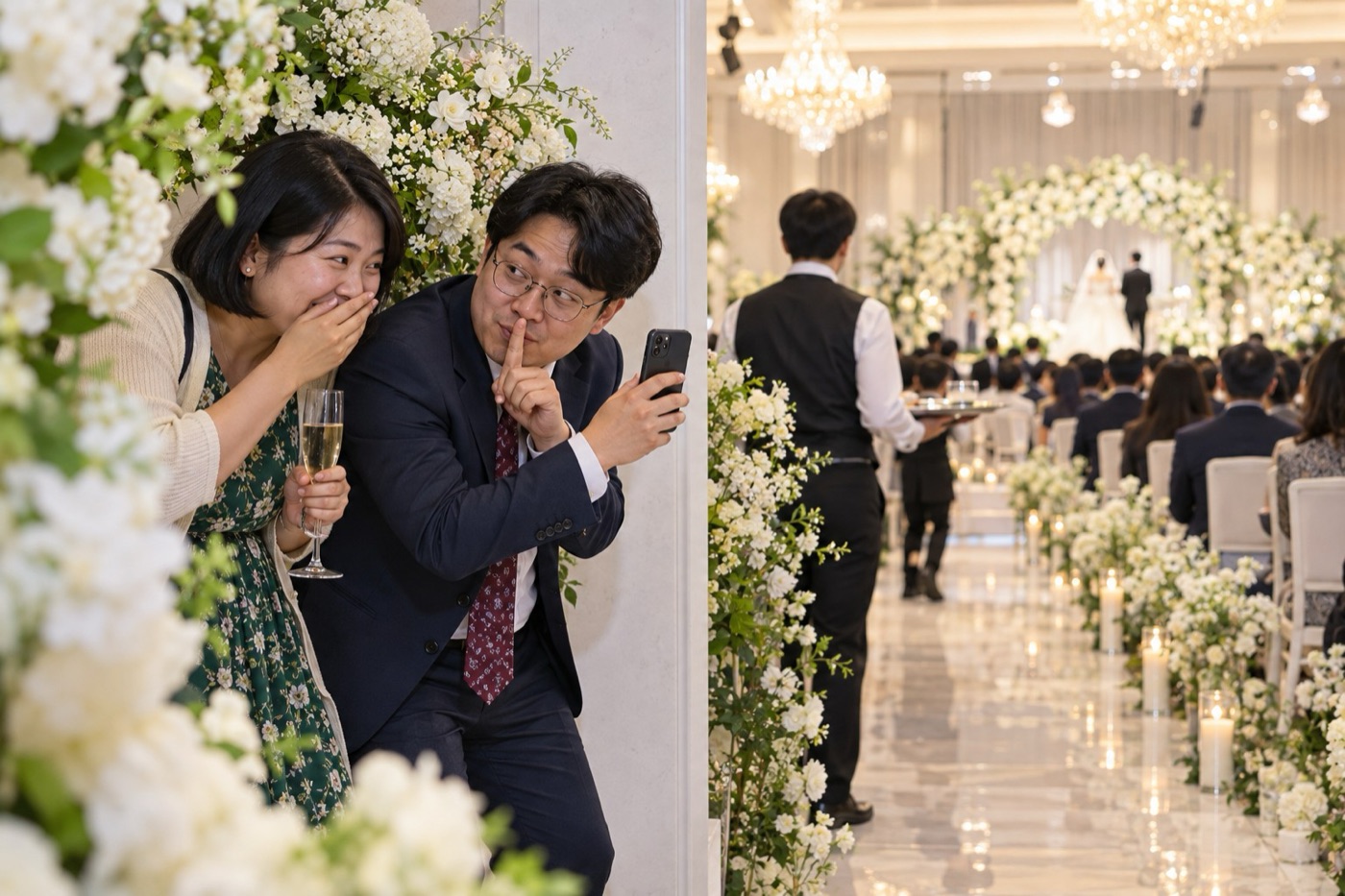
Imagine you are enjoying your own wedding when you notice two strangers at the back of the room. They are not friends or relatives, and nobody invited them. Perhaps they are planning a wedding of their own.
The practice has been called an "undercover tour". It can help couples make up their minds about whether an expensive venue is worth the money. A company may show beautiful photographs or an empty hall, but a real wedding gives visitors a much more complete picture.
It is easy to understand why a couple might feel nervous. Booking a venue often means paying a large deposit months before the day, and it is not easy to change your mind later. If the room feels wrong on the morning of the wedding, there is no second chance.
However, the idea has made some people angry. A wedding is a private celebration, even when it takes place in a busy hotel or a large hall. Uninvited visitors can make guests uncomfortable, especially if nobody knows who they are. They may also get in the way of the staff and the people taking photographs.
Supporters of the practice say that weddings are expensive and couples need good information before they spend so much. Critics say there are more polite ways to do this. A couple can book an official tour, or ask the venue to show them a video of a real event.
The story is funny because wedding crashers are usually imagined as people looking for free food and a good party. These visitors are doing something very different. They are carrying out research, and they are studying the room rather than enjoying themselves.
Yet the awkward question stays the same. A wedding is somebody's big day, not a shop window. When is curiosity a good enough reason to walk into it?
Intermediate version
Wedding guests normally have a simple reason for attending: they know the people getting married. But in South Korea, some couples have been turning up at strangers' ceremonies with an entirely different purpose. They want to inspect the venue before spending a large sum on their own celebration.
The practice, sometimes described as an "undercover tour", allows prospective customers to see a wedding hall in action. Advertisements and official viewings can make almost any room look attractive. A real event reveals far more practical detail, such as the layout, the lighting and the parking.
Couples have understandable reasons for weighing everything up so carefully. Packages can be expensive, deposits are often large, and there is considerable pressure to get every detail right. Choosing a venue without seeing how it performs during a real ceremony may feel risky, particularly when backing out later would mean losing money.
Supporters of the practice present it as sensible research. Nobody would buy a car without taking it out for a drive first, they argue, and a wedding can cost a great deal more than a car. Critics reply that a test drive does not involve sitting at the back of somebody else's family occasion.
But the method also creates an awkward ethical problem. A wedding is not a public product demonstration. Invited guests may feel uncomfortable when unfamiliar people wander around, and the couple getting married may resent strangers using their celebration for research. The people paying for the event have not agreed to become part of somebody else's shopping trip.
There is a question of scale here too. One quiet observer at the back of a large hall might never be noticed, whereas a steady stream of visitors would change the atmosphere completely. Much of the discomfort comes not from the behaviour itself but from the thought of being watched by people who are assessing the room rather than celebrating with you.
Venues could easily reduce the temptation. Supervised visits during real events, arranged with the couple's permission, would give customers the same information without the secrecy. Honest video tours and clear, detailed pricing would also help couples compare one hall with another and book with some peace of mind.
The story is a reminder that consumer pressure can produce unexpected behaviour. When an occasion is marketed as the most important day of someone's life, prospective customers start treating every detail as a financial risk. The real challenge is finding out enough to feel confident without crossing a line and turning another person's celebration into your research project.
Advanced version
Choosing a wedding venue can mean spending a lot before seeing what a real celebration feels like there. In South Korea, some couples have tried an unusual form of research: turning up at strangers' weddings without an invitation.
The so-called undercover tour allows potential customers to observe a venue under real operating conditions. A polished showroom presentation may demonstrate the quality of the decorations but reveal little about the flow of guests, the competence of the staff or the atmosphere during a ceremony. For a couple facing an expensive commitment, firsthand observation can seem considerably more valuable than another glossy brochure.
The underlying logic is that of any cautious consumer. A hall is sold through photographs taken in ideal conditions, and photographs are precisely what a real wedding cannot be judged by. Sizing the place up while it is working, with guests arriving, music playing and staff under pressure, is the one test a marketing department cannot stage.
Critics are unpersuaded. The comparison with other large purchases breaks down, they would argue, at the point where the thing being inspected is somebody else's family occasion: the hall may be for hire, but the afternoon is not. Discretion, on that reading, is less a question of etiquette than of consent.
The practice nevertheless exposes a conflict between consumer information and personal boundaries. Wedding venues are commercial premises, but the ceremonies taking place inside them are private occasions. The customers carrying out an unofficial inspection have not secured the consent of the people whose celebration they are observing, however harmless their intentions may appear.
Their behaviour can also be read as a response to the anxieties of modern wedding planning. Couples are encouraged to produce a flawless event while being confronted with complicated packages, limited availability and high prices. Under such conditions, ordinary consumer caution can shade into something closer to surveillance, and a booking starts to feel less like a purchase than a leap of faith.
Businesses therefore have every incentive to offer greater transparency. Permission-based observation sessions, realistic recordings of ceremonies and clearer explanations of total costs would reduce the temptation to turn up unannounced. A venue confident that its service stands up to scrutiny loses very little by allowing customers to see it properly.
Couples choosing a venue, for their part, may need to accept that no venue can guarantee the perfect atmosphere, since an occasion depends at least as much on the people attending as on the room they are in. Research can establish how a hall functions; it cannot establish how an evening will feel, which is why couples eventually have to fall back on judgement.
What makes the phenomenon more than an amusing social-media story is the way it blurs the distinction between a personal milestone and a commercial product. If a wedding has become something to be researched like a car or a property investment, perhaps the industry itself has helped create the behaviour it now finds so awkward. Couples who have been taught to treat their celebration as a project can hardly be blamed for managing it like one.
After you read
4True, false or not given5 statements
Choose T (true), F (false) or NG (the article does not say).
- Couples can always change their booking after paying a deposit.
The text says: "it is not easy to change your mind later."
- A couple can book an official tour instead.
The text says: "A couple can book an official tour."
- Venues in South Korea have banned the practice.
The text does not say that any venue has banned it.
- The visitors are studying the room rather than celebrating.
The text says: "they are studying the room rather than enjoying themselves."
- The couples visit the weddings because they want free food.
The text says these visitors are "doing something very different" from people looking for free food.
5Vocabulary5 gaps
Complete the sentences with words from the box. Two words are not needed.
celebrationcuriositydepositnervousprivaterelativesresearch
- To keep the room, you must pay a of fifty pounds today.
- Maria felt before she spoke in front of two hundred guests.
- At the party, the bride's sat at the front, including her aunts and cousins.
- His was so strong that he opened the door to see what was behind it.
- The wedding was a party, so only family could come.
6Verb forms5 gaps
Write the correct form of the verb in brackets.
- Imagine you your own wedding when you notice two strangers at the back of the room. (ENJOY)
- Booking a venue often means a large deposit. (PAY)
- However, the idea some people angry. (MAKE)
- Wedding crashers are usually as people looking for free food. (IMAGINE)
- Booking a venue is hard to undo, and it is not easy your mind later. (CHANGE)
7Language focusphrasal verbs
Complete the sentences with words from the box. Two words are not needed. A phrasal verb is a verb with a small word, like up or off. The small word changes the meaning, so learn the whole phrase.
acrossapartdownoffonoutup
- After a long talk, the couple made their minds and booked the hall.
- Couples use a spreadsheet to work how much the day will cost.
- The manager had to call the tour because of the storm.
- The band carried playing even when the lights went out.
- The hall turned the couple's request for a free visit.
4True, false or not given5 statements
Choose T (true), F (false) or NG (the article does not say).
- Cancelling a booking could cost couples money, which makes the choice harder.
The text says choosing unseen "may feel risky, particularly when backing out later would mean losing money."
- Critics reject the car comparison because they think a wedding is cheaper than a car.
Supporters say a wedding can cost "a great deal more than a car"; critics object that a test drive does not involve a stranger's family occasion.
- A South Korean venue has asked the police to stop the visits.
The text does not mention any complaint to the police.
- One quiet observer in a big hall might go unnoticed, but many visitors would not.
The text says one observer "might never be noticed, whereas a steady stream of visitors would change the atmosphere."
- The writer thinks honest video tours would make it harder to compare halls.
The text says they "would also help couples compare one hall with another."
5Vocabulary6 gaps
Complete the sentences with words from the box. Two words are not needed.
atmosphereconsiderableethicalreluctanceresentscalesecrecytemptation
- Many couples having strangers watch their wedding without permission.
- Organising a wedding for two hundred guests takes a amount of time and effort.
- Some people argue that it is not to use another family's celebration for your own research.
- The plan was carried out in complete , and not even the staff knew about it.
- The soft lights and live music created a relaxed in the hall.
- It is hard to resist the to peek at a stranger's party when you are curious.
6Verb forms5 gaps
Write the correct form of the verb in brackets.
- Before the ceremony began, the staff the hall. (CLEAN)
- Two visitors to leave the hall yesterday. (ASK)
- By next June, the couple their venue. (BOOK)
- Some couples avoid a large sum before they have seen a real event. (SPEND)
- The practice has a lot of criticism online. (ATTRACT)
7Language focusphrasal verbs
Complete the sentences with words from the box. Two words are not needed. Many phrasal verbs have a one-word meaning, such as weigh up (consider) or look into (investigate). Learn the meaning with the particle.
acrossalongapartintooffthroughup
- Couples should weigh the costs carefully before signing a contract.
- The high price put many couples booking that hall.
- The manager promised to look how the visitors got in.
- Please go the contract line by line before you sign it.
- Yesterday I came an article about wedding crashers.
4True, false or not given5 statements
Choose T (true), F (false) or NG (the article does not say).
- The writer treats photographs taken in ideal conditions as a poor basis for judging a real wedding.
The text says a hall "is sold through photographs taken in ideal conditions, and photographs are precisely what a real wedding cannot be judged by."
- The writer says critics see the issue mainly as a matter of etiquette.
The text says discretion is "less a question of etiquette than of consent."
- Most couples who made undercover tours later chose a different venue.
The text does not say what couples decided afterwards.
- The writer suggests that harmless intentions do not settle the question of consent.
The text says the visitors have not secured consent "however harmless their intentions may appear."
- The writer thinks thorough research can remove all uncertainty about a venue.
The text says no venue can guarantee the atmosphere, and research "cannot establish how an evening will feel."
5Vocabulary6 gaps
Complete the sentences with words from the box. Two words are not needed.
blursconsentincentiveobligationreluctancescrutinysurveillanceunannounced
- The proposal did not stand up to , and its flaws soon became obvious.
- A small discount is rarely enough of an for a shopper to wait three weeks.
- Guests were startled when the inspectors arrived in the middle of the ceremony.
- Photographs of guests should never be shared online without their .
- Hidden cameras at every door were part of a system that recorded the staff all day.
- Online shopping the line between browsing and buying, because one click completes the purchase.
6Word forms5 gaps
Use the word in brackets to make a word that fits the gap.
- Despite the manager's reassurances, the couple remained that the hall was worth the price. (PERSUADE)
- Customers demanded greater about how deposits were calculated. (TRANSPARENT)
- Her to sign the contract grew when she noticed the small print. (RELUCTANT)
- The staff handled the awkward situation with great . (DISCREET)
- A long contract leaves little if your plans change. (FLEXIBLE)
7Language focusphrasal verbs
Complete the sentences with words from the box. Two words are not needed. At C1, many phrasal verbs need a fixed particle and often a preposition after them, such as stem from and boil down to. Learn the whole chunk.
alongasidedownfromontooutthrough
- The row stemmed a misunderstanding about the guest list.
- The whole argument boils to one question: should strangers be allowed in?
- The planner promised to iron any last-minute problems before the ceremony.
- The venue brushed the complaints as exaggerated.
- The deal fell at the last minute when the venue raised its prices.
Speak
8Talk about it3 questions
Discuss in pairs or small groups. Give reasons for your answers.
- Would you invite a stranger if they helped pay for the party?
- When does saving money change the meaning of a private celebration?
- What would matter more at your ideal party: the guests or the setting?
8Talk about it3 questions
Discuss in pairs or small groups. Give reasons for your answers.
- Would you invite a stranger if they helped pay for the party?
- When does saving money change the meaning of a private celebration?
- What would matter more at your ideal party: the guests or the setting?
8Talk about it3 questions
Discuss in pairs or small groups. Give reasons for your answers.
- Would you invite a stranger if they helped pay for the party?
- When does saving money change the meaning of a private celebration?
- What would matter more at your ideal party: the guests or the setting?
9Role-play: can we visit your wedding?
Work in pairs. Read your card, then have the conversation. Swap roles and do it again.
Student A · the bride or groom
You are at your wedding. A stranger has come to speak to you. Ask who they are and why they came. Decide if they can stay, leave, or stay with a condition.
Student B · the visiting couple
You are planning your own wedding and you came in secret to see the hall. Explain why you came and say sorry. Ask if you can stay for a short time.
Useful phrases
- Excuse me, who are you?
- We're planning our own wedding.
- I'm sorry, we didn't mean to upset you.
- It's a private day, so I'd rather you left.
- Could we stay for ten minutes?
- I'd feel better if you'd asked first.
Afterwards, tell the class: did the couple stay, and was that fair?
Your words
Highlights0 saved
Highlights0 saved
Highlights0 saved
Was this lesson useful? Support johnplusnews on Ko-fi
Continue reading
Work
Could a Better Job Be About Time, Not Money?
A global survey of 40,500 workers found that work-life balance has overtaken salary as the main reason people would consider leaving a job. What does that tell us about how people want to live?
Technology
Can You Be Emotionally Close to Someone Who Is Not Human?
A survey of 463 adults in the United States found that people in relationships with AI chatbots can feel as emotionally close as other couples, but the link between closeness and loneliness looked different.
Relationships
Would You Sign a Contract Before Getting Married?
More young Americans are signing prenuptial agreements before their weddings. Is planning for a divorce unromantic, or is it honest and sensible?