News lesson15 October 2026
A Name at Last for the Man in the Barrel
Four years after boaters found the remains, DNA gave the victim back his identity. The murder itself is still unsolved.
Before you read
1Warm up3 questions
Talk about these questions with a partner.
- Why do unsolved mysteries hold people's attention?
- Would you watch a mystery if you already knew the ending?
- When does curiosity about a crime become intrusive?
2Key words8 words
These words are in the article. Choose the letter of the meaning for each one.
- barrel
- drought
- remains
- detectives
- murder
- hidden
- connection
- warned
- Aput in a place where nobody can see it
- Bwhat is left of a dead body
- Ctold someone about a possible problem
- Da long time with no rain
- Ethe crime of killing a person on purpose
- Fa link between two things or people
- Gpolice officers who find out who did a crime
- Ha big round container for liquids, made of metal or wood
1Warm up3 questions
Talk about these questions with a partner.
- Why do unsolved mysteries hold people's attention?
- Would you watch a mystery if you already knew the ending?
- When does curiosity about a crime become intrusive?
2Key words8 words
These words are in the article. Choose the letter of the meaning for each one.
- exposed
- remains
- concealed
- forensic
- victim
- timeline
- circumstances
- theories
- Ahidden on purpose
- Ba list of events in the order they happened
- Cideas that try to explain why something happened
- Dwhat is left of a dead body
- Ethe facts and conditions around an event
- Fno longer covered, so that people can see it
- Gusing science to help solve a crime
- Ha person who is hurt or killed in a crime
1Warm up3 questions
Talk about these questions with a partner.
- Why do unsolved mysteries hold people's attention?
- Would you watch a mystery if you already knew the ending?
- When does curiosity about a crime become intrusive?
2Key words8 words
These words are in the article. Choose the letter of the meaning for each one.
- homicide
- reservoir
- forensic
- speculation
- acknowledged
- exerted
- receding
- disposed of
- Amoving back or getting lower
- Busing science to help solve a crime
- Cgot rid of
- Dused power or influence to affect something
- Ea large lake, often made by people, that stores water
- Fadmitted or accepted that something is true
- Gguessing about something without knowing the facts
- Hthe crime of killing a person
Read
3Read the article
The paragraphs are numbered. Look out for the key words from task 2.
Core version
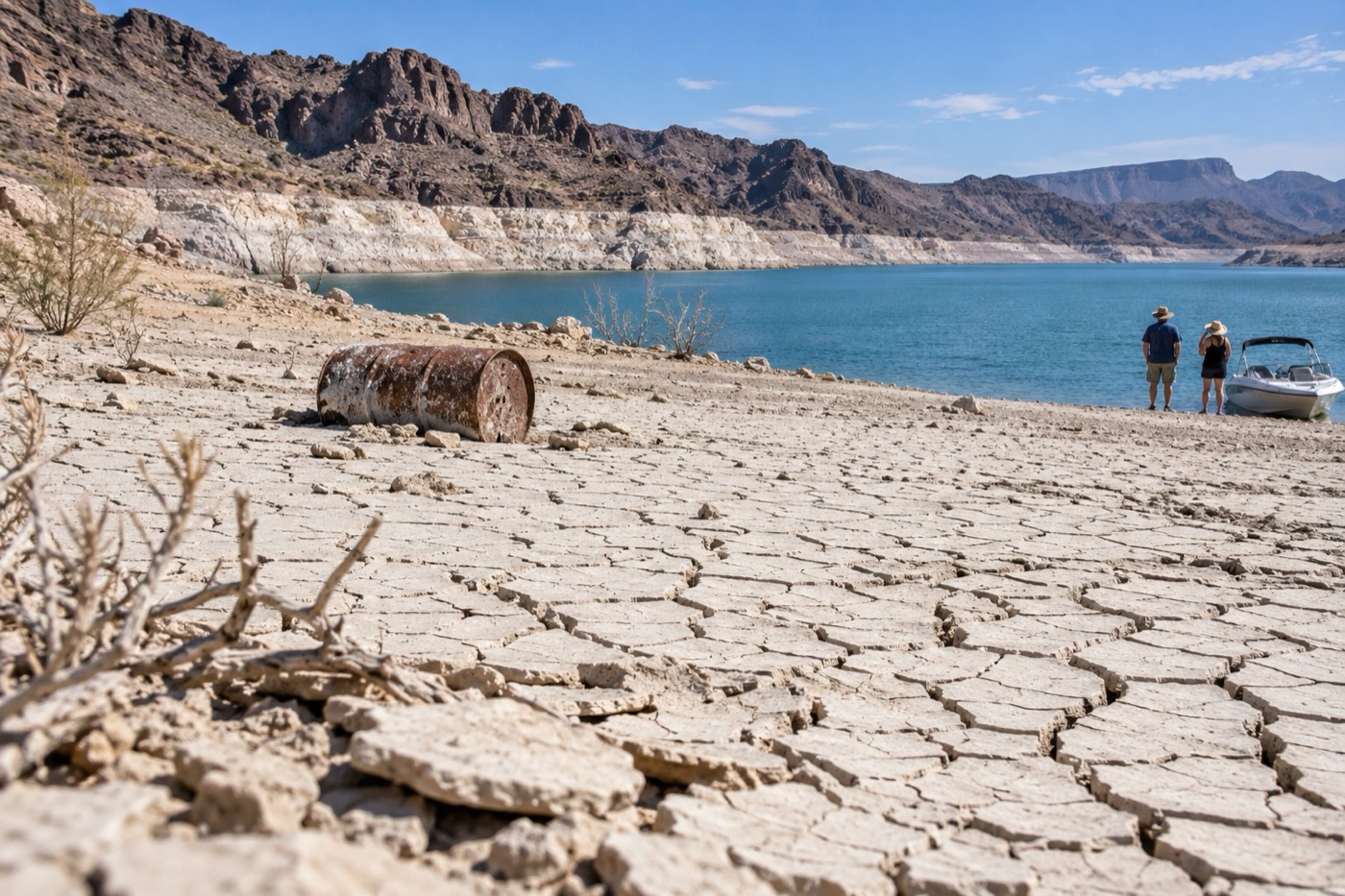
In May 2022, some people boating on Lake Mead, near Las Vegas, noticed a large rusty barrel beside the water. The lake was unusually low after years of drought. Places that had been underwater were now dry. When the boaters looked more closely, they made a terrible discovery. Inside the barrel were human remains. Someone had hidden a body in the lake many years earlier.
Police soon worked out that the person had probably been killed decades ago. The victim had been shot in the head. His clothes and shoes suggested that he died around the late 1970s or early 1980s. But nobody knew his name. Detectives were trying to solve a murder without knowing who the victim was, where he came from or why he had disappeared.
The discovery brought back memories of Las Vegas during the years when organised crime had more power in the city. Some people wondered if the case had something to do with the Mafia. Putting a body in a barrel sounded like something from a gangster film. But police warned that there was no evidence proving a connection. It was important not to turn a death into a story without facts.
Investigators continued. Specialists studied a sample from the victim's bones and used modern DNA methods to search for possible relatives. This kind of work can help identify people who died long before today's technology existed. Researchers also followed up information about the man's family. Four years after the barrel appeared, they finally found an answer.
In October 2026, officials announced that the victim was Edward Lelburian Jackson, known as Buddy. He was from Arkansas and was probably in his fifties when he died. His family had last seen him in the early 1980s. He was known to travel, and nobody had reported him missing at the time. The news finally gave the man his name back.
But identifying Jackson did not solve the murder. Detectives still wanted to find out who had killed him and why. The barrel had been hidden for decades, and people who knew what happened may have died or forgotten important details. For Jackson's family, the name mattered, even though many questions remain. What happened to Buddy Jackson before he ended up in the lake?
Intermediate version
On 1 May 2022, boaters exploring Lake Mead near Las Vegas spotted a rusted barrel on a newly exposed stretch of shoreline. Prolonged drought and falling water levels had revealed areas that had remained underwater for decades. The discovery seemed unusual, but the contents were far more disturbing: human remains. Someone had put a body inside the barrel and left it in the lake. Decades later, a changing landscape had brought a possible murder back into the light.
Investigators established that the victim had been shot in the head. His clothing and shoes suggested he had died in the late 1970s or early 1980s. The case immediately attracted attention because Las Vegas had a notorious history of organised crime. A body sealed inside a barrel seemed to belong in a gangster film, and rumours began to spread. Detectives, however, stressed that the dramatic circumstances did not prove any connection with the Mafia.
The biggest difficulty was simpler: nobody knew who the victim was. Without a name, investigators could not easily build a timeline or work out where he had last been seen. Traditional clues had taken them only so far. Specialists therefore turned to DNA, using material recovered from bone to search for family connections. Forensic genealogy can sometimes link unidentified remains to relatives, even when there is no direct match in a police database. Gradually, the investigation began to move forward.
In October 2026, officials announced a breakthrough. The man was Edward Lelburian Jackson, who was known to his family as Buddy and came from Arkansas. He had been in his mid-to-late fifties when he died. His relatives had last seen him during the early 1980s, but because he was accustomed to travelling independently, they had not reported him missing. A family story that had remained uncertain for decades could now be connected to the body discovered beside the lake.
There was still a gap between identifying Jackson and understanding his death. Police knew that he had been shot and concealed, but the motive remained unclear. His history included some minor criminal matters, yet investigators said there was no evidence establishing a mob connection. It would have been easy to fill the empty spaces with dramatic theories about old Las Vegas. Responsible reporting, however, requires separating what is known from what merely sounds convincing.
The case is also a reminder that new discoveries can emerge from unexpected places. The falling water level was an environmental warning for communities that depend on the Colorado River. At the same time, it exposed a long-buried crime. Modern scientific techniques supplied a name that the barrel itself could not reveal. For Jackson's family, that identification mattered enormously, even though it could not answer every question. The mystery of who killed him remains open, waiting for someone to provide the final missing piece.
Advanced version
On a stretch of newly exposed shoreline at Lake Mead in May 2022, a group of boaters came across an object that looked oddly out of place: a corroded metal barrel. The reservoir near Las Vegas had been shrinking as drought and heavy water use brought down its level, exposing ground that had been submerged for decades. Inside the barrel were human remains. What at first appeared to be a grim curiosity soon became the centre of a homicide investigation reaching back roughly forty years.
The victim had suffered a gunshot wound to the head, and details of his clothing suggested a death in the late 1970s or early 1980s. The location and method of concealment inevitably stirred memories of Las Vegas's organised-crime era, when mob figures exerted considerable influence over the city. Public speculation took off almost immediately. Yet detectives repeatedly cautioned that a barrel and a dramatic setting did not constitute evidence of a Mafia connection. Behind the sensational headlines was an unidentified person whose family might still be waiting for answers.
Establishing a name proved painstaking. With little conventional evidence to go on, investigators drew on forensic genealogy, analysing DNA recovered from bone and tracing potential links to living relatives. Such methods can reopen apparently hopeless cases by identifying biological connections that were impossible to investigate when the person died. Researchers also examined family records and other leads. The work did not instantly solve the mystery, but it gradually narrowed the possibilities until a credible identification emerged.
At an October 2026 press conference, officials identified the remains as Edward Lelburian Jackson, known as Buddy. He was from Arkansas and was believed to have been in his mid-to-late fifties when he was killed. His family had last seen him in the early 1980s. Because Jackson travelled independently, his absence had not resulted in a missing-person report at the time. The announcement supplied the crucial human detail absent from so much of the earlier coverage: the man in the barrel was no longer simply an anonymous victim.
Identifying him, however, was not the same as solving his murder. The circumstances of his final days remained uncertain, as did the identity of whoever shot him and disposed of the body. Police acknowledged aspects of Jackson's past that investigators considered relevant, but they had not established a connection to organised crime. A compelling narrative practically writes itself when a body emerges from a desert reservoir near Las Vegas; the challenge is resisting the urge to turn speculation into fact. Investigators still need evidence, witnesses or new leads to reconstruct what actually happened.
Receding water revealed what someone had attempted to hide, while DNA analysis recovered an identity that time had almost erased. Neither development could restore the decades that Jackson's relatives spent without answers. Yet giving a name to unidentified remains is not a minor achievement: it returns a life to the centre of a story otherwise dominated by the manner of death. The next chapter, if there is one, will depend on discovering who placed Buddy Jackson in that barrel and why.
After you read
4True, false or not given5 statements
Choose T (true), F (false) or NG (the article does not say).
- In October 2026, officials said that the victim was a man from Arkansas.
The text says: "In October 2026, officials announced that the victim was Edward Lelburian Jackson, known as Buddy."
- Jackson's family has spoken publicly about the news.
Not stated. The text does not say whether Jackson's family has spoken in public.
- The boaters saw the barrel because the lake was low.
The text says: "The lake was unusually low after years of drought."
- Police proved that the Mafia was responsible for the death.
The text says the opposite: "But police warned that there was no evidence proving a connection."
- Police found out the man's name straight away.
The text says that "Four years after the barrel appeared, they finally found an answer."
5Vocabulary5 gaps
Complete the sentences with words from the box. Two words are not needed.
cluediscoveryevidencemotiverelativessampletechnology
- Scientists tested a small of bone to find the DNA.
- Your aunts, uncles and cousins are your .
- Without clear , police cannot say who did it.
- Modern can help to identify people who died long ago.
- The of an old boat by the water surprised the walkers.
6Verb forms5 gaps
Write the correct form of the verb in brackets.
- In May 2022, some people on Lake Mead noticed a rusty barrel. (BOAT)
- The victim in the head. (SHOOT)
- Police that the man had probably died many years ago. (SAY)
- In October 2026, officials the name of the victim. (ANNOUNCE)
- His family him for the last time in the early 1980s. (SEE)
7Language focusprepositions
Complete the sentences with words from the box. Two words are not needed. Many words go with one small word. Learn them together, for example search for, known as and come from.
asbyforfromintoofwith
- Some people wondered if the case had something to do the Mafia.
- Detectives continued to search the answer.
- The man was known Buddy.
- Buddy Jackson's family came Arkansas.
- It was important not to turn a death a story without facts.
4True, false or not given5 statements
Choose T (true), F (false) or NG (the article does not say).
- The barrel appeared on land that had been underwater for decades.
The text says: "Prolonged drought and falling water levels had revealed areas that had remained underwater for decades."
- The victim was named more than four years after the barrel was found.
The barrel was found in May 2022 and the name was announced in October 2026.
- Jackson's family reported him missing in the early 1980s.
The text says that "they had not reported him missing".
- Forensic genealogy only works when there is an exact match in a police database.
The text says it can link remains to relatives "even when there is no direct match in a police database".
- Police have named a suspect in the killing.
Not stated. The text does not say whether police have named a suspect.
5Vocabulary6 gaps
Complete the sentences with words from the box. Two words are not needed.
alibibreakthroughconvincingmotiveprolongedrumoursstressedwitness
- Residents suffered during the drought, which lasted for several years.
- After the film came out, about the actor's private life spread quickly.
- Scientists announced a major in the treatment of the disease.
- The robber's was never clear, since he had taken nothing of value.
- The spokesperson that nobody should jump to conclusions.
- Her explanation was so that nobody doubted it.
6Verb forms5 gaps
Write the correct form of the verb in brackets.
- When the boaters spotted the barrel, the lake for years. (SHRINK)
- The barrel in the lake decades before the water level dropped. (LEAVE)
- If the investigators had known his name earlier, they his family sooner. (CONTACT)
- By October 2026, his relatives him for more than forty years. (NOT SEE)
- Specialists material taken from the bone to search for family links. (USE)
7Language focusprepositions
Complete the sentences with words from the box. Two words are not needed. Verbs and nouns often need one fixed preposition. Learn the pair together: depend on, turn to, a gap between.
atbetweenfromofontowith
- Specialists turned DNA when traditional clues were not enough.
- Responsible reporting means separating fact speculation.
- Many communities along the river depend it for their water.
- There was still a gap identifying a victim and understanding a death.
- It would have been easy to fill the empty spaces dramatic theories.
4True, false or not given5 statements
Choose T (true), F (false) or NG (the article does not say).
- More than forty years passed between the family last seeing Jackson and the announcement of his identity.
The family last saw him in the early 1980s and the announcement came in October 2026.
- Investigators remained cautious about a Mafia link even after Jackson was identified.
Police "had not established a connection to organised crime" after the identification.
- Naming Jackson allowed investigators to say who had shot him.
The text says the identity of "whoever shot him" remained uncertain.
- The writer regards the identification as a minor achievement because the murder is unsolved.
The text says that giving a name to remains "is not a minor achievement".
- Other barrels have since been found in the same reservoir.
Not stated. The text does not mention any other barrels at the reservoir.
5Vocabulary6 gaps
Complete the sentences with words from the box. Two words are not needed.
anonymouscompellingcorrodedfragilenegligiblepainstakingsensationalsubmerged
- After the flood, the farmland stayed for weeks, and the crops rotted in the fields.
- Years of salt water had left the iron gates so badly that they crumbled when touched.
- Restoring the manuscript was a task that took the conservators three years.
- The defence faced such evidence that the jury could see no alternative to a guilty verdict.
- The donor, who remained , gave the museum a large sum and asked for no credit.
- The paper was criticised for its coverage, which prized shock above accuracy.
6Word forms5 gaps
Use the word in brackets to make a word that fits the gap.
- The location and method of stirred memories of Las Vegas's organised-crime era. (CONCEAL)
- Because Jackson travelled independently, his had not led to a missing-person report. (ABSENT)
- Investigators warned against drawing conclusions from the dramatic setting. (HASTE)
- Forensic genealogy is in cases where no relatives appear in any police database. (VALUE)
- Giving a name to remains is not a minor achievement. (IDENTIFY)
7Language focusprepositions
Complete the sentences with words from the box. Two words are not needed. At this level, fixed adjective and verb phrases do not allow a swap. Learn the whole chunk: tantamount to, fraught with, drew on.
aboutbyforinontowith
- Investigators drew forensic genealogy when conventional evidence ran out.
- Repeating an unproven theory as fact is tantamount inventing it.
- A case this old is fraught difficulty, since witnesses may have died.
- A single announcement can culminate the end of decades of uncertainty.
- Early reports were dominated lurid theories about organised crime.
Speak
8Talk about it3 questions
Discuss in pairs or small groups. Give reasons for your answers.
- What do true-crime stories owe the people involved?
- Should a mystery stay in the news until it is solved?
- What makes a crime story worth telling beyond the shocking details?
8Talk about it3 questions
Discuss in pairs or small groups. Give reasons for your answers.
- What do true-crime stories owe the people involved?
- Should a mystery stay in the news until it is solved?
- What makes a crime story worth telling beyond the shocking details?
8Talk about it3 questions
Discuss in pairs or small groups. Give reasons for your answers.
- What do true-crime stories owe the people involved?
- Should a mystery stay in the news until it is solved?
- What makes a crime story worth telling beyond the shocking details?
9Role-play: should an old case stay open?
Work in pairs. Read your card, then have the conversation. Swap roles and do it again.
Student A · a friend who thinks the case should stay open
You read about a very old case. Explain why you think the police should keep investigating. Ask your friend two questions about what they think.
Student B · a friend who thinks the money should be used elsewhere
You think police time and money should go to newer cases. Explain your view politely. Ask your friend what could still be found after so many years.
Useful phrases
- I think the police should keep trying.
- I see what you mean, but it's been a long time.
- What could they still find after all these years?
- The family deserves an answer, don't you think?
- I'd rather they spent the money on new cases.
- Maybe we can agree on one thing.
Afterwards, tell the class: did you agree, and what helped you decide?
Your words
Highlights0 saved
Highlights0 saved
Highlights0 saved
Was this lesson useful? Support johnplusnews on Ko-fi
Continue reading
Language
Did Writing Really Make Languages More Complicated?
A large study of about 100,000 sentences in 30 languages found no universal pattern showing that writing makes sentences more complex. It does not say that writing never changes a language.
Relationships
Would You Sign a Contract Before Getting Married?
More young Americans are signing prenuptial agreements before their weddings. Is planning for a divorce unromantic, or is it honest and sensible?
Work
They Still Have Their Jobs. They Are Leaving Anyway
Nobody made these workers redundant. AI changed what their work felt like, and they walked out on careers they had spent a decade building.