News lesson24 February 2026
The Conversations We No Longer Start
Phones and headphones make silence easy. Yet research suggests we expect a chat with a stranger to go far worse than it actually does.
Before you read
1Warm up3 questions
Talk about these questions with a partner.
- What makes it easy to start talking to someone you do not know?
- Would you enjoy a journey more if a stranger spoke to you?
- Where does a short conversation feel welcome?
2Key words8 words
These words are in the article. Choose the letter of the meaning for each one.
- polite
- headphones
- annoying
- delayed
- pleasant
- ordinary
- kindness
- surprisingly
- Abeing friendly and good to other people
- Bin a way that you did not expect
- Cthings you wear over your ears to listen to music
- Dmaking you a little angry or tired
- Enice and enjoyable
- Flater than planned
- Gnormal, not special
- Hshowing good manners to other people
1Warm up3 questions
Talk about these questions with a partner.
- What makes it easy to start talking to someone you do not know?
- Would you enjoy a journey more if a stranger spoke to you?
- Where does a short conversation feel welcome?
2Key words8 words
These words are in the article. Choose the letter of the meaning for each one.
- encounters
- interruption
- assumptions
- loneliness
- privacy
- entertainment
- meaningful
- decline
- Aimportant or full of value
- Bsomething that stops what you are doing for a short time
- Cthings you believe are true without checking
- Dthe sad feeling of having no one to talk to
- Emeetings that happen by chance
- Ffilms, music, games and other things people enjoy
- Ga slow fall in number or quality
- Hbeing alone, away from other people's attention
1Warm up3 questions
Talk about these questions with a partner.
- What makes it easy to start talking to someone you do not know?
- Would you enjoy a journey more if a stranger spoke to you?
- Where does a short conversation feel welcome?
2Key words8 words
These words are in the article. Choose the letter of the meaning for each one.
- retreats
- scarcely
- ordinariness
- etiquette
- reinforced
- perspectives
- wither
- anonymity
- Athe accepted rules for polite behaviour
- Bways of seeing or thinking about something
- Cthe quality of being normal and not special
- Dalmost not at all
- Eslowly become weaker and disappear
- Fmade stronger
- Gmoves away from other people to a quieter place
- Hthe state of not being known by name to others
Read
3Read the article
The paragraphs are numbered. Look out for the key words from task 2.
Core version
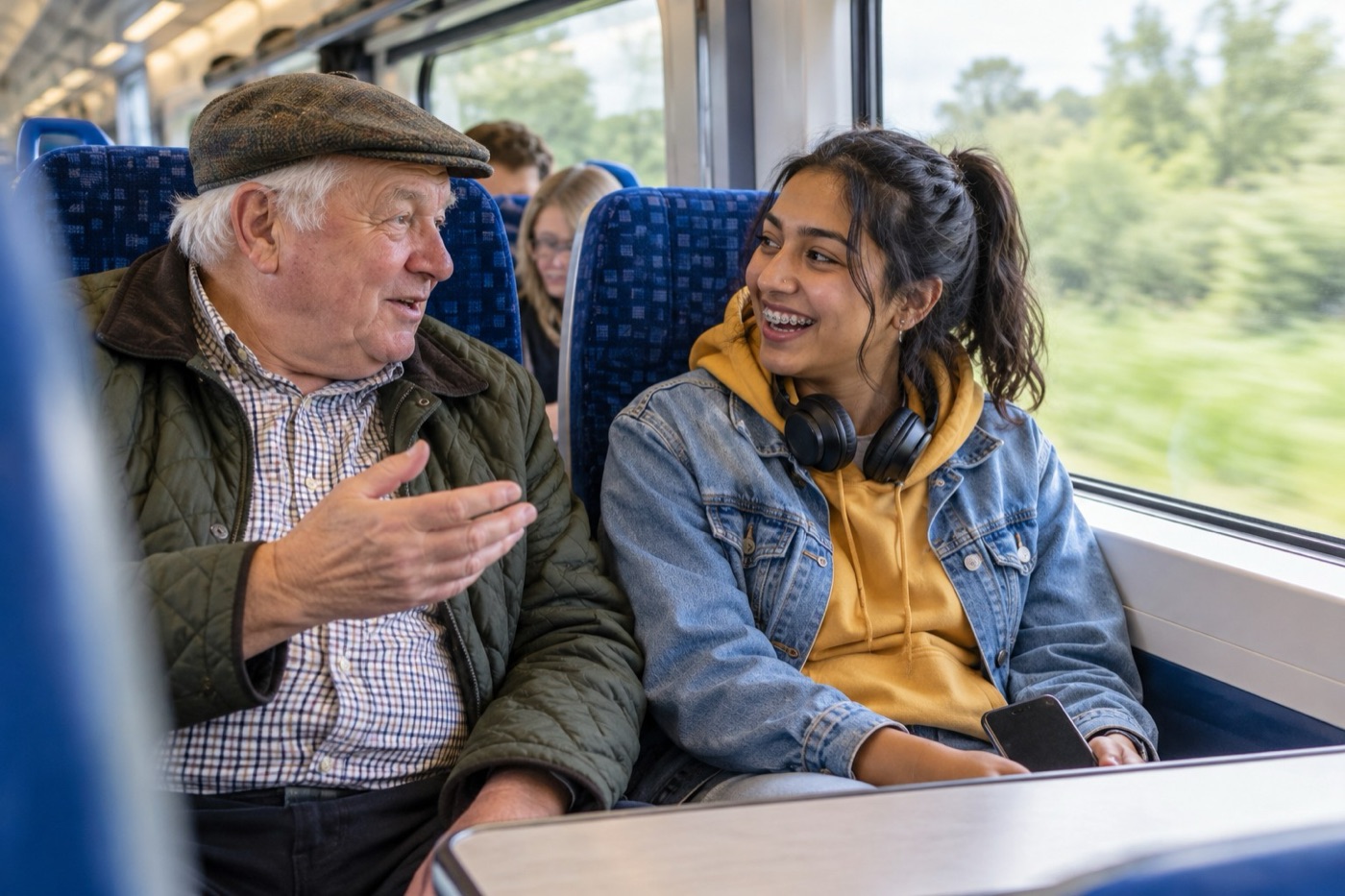
Two people sit next to each other on a train. One looks at a phone, and the other puts on headphones. They spend an hour together without saying a word. This is a normal scene in many cities. But what might happen if one of them looked up and started a conversation? They could exchange a few polite words, share a joke or discover that they have something in common.
An article in the Guardian in February 2026 asked whether we are forgetting how to talk to strangers. The writer described meeting people in ordinary places and finding that even short conversations could be surprisingly pleasant. It raised a simple question: if we have more ways to contact each other than ever before, why do we sometimes avoid speaking to the person standing right beside us?
Technology may be part of the answer. Phones help us pass the time and keep in touch with people we already know. Headphones let us listen to music while travelling. These things are useful, but they can also stop conversations before they begin. It is harder to say hello to someone who is staring at a screen or whose ears are covered.
Fear is another reason. Some people worry that a stranger will think they are strange, boring or annoying. Others are naturally shy and find small talk uncomfortable. Of course, not every person wants to chat, and we should respect that. A woman travelling alone at night may feel very different from someone waiting in a sunny café with friends.
Still, research discussed in the article suggests that people sometimes underestimate how enjoyable a conversation with a stranger might be. A simple question about a delayed train or a friendly comment about a dog can break the ice. The talk does not need to be deep. Small moments of kindness can brighten an ordinary day and remind us that other people have interesting lives.
Nobody needs to talk to every stranger they meet. Sometimes silence is exactly what we want. But perhaps we can leave a little room for friendly contact. Put your phone away for a minute, smile or say something simple when the moment feels right. If the other person responds, you might end up having a lovely conversation. If not, that's fine too. The art of talking to strangers begins with noticing that they are there.
Intermediate version
You board a train, sit beside another passenger and immediately reach for your phone. They put on headphones. For the next hour, the two of you travel through the same landscape without exchanging a word. There is nothing particularly rude about this; it is simply how many journeys work now. Yet a Guardian article published in February 2026 asked whether our increasingly private routines are costing us something valuable: the ability to strike up ordinary conversations with people we have never met. The article explored that concern; it did not measure a decline across everyone's daily life.
The writer described brief encounters that turned out to be unexpectedly meaningful, including a conversation with an older passenger and a friendly exchange with someone working in a café. These moments were not dramatic, but that was precisely the point. A small conversation can make an anonymous public place feel more human. It may also remind us that other people have stories we would never come across through the familiar circles of our own social media accounts.
There are several reasons we keep to ourselves. Smartphones offer endless entertainment, while headphones create a convenient barrier against interruption. Many people are also afraid of looking foolish or annoying someone who wants to be left alone. After the pandemic, some became less comfortable with casual social contact. For shy people, small talk can feel like an unnecessary test rather than a pleasant opportunity. And safety matters: no one should feel obliged to speak with someone whose attention is unwanted.
Nevertheless, psychological research discussed in the article suggests that we sometimes expect conversations with strangers to go worse than they actually do. A comment about the weather or a question about a delayed bus can break the ice without demanding a personal story. If the other person smiles and carries on, a conversation may develop naturally. If they give short answers and look away, it is perfectly reasonable to let the exchange end.
Talking to strangers also has a social value beyond making an individual day more enjoyable. Casual encounters bring people from different ages, professions and backgrounds into contact. Without them, it becomes easier to imagine that everybody outside our immediate circle is somehow unfamiliar or unapproachable. A friendly chat will not solve loneliness or political division, but it can challenge small assumptions we did not realise we held.
Perhaps the answer is not to insist that everyone becomes outgoing. Privacy, silence and personal space remain important. Instead, we could learn to read the room and recognise when a relaxed conversation might be welcome. Put away the phone for a moment, thank someone properly or ask a simple question without expecting anything in return. The aim is not to collect new friends on every journey. It is to remember that everyday life can include moments of connection that no app has arranged for us.
Advanced version
Imagine two passengers sharing a train carriage for an hour, scarcely acknowledging each other's existence. One disappears into a stream of messages; the other retreats behind headphones. Neither is behaving badly, and both may have perfectly legitimate reasons for wanting privacy. Still, the scene is a familiar one. A Guardian feature in February 2026 asked whether we are losing small, unplanned conversations like these. It explored the concern rather than measuring a decline in everyone's daily life.
The writer described encounters that had proved unexpectedly rewarding, including a conversation with an older woman on a train and an exchange with someone working in hospitality. These were not life-changing friendships or dramatic revelations. Their significance lay in their ordinariness. For a few minutes, two people stepped outside their established social circles and recognised each other as individuals rather than background characters in a busy public space. Such moments can be fleeting, but they may leave an impression out of proportion to their length.
Modern technology offers obvious explanations for their scarcity. Our phones fill almost every empty interval, while headphones signal that we would prefer not to be disturbed. There are less visible barriers too: social anxiety, uncertainty about etiquette and the fear of making an unwanted approach. The pandemic may have reinforced habits of keeping our distance. Moreover, any appeal for more spontaneous interaction must acknowledge unequal experiences of safety. A conversation that feels harmless to one person may feel intrusive or threatening to another, particularly when boundaries are ignored.
Yet research into social interaction suggests that we may systematically underestimate the pleasure of talking to unfamiliar people. The anticipation can be awkward, while the conversation itself turns out to be warmer than expected. A remark about a delayed train, a shared laugh or a question about a dog can provide a low-pressure opening. The important skill is not relentless confidence, but sensitivity: noticing whether someone seems receptive, listening carefully and knowing when to back off. Genuine connection cannot be forced without defeating its purpose.
There are wider consequences to consider. When our social worlds are increasingly organised around existing friends, algorithms and shared interests, we lose some opportunities to encounter perspectives that differ from our own. Brief conversations are hardly a cure for loneliness, but they can make a city feel less anonymous and remind us that strangers have complicated lives. They may also soften the tendency to treat people outside our group as a faceless crowd. A society can be highly connected digitally while allowing everyday curiosity about other people to wither.
The solution is not a campaign to make every commuter talkative. Silence can be restorative, and nobody owes strangers their attention. But we could leave room for the occasional unplanned exchange instead of automatically shutting ourselves away. Looking up from a screen, offering a genuine compliment or asking a simple question can be enough. Sometimes nothing comes of it. On other days, a conversation breaks through the anonymity and changes the mood of an entire journey.
After you read
4True, false or not given5 statements
Choose T (true), F (false) or NG (the article does not say).
- People sometimes expect a conversation with a stranger to be less enjoyable than it really is.
The text says: "Still, research discussed in the article suggests that people sometimes underestimate how enjoyable a conversation with a stranger might be."
- Phones and headphones can make it harder to start a conversation.
The text says: "These things are useful, but they can also stop conversations before they begin."
- Most people in cities say they would like more conversations with strangers.
Not stated. This version does not give this information.
- The two passengers on the train talk to each other during the journey.
The text says the opposite: "They spend an hour together without saying a word."
- An interesting conversation with a stranger has to be a deep one.
The text says: "The talk does not need to be deep."
5Vocabulary5 gaps
Complete the sentences with words from the box. Two words are not needed.
brightenchatexchangegreetremindrespectunderestimate
- At the end of the year, the students cards with their classmates.
- You don't have to agree with her, but you should her opinion.
- A few fresh flowers can a dull, grey room.
- Many students how long a big project takes.
- Please me to buy milk on the way home.
6Verb forms5 gaps
Write the correct form of the verb in brackets.
- An article in the Guardian whether we are forgetting how to talk to strangers. (ASK)
- The writer described people in ordinary places. (MEET)
- It is harder to say hello to someone who at a screen. (STARE)
- Research in the article suggests that short conversations can be pleasant. (DISCUSS)
- Nobody to talk to every stranger they meet. (NEED)
7Language focusprepositions
Complete the sentences with words from the box. Two words are not needed. Some adjectives and verbs always take one fixed preposition. Learn the pair together, such as afraid of.
aboutatfrominofonto
- Some people are afraid starting a conversation with someone new.
- Shy people are often worried saying the wrong thing.
- Are you interested meeting new people on your journey?
- Whether we talk or not can depend how safe we feel.
- My brother is very good making small talk with anyone.
4True, false or not given5 statements
Choose T (true), F (false) or NG (the article does not say).
- The writer's encounters included a conversation with an older passenger.
The text says: "The writer described brief encounters that turned out to be unexpectedly meaningful, including a conversation with an older passenger and a friendly exchange with someone working in a café."
- Train companies have started campaigns encouraging passengers to talk.
Not stated. This version does not give this information.
- Everybody should become more outgoing.
The text says the opposite: "Perhaps the answer is not to insist that everyone becomes outgoing."
- People may expect a chat with a stranger to be worse than it turns out to be.
The text says: "Nevertheless, psychological research discussed in the article suggests that we sometimes expect conversations with strangers to go worse than they actually do."
- According to the article, a friendly chat will solve political division.
The text says: "A friendly chat will not solve loneliness or political division."
5Vocabulary6 gaps
Complete the sentences with words from the box. Two words are not needed.
anonymouscasualfoolishobligedoutgoingreservedunwantedwithdrawn
- Nobody should feel to answer personal questions from a stranger.
- He wore jeans and a T-shirt because the dinner was a occasion.
- The prize was donated by an businessman who did not want his name known.
- It would be to travel across the city without checking the train times.
- Our new colleague is cheerful and , so she soon knew everyone in the office.
- Her advice annoyed him because he had not asked for it.
6Verb forms5 gaps
Write the correct form of the verb in brackets.
- By the time the train arrived, the two passengers together for an hour. (TRAVEL)
- If people put their phones away, strangers to each other more often. (TALK)
- The Guardian article in February 2026. (PUBLISH)
- Since she moved to the city, she more confident with strangers. (BECOME)
- While the train at the platform, a stranger asked me the time. (WAIT)
7Language focusprepositions
Complete the sentences with words from the box. Two words are not needed. Many verbs and adjectives need one fixed preposition, and a different preposition can change the meaning. Learn each pair as a chunk.
aboutforfromofontowith
- Spending a few minutes chatting can contribute a more positive mood.
- Shy people often apologise interrupting others.
- People of all ages can benefit a friendly chat.
- Nobody should insist talking to a person who wants silence.
- Many people are anxious approaching strangers.
4True, false or not given5 statements
Choose T (true), F (false) or NG (the article does not say).
- The article suggests that people tend to expect a conversation to be worse than it proves to be.
The text says that "the anticipation can be awkward, while the conversation itself turns out to be warmer than expected".
- The writer thinks that passengers who stay silent on a train are behaving badly.
The text says: "Neither is behaving badly".
- Researchers have measured how long the average unplanned conversation lasts.
Not stated. This version does not give this information.
- The writer accepts that a call for more conversation may affect people differently depending on how safe they feel.
The text says any appeal "must acknowledge unequal experiences of safety".
- The writer expects talking to strangers to cure loneliness.
The text says brief conversations are "hardly a cure for loneliness".
5Vocabulary6 gaps
Complete the sentences with words from the box. Two words are not needed.
assertivefacelesshesitantlegitimatereceptiverelentlessrestorativespontaneous
- Her employer accepted that she had a reason for being late, as the trains had been cancelled.
- The committee was to new ideas, so the proposal was approved without much argument.
- Despite the pressure from the press, the minister refused to comment.
- The best moments of the trip were : we simply stopped at a village market because it looked interesting.
- Critics describe the agency as a bureaucracy in which nobody knows who is responsible.
- After a week of back-to-back meetings, a quiet weekend in the country proved genuinely .
6Word forms5 gaps
Use the word in brackets to make a word that fits the gap.
- Her to answer personal questions made the interviewer cautious. (RELUCTANT)
- The of smartphones has changed how commuters spend their journeys. (PREVALENT)
- Her remarks were taken as a criticism, although none was intended. (MISTAKE)
- Years of silence led to growing between the neighbours. (ESTRANGE)
- Silence on a train should not be mistaken for . (HOSTILE)
7Language focusprepositions
Complete the sentences with words from the box. Two words are not needed. At this level the preposition is part of a fixed adjective phrase. Learn the whole chunk, such as fraught with, not the adjective alone.
byforfromofontowith
- Silence can be conducive reflection, but it can also isolate people.
- Any campaign for friendlier trains is contingent people's sense of safety.
- Approaching a stranger can be fraught awkwardness.
- Constant scrolling may be symptomatic a wider reluctance to engage.
- No passenger should be held accountable a stranger's discomfort.
Speak
8Talk about it3 questions
Discuss in pairs or small groups. Give reasons for your answers.
- How can someone invite a conversation without making the other person feel trapped?
- Would a place feel friendlier if more people said hello?
- Which matters more for a good conversation: having something in common or being curious?
9Role-play: a quiet journey
Work in pairs. Read your card, then have the conversation. Swap roles and do it again.
Student A · the chatty colleague
You and your colleague take the same train to work every morning. You find the journey boring in silence. Ask your colleague to talk more, and explain why it matters to you.
Student B · the quiet colleague
You like to read or listen to music on the train, and you need a quiet start to the day. Explain what you need, but try to agree a plan that is fair for both of you.
Useful phrases
- Do you mind if we chat for a bit?
- I'd rather keep the journey quiet, if that's okay.
- I find the trip boring when we don't talk.
- How about we talk on the way home instead?
- That's fair, I didn't realise you felt that way.
- Let's try it for a week and see how it goes.
Afterwards, tell the class: what plan did you agree, and was it fair for both people?
Your words
Highlights0 saved
Highlights0 saved
Highlights0 saved
Was this lesson useful? Support johnplusnews on Ko-fi
Continue reading
Language
Did Writing Really Make Languages More Complicated?
A large study of about 100,000 sentences in 30 languages found no universal pattern showing that writing makes sentences more complex. It does not say that writing never changes a language.
Technology
Can You Be Emotionally Close to Someone Who Is Not Human?
A survey of 463 adults in the United States found that people in relationships with AI chatbots can feel as emotionally close as other couples, but the link between closeness and loneliness looked different.
Relationships
Would You Sign a Contract Before Getting Married?
More young Americans are signing prenuptial agreements before their weddings. Is planning for a divorce unromantic, or is it honest and sensible?