News lesson8 October 2026
The 1990s Are Back, but What Are We Really Missing?
Objects that are slower and less reliable than a phone are selling well. The appeal may be the limits they impose rather than the decade itself.
Before you read
1Warm up3 questions
Talk about these questions with a partner.
- Which old object would you choose over its modern version?
- Can you miss a time you never lived through?
- What do you think people will miss about life today?
2Key words8 words
These words are in the article. Choose the letter of the meaning for each one.
- teenager
- attractive
- constantly
- discover
- ordinary
- discrimination
- financial
- developed
- Anice to look at or think about, so you want it
- Bnormal, not special
- Cabout money
- Da young person between thirteen and nineteen years old
- Etreated so that the pictures on a film can be seen
- Ftreating some people worse than others because of who they are
- Gto find or learn something for the first time
- Hall the time, without stopping
1Warm up3 questions
Talk about these questions with a partner.
- Which old object would you choose over its modern version?
- Can you miss a time you never lived through?
- What do you think people will miss about life today?
2Key words8 words
These words are in the article. Choose the letter of the meaning for each one.
- imagine
- constantly
- privacy
- old-fashioned
- distant
- dissatisfaction
- discrimination
- recorded
- Aunfair treatment of people because of who they are
- Bnot modern any more
- Csaved on a camera, phone or other device so you can see or hear it later
- Dthe unhappy feeling when something is not good enough
- Eto make a picture of something in your mind
- Fthe freedom to keep things to yourself, away from other people
- Gfar away in time or space
- Hall the time, without stopping
1Warm up3 questions
Talk about these questions with a partner.
- Which old object would you choose over its modern version?
- Can you miss a time you never lived through?
- What do you think people will miss about life today?
2Key words8 words
These words are in the article. Choose the letter of the meaning for each one.
- analogue
- oversized
- carefree
- curated
- urgent
- algorithms
- revisit
- innocent
- Amade larger than the usual size
- Bto look at or think about something again
- Csets of rules a computer follows, for example to choose what you see online
- Dwithout worries or responsibilities
- Eusing physical forms like film, tape and discs, not digital data
- Fwithout knowledge of harm or difficulty, naive
- Gchosen and organised, especially for an exhibition
- Hneeding attention or action very soon
Read
3Read the article
The paragraphs are numbered. Look out for the key words from task 2.
Core version
A teenager buys an old camera even though a phone takes clearer photographs. Another chooses a CD that holds only one album instead of millions of songs. Baggy jeans and 1990s bands are popular again, often with people who were not alive when they first appeared. Why would a generation with faster, easier technology want objects that do less? The answer may say more about life now than about the past.
In October 2026, Tate Britain in London opened an exhibition about art and fashion from the 1990s. It includes photographs, clothes and creative work from an important time in British culture. But the interest in the decade goes well beyond a museum. Old trainers, film cameras and music from the period are appearing everywhere from fashion shops to social media videos.
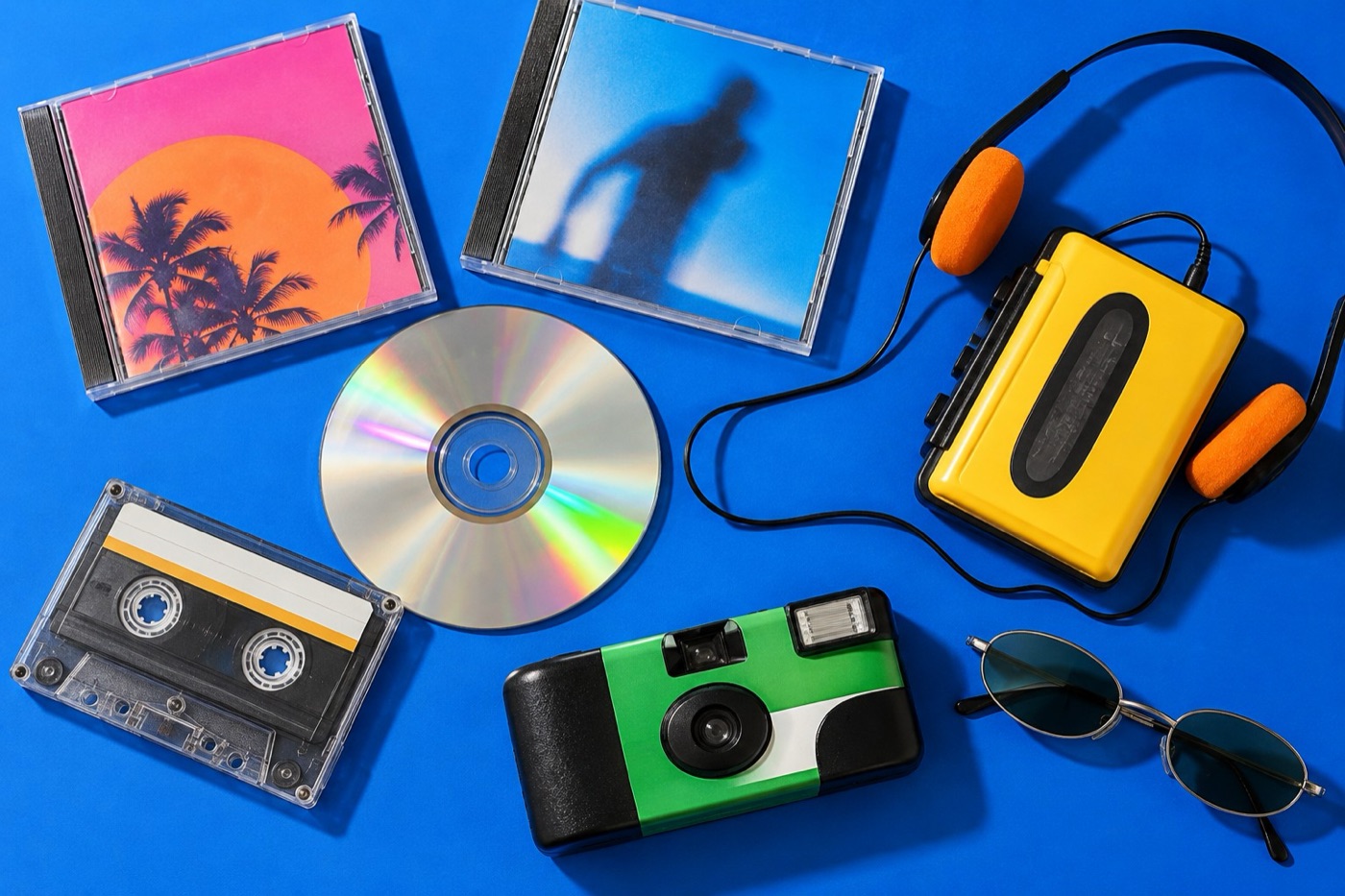
One reason is the way people used technology then. There were computers and mobile phones, but most people did not carry the internet around in their pockets. Friends often made plans on a home telephone. People listened to albums on CD players and took photographs on film cameras that could not show the picture immediately. They had to wait until the film was developed to find out how the pictures had turned out. Going out meant spending time together without constantly receiving messages.
This sounds attractive to people who feel tired of their smartphones. They may want fewer notifications and less pressure to share every moment. An old camera or simple phone can make life feel different for a while. It is also fun to discover music and clothes that your parents or older friends enjoyed. Something that was once ordinary can feel new again.
But memories of the past are not always fair. The 1990s had problems too, including wars, discrimination and financial worries. Modern technology has made many parts of life easier and safer. Perhaps the real attraction is not the decade itself but the idea of being less distracted. We cannot go back in time, but we can choose how we use our phones and how much attention we pay to the people around us.
Intermediate version
A young music fan buys a CD released before she was born. Someone else carries an old film camera, which cannot show whether the photograph worked until the film is developed. These objects are slower and less convenient than the phones already in their pockets, and that may be the point. The return of 1990s clothes, music and technology is not only nostalgia. For people with no memory of the decade, it can represent a life with fewer notifications and less pressure to record everything.
It is tempting to put the trend down to nostalgia, but that only goes so far. Plenty of the people buying 90s clothes or listening to Britpop have no personal memories of the period. For them, the decade represents something they imagine modern life has lost: a world in which people were not constantly checking their phones or worrying about what might appear on social media. Photographs were developed later, and an evening out could pass without being recorded. To a generation that has grown up online, that sounds less like a limitation than a kind of privacy.
The appeal goes beyond technology. Fashion moves in cycles, and styles that once looked old-fashioned eventually seem fresh again. Music can have the same effect. A song becomes popular with a new generation, older fans rediscover it and suddenly a period that seemed distant is everywhere. Parents and children may even find themselves enjoying the same bands, though perhaps for different reasons.
There is another reason some younger people find the past attractive: modern life can feel exhausting. Notifications, online arguments and the pressure to keep up with everyone else rarely give us a moment's peace. Using an old camera or listening to a CD requires a little more patience. These small habits can make an experience feel more personal, even if they are less convenient.
However, it is easy to look back through rose-tinted glasses. The 1990s were not free of serious problems. Wars, discrimination and the AIDS crisis affected millions of lives. Without today's technology, keeping in touch across countries could be expensive and difficult, and finding information was far less convenient. The decade was not a simpler world for everyone.
Perhaps today's revival is less about wanting to live in the past than choosing what to bring into the present. People can enjoy old music, clothes and technology without pretending that an earlier generation had everything right. The interesting question is why objects that were once replaced by newer inventions now seem worth using again. Their attraction may tell us more about our dissatisfaction with modern habits than about the 1990s themselves.
Advanced version
Many young people raised with instant photographs and unlimited music are choosing film cameras that conceal the image and albums that must be played in order. The inconvenience is part of the attraction. Alongside oversized sportswear and renewed enthusiasm for Britpop, these objects have turned the 1990s into an imagined alternative to permanent connection. For many of their new owners, the decade is not a remembered past at all; it is a story about what the present appears to have lost.
The decade has taken on a mythology as the last truly analogue period, when photographs could remain private, social arrangements required commitment and a night out did not automatically generate digital evidence. That picture is appealing precisely because it contrasts with a present shaped by notifications, algorithms and the expectation of permanent availability. For younger people, the 1990s are not so much a remembered past as an imagined alternative, pieced together from clothing, photographs, music videos and stories told by older generations.
Cultural revivals have always worked this way. Fashion regularly borrows from earlier periods, stripping familiar objects of their original associations before presenting them as desirable again. The current interest in Britpop, grainy photography and physical music formats combines that familiar cycle with a sharper reaction against digital convenience. A CD must be chosen and played; a film photograph cannot be immediately deleted. The extra effort, once considered a disadvantage, has become part of the attraction.
A revival can make the past look simpler than it was. The 1990s brought memorable music, clothes and design, but also inequality, discrimination, war and the continuing toll of AIDS. Enjoying an old camera or album does not require pretending the decade was carefree. It is a choice about an object, not a vote for everything that came with it.
Tate's exhibition, curated by Edward Enninful, offers an opportunity to revisit the decade as a contested cultural moment rather than a collection of fashionable accessories. Artists and photographers explored questions of class, identity, race and representation that remain urgent today. Looking closely at their work complicates the idea that the period was simply more innocent or authentic. Some of the tensions that shape present-day debates were already visible, even if they were expressed through different media.
Perhaps the renewed enthusiasm for the 1990s tells us less about what life was actually like then than about the aspects of modern living that people feel powerless to change. Digital technology has delivered remarkable convenience, but it has also turned attention into a valuable commodity. Choosing an old camera will not solve that problem. It may, however, offer a small reminder that convenience is not the only measure of a satisfying life, and that not every moment needs to be shared to be worth remembering.
After you read
4True, false or not given5 statements
Choose T (true), F (false) or NG (the article does not say).
- Everyone buying 90s clothes remembers the decade personally.
The text says the opposite: "Baggy jeans and 1990s bands are popular again, often with people who were not alive when they first appeared."
- The Tate Britain exhibition is about art and fashion from the 1990s.
The text says: "In October 2026, Tate Britain in London opened an exhibition about art and fashion from the 1990s."
- In the 1990s, most people had the internet in their pockets.
The text says: "most people did not carry the internet around in their pockets."
- The 1990s had some serious problems.
The text says: "The 1990s had problems too, including wars, discrimination and financial worries."
- Sales of film cameras doubled in Britain in 2026.
Not stated. The text gives no sales figures for film cameras.
5Vocabulary5 gaps
Complete the sentences with words from the box. Two words are not needed.
attentiondecisionexhibitiongenerationmemorynotificationspressure
- Many phones send every few minutes, so people keep looking at the screen.
- A museum can hold an of paintings, photographs or clothes for a few months.
- Most students in my class are the same age, so we belong to the same .
- Students often feel to get high marks, especially before exams.
- It is rude to look at your phone when a friend needs your full .
6Verb forms5 gaps
Write the correct form of the verb in brackets.
- A teenager an old camera even though a phone takes clearer photographs. (BUY)
- In October 2026, Tate Britain an exhibition about the 1990s. (OPEN)
- Old trainers and film cameras are everywhere, from fashion shops to social media. (APPEAR)
- People to albums on CD players and waited to see their photographs. (LISTEN)
- Last year my cousin an old film camera in a shop window. (SEE)
7Language focusphrasal verbs
Complete the sentences with words from the box. Two words are not needed. A phrasal verb is a verb plus a small word, like out or off. The two words together have a new meaning. Choose the verb that fits the small word.
carryfindgivegoholdpullswitch
- I need to out whether the exhibition is free.
- My grandfather used to around a small radio everywhere.
- Nobody can back in time.
- Some people up social media for a month.
- Please off your phone before the film begins.
4True, false or not given5 statements
Choose T (true), F (false) or NG (the article does not say).
- The text suggests that part of the 1990s appeal for young people is a sense of privacy.
The text says that to a generation raised online, the decade "sounds less like a limitation than a kind of privacy."
- The writer believes nostalgia fully explains the trend.
The text says: "It is tempting to put the trend down to nostalgia, but that only goes so far."
- CD sales have overtaken streaming among younger listeners.
Not stated. The text gives no sales figures for CDs or streaming.
- According to the text, keeping in touch across countries was easier in the 1990s than it is now.
The text says that without today's technology, keeping in touch "could be expensive and difficult."
- Parents and children can enjoy the same bands for different reasons.
The text says they "may even find themselves enjoying the same bands, though perhaps for different reasons."
5Vocabulary6 gaps
Complete the sentences with words from the box. Two words are not needed.
affecteddistractionexhaustingnostalgiapatiencereliablerevivaltempting
- Free delivery makes the offer very .
- After a twelve-hour shift, the long journey home was .
- Learning to play an instrument takes a great deal of .
- Interest in vinyl records is part of a wider of old technology.
- The strike thousands of passengers across the country.
- Hearing that old song filled her with for her school days.
6Verb forms5 gaps
Write the correct form of the verb in brackets.
- When she finally saw the photographs, she where they were taken. (FORGET)
- Film cameras by a growing number of young photographers. (USE)
- If people had to wait for their photographs, they more carefully about each shot. (THINK)
- She her phone all morning, so she needs a break. (CHECK)
- Years ago, friends meet at a fixed time because they could not send messages. (HAVE TO)
7Language focusphrasal verbs
Complete the sentences with words from the box. Two words are not needed. Many phrasal verbs have a fixed particle that you must learn with the verb. Some, like put down to, have two particles and a meaning you cannot guess.
bringcarrycatchkeeplookpickput
- The shop owner the drop in sales down to bad weather.
- I try to in touch with school friends by calling every Sunday.
- When I back, my school days seem much simpler.
- The exhibition aims to the past back to life.
- Styles like this often on quickly with teenagers.
4True, false or not given5 statements
Choose T (true), F (false) or NG (the article does not say).
- The writer presents the taste for old objects as partly a reaction to digital habits, not only as a fashion cycle.
The text says the interest "combines that familiar cycle with a sharper reaction against digital convenience."
- The writer expects an old camera to fix the way technology competes for our attention.
The text says: "Choosing an old camera will not solve that problem."
- Most of the people who buy film cameras are under twenty-five.
Not stated. The text gives no ages or figures for buyers.
- Some of the issues debated today were already being explored in 1990s art.
The text says artists explored questions that "remain urgent today" and that some present-day tensions "were already visible."
- The exhibition treats the 1990s as a period of simple optimism.
The text says it revisits the decade "as a contested cultural moment" and complicates the idea of an innocent period.
5Vocabulary6 gaps
Complete the sentences with words from the box. Two words are not needed.
biascommoditycomplicateshazardmythologystrippingtensionstoll
- Years of conflict have taken a heavy on the mental health of the town's residents.
- In a crowded online market, a person's attention has become a that companies compete to buy.
- The new evidence the simple story that the company acted alone.
- Every nation builds a around its past, in which heroes are bold and mistakes are quietly forgotten.
- Beneath the polite conversation at the table, old between the two families were easy to sense.
- Critics accuse the brand of the festival of its original meaning by selling tickets as a luxury package.
6Word forms5 gaps
Use the word in brackets to make a word that fits the gap.
- The expectation of constant means many workers answer messages at midnight. (AVAILABLE)
- Fashion revivals often erase the political that objects once carried. (ASSOCIATE)
- Campaigners argue that economic is widening between the richest and poorest areas. (EQUAL)
- Critics complained about the poor of women among the characters. (REPRESENT)
- Collectors pay far more for an object whose can be proved. (AUTHENTIC)
7Language focusphrasal verbs
Complete the sentences with words from the box. Two words are not needed. At this level, many phrasal verbs are figurative and fairly formal. Learn the whole chunk, such as shy away from or brush aside, rather than guessing from the verb.
brushchipclingfactorharkphaseshy
- Many brands away from admitting that their 'vintage' range is simply reprinted.
- When pricing a retro console, sellers must in the cost of restoring it.
- Many commentators back to a golden age that never really existed.
- As streaming took over, shops began to out CDs from their shelves.
- Fans tend to aside the awkward parts of the decade they idealise.
Speak
8Talk about it3 questions
Discuss in pairs or small groups. Give reasons for your answers.
- Which older habit would you bring back for a week?
- Is using an old device a real break from modern life or another trend?
- What makes an inconvenient object enjoyable to use?
8Talk about it3 questions
Discuss in pairs or small groups. Give reasons for your answers.
- Which older habit would you bring back for a week?
- Is using an old device a real break from modern life or another trend?
- What makes an inconvenient object enjoyable to use?
8Talk about it3 questions
Discuss in pairs or small groups. Give reasons for your answers.
- Which older habit would you bring back for a week?
- Is using an old device a real break from modern life or another trend?
- What makes an inconvenient object enjoyable to use?
9Role-play: a phone-free weekend
Work in pairs. Read your card, then have the conversation. Swap roles and do it again.
Student A · the friend with the idea
You want a phone-free weekend with your friend. You would use a film camera, play CDs and make plans on paper. Explain why you think it will be relaxing, and answer your friend's worries.
Student B · the friend with doubts
You like the idea a little, but you need your phone for work messages and for getting around. Ask questions, say what worries you, and try to agree a plan that you both like.
Useful phrases
- I'd love to try a weekend without my phone.
- It'd be nice to talk without any notifications.
- But what if my boss needs to reach me?
- We could check our messages once a day.
- I'm not sure that's a good idea.
- Let's give it a go and see what happens.
Afterwards, tell the class: did you agree a plan, and would you really do it?
Your words
Highlights0 saved
Highlights0 saved
Highlights0 saved
Was this lesson useful? Support johnplusnews on Ko-fi
Continue reading
Technology
Can You Be Emotionally Close to Someone Who Is Not Human?
A survey of 463 adults in the United States found that people in relationships with AI chatbots can feel as emotionally close as other couples, but the link between closeness and loneliness looked different.
Work
They Still Have Their Jobs. They Are Leaving Anyway
Nobody made these workers redundant. AI changed what their work felt like, and they walked out on careers they had spent a decade building.
Food
The Chef Who Lost His Job Over Pineapple
An Italian chef in Australia was sacked for refusing to add pineapple. A food historian says the rule he was defending is younger than he thinks.