News lessonNovember 2026
A Chef Was Sacked Over Pineapple. Was He Defending Anything Real?
Davide Tamburella would not put pineapple on a pizza, and it cost him his job. A food historian argues that the tradition he protected keeps moving.
Before you read
1Warm up3 questions
Talk about these questions with a partner.
- Is there a food that you love and your friends think is strange?
- Would you send a dish back if the cook made it differently?
- What is the most traditional meal in your country?
2Key words8 words
These words are in the article. Choose the letter of the meaning for each one.
- combination
- divides
- strongly
- defend
- fashions
- allows
- connect
- argument
- Aspeak or act to protect something
- Bwith very strong feelings
- Cstyles that are popular for a short time
- Da talk where people do not agree
- Esays that something is OK
- Ftwo or more things put together
- Gsplits people into groups that disagree
- Hjoin one thing to another
1Warm up3 questions
Talk about these questions with a partner.
- Who decides what counts as an authentic dish?
- Have you ever changed a traditional recipe from your own country?
- Why do people argue about food so easily?
2Key words8 words
These words are in the article. Choose the letter of the meaning for each one.
- reliable
- cheerful
- employment
- geographical
- pressure
- fashions
- offends
- obliges
- Ahaving a job with a company
- Bto do with places and where they are
- Cmakes someone have to do something
- Dhappy and positive
- Estrong influence that makes you do something
- Fstyles that are popular for a short time
- Gmakes someone feel upset or insulted
- Halmost certain to work every time
1Warm up3 questions
Talk about these questions with a partner.
- Can a tradition be real if it is only fifty years old?
- Is protecting a national cuisine different from protecting a language?
- What does it mean to call a dish authentic?
2Key words8 words
These words are in the article. Choose the letter of the meaning for each one.
- decline
- mockery
- accelerating
- innovations
- outrage
- permitted
- united
- authorities
- Apeople or groups with official power or expert opinion
- Blaughing at someone in an unkind way
- Ca slow fall in quality or strength
- Dgetting faster
- Estrong anger about something that seems wrong
- Fallowed
- Gjoined together and agreeing
- Hnew ideas or methods
Read
3Read the article
The paragraphs are numbered. Look out for the key words from task 2.
Core version
Pizza brings people together. Then somebody mentions pineapple, and the table divides. Some people love sweet fruit against salty cheese. Others say it has no place on a pizza at all.
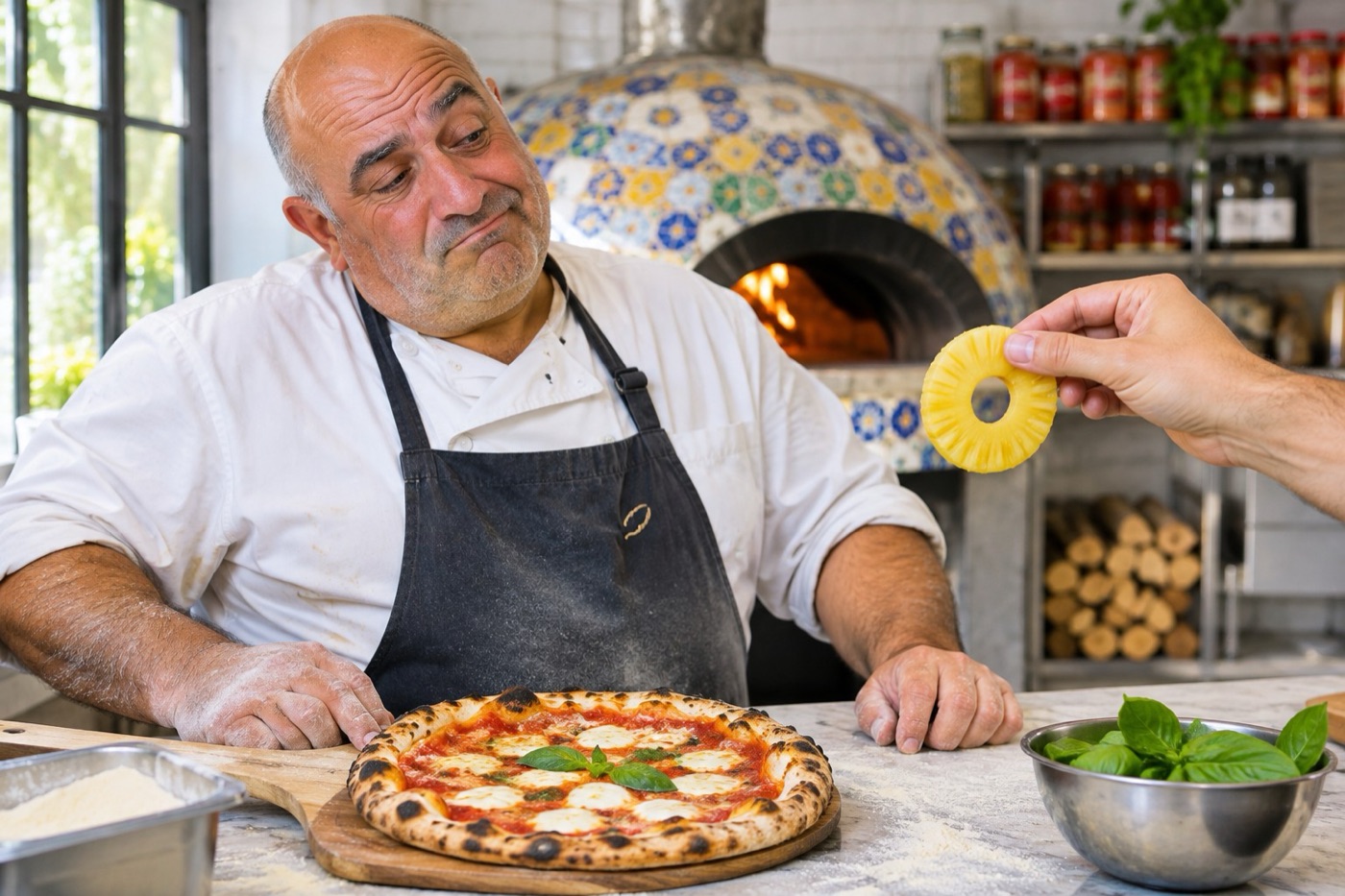
An Italian chef called Davide Tamburella felt so strongly about it that it cost him his job. He was working at a restaurant in Brisbane, Australia, and he refused to put pineapple on a pizza. He told his customers and his boss that the combination was an insult to Italian culture. The restaurant sacked him. There is a small joke hidden in the story. Queensland, the state where Brisbane is, grows almost all of Australia's pineapples.
He is not the first cook to lose a job this way. In 2017 a chef from Bologna was sacked by a restaurant near Lyon, in France. He had refused to cook the pasta for longer, and he would not serve spaghetti bolognese, because that dish does not exist in Bologna.
Luca Cesari is a food historian who has written a history of pizza. In an opinion article for The Guardian, he explains why Italians react so strongly. Food fashions are changing quickly, he says, and there are now more chefs on television than grandmothers cooking at home. People can feel that something they love is in danger.
But Cesari also points out a problem. Many of the rules Italians defend are not very old at all. Pasta was eaten soft for hundreds of years. Cream in carbonara was introduced by a few cooks in Rome in the 1960s. The pizza of a hundred years ago was nothing like the pizza we eat today.
Not every Italian is against pineapple either. Gino Sorbillo, a famous pizza maker, allows it on a white pizza with no tomato. Franco Pepe, who many people call the best in the world, invented a pizza cone filled with pineapple, ham and cheese.
So who decides what is traditional? A recipe can connect us to our family and our home. It can also change, as it always has. Perhaps the best table is one where the old version and the new one sit side by side, and the argument is part of the meal.
Intermediate version
It is one of the most reliable ways to start an argument at dinner: ask whether pineapple belongs on a pizza. For some people, sweet fruit and salty cheese are a small, cheerful act of rebellion. For others, the combination ruins the entire evening. One Italian chef felt strongly enough that the disagreement ended his employment.
Davide Tamburella was working at a restaurant in Brisbane, Australia, when he refused to put pineapple on a pizza. He would not give way to his customers or to his boss, insisting that the combination was an insult to Italian culture. The restaurant sacked him. The detail that makes the story funnier is geographical: Queensland grows almost all of Australia's pineapples.
He has company. In 2017 Maurizio Landi, a chef from Bologna, was sacked by a bistro near Lyon after resisting pressure to cook his pasta for longer and to serve spaghetti bolognese. In Bologna, ragù is eaten with tagliatelle and nothing else, so the request was close to an insult.
Writing in The Guardian, the food historian Luca Cesari offers an explanation that is more sympathetic than it first appears. Italians can sense that their cooking is under pressure, he suggests. Food fashions move faster than ever, and there are now more chefs on television than grandmothers cooking at home. Defending a recipe is a way of defending something larger.
The difficulty is that the recipes keep moving too. Cesari notes that several of the rules modern Italians enforce would have puzzled their ancestors. Pasta was eaten soft for centuries, and macaroni with cheese was served beside meat from the Middle Ages onwards. A spoonful of cream in a carbonara is now enough to cause an argument, yet a few Roman cooks introduced it in the 1960s and kept it up for forty years.
Even the pineapple is less settled than it sounds. Gino Sorbillo, one of the most respected pizza makers in the world, has allowed it on a white pizza with no tomato, which would otherwise make it too acidic. Franco Pepe created a filled pizza cone he called the AnaNascosta, the hidden pineapple. Being Italian, it turns out, does not require a single opinion about every topping.
Cesari's list of inconsistencies goes on. Grated cheese on fish offends many Italians, who will nonetheless order the thoroughly traditional mussels with pecorino. A cappuccino after dinner attracts horrified looks, while a caffè macchiato, much the same drink in a smaller cup, passes without any comment at all.
None of that obliges anybody to enjoy it. You can dislike pineapple on pizza for the ordinary reason that you dislike the taste. The interesting question is why a small yellow fruit makes so many of us ready to defend everything standing behind it.
Advanced version
Some disagreements can divide a table before anyone has eaten. Pineapple on pizza is the reigning example. Its defenders enjoy the sweetness against the salt, and a little pleasure in breaking a rule. Its opponents regard the whole arrangement as evidence of a civilisation in decline.
Davide Tamburella went further than an opinion. Working at a restaurant in Brisbane, he refused to put pineapple on a pizza, would not yield to his customers or his employer, and was sacked for it, insisting throughout that the combination insulted Italian culture. Queensland, as it happens, grows almost all of Australia's pineapples, which gives the stand a certain splendid futility.
He joins a small tradition. In 2017 Maurizio Landi, from Bologna, lost a job near Lyon for refusing to overcook pasta and to produce spaghetti bolognese, a dish his home city does not recognise. There, ragù meets tagliatelle and nothing else.
Writing in The Guardian, the food historian Luca Cesari treats this with affection rather than mockery, and then quietly removes the ground from under it. Italians can feel their cuisine slipping, he argues, with food fashions accelerating and more chefs on television than grandmothers at the stove. The instinct to guard it is understandable. The trouble is the thing being guarded.
Cesari's list is quietly devastating. Pasta was eaten soft for centuries. Macaroni with cheese sat beside meat dishes from the Middle Ages. Cream in a carbonara, now close to a criminal offence, was introduced by Roman cooks in the 1960s and persisted for forty years before everyone agreed to forget it. Grated cheese on fish provokes outrage from people who will happily eat the thoroughly traditional mussels with pecorino. A cappuccino after dinner horrifies waiters, while a caffè macchiato, which is much the same drink in miniature, passes without comment.
Nor is the profession united. Gino Sorbillo has permitted pineapple on a white pizza, where no tomato makes it too acidic. Franco Pepe built the AnaNascosta, a filled cone of pineapple, San Daniele ham and Grana Padano. A London chain spent the summer selling a spiced pineapple sauce specifically to annoy the prejudice out of existence. Italian pizzerias, meanwhile, sell frankfurters with chips, speck with mascarpone and tuna with onion, and the traditional pizza of Pesaro arrives as a margherita under hard-boiled eggs and mayonnaise.
The longest view belongs to a newspaper. In December 1860 the Morning Post described Neapolitan pizza and reported that the highest authorities dismissed anchovies, sausage and mushrooms as modern innovations unworthy of the name. The toppings change; the authorities are permanent.
Cesari's conclusion is the sharpest thing in the piece. Italians, he suggests, do not need pineapple pizza in order to eat. They need it in order to have something to despise, because despising it places you on the right side of a line. That is worth holding on to when the next argument starts, because the heat rarely comes from the ingredient. It comes from what we have decided the ingredient stands for.
After you read
4True, false or not given5 statements
Choose T (true), F (false) or NG (the article does not say).
- The restaurant where Tamburella worked is in a state that grows pineapples.
Brisbane is in Queensland, which grows almost all of Australia's pineapples.
- Tamburella was the first chef to lose a job like this.
The text says: "He is not the first cook to lose a job this way."
- Tamburella found a new job soon after the restaurant sacked him.
The text does not say what he did next.
- Luca Cesari thinks all the rules Italians defend are very old.
He says many of the rules "are not very old at all".
- Franco Pepe has made a pizza with pineapple in it.
He invented a pizza cone filled with pineapple, ham and cheese.
5Vocabulary5 gaps
Complete the sentences with words from the box. Two words are not needed.
carbonaradangerhistorianinventedsackedsaucewaiter
- After the argument, the restaurant the chef and he had to find a new job.
- Luca Cesari is a food who has written a history of pizza.
- Cream in was introduced by a few cooks in Rome in the 1960s.
- People can feel that something they love is in .
- Franco Pepe a pizza cone filled with pineapple, ham and cheese.
6Verb forms5 gaps
Write the correct form of the verb in brackets.
- He to put pineapple on a pizza. (REFUSE)
- He his customers that the combination was an insult. (TELL)
- Pasta soft for hundreds of years. (EAT)
- The pizza of a hundred years ago nothing like the pizza we eat today. (BE)
- Queensland almost all of Australia's pineapples. (GROW)
7Language focuslinking words
Complete the sentences with words from the box. Two words are not needed. Use so for a result, because for a reason, but for a contrast and although for a surprise.
althoughbecausebutorsothenunless
- He felt strongly about pizza, he refused to add fruit.
- Some people love pineapple on pizza, others hate it.
- He lost his job he would not change the recipe.
- Italians defend old rules, many of those rules are quite new.
- First he said no. the boss told him to leave.
4True, false or not given5 statements
Choose T (true), F (false) or NG (the article does not say).
- Maurizio Landi was sacked in the same country as Davide Tamburella.
Tamburella lost his job in Brisbane, Australia, and Landi near Lyon, in France.
- Sorbillo leaves tomato off the pineapple pizza because tomato would make it too acidic.
The text says a white pizza has "no tomato, which would otherwise make it too acidic".
- Tamburella had worked at the Brisbane restaurant for several years.
The text does not say how long he worked there.
- Many Italians who dislike grated cheese on fish still eat mussels with pecorino.
The text says they "will nonetheless order" the traditional mussels with pecorino.
- The cream in carbonara disappeared from Roman kitchens within ten years.
Roman cooks "kept it up for forty years".
5Vocabulary6 gaps
Complete the sentences with words from the box. Two words are not needed.
ancestorsgratedhorrifiedinconsistenciesrebellionresistingsympatheticthoroughly
- Teenagers often show a small act of by refusing to wear the clothes their parents choose.
- My lived in the same village for centuries, so our family recipes are very old.
- The manager was when I explained why I was late, and said it could happen to anyone.
- The report listed several in the company's rules, such as different holidays for similar jobs.
- He spent months pressure to change the menu.
- The soup was cooked, so there was no need to leave it on the heat any longer.
6Verb forms5 gaps
Write the correct form of the verb in brackets.
- Tamburella at a restaurant in Brisbane when he refused to add pineapple. (WORK)
- Several of the rules Italians enforce today their ancestors, who ate soft pasta. (PUZZLE)
- Maurizio Landi by a bistro near Lyon in 2017. (SACK)
- By the 1960s, pasta soft for centuries. (EAT)
- Gino Sorbillo pineapple on a white pizza. (ALLOW)
7Language focuslinking words
Complete the sentences with words from the box. Two words are not needed. Check where the gap sits: between two clauses, at the start of a sentence, or before a noun phrase.
despitemoreovernonethelessotherwisethereforeunlessyet
- Italians defend old rules fiercely, many of those rules are quite recent.
- the pressure from his boss, Tamburella would not add pineapple.
- Sorbillo leaves the tomato off the white pizza. , the pineapple would taste far too acidic.
- Pasta was eaten soft for centuries. The rule that it must be firm is, , quite modern.
- Pineapple on pizza may not suit your taste. , that is no reason to look down on people who enjoy it.
4True, false or not given5 statements
Choose T (true), F (false) or NG (the article does not say).
- The 1860 report suggests that complaints about toppings are older than the pineapple row.
In 1860 authorities already dismissed anchovies, sausage and mushrooms as modern innovations.
- Tamburella and Landi lost their jobs for the same reason.
Tamburella refused pineapple; Landi refused to overcook pasta and to produce spaghetti bolognese.
- The AnaNascosta is sold by the London chain mentioned in the article.
The text does not say where the AnaNascosta is sold.
- The article implies that some Italians accept mussels with pecorino while objecting to cheese on fish in general.
Grated cheese on fish causes outrage among people who happily eat mussels with pecorino.
- Some Roman cooks were still putting cream in carbonara in the 1980s.
The text says cream was introduced in the 1960s and "persisted for forty years", which covers the 1980s.
5Vocabulary6 gaps
Complete the sentences with words from the box. Two words are not needed.
ambitiondespisedevastatingdismissedpersistedreigningtoleranceunworthy
- The champion defended her title for the third year running.
- Despite repeated warnings, the rumour for decades before anyone checked its source.
- The committee the complaint as trivial and moved on to the next item.
- The inspector's report was , exposing every flaw in the safety system.
- Some people reality television yet watch it every week.
- She considered the offer of her talents and turned it down.
6Word forms5 gaps
Use the word in brackets to make a word that fits the gap.
- Cesari's examples expose a striking in what Italians condemn. (CONSISTENT)
- The speed of change has produced a growing sense of among Italian cooks. (SECURE)
- The chef's to compromise cost him his job. (WILLING)
- Critics find the topping because it breaks a rule they have never questioned. (ACCEPT)
- The historian's account is rather than hostile. (SYMPATHY)
7Language focuslinking words
Complete the sentences with words from the box. Two words are not needed. Some of these only work at the start of a sentence, and some need a clause, a noun or just a short phrase after them.
albeithencemeanwhilenotwithstandingprovidedtherebywhereas
- The row is lively, rather short on historical evidence.
- Tamburella insisted on tradition, Cesari shows how recent most of it is.
- the historian's evidence, many diners still insist the rule is ancient.
- Objections to toppings date back to 1860; , today's outrage is hardly new.
- Defenders of tradition issue warnings; , pizzerias in Italy sell frankfurters with chips.
Speak
8Talk about it3 questions
Discuss in pairs or small groups. Give reasons for your answers.
- Was the chef right to refuse, or should he have made the pizza?
- Should a recipe always stay the same?
- Which meal reminds you most of home?
8Talk about it3 questions
Discuss in pairs or small groups. Give reasons for your answers.
- The chef lost his job over a topping. Was that a reasonable price?
- Cesari says cream in carbonara was once normal. Does that change your view of food rules?
- What food opinion would you defend at a dinner table?
8Talk about it3 questions
Discuss in pairs or small groups. Give reasons for your answers.
- Cesari suggests Italians need pineapple pizza to despise rather than to eat. Is he being unfair?
- The 1860 newspaper complained about anchovies and mushrooms. Will today's outrage look the same in a century?
- Does knowing a tradition has changed make you less willing to defend it?
9Role-play: pineapple on the menu
Work in pairs. Read your card, then have the conversation. Swap roles and do it again.
Student A · the restaurant owner
A customer wants pineapple on a pizza. Your chef says no. Ask why he refuses and what he wants to do. Decide whether to say yes, say no, or find a middle way.
Student B · the chef
You are a proud Italian chef. A customer wants pineapple on a pizza and you think it's wrong. Explain your reasons, but remember that you need your job.
Useful phrases
- I'm sorry, but I can't put pineapple on a pizza.
- It's not a real Italian pizza.
- The customer's always right, you know.
- I'd rather lose my job than do it.
- Could we offer it on a white pizza?
- Let's find a solution we're both happy with.
Afterwards, tell the class: did the chef keep his job, and who gave way first?
Your words
Highlights0 saved
Highlights0 saved
Highlights0 saved
Was this lesson useful? Support johnplusnews on Ko-fi
Continue reading
Language
Did Writing Really Make Languages More Complicated?
A large study of about 100,000 sentences in 30 languages found no universal pattern showing that writing makes sentences more complex. It does not say that writing never changes a language.
History
Were People Getting High 2,800 Years Ago?
Cannabis seeds and chemical traces in preserved hair from a Siberian tomb suggest that some Scythians were exposed to its intoxicating compounds about 2,800 years ago. The evidence is strong, but it leaves many questions open.
Language
Are You the Same Person in Your Second Language?
A study of 106 Greek-English bilinguals found that the language they used did not change their moral decisions, although it did shift how some of them described themselves.