Can a Repair Make Your Clothes More You?
A San Francisco library advertised a teen workshop on mending and upcycling clothes. Would you hide a repair, or let it show?
Warm up3 questions
- Would you wear a repaired item if the repair was easy to see?
- Which item of clothing would you most want to keep?
- Would you rather learn to sew or learn to customise trainers?
Sentence help (optional): I'd choose ... because ... · For me, ... · I think ... because ...
Warm up3 questions
- Would you wear a repaired item if the repair was easy to see?
- Which item of clothing would you most want to keep?
- Would you rather learn to sew or learn to customise trainers?
Warm up3 questions
- Would you wear a repaired item if the repair was easy to see?
- Which item of clothing would you most want to keep?
- Would you rather learn to sew or learn to customise trainers?
Core version
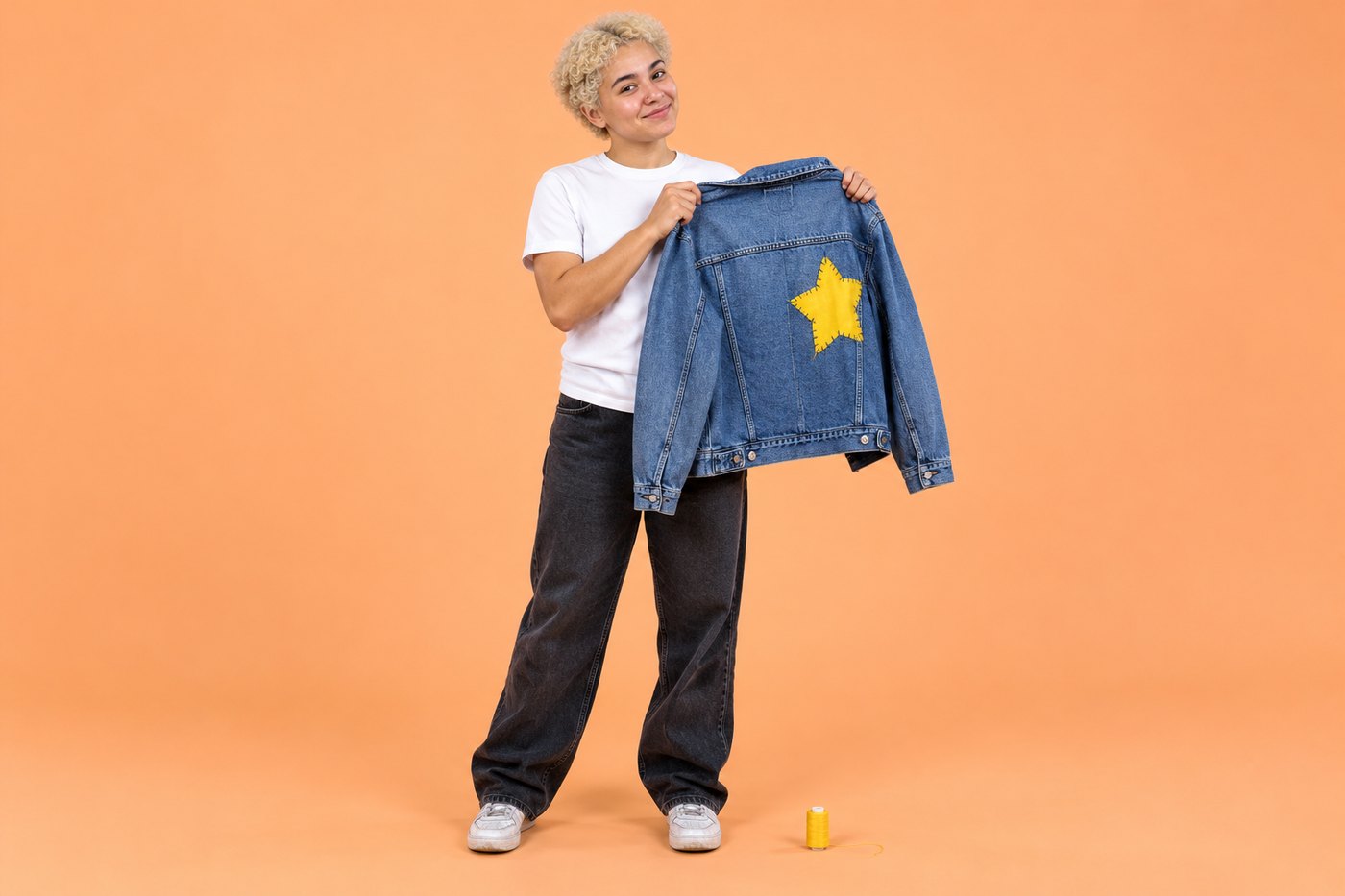
Imagine your favourite bag has a small hole. You have two choices. You can hide the hole with a stitch that nobody can see. Or you can cover it with a bright patch that everybody can see. Which choice feels more like you?
The public library in San Francisco, in the United States, advertised a workshop for teenagers aged 13 to 18. It was listed for 19 April 2026 and called "Mending and Upcycling". The teacher was Lucy Ornelas, a textile artist who teaches a fashion design class for a youth arts group called YAX.
The listing said that teenagers would learn three skills: visible mending, patching and hand-stitching. Visible mending means that you don't hide a repair. You make it part of the design. A patch is a piece of cloth that covers a hole. Hand-stitching means sewing with a needle and thread, with no machine.
People were asked to bring one small item that needed repair, no bigger than a hand. The goal was to give clothes a new life and to make less textile waste. Upcycling means turning something old into something better or more useful. Space in the workshop was limited.
A repair can be different things. You can mend a hole so the bag works again. Or you can give the bag a new look, with a patch in a surprising colour. Some people like repairs to be invisible. Other people like them to show, because the repair tells a story.
This was an event listing for a planned workshop, so it tells us what the library advertised. It doesn't tell us how many people came, what they thought or how much waste they saved. And not everyone loves visible repairs.
So back to your bag. Would you hide the repair or show it? And what would a patch say about you?
Intermediate version
Your favourite bag has a small hole in the bottom. You could hide the damage with a careful stitch, cover it with a bright patch, or buy a new bag. Each choice says something slightly different about you. Which one would you pick?
The San Francisco Public Library advertised a workshop for ages 13 to 18, listed for Sunday 19 April 2026 and called "Mending and Upcycling with Youth Art Exchange". Lucy Ornelas, a textile artist who teaches fashion design for the youth arts group YAX, was to lead it.
According to the listing, teenagers would learn essential textile repair skills, including visible mending, patching and hand-stitching. They were encouraged to bring one textile item that needed repair, no larger than the palm of a hand. The stated goals were to upcycle clothing and reduce textile waste, and space was limited. The listing also credited the library's Youth Advisory Board interns, who helped plan programmes for young people.
Two ideas are worth separating. Mending repairs damage so that something works again, and it can be invisible. Upcycling changes what an object is for, or makes it better than it was, so a torn T-shirt might become a bag. Visible mending sits between them. It fixes the damage, but it shows the fix as part of the design.
That is why a repair can say something. A neat invisible stitch says that nothing happened. A bright patch says that the object has a history and that someone chose how to deal with it. Some people find that more interesting than a new item, while others prefer clothes that look as if nothing has ever happened to them. Neither taste is wrong.
Remember what the source is. It's an event listing, so it tells us what was advertised, not how many people attended, what they thought or how much waste they saved. We shouldn't assume that repaired clothes are embarrassing or that expensive clothes are needed to take part.
So here is a question for your own wardrobe. If one item had a small tear, would you hide the repair, make it a feature or choose another solution? And what would you want that choice to say about you?
Advanced version
A tear can disappear under a careful repair, or become the most noticeable part of a bag. A bright patch makes a choice visible: someone decided to keep the item and change its look. A mending workshop offers the tools for doing that. What the repaired piece should look like is still up to its owner.
The occasion for it is modest. The San Francisco Public Library listed a workshop for ages 13 to 18 on Sunday 19 April 2026, called "Mending and Upcycling with Youth Art Exchange". Lucy Ornelas, a San Francisco textile artist and instructor for the Fashion Design class at YAX, a nonprofit that offers free after-school arts programmes to public high school students, was to teach it.
According to the listing, participants would learn essential textile repair skills, including visible mending, patching and hand-stitching, and were encouraged to bring a textile item that needed repair, no larger than the palm of a hand. The stated goals were to upcycle clothing and reduce textile waste. It also mentions the library's Youth Advisory Board interns, who had spent the school year planning programmes for young people.
The vocabulary of repair is worth unpacking. Mending restores function. Upcycling changes purpose or raises an object's status, so a damaged item becomes something new. Visible mending does something slightly different: it keeps the original purpose but refuses to hide the damage. It turns a flaw into a decision, which is why it appeals to people who like objects to carry their history.
But that taste isn't neutral. When a person who can easily afford new clothes wears a visible repair, it can read as a choice. When a person with less money wears the same repair, others may read it as necessity. The viewer's assumptions do a lot of work here, which is why a workshop that teaches the skill is only part of the story. Who is allowed to look creative, and who is assumed to be struggling?
The limits of the source matter. A listing says what was advertised. It doesn't report how many people came, what they made or thought, or how much waste was reduced, and it says nothing about whether the participants agreed about any of this. Nor should we assume that repaired clothes are embarrassing, or that expensive clothes are needed to take part.
What it does give us is a practical, low-cost way to ask about taste. So if you owned one item with a small tear, would you hide the repair, make it a feature or choose another solution? And who are you imagining when you decide how it should look?
Study this story
Save the words you want to keep, talk about the story, then practise the language.
Highlights0 saved
Highlights0 saved
Highlights0 saved
Talk about it3 questions
- Could a visible repair make something look better?
- What would make a clothes-repair session with friends fun?
- Would you care more about clothes if you helped make or mend them?
Sentence help (optional): I think ... because ... · One reason is ... · For me, ...
You can talk about people in general instead of yourself, and you can pass on any question.
Talk about it3 questions
- Could a visible repair make something look better?
- What would make a clothes-repair session with friends fun?
- Would you care more about clothes if you helped make or mend them?
You can talk about people in general instead of yourself, and you can pass on any question.
Talk about it3 questions
- Could a visible repair make something look better?
- What would make a clothes-repair session with friends fun?
- Would you care more about clothes if you helped make or mend them?
You can talk about people in general instead of yourself, and you can pass on any question.
Try it
Draw a patch or a redesign for an invented damaged bag. Then explain its practical job and its visual idea to someone else. A paper design is enough, so you don't need to sew or buy anything. If a teacher or adult is helping, hand-stitching can be an optional extra.
Exercises4 exercises
1. Complete the sentences
Drag a word into each gap, or tap a word and then tap a gap. Tap a filled gap to put the word back. Two words are not needed.
- You can cover a hole with a bright .
- Hand-stitching means sewing with a needle and , with no machine.
- Visible mending means that you don't a repair.
- The goal was to make less textile .
- means turning something old into something better or more useful.
2. Match the meaning
Choose the meaning of each word or phrase as it is used in the article.
- workshop
- needle
- listing
- textile
Write the letter of the meaning next to each word.
- A cloth or fabric, such as cotton or wool
- B a short class where people learn by doing
- C a thin, pointed tool for sewing
- D a short description of an event on a list
3. Put the verb in the right form
Write the correct form of the verb in brackets.
- The library a workshop for teenagers aged 13 to 18. (advertise)
- The listing that teenagers would learn three skills. (say)
- People asked to bring one small item. (be)
- Which choice more like you? (feel)
- Some people repairs to be invisible. (like)
4. True, false or not given
Choose Not given if the article does not say, even when you think the statement is probably true.
- The workshop was meant for young people between 13 and 18.
The text says: "advertised a workshop for teenagers aged 13 to 18"
- The workshop was listed for 19 May 2026.
The text says the opposite: "It was listed for 19 April 2026"
- People were asked to bring one small item that needed repair.
The text says: "People were asked to bring one small item that needed repair, no bigger than a hand."
- The listing says how many people came.
The text says the opposite: "It doesn't tell us how many people came"
- Lucy Ornelas has taught for ten years.
Not stated. This version does not give this information.
Your score
Do all four, then add them up.
Answer key
- Complete the sentences1 patch · 2 thread · 3 hide · 4 waste · 5 upcycling
- Match the meaning1 workshop = B · 2 needle = C · 3 listing = D · 4 textile = A
- Put the verb in the right form1 advertised · 2 said · 3 were · 4 feels · 5 like
- True, false or not given1 True · 2 False · 3 True · 4 False · 5 Not given
1. Complete the sentences
Drag a word into each gap, or tap a word and then tap a gap. Tap a filled gap to put the word back. Two words are not needed.
- Teenagers could bring one textile item that needed .
- Participants should bring an item no larger than the of a hand.
- The stated goals were to clothing and reduce textile waste.
- The listing credited the library's Youth Advisory Board , who helped plan programmes.
- A neat stitch means that nothing happened.
2. Match the meaning
Choose the meaning of each word or phrase as it is used in the article.
- essential
- upcycling
- textile
- visible mending
Write the letter of the meaning next to each word.
- A a fix that is shown as part of the design
- B very important and needed
- C changing an old object into something new or better
- D cloth or fabric, such as cotton or wool
3. Put the verb in the right form
Write the correct form of the verb in brackets.
- The library a workshop for ages 13 to 18. (advertise)
- Lucy Ornelas, a textile artist, to lead the workshop. (be)
- They encouraged to bring one textile item. (be)
- A bright patch that the object has a history. (say)
- Mending damage so that something works again. (repair)
4. True, false or not given
Choose Not given if the article does not say, even when you think the statement is probably true.
- The workshop was meant for young people from 13 to 18.
The text says: "The San Francisco Public Library advertised a workshop for ages 13 to 18"
- Participants were asked to bring a large item of clothing.
The text says the opposite: "no larger than the palm of a hand"
- Mending can be invisible.
The text says: "Mending repairs damage so that something works again, and it can be invisible."
- The listing says how much waste the workshop saved.
The text says the opposite: "it tells us what was advertised, not how many people attended, what they thought or how much waste they saved"
- Lucy Ornelas has her own clothing shop.
Not stated. This version does not give this information.
Your score
Do all four, then add them up.
Answer key
- Complete the sentences1 repair · 2 palm · 3 upcycle · 4 interns · 5 invisible
- Match the meaning1 essential = B · 2 upcycling = C · 3 textile = D · 4 visible mending = A
- Put the verb in the right form1 advertised · 2 was · 3 were · 4 says · 5 repairs
- True, false or not given1 True · 2 False · 3 True · 4 False · 5 Not given
1. Complete the sentences
Drag a word into each gap, or tap a word and then tap a gap. Tap a filled gap to put the word back. Two words are not needed.
- The 's assumptions do a lot of work here.
- Mending restores .
- Visible mending turns a flaw into a .
- A person with less money may find that others read the same repair as , not as a choice.
- But that taste isn't .
2. Match the meaning
Choose the meaning of each word or phrase as it is used in the article.
- flaw
- purpose
- advertised
- assumptions
Write the letter of the meaning next to each word.
- A the reason something is made or used
- B a small fault in something
- C things you believe without checking
- D announced publicly to attract people
3. Make the right word
Use the word in brackets to make a word that fits the gap.
- To one person the patch looks . (CREATE)
- The workshop teaches a skill. (PRACTICE)
- Repaired clothes are not . (EMBARRASS)
- A repair can become the most part of a bag. (NOTICE)
- Nor should we assume that clothes are needed to take part. (EXPENSE)
4. True, false or not given
Choose Not given if the article does not say, even when you think the statement is probably true.
- The workshop was listed for Sunday 19 April 2026.
The text says: "listed a workshop for ages 13 to 18 on Sunday 19 April 2026"
- Participants were told to bring any large item.
The text says the opposite: "no larger than the palm of a hand"
- Mending restores function.
The text says: "Mending restores function."
- People read a visible repair in the same way, whoever wears it.
The text says the opposite: "When a person who can easily afford new clothes wears a visible repair, it can read as a choice. When a person with less money wears the same repair, others may read it as necessity."
- The workshop was fully booked.
Not stated. This version does not give this information.
- The listing mentions interns who planned programmes for young people.
The text says: "It also mentions the library's Youth Advisory Board interns, who had spent the school year planning programmes for young people."
Your score
Do all four, then add them up.
Answer key
- Complete the sentences1 viewer · 2 function · 3 decision · 4 necessity · 5 neutral
- Match the meaning1 flaw = B · 2 purpose = A · 3 advertised = D · 4 assumptions = C
- Make the right word1 creative · 2 practical · 3 embarrassing · 4 noticeable · 5 expensive
- True, false or not given1 True · 2 False · 3 True · 4 False · 5 Not given · 6 True
Continue reading
Science & making
Can Dogs Smell When People Are Stressed?
Researchers tested whether the smell of a stressed person changes how dogs behave. The result is interesting, but it is smaller than the headlines might suggest.
Hobbies
Why Is Porridge Cool Again?
Oats are a very old breakfast, but searches and sales at some shops are rising. Is porridge really back, or is it just a nicer photo?
Sport
The 14-Year-Old Who Became a World Surfing Champion
Leihani Zoric turned fourteen just days before she beat some of the best adult surfers in the world. What does her win say about talent, pressure and growing up in the spotlight?



Read this article online: johnplusnews.com/articles/can-a-repair-make-your-clothes-more-you/