Can Dogs Smell When People Are Stressed?
Researchers tested whether the smell of a stressed person changes how dogs behave. The result is interesting, but it is smaller than the headlines might suggest.
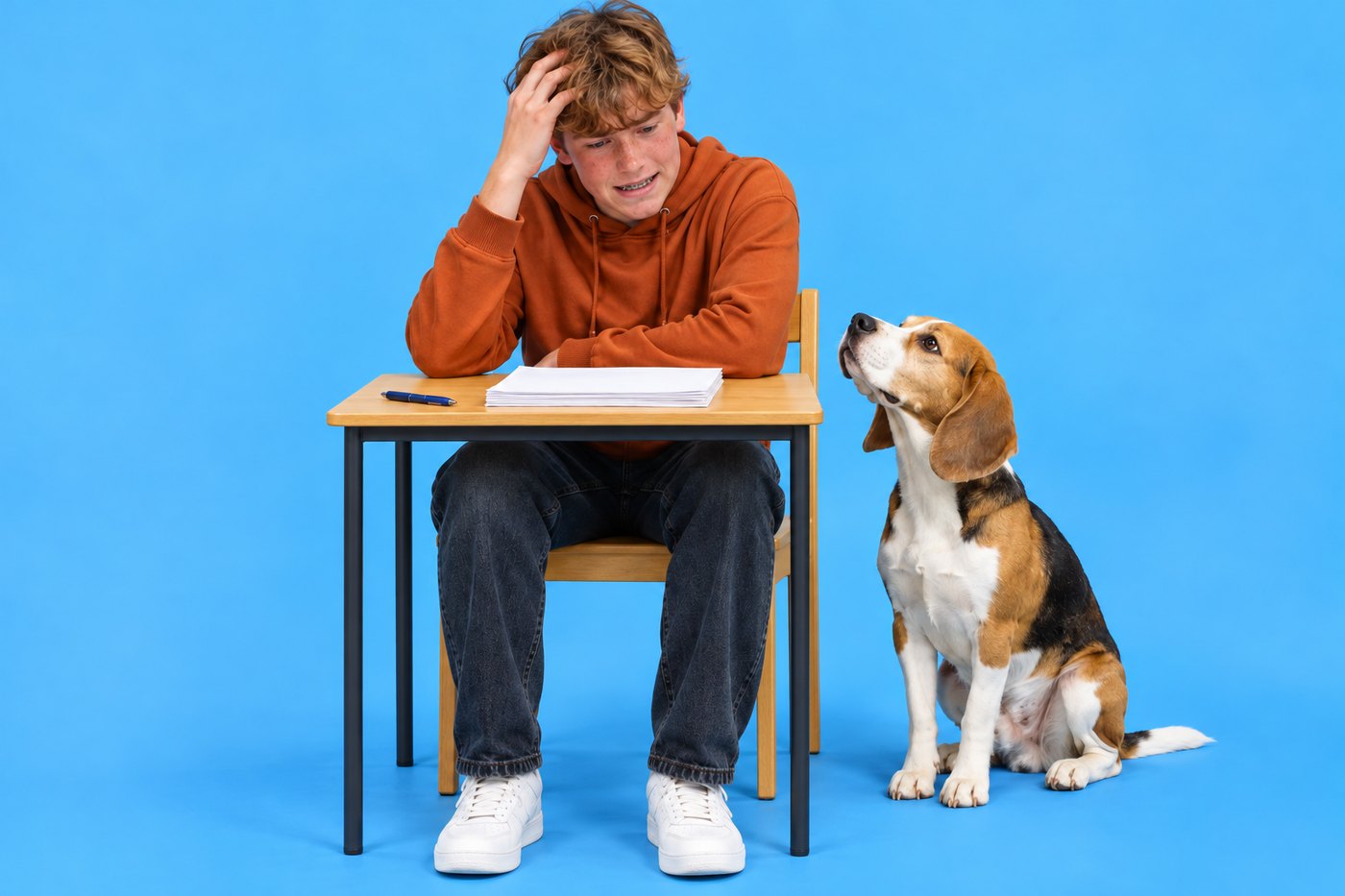
Warm up3 questions
- What do you think animals notice about people?
- Would you rather understand what a dog smells or what it hears?
- What would make an animal experiment convincing to you?
Sentence help (optional): I'd choose ... because ... · For me, ... · I think ... because ...
Warm up3 questions
- What do you think animals notice about people?
- Would you rather understand what a dog smells or what it hears?
- What would make an animal experiment convincing to you?
Warm up3 questions
- What do you think animals notice about people?
- Would you rather understand what a dog smells or what it hears?
- What would make an animal experiment convincing to you?
Core version
Have you ever walked into a room and felt that something was wrong before anyone said a word? Some dog owners say their dogs seem to know when they're upset. But can a dog really notice that a person is stressed? Scientists in the United Kingdom decided to test it.
The researchers, from the University of Bristol, worked with 18 dogs and their owners. First they trained each dog with two food bowls in two different places. In one place, the bowl always had a treat. In the other place, the bowl was always empty. Soon the dogs learned the difference. They went to the treat bowl faster.
Then came the clever part. The researchers put a bowl in a new place between the other two. Nobody could know if it had food. This is called an "ambiguous" place, which means that the answer is not clear. The scientists measured how fast each dog went to the new bowl.
At the same time, the dogs could smell different things. Some smells came from people who had done a hard maths test and felt stressed. Other smells came from people who listened to calm sounds and felt relaxed. In one more test, there was no smell at all.
When the dogs smelled the stress samples, they were slower to go to the new bowl closest to the empty one. The relaxed smell did not do that.
The researchers say the slower approach might mean the dogs expected no food. But that is an idea, not a proof. This was a small study with 18 dogs, and a dog can't tell us what it feels. It doesn't mean dogs can read your mind. And it doesn't mean you are a bad owner when you feel stressed.
So what would you test next? Think of one question about animals that a bowl, a stopwatch and a lot of patience could help to answer.
Intermediate version
A dog lifts its head the moment you sit down after a terrible day. Is it a coincidence, or can it smell that something is wrong? Plenty of owners feel sure, but feeling sure isn't the same as showing it, so scientists look for a way to test the idea.
In July 2024, researchers at the University of Bristol published a study in the journal Scientific Reports. They worked with 18 dogs and their owners. The dogs were between eight months and ten years old, and eight of them were registered teaching dogs at the university.
First, each dog learned two rules. A bowl in one place always contained a treat, and a bowl in another place was always empty. Once the dogs had learned the difference, they approached the treat location faster than the empty one. Then the researchers placed bowls in new, ambiguous locations between the two, where nobody, including the dog, could know whether there was food.
Meanwhile, the dogs smelled one of three things. One was nothing at all. Another was sweat and breath from people who were stressed because they were doing an arithmetic test. The third was sweat and breath from people who were relaxed, listening to soundscapes.
When the stress smell was present, the dogs were slower to approach the ambiguous bowl nearest the empty one. The relaxed smell had no such effect. The dogs also learned the difference between the two trained bowls faster when the stress smell was there.
It's important to separate what the team saw from what they think it means. They saw a change in speed. The researchers think the stress smell may have made the dogs less hopeful of finding food. Their behaviour cannot tell us exactly what they felt. Their wording is careful: they use words like "may" and "suggest", and slow walking could have other explanations. A study of 18 dogs can't answer every question.
So can dogs smell when people are stressed? This study found that the smell of stressed people changed how dogs behaved in a test. It did not show that dogs read minds. If you could design one more experiment, what would you test?
Advanced version
You can't give a dog a questionnaire. When scientists want to know how an animal is feeling, they have to work it out from what the animal does, and behaviour is easy to over-read. A slow walk towards a bowl could mean fear, caution, tiredness or simple boredom.
A team at the University of Bristol, led by Nicola Rooney, designed one. Their study, published in Scientific Reports in July 2024, involved 18 dog and owner pairs. The dogs ranged from eight months to ten years old, and eight were registered teaching dogs at the university.
The method rests on a simple question: what does the dog expect to find? Each dog first learned that a bowl in one place held a treat and a bowl in another was empty, and once it could tell the two apart it approached the treat location faster. The researchers then placed bowls in ambiguous locations between the two trained spots. How quickly a dog approached an ambiguous bowl was treated as a clue to what it expected.
At the same time, each dog was exposed to one of three conditions. There was no odour, which was the control. There were sweat and breath samples from people who were stressed by an arithmetic test. And there were samples from people who were relaxed, listening to soundscapes.
With the stress odour present, dogs were slower to approach the ambiguous location nearest the empty-bowl spot. The relaxed odour produced no such effect, and the dogs also became quicker at telling the two trained bowls apart. One caution belongs here: this is one small study of 18 dogs and a behavioural clue, not a report of what the dogs felt.
The authors suggest that the smell of stress may have led the dogs to expect that the new location was empty too. They describe this as a "pessimistic" response reflecting a negative emotional state, and they speculate that it could be a way for a dog to conserve energy and avoid disappointment. Rooney said the odour of a stressed, unfamiliar person can affect a dog's emotional state, and she linked this to how dogs are looked after in kennels and as companion and assistance dogs.
Each link in that chain deserves some doubt. "Pessimism" is an interpretation of a behavioural test, not something the dogs reported. The stress came from one particular situation, an arithmetic test, so the study can't tell us how dogs respond to other kinds of stress, to people they know well, or to emotions such as excitement. Nor does it show that dogs understand what stress is, and nothing in it suggests that owners harm their dogs by feeling stressed.
That leaves the next experiment to you. You could change the smell, the task or the kind of dog. Which would you change first, and what result would surprise you?
Study this story
Save the words you want to keep, talk about the story, then practise the language.
Highlights0 saved
Highlights0 saved
Highlights0 saved
Talk about it3 questions
- Does this study change how you think about dogs?
- What would you like researchers to find out next?
- Should a small experiment become a big claim in a headline?
Sentence help (optional): I think ... because ... · One reason is ... · For me, ...
You can talk about people in general instead of yourself, and you can pass on any question.
Talk about it3 questions
- Does this study change how you think about dogs?
- What would you like researchers to find out next?
- Should a small experiment become a big claim in a headline?
You can talk about people in general instead of yourself, and you can pass on any question.
Talk about it3 questions
- Does this study change how you think about dogs?
- What would you like researchers to find out next?
- Should a small experiment become a big claim in a headline?
You can talk about people in general instead of yourself, and you can pass on any question.
Try it
On paper, draw the three bowl positions from the experiment: one with a treat, one empty and one in between. Under your drawing, write one thing the researchers observed and one thing they only suggested. This is a drawing and thinking task, so please don't try it with a real animal.
Exercises4 exercises
1. Complete the sentences
Drag a word into each gap, or tap a word and then tap a gap. Tap a filled gap to put the word back. Two words are not needed.
- In one place, the bowl always had a .
- In the other place, the bowl was always .
- The scientists how fast each dog went to the new bowl.
- With the stress smell, the dogs were to go to the new bowl.
- The researchers' explanation is only an idea, not a .
2. Match the meaning
Choose the meaning of each word or phrase as it is used in the article.
- ambiguous
- stressed
- relaxed
- expected
Write the letter of the meaning next to each word.
- A calm and not worried
- B thought that something would probably happen
- C feeling worried or under a lot of pressure
- D not clear, with more than one possible answer
3. Put the verb in the right form
Write the correct form of the verb in brackets.
- The researchers with 18 dogs and their owners. (work)
- This is an "ambiguous" place. (call)
- Soon the dogs the difference. (learn)
- The relaxed smell not do that. (do)
- Some dog owners say their dogs to know when they're upset. (seem)
4. True, false or not given
Choose Not given if the article does not say, even when you think the statement is probably true.
- Eighteen dogs took part in the study together with their owners.
The text says: "The researchers, from the University of Bristol, worked with 18 dogs and their owners."
- One bowl place always held a treat and the other place never did.
The text says: "In one place, the bowl always had a treat. In the other place, the bowl was always empty."
- The dogs went more slowly to the new bowl when they smelled the relaxed samples.
The text says the opposite: "When the dogs smelled the stress samples, they were slower to go to the new bowl closest to the empty one. The relaxed smell did not do that."
- The researchers say the study proves that dogs can read minds.
The text says the opposite: "It doesn't mean dogs can read your mind."
- The dogs were all less than a year old.
Not stated. This version does not give this information.
Your score
Do all four, then add them up.
Answer key
- Complete the sentences1 treat · 2 empty · 3 measured · 4 slower · 5 proof
- Match the meaning1 ambiguous = D · 2 stressed = C · 3 relaxed = A · 4 expected = B
- Put the verb in the right form1 worked · 2 called · 3 learned or learnt · 4 did · 5 seem
- True, false or not given1 True · 2 True · 3 False · 4 False · 5 Not given
1. Complete the sentences
Drag a word into each gap, or tap a word and then tap a gap. Tap a filled gap to put the word back. Two words are not needed.
- Is it a , or can the dog smell that something is wrong?
- Eight of the dogs were teaching dogs at the university.
- The researchers placed bowls in new, locations.
- The dogs the treat location faster than the empty one.
- Slow walking could have other .
2. Match the meaning
Choose the meaning of each word or phrase as it is used in the article.
- registered
- coincidence
- arithmetic
- hopeful
Write the letter of the meaning next to each word.
- A two things happening together by chance
- B working with numbers by adding, taking away and multiplying
- C feeling that something good may happen
- D officially recorded on a list
3. Put the verb in the right form
Write the correct form of the verb in brackets.
- In July 2024, researchers at the University of Bristol a study. (publish)
- First, each dog two rules. (learn)
- The stress smell may have the dogs less hopeful of finding food. (make)
- A dog its head the moment you sit down after a terrible day. (lift)
- The team a change in speed. (see)
4. True, false or not given
Choose Not given if the article does not say, even when you think the statement is probably true.
- The study involved 18 dogs and their owners.
The text says: "They worked with 18 dogs and their owners."
- All 18 dogs were registered teaching dogs.
The text says the opposite: "eight of them were registered teaching dogs at the university"
- The relaxed smell did not slow the dogs down.
The text says: "When the stress smell was present, the dogs were slower to approach the ambiguous bowl nearest the empty one. The relaxed smell had no such effect."
- The study showed that dogs can read minds.
The text says the opposite: "It did not show that dogs read minds."
- The researchers tested cats as well as dogs.
Not stated. This version does not give this information.
Your score
Do all four, then add them up.
Answer key
- Complete the sentences1 coincidence · 2 registered · 3 ambiguous · 4 approached · 5 explanations
- Match the meaning1 registered = D · 2 coincidence = A · 3 arithmetic = B · 4 hopeful = C
- Put the verb in the right form1 published · 2 learned or learnt · 3 made · 4 lifts · 5 saw
- True, false or not given1 True · 2 False · 3 True · 4 False · 5 Not given
1. Complete the sentences
Drag a word into each gap, or tap a word and then tap a gap. Tap a filled gap to put the word back. Two words are not needed.
- A slow walk could mean many things, because behaviour is easy to .
- Dogs were slower to approach the location nearest the empty-bowl spot.
- This is one small study of 18 dogs, and the slow approach is only a , not a report of what they felt.
- It could be a way for a dog to energy.
- Each dog was to one of three conditions.
2. Match the meaning
Choose the meaning of each word or phrase as it is used in the article.
- control
- pessimistic
- exposed to
- speculate
Write the letter of the meaning next to each word.
- A placed in contact with something
- B to suggest an idea without strong evidence
- C expecting bad things to happen
- D a condition used for comparison, where nothing special is added
3. Make the right word
Use the word in brackets to make a word that fits the gap.
- Rooney said that the odour of a stressed, person can affect a dog. (FAMILIAR)
- The authors describe a negative state. (EMOTION)
- Calling it pessimism is an of the test results. (INTERPRET)
- It is a test, based on what the dogs do. (BEHAVE)
- One possible reason is to avoid . (DISAPPOINT)
4. True, false or not given
Choose Not given if the article does not say, even when you think the statement is probably true.
- The study was published in Scientific Reports in July 2024.
The text says: "Their study, published in Scientific Reports in July 2024, involved 18 dog and owner pairs."
- All of the dogs were registered teaching dogs.
The text says the opposite: "eight were registered teaching dogs at the university"
- With the relaxed odour present, the dogs were slower to approach the ambiguous bowl.
The text says the opposite: "The relaxed odour produced no such effect"
- Some of the samples came from people who were stressed by an arithmetic test.
The text says: "There were sweat and breath samples from people who were stressed by an arithmetic test."
- The teaching dogs behaved differently from the other dogs.
Not stated. This version does not give this information.
- The authors speculate that the dogs' response might help a dog avoid disappointment.
The text says: "they speculate that it could be a way for a dog to conserve energy and avoid disappointment"
Your score
Do all four, then add them up.
Answer key
- Complete the sentences1 over-read · 2 ambiguous · 3 clue · 4 conserve · 5 exposed
- Match the meaning1 control = D · 2 pessimistic = C · 3 exposed to = A · 4 speculate = B
- Make the right word1 unfamiliar · 2 emotional · 3 interpretation · 4 behavioural or behavioral · 5 disappointment
- True, false or not given1 True · 2 False · 3 False · 4 True · 5 Not given · 6 True
Continue reading
Science & making
Could You Build a Satellite That Fits in a Can?
Teams of students aged 14 to 19 build a model satellite the size of a drinks can. It never reaches space, but it still has to do real science.
Science & making
Can a Repair Make Your Clothes More You?
A San Francisco library advertised a teen workshop on mending and upcycling clothes. Would you hide a repair, or let it show?
Science & making
The Teen Who Turned Paper Folding into Research
A 17-year-old from Japan won a top science prize for studying how folded shapes move, starting from a ladybird's wing.

Read this article online: johnplusnews.com/articles/can-dogs-smell-when-people-are-stressed/