News lesson7 October 2026
A Virus, Some Goggles and a Glimpse of Light
Ten patients with advanced retinitis pigmentosa took part in the trial. Six showed a meaningful gain, though none of them could recognise a face.
Before you read
1Warm up3 questions
Talk about these questions with a partner.
- What everyday invention do you wish someone would improve?
- What makes a science headline sound too good to be true?
- Can a small improvement be life-changing?
2Key words8 words
These words are in the article. Choose the letter of the meaning for each one.
- goggles
- virus
- restore
- damage
- sensitive
- trial
- confidence
- cure
- Aspecial glasses that cover your eyes
- Bto bring something back to how it was before
- Ca feeling that you can do something well
- Dable to notice small changes, such as light
- Ea very small living thing that can make people ill
- Fa treatment that makes an illness go away
- Gharm that spoils something
- Ha test to see if a new treatment works
1Warm up3 questions
Talk about these questions with a partner.
- What everyday invention do you wish someone would improve?
- What makes a science headline sound too good to be true?
- Can a small improvement be life-changing?
2Key words8 words
These words are in the article. Choose the letter of the meaning for each one.
- detect
- gradually
- retina
- combines
- meaningful
- prospect
- goggles
- tissue
- Ato notice or find something that is hard to see
- Bputs two or more things together
- Cslowly, a little at a time
- Dimportant enough to matter
- Eclose-fitting glasses that cover the eyes
- Fa group of cells that forms part of the body
- Gthe chance that something good may happen
- Hthe part at the back of the eye that senses light
1Warm up3 questions
Talk about these questions with a partner.
- What everyday invention do you wish someone would improve?
- What makes a science headline sound too good to be true?
- Can a small improvement be life-changing?
2Key words8 words
These words are in the article. Choose the letter of the meaning for each one.
- photoreceptors
- mutation
- degeneration
- complication
- open-label
- familiarity
- resolution
- stimulate
- Aa slow process of getting worse
- Ba new medical problem that makes treatment harder
- Ca change in a gene
- Dhow much fine detail an image shows
- Eknowing something well because you have used it a lot
- Fcells in the eye that react to light
- Gto make something become active
- Hdescribing a trial where everyone knows who gets the treatment
Read
3Read the article
The paragraphs are numbered. Look out for the key words from task 2.
Core version
For a person who has lost much of their sight, being able to find a door or see where an object is placed could make daily life easier. Scientists are trying out an experimental treatment that may help some people with one inherited eye condition do these things. It uses a form of gene therapy together with special electronic goggles. The results of a small study, published in October 2026, offer some hope, although the treatment is still experimental.
The study involved ten people with advanced retinitis pigmentosa. This is a group of inherited eye conditions that slowly damage the cells needed for vision. Over time, people can lose so much sight that everyday activities become difficult. Existing treatments cannot restore ordinary vision for most people with very advanced forms of the condition.
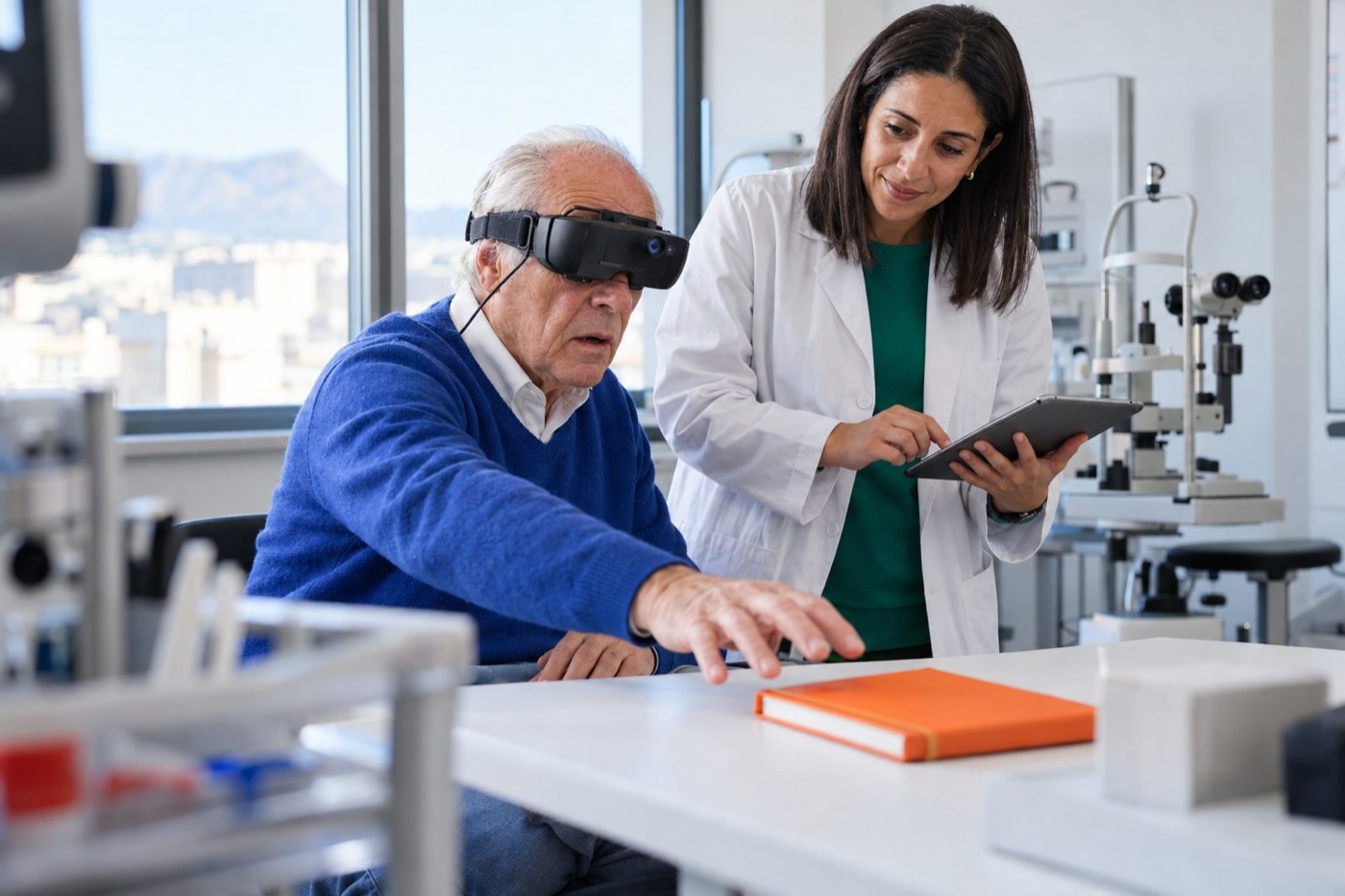
Researchers used a method called optogenetics. First, doctors injected a virus into one eye. The virus had been changed so that it could carry instructions that helped certain cells in the eye respond to light. Patients then used special goggles, which took pictures of the world around them and turned those pictures into light signals. Together, the injection and the goggles gave the brain some visual information.
The results were encouraging but limited. Six of the ten patients showed an important improvement in how sensitive they were to light. Some were also better able to find or touch objects while using the goggles. Researchers reported tasks such as finding a notebook or a doorway. However, the patients could not see normally, and the technology did not allow them to make out faces.
The trial mainly tested whether the treatment was safe. One serious eye-related problem occurred during an injection, but doctors treated it quickly. The researchers said that more studies are necessary to understand how useful the treatment could become. The small number of patients also means it is too early to know whether similar results would occur in a much larger group.
Even small improvements can matter in daily life. Finding an object independently or moving around a room with greater confidence may seem ordinary to someone with good vision, but it can be significant for somebody with severe sight loss. Scientists hope the approach will become more effective in the future. For now, it is an early medical step, not a cure for blindness, and the next challenge is to turn a promising experiment into help that more people can actually use.
Intermediate version
Imagine being able to detect a doorway after years of seeing almost nothing. That may sound like a modest achievement, but for somebody with severe sight loss it could make a practical difference. Researchers have reported encouraging results from an experimental treatment that combines gene therapy with electronic goggles. The study, published in the New England Journal of Medicine in October 2026, involved ten patients whose vision had been badly damaged by an inherited eye disease called retinitis pigmentosa.
The disease gradually destroys the light-sensitive cells in the retina, the tissue at the back of the eye that detects light and helps create images. When the damage becomes advanced, restoring sight is extremely difficult. The new treatment finds an unusual way to get around the problem. Instead of repairing the cells that have already been lost, it aims to make other surviving cells respond to light.
Doctors injected a modified virus into one eye of each participant. It delivered genetic instructions for a light-sensitive protein, allowing certain nerve cells to react to carefully controlled signals. Patients then wore special goggles that converted camera images into pulses of light. The system did not recreate ordinary vision. Rather, it gave the surviving cells a way of sending a limited amount of visual information to the brain.
Six of the ten participants showed what researchers considered a clinically meaningful improvement in light sensitivity, while seven of the ten showed some increase. With the goggles, some were better able to locate objects and carry out simple tasks, such as finding a notebook or identifying the position of a door. There were limits, however. The participants could not recognise faces, and the system produced only a restricted form of visual information. Those who spent more time learning to use the goggles generally performed better.
Safety was the main purpose of the trial. Researchers recorded eye-related side effects, most of which were mild or moderate. One severe event occurred immediately after an injection, but it was treated and resolved within minutes. The study was also small and had no untreated comparison group. That makes it important not to exaggerate its results or suggest that the treatment is ready for general use.
Nevertheless, the research represents a meaningful step forward. Rather than depending on the exact genetic cause of the disease, the method targets nerve cells that may survive several different forms of retinal damage. Further work will be needed to improve the images, test more patients and narrow down who might benefit most. For people who have lost their sight, the prospect of detecting an object or moving more confidently through a familiar room offers hope. The challenge is to turn those early gains into reliable improvements in everyday life.
Advanced version
An experimental treatment helped some people with severe sight loss detect more light and carry out simple visual tasks. That is a meaningful change, but it is not a cure for blindness. Researchers reported the results in October 2026 after treating ten patients with advanced retinitis pigmentosa, an inherited eye disease. The approach combined gene therapy with electronic goggles.
Retinitis pigmentosa gradually damages the retina's photoreceptors, the specialised cells that normally convert light into signals the nervous system can interpret. By the later stages, these cells may no longer function, making conventional restoration extremely difficult. Yet other retinal cells, including ganglion cells that transmit information towards the brain, can remain relatively intact. The experimental approach seeks to build on that distinction rather than reconstruct the eye's original machinery.
Researchers delivered genetic instructions for a light-sensitive protein called ChrimsonR through a single injection into the worse-seeing eye of each participant. Special goggles then recorded the surrounding scene and converted it into patterns of light designed to stimulate the modified cells. The technique, known as optogenetics, effectively gives surviving nerve cells a role they would not ordinarily perform. It also offers a potential advantage over treatments aimed at one specific genetic mutation: in principle, several causes of severe retinal degeneration might be addressed through the same general mechanism.
The results require careful interpretation. Seven of the ten participants experienced increased light sensitivity, although only six met the study's threshold for a clinically meaningful improvement. Some were able to locate or touch objects more successfully while wearing the goggles, and greater familiarity with the equipment appeared to help. The visual information remained crude, however. Participants could not recognise faces, and detecting the outline or position of an object is a considerable distance from restoring everyday sight. These limitations are central to understanding both the significance of the research and the work still required.
Safety, rather than proof of clinical effectiveness, was the study's primary objective. Most recorded eye-related adverse events were mild or moderate; one serious complication occurred immediately after an injection and resolved rapidly with treatment. The trial was small, open-label and lacked a control group, so it cannot establish how widely or reliably the benefits might be reproduced. Independent researchers nevertheless welcomed the evidence that optogenetic stimulation can provide visual function over an extended period.
Medicine advances not only through spectacular recoveries but through the steady accumulation of smaller capabilities. For someone with severe visual impairment, identifying a doorway or reaching towards an object can offer a measure of independence even when familiar faces remain invisible. The next challenge is to improve resolution, assess safety in larger studies and determine whether gains achieved in the laboratory hold up outside controlled settings. The treatment cannot yet return the world to patients as they once saw it. What it may eventually offer is a new way of navigating that world.
After you read
4True, false or not given5 statements
Choose T (true), F (false) or NG (the article does not say).
- More than half of the patients showed a clear improvement in sensitivity to light.
The text says: "Six of the ten patients showed an important improvement in how sensitive they were to light."
- The goggles will be available in shops next year.
Not stated. The text does not say when the goggles might be sold.
- The study was small, with ten patients.
The text says: "The study involved ten people with advanced retinitis pigmentosa."
- The treatment allowed patients to recognise faces.
The text says the opposite: "the technology did not allow them to make out faces."
- The virus was put into both eyes of each patient.
The text says doctors put a virus "into one eye".
5Vocabulary5 gaps
Complete the sentences with words from the box. Two words are not needed.
encouragingexperimentalindependentlyinjectedlimitedreliabletreated
- Because the treatment is still , doctors cannot offer it to everyone yet.
- The first results were , so the researchers felt hopeful.
- Doctors the medicine into one eye with a very small needle.
- Many people prefer to do things and not ask for help.
- The goggles gave only a amount of information, so patients could not see faces.
6Verb forms5 gaps
Write the correct form of the verb in brackets.
- The study ten people with advanced retinitis pigmentosa. (INVOLVE)
- The virus had been so that it could carry instructions to the cells. (CHANGE)
- Six of the ten patients an important improvement in light sensitivity. (SHOW)
- One serious problem during an injection. (OCCUR)
- The results of the study, in October 2026, offer some hope. (PUBLISH)
7Language focusphrasal verbs
Complete the sentences with words from the box. Two words are not needed. A phrasal verb is a verb plus a small word such as on or off. The small word changes the meaning, so learn the pair together.
apartbehindintoonoutthroughup
- The team wants to find whether the treatment is safe.
- The goggles turn pictures light signals.
- The researchers will carry with a larger study.
- People should not give hope after one small trial.
- It is hard to tell two similar objects without clear vision.
4True, false or not given5 statements
Choose T (true), F (false) or NG (the article does not say).
- The treatment costs less than existing eye surgery.
Not stated. The text does not compare the cost with other treatments.
- Patients who practised more with the goggles generally performed better.
The text says: "Those who spent more time learning to use the goggles generally performed better."
- The study appeared in the New England Journal of Medicine.
The text says it was "published in the New England Journal of Medicine in October 2026".
- The trial included an untreated comparison group.
The text says the opposite: "had no untreated comparison group."
- More participants showed some increase in light sensitivity than showed a clinically meaningful one.
Seven of the ten showed some increase, but only six showed a clinically meaningful improvement.
5Vocabulary6 gaps
Complete the sentences with words from the box. Two words are not needed.
exaggeratefamiliarmildmodifiedresolvedrestrictedseveresurviving
- News reports should not the results of a small early trial.
- Access to the new treatment is to people who join a clinical trial.
- The flood destroyed most of the village, and the houses were repaired later.
- The doctor said the pain was and that the patient needed hospital care at once.
- The problem was within minutes, and the test carried on.
- Walking in a room is easier than in a place you have never visited.
6Verb forms5 gaps
Write the correct form of the verb in brackets.
- By the time the study ended, six patients a meaningful improvement. (SHOW)
- Camera images into pulses of light by the goggles. (CONVERT)
- If the trial had included an untreated group, the researchers the two groups. (COMPARE)
- Immediately after an injection, a serious event , but it was treated within minutes. (OCCUR)
- The goggles allow patients objects more easily. (LOCATE)
7Language focusphrasal verbs
Complete the sentences with words from the box. Two words are not needed. Check what follows the gap: some of these verbs take an object, and some take a how-clause or another preposition.
acrossbehinddownintoonoutup
- A larger study may help doctors narrow the list of people who could benefit.
- Researchers still have to work how long the effect lasts.
- The team hopes to turn these early gains lasting benefits.
- A good trial must follow with patients to check for later side effects.
- The size of the gain may depend how long a patient practises.
4True, false or not given5 statements
Choose T (true), F (false) or NG (the article does not say).
- Everyone whose light sensitivity increased also reached the level the study counted as a clinically meaningful improvement.
Seven participants had increased sensitivity, but only six met the study's level.
- The optogenetic approach could in principle help people whose severe sight loss has different genetic causes.
The text says several causes of severe retinal degeneration "might be addressed through the same general mechanism".
- Participants practised with the goggles at home during the study.
Not stated. The text does not say where participants used the goggles.
- The gene therapy was injected into each participant's better-seeing eye.
The text says it went into "the worse-seeing eye of each participant".
- The treatment worked on cells that were still present after the photoreceptors had stopped working.
The photoreceptors may no longer function, yet other retinal cells remain relatively intact and are modified.
5Vocabulary6 gaps
Complete the sentences with words from the box. Two words are not needed.
conventionalintactreconstructspectacularthresholdtransmitwelcomedwithstand
- Although the storm wrecked the roof, the walls were left .
- To qualify for the programme, a candidate's score must exceed a certain .
- The surgeon's result was nothing short of : the patient walked out the next day.
- Doctors were reluctant to depart from methods that had served them for decades.
- It would be impossible to the ancient temple from the few fragments that survive.
- The council the proposal, saying it would bring much-needed jobs.
6Word forms5 gaps
Use the word in brackets to make a word that fits the gap.
- These cells may no longer function, making of normal sight extremely difficult. (RESTORE)
- The data from ten patients are far from . (CONCLUDE)
- The results require careful . (INTERPRET)
- For someone with severe visual , finding a doorway matters. (IMPAIR)
- Some online headlines made claims that a cure was near. (SUBSTANTIATE)
7Language focusphrasal verbs
Complete the sentences with words from the box. Two words are not needed. At this level many phrasal verbs are figurative. Learn the whole unit and the particle that follows, such as aside, out, on or up.
backbankbrushhandpanrulewear
- Sceptics were quick to aside the findings as too small to matter.
- A small trial without a control group cannot out the possibility that chance explains the result.
- It is too early to say how the research will out.
- Patients should not on a cure from a single small trial.
- Larger studies are needed to up these early claims.
Speak
8Talk about it3 questions
Discuss in pairs or small groups. Give reasons for your answers.
- How should a headline explain a treatment that helps some people a little?
- What should researchers explain before asking people to try a new treatment?
- Which matters more in a science story: the breakthrough or what it changes in daily life?
9Role-play: choosing a headline
Work in pairs. Read your card, then have the conversation. Swap roles and do it again.
Student A · the editor
You edit a newsletter for a charity that supports people with sight loss. You want a short, exciting headline about a small trial. Ask the writer what the study really showed, then decide together.
Student B · the writer
You've read about a small trial. It helped some people find objects, but it isn't a cure. Explain why the headline must be honest, and suggest a version you both like.
Useful phrases
- I'd like the headline to catch people's attention.
- That's not quite accurate, though.
- We shouldn't promise more than the study showed.
- What if we say it's an early step?
- I'm not sure that's fair to our readers.
- Let's agree on a version we're both happy with.
Afterwards, tell the class: which headline did you choose, and why is it fair to readers?
Your words
Highlights0 saved
Highlights0 saved
Highlights0 saved
Was this lesson useful? Support johnplusnews on Ko-fi
Continue reading
Language
Did Writing Really Make Languages More Complicated?
A large study of about 100,000 sentences in 30 languages found no universal pattern showing that writing makes sentences more complex. It does not say that writing never changes a language.
Psychology
The Way You Think About Being Alone Changes How It Feels
Researchers read 144 newspaper articles about solitude and found them overwhelmingly gloomy. They also found that what you believe about time alone predicts how lonely it makes you.
History
Were People Getting High 2,800 Years Ago?
Cannabis seeds and chemical traces in preserved hair from a Siberian tomb suggest that some Scythians were exposed to its intoxicating compounds about 2,800 years ago. The evidence is strong, but it leaves many questions open.