News lesson14 October 2026
The Bird That Would Not Quite Be a Dodo
Colossal Biosciences has rebuilt most of the dodo's genome and hopes to edit a Nicobar pigeon. Critics ask what the finished bird would actually be.
Before you read
1Warm up3 questions
Talk about these questions with a partner.
- Which extinct animal would you most like to see alive?
- Would you visit a place to see an animal created by scientists?
- What makes an animal worth protecting?
2Key words8 words
These words are in the article. Choose the letter of the meaning for each one.
- extinction
- symbol
- genes
- beak
- relative
- species
- conservation
- survive
- Atiny parts inside a living thing that decide how it looks and grows
- Ba member of the same family or group
- Cthe hard part of a bird's mouth
- Dsomething that stands for a bigger idea
- Eto stay alive
- Fone kind of animal or plant
- Gwhen a type of animal or plant dies and none are left
- Hwork to protect nature and wild animals
1Warm up3 questions
Talk about these questions with a partner.
- Which extinct animal would you most like to see alive?
- Would you visit a place to see an animal created by scientists?
- What makes an animal worth protecting?
2Key words8 words
These words are in the article. Choose the letter of the meaning for each one.
- genome
- flightless
- extinct
- habitat
- ecosystem
- resurrection
- resources
- enormous
- Aall the genetic information of a living thing
- Bno longer alive anywhere in the world
- Call the living things in an area and how they affect each other
- Dvery, very big
- Ethe natural place where an animal or plant lives
- Fnot able to fly
- Gmoney, time and materials that you can use
- Hthe act of bringing something back to life
1Warm up3 questions
Talk about these questions with a partner.
- Which extinct animal would you most like to see alive?
- Would you visit a place to see an animal created by scientists?
- What makes an animal worth protecting?
2Key words8 words
These words are in the article. Choose the letter of the meaning for each one.
- shorthand
- genome
- conceptual
- advocates
- unglamorous
- prospect
- restoration
- spectacular
- Aconnected with ideas rather than practical details
- Bthe chance that something will happen
- Cnot exciting or attractive
- Dvery impressive and dramatic
- Ethe act of returning something to its earlier condition
- Fa quick way of referring to something bigger
- Gthe full set of genetic instructions of a living thing
- Hpeople who publicly support an idea or plan
Read
3Read the article
The paragraphs are numbered. Look out for the key words from task 2.
Core version
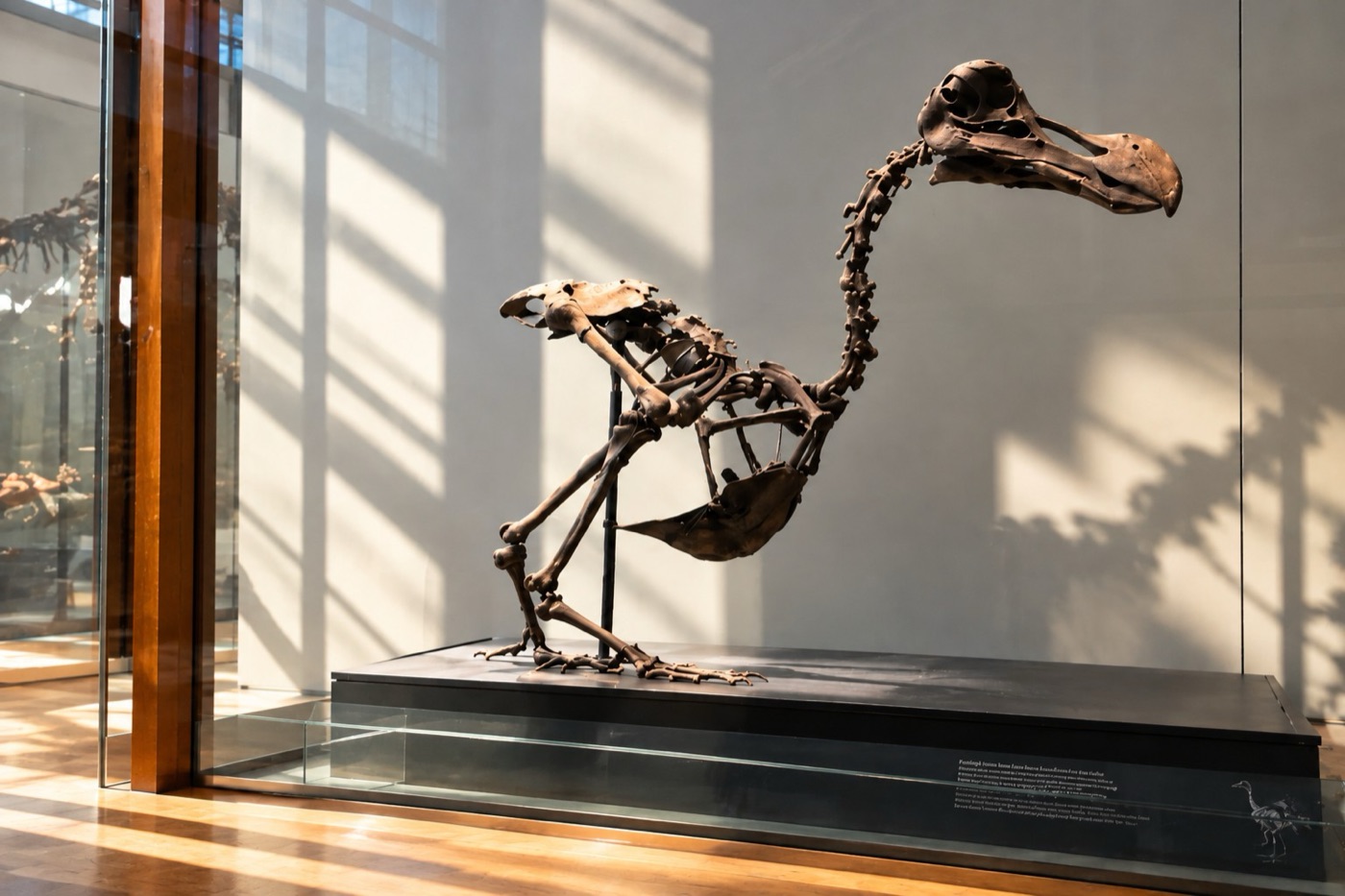
The dodo was a large bird that could not fly. It lived on the island of Mauritius in the Indian Ocean until it died out in the seventeenth century. Today, the bird is famous as a symbol of extinction. But scientists at an American biotechnology company are trying to do something extraordinary: create a living bird with some of the dodo's characteristics.
The company, Colossal Biosciences, uses genetic technology to study animals that no longer exist. Genes are the instructions inside a living thing that help control how it grows and develops. In October 2026, the company announced progress in its dodo project. It said it had rebuilt most of the dodo's genetic information and developed tools to find the genes linked to features such as the shape of its head and beak. It hopes to make careful changes to a living relative of the dodo.
That living relative is the Nicobar pigeon. It is a colourful bird found on islands in Asia, and scientists believe it is the dodo's closest living relative. The basic idea is to study the genetic differences between the birds and change some of the pigeon's genes.
However, this is not like bringing an original dodo back from the dead. The scientists have not produced a living dodo, and nobody can simply copy one from an old bone. Even if the project succeeds, the result may be a new bird that resembles a dodo in some ways, rather than exactly the same species that disappeared centuries ago.
Some conservation experts think the research could lead to useful new ways of protecting endangered animals. Others believe that the money would be better spent saving species that are still alive. They also ask where a new dodo-like bird would live. The original birds disappeared after people arrived on Mauritius and introduced animals that disturbed their habitat. Any future bird would need a safe place to survive.
For now, the dodo remains extinct. Colossal's announcement is about progress in genetic research, not a successful return. But the project raises an interesting question. If humans helped cause an animal's disappearance, should we try to bring it back, or should we focus on preventing the next extinction? The answer could shape how conservation works for many years to come.
Intermediate version
The dodo has been extinct for more than three centuries, yet it may be one of the most recognisable birds in history. The large, flightless creature once lived on Mauritius, where hunting and animals introduced by humans helped to wipe it out. Now a US biotechnology company wants to create a living bird with some of the dodo's distinctive features. Whether that would count as bringing the dodo back is another question.
Colossal Biosciences announced fresh progress in October 2026. The company said it had reconstructed about 95% of the dodo's genome, the collection of genetic instructions that helped determine how the bird developed. It is also using an AI-assisted system to pick out changes linked to features such as the dodo's unusually shaped beak. Researchers hope to introduce selected changes into the genes of a living relative, the Nicobar pigeon.
This is where the idea becomes complicated. The Nicobar pigeon is not a dodo, even though the species share an evolutionary history. Changing some of its genes could eventually produce a bird that looks or behaves more like the extinct species. But it would not necessarily recreate the original animal, complete with the same behaviour, development and place in the ecosystem. Colossal has not yet produced a living dodo or dodo-like bird through this programme.
Supporters argue that research into gene editing and reproduction could produce tools useful for conservation. If scientists become better at protecting genetic diversity or helping endangered birds reproduce, living species may benefit. The company is also working with people in Mauritius to explore how suitable habitat might be restored. Without a safe environment, even an impressive scientific achievement would have little chance of surviving outside a laboratory.
Critics question the priorities. De-extinction projects attract publicity and investment partly because famous animals are involved. Meanwhile, many less glamorous species are disappearing right now. Some researchers also object to the word 'resurrection', which suggests an exact return that current technology cannot deliver. They argue that a genetically modified relative would be a new creation rather than the original species brought back to life.
The dodo project is only beginning to take shape and remains an experiment with an uncertain outcome. Its value may eventually lie in techniques developed along the way rather than in producing a perfect copy of an extinct bird. Even so, the ambition forces us to confront an uncomfortable question about conservation. If we can spend enormous resources trying to reverse one historic loss, how much should we spend preventing the ordinary, less famous losses taking place around us today?
Advanced version
The dodo is the bird everyone knows is gone. A large, flightless species that vanished from Mauritius in the seventeenth century, it has become shorthand for extinction. In October 2026, the US-based Colossal Biosciences announced further progress towards engineering a bird with some of the dodo's defining characteristics. The ambition is striking. What success would actually mean is much less clear.
Colossal says it has reconstructed about 95% of the extinct bird's genome, the full set of its genetic instructions, and developed an AI-assisted system to identify the genetic changes linked to features such as the unusual shape of its head and beak. Its proposed route involves introducing selected changes into a living relative, the Nicobar pigeon, and addressing the formidable reproductive challenges involved in producing genetically modified birds. These are genuine areas of technical research, but no recreated dodo has emerged, and the distance between identifying promising genetic targets and producing a viable animal remains considerable. Nor is that a gap which funding and publicity alone will bridge.
The deeper difficulty is conceptual. Scientists may be able to piece together a genetic approximation of the bird, but a species is not simply a list of instructions waiting to be reassembled. Genes interact with development, behaviour, environment and the experience of generations. A bird engineered to resemble the dodo might share some physical characteristics with its extinct ancestor without reproducing its full biology or ecological role.
For this reason, a number of evolutionary biologists argue that 'de-extinction' is a misleading description. A proxy species, however remarkable, should not be confused with the recovery of an organism that has genuinely vanished.
There is also a practical question about what such a bird would do once created. Mauritius has changed profoundly since the dodo's disappearance. Introduced predators, habitat destruction and other human influences helped drive the original species towards extinction. Releasing a dodo-like bird without grappling with those pressures would make little ecological sense.
Colossal says it is collaborating with Mauritian partners on habitat preparation, a reminder that restoration depends as much on ordinary conservation work as on sophisticated genetics. Habitat preparation is slow, unglamorous work, and it would have to succeed before any engineered bird could be released with any prospect of surviving.
Advocates see wider benefits in the research. Methods developed for gene editing, reproduction and the preservation of genetic diversity might eventually help threatened species. Critics counter that spectacular resurrection projects attract disproportionate attention and resources while existing wildlife faces immediate and measurable dangers. Both arguments have merit, although the potential benefits of experimental biotechnology should not be mistaken for benefits already demonstrated in conservation programmes.
For now, the dodo belongs to history rather than to the forests of Mauritius. The company has advanced aspects of a research programme; it has not done away with extinction. Perhaps the most useful contribution of such ambitious science will be to sharpen rather than dissolve the distinction between restoration and imitation. A convincing likeness could be a remarkable scientific achievement. Whether it would repair the ecological loss that made the dodo famous is an altogether more demanding question.
After you read
4True, false or not given5 statements
Choose T (true), F (false) or NG (the article does not say).
- Some experts would prefer to spend the money on animals that still exist.
The text says: "Others believe that the money would be better spent saving species that are still alive."
- Scientists have produced a living dodo.
The text says the opposite: "The scientists have not produced a living dodo."
- Scientists believe the Nicobar pigeon is a distant relative of the dodo.
The text says it is "the dodo's closest living relative".
- The dodo came from an island in the Indian Ocean.
The text says: "It lived on the island of Mauritius in the Indian Ocean."
- The company plans to set the first new bird free on Mauritius next year.
Not stated. The text gives no date for any release.
5Vocabulary5 gaps
Complete the sentences with words from the box. Two words are not needed.
characteristicsdisturbedextraordinaryhabitatintroducedpredatorresembles
- Cutting down forests destroys the where many animals live.
- Bringing back a lost animal would be an achievement.
- Dogs and wolves share several , such as sharp teeth and a good sense of smell.
- Rats to the island by ships ate the birds' eggs.
- A mule a horse, but it is a different animal.
6Verb forms5 gaps
Write the correct form of the verb in brackets.
- In October 2026, the company progress in its dodo project. (ANNOUNCE)
- It said it most of the dodo's genetic information. (REBUILD)
- People rats and pigs to Mauritius, and the animals harmed the birds. (BRING)
- The original birds after people arrived on Mauritius. (DISAPPEAR)
- Any future bird a safe place to survive. (NEED)
7Language focuscollocations
Complete the sentences with words from the box. Two words are not needed. A collocation is a pair of words that go together naturally. We say make progress, not do progress.
dogivemadeplayposeraisestake
- The team has good progress with its genetic research.
- The project an interesting question about how we protect animals.
- Governments must action to protect rare animals.
- Rats and cats a serious threat to island birds.
- Safe habitats an important role in protecting wildlife.
4True, false or not given5 statements
Choose T (true), F (false) or NG (the article does not say).
- The project is funded mainly by the Mauritian government.
Not stated. The text does not say who pays for the project.
- Colossal says it has rebuilt almost all of the dodo's genetic code.
The text says: "reconstructed about 95% of the dodo's genome".
- Colossal is cooperating with Mauritians to prepare places where birds could live.
The text says: "The company is also working with people in Mauritius".
- Colossal has produced a dodo-like bird through the programme.
The text says: "Colossal has not yet produced a living dodo or dodo-like bird".
- Researchers who object to the word 'resurrection' think it describes the technology accurately.
The text says it "suggests an exact return that current technology cannot deliver".
5Vocabulary6 gaps
Complete the sentences with words from the box. Two words are not needed.
achievementambitioncampaignconfrontdistinctiveprioritiespublicityrecreate
- Landing a probe on a comet was widely praised as a great , and the team received awards.
- The dodo had several features, including an unusually shaped beak.
- The film received a lot of before its release, which helped it sell tickets.
- Her is to become the first person in her family to run a company.
- After the argument, he decided to his manager and explain how he felt.
- Doctors must decide their when many patients arrive at once.
6Verb forms5 gaps
Write the correct form of the verb in brackets.
- By October 2026, the company most of the dodo's genome. (RECONSTRUCT)
- The dodo extinct for more than three centuries. (BE)
- Without safe habitat, any released bird little chance of surviving in the wild. (HAVE)
- The word 'resurrection' by some researchers because it suggests an exact return. (CRITICISE)
- If scientists better at protecting genetic diversity, living species may benefit. (GET)
7Language focuscollocations
Complete the sentences with words from the box. Two words are not needed. Some verbs go with certain nouns for no logical reason. We raise funds and reach a conclusion, but we do not make them.
attractdofacemakepayraisereach
- The company hopes to funds from investors to continue the project.
- Famous animals more attention than quiet, ordinary species.
- Any attempt to restore a lost species will enormous practical challenges.
- After years of debate, scientists have yet to a firm conclusion.
- A gene-editing breakthrough could a real contribution to wildlife protection.
4True, false or not given5 statements
Choose T (true), F (false) or NG (the article does not say).
- The article suggests that identifying genes linked to the dodo's beak is easier than producing a viable bird.
The text says the distance between "identifying promising genetic targets and producing a viable animal remains considerable".
- The writer thinks funding and publicity would be enough to close the gap between genetic research and a viable bird.
The text says: "Nor is that a gap which funding and publicity alone will bridge."
- The writer accepts that both supporters and critics of the project have a reasonable point.
The text says: "Both arguments have merit".
- Mauritius has agreed to release any engineered bird into the wild.
Not stated. The text does not say whether Mauritius has agreed to any release of engineered birds.
- The writer treats a convincing likeness of the dodo as scientifically worthless.
The text says it "could be a remarkable scientific achievement".
5Vocabulary6 gaps
Complete the sentences with words from the box. Two words are not needed.
approximationbridgedissolveformidablemeritpervasiveproxytenuous
- Persuading regulators to approve the release would be a task, given how cautious they are.
- The model offers only a rough of how the ecosystem really behaves.
- I disagree with the conclusion, but I admit the argument has some .
- Once the cost was explained, the initial enthusiasm began to .
- It will take more than donations to the gap between the plans and the practice.
- Rising sales are sometimes used as a for consumer confidence.
6Word forms5 gaps
Use the word in brackets to make a word that fits the gap.
- Mauritius has changed profoundly since the dodo's . (APPEAR)
- The of extinction is what makes every loss so serious. (REVERSE)
- A bird engineered to resemble it might not reproduce its role. (ECOLOGY)
- The of any release depends on controlling introduced predators. (SUSTAIN)
- Spending large sums on one famous species may leave others without help. (PROPORTION)
7Language focuscollocations
Complete the sentences with words from the box. Two words are not needed. At C1, many collocations need one exact verb or adjective. We lay the groundwork, but we make progress.
dismantleheatedlaypavesweepingunforeseenvoiced
- The pilot study helped the groundwork for a much larger programme.
- Several biologists have doubts about whether a modified pigeon counts as a dodo.
- The announcement has triggered a debate among biologists.
- Promoters of the technology sometimes make claims about what it can achieve.
- Releasing animals without proper planning can have consequences for native wildlife.
Speak
8Talk about it3 questions
Discuss in pairs or small groups. Give reasons for your answers.
- Would a bird that looked like a dodo count as bringing it back?
- Would you spend more on protecting living species or recreating extinct ones?
- Could the promise of bringing animals back make extinction seem less serious?
9Role-play: where should the money go?
Work in pairs. Your wildlife charity has £50,000 to spend. Read your card, then have the conversation. Swap roles and do it again.
Student A · the colleague who wants to protect living birds
You want to spend the money on a nature reserve for birds in danger today. Explain why. Ask your partner what they would really get for the money.
Student B · the colleague who likes the new science
You want to give the money to research that tries to bring back a lost animal. Say why it could help. Listen to your partner's worries and try to agree a plan.
Useful phrases
- I'd rather spend it on animals we can still save.
- That's a fair point, but it's worth the risk.
- What would we actually get for the money?
- I don't think it's one or the other.
- Could we split it between the two projects?
- We're running out of time, so let's decide.
Afterwards, tell the class: where did the money go, and who gave way?
Your words
Highlights0 saved
Highlights0 saved
Highlights0 saved
Was this lesson useful? Support johnplusnews on Ko-fi
Continue reading
Language
Did Writing Really Make Languages More Complicated?
A large study of about 100,000 sentences in 30 languages found no universal pattern showing that writing makes sentences more complex. It does not say that writing never changes a language.
History
Were People Getting High 2,800 Years Ago?
Cannabis seeds and chemical traces in preserved hair from a Siberian tomb suggest that some Scythians were exposed to its intoxicating compounds about 2,800 years ago. The evidence is strong, but it leaves many questions open.
Travel
What Happens When One of the World's Quietest Places Gets Easier to Visit?
Greenland now has three new airports and more visitors than ever, but tourism is still a small part of its economy. Some residents worry about what a rush of visitors could do to a quiet place with a fragile environment.