Could Potatoes Grow on the Moon?
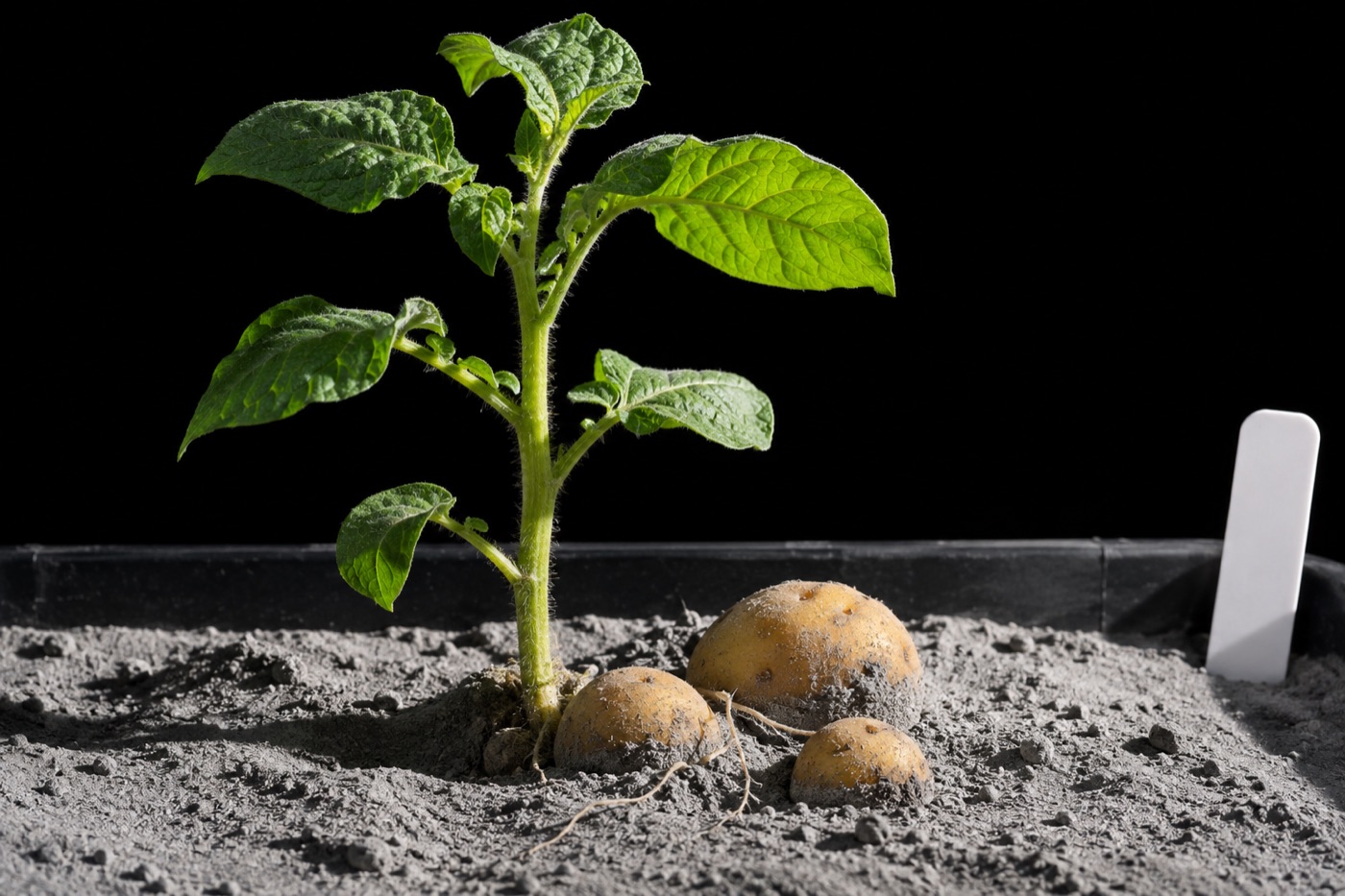
Researchers grew potatoes in Earth-made material that imitates Moon soil. With enough compost mixed in, the plants did about as well as potatoes in ordinary soil. It was a greenhouse test on Earth, not real Moon soil.
Warm up3 questions
- Why would growing food be important for people living on the Moon?
- What do plants need to grow well?
- What is compost, and how is it made?
Sentence help (optional): I'd choose ... because ... · For me, ... · I think ... because ...
Warm up3 questions
- Why would growing food be important for people living on the Moon?
- What do plants need to grow well?
- What is compost, and how is it made?
Warm up3 questions
- Why would growing food be important for people living on the Moon?
- What do plants need to grow well?
- What is compost, and how is it made?
Core version
Imagine living on the Moon. You could look out of the window and see Earth in the distance, but there would be no supermarket around the corner. Astronauts would need food, and sending every meal from Earth would be expensive and difficult. Scientists in the United States are trying to solve that problem. In November 2026, they reported an exciting experiment involving one of the world's most familiar foods: potatoes.
Researchers at Oregon State University grew potato plants in a material designed to be similar to soil found on the Moon. It was not real soil brought back from space. Scientists call the loose, rocky material on the Moon regolith. They made several versions of this material and tried growing plants in it under controlled conditions on Earth. At first, the potatoes struggled to grow.
Then the researchers mixed in vermicompost, a type of compost made with the help of earthworms. When the mixture contained 30% compost, the plants grew about as well as potatoes grown in ordinary Earth soil under the same conditions. Smaller amounts of compost were less successful, and plants in the Moon-like material without enough extra organic matter grew badly. The result was reported in a scientific paper published on 19 November 2026.
Why does compost make such a difference? Plants need nutrients and suitable conditions around their roots. Moon-like material can be difficult for plants because it lacks the living, healthy qualities of normal garden soil. The compost seems to help the plants get what they need and deal with some harmful parts of the material. The potatoes were able to complete their life cycle and produce new potatoes.
Of course, this does not mean astronauts can start planting potatoes outside a Moon base tomorrow. The experiment took place in a greenhouse on Earth, using pretend Moon soil. There were no freezing lunar nights, dangerous radiation or problems with living on a surface with almost no air. A real Moon farm would need special buildings, water, energy and many other systems. Scientists still have a lot of work to do.
Even so, growing food in space could make future journeys easier. Astronauts might spend months or years away from Earth, so fresh food could become very important. The research also shows how something as ordinary as compost can help with an extraordinary challenge. If you lived on the Moon, which food would you most want scientists to find a way to grow?
Intermediate version
Imagine being part of a team living on the Moon for several months. You could not simply pop into a supermarket when your food supplies ran low, and delivering every meal from Earth would be extremely expensive. Scientists therefore want to find ways of growing crops away from our planet. In November 2026, researchers at Oregon State University reported encouraging progress with a familiar vegetable: the potato. Their results suggest that Moon-like soil might support food production if it is mixed with enough organic material.
The study, published in npj Microgravity on 19 November, used several types of lunar regolith simulant. Regolith is the loose, rocky material covering the Moon's surface, and a simulant is an Earth-made substitute designed to share some of its properties. The scientists grew potato plants in these materials under controlled greenhouse conditions, adding different quantities of vermicompost. This compost is created when earthworms break down organic matter, producing material rich in nutrients that can support plant growth.
Without sufficient compost, the potatoes struggled. Their growth was poor and they produced fewer tubers, the parts of the plant we eat. But when the mixture contained 30% vermicompost, the plants performed about as well as potatoes grown in ordinary Earth soil under comparable conditions. Lower amounts provided only partial improvement. This matters because it suggests that future Moon farms might not need to bring all their growing material from Earth. Instead, they could potentially improve local material with specially prepared organic matter.
There are several reasons why the approach might work. Ordinary soil contains nutrients and biological activity that help plant roots develop. Moon-like regolith lacks many of those advantages and can contain substances that make growth difficult. Compost can supply nutrients and may reduce some harmful effects. The researchers also found that plants could complete their life cycle and produce potatoes, which is far more useful than simply getting a few leaves to appear.
However, the headline needs an important warning. These potatoes were not grown on the Moon, and the researchers did not use genuine lunar soil. The experiment took place in an Earth greenhouse, where temperature, light and water could be controlled. A real lunar greenhouse would also need protection from radiation, extreme temperatures and the Moon's lack of a breathable atmosphere. Engineers would have to work out how to supply energy and recycle water efficiently over long periods.
Nevertheless, the results offer a promising step towards growing fresh food during space missions. Potatoes provide useful energy, can be prepared in many ways and are familiar to people around the world. The experiment also shows that solving future space problems may depend on surprisingly simple ideas, such as using compost to improve difficult growing material. Would you rather take all your food from Earth or learn to grow it in a greenhouse on the Moon?
Advanced version
A permanent settlement on the Moon would face a surprisingly ordinary challenge: feeding its inhabitants. Delivering every meal from Earth would require enormous logistical effort, making local food production an attractive long-term goal. Yet the lunar surface is hardly a welcoming place for crops. Its loose mineral covering, known as regolith, lacks the qualities that make terrestrial soil suitable for agriculture. A study published in November 2026 suggests that a familiar biological material might help overcome some of those difficulties: compost produced with the assistance of earthworms.
Researchers at Oregon State University investigated how potatoes performed in several lunar regolith simulants, Earth-made materials designed to resemble different types of lunar surface deposits. Their findings, published in npj Microgravity on 19 November 2026, compared potato plants grown with varying proportions of vermicompost, a nutrient-rich material created as earthworms break down organic waste. The experiments took place under controlled greenhouse conditions on Earth, using simulated rather than real lunar soil, a distinction that is essential when interpreting the results.
The difference between the growing mixtures was striking. Plants raised in largely unamended simulant were stunted and produced poor yields, while adding modest amounts of vermicompost improved their performance only partly. When the mixture contained 30% compost, however, the potatoes achieved growth and yields comparable with those cultivated in ordinary Earth soil under similar conditions. The researchers also examined plant responses and tuber composition, providing evidence that producing a crop in these difficult materials might be biologically feasible.
The compost appears to do more than supply the nutrients missing from a mineral substrate. Researchers suggested that it may also help protect plants from potentially harmful components of lunar-like material. This raises the possibility of using recycled organic waste to improve local growing conditions in future space habitats. Rather than transporting enormous quantities of finished soil, crews might eventually build a more sustainable agricultural system by combining available minerals with carefully processed biological matter.
Nevertheless, there is a substantial gulf between success in a greenhouse and reliable farming on the Moon. Real regolith is not identical to the simulants used in research, and the lunar environment presents severe obstacles, including extreme temperatures, radiation and an almost complete absence of atmosphere. Water, lighting, energy and the safe recycling of waste would all need to be managed. Future experiments must also establish whether crops can be grown consistently, at useful scales and with acceptable nutritional quality over repeated cycles.
The significance of the study is therefore not that potatoes are ready to be planted directly in lunar dust. Researchers will need to repeat and expand experiments before anyone can depend on such a system for survival. It is that scientists have identified a plausible ingredient for a much larger system of space agriculture. There is something appealing about the idea that a technology as advanced as a Moon settlement might rely on a process as familiar as composting. If humans establish a long-term presence beyond Earth, should we prioritise reproducing ordinary food and routines, or develop entirely new ways of eating and living?
Study this story
Save the words you want to keep, talk about the story, then practise the language.
Highlights0 saved
Highlights0 saved
Highlights0 saved
Talk about it3 questions
- Why is pretend Moon soil different from real Moon conditions?
- Would you enjoy eating food grown in a Moon greenhouse?
- Which food would be most useful for astronauts to grow?
Sentence help (optional): I think ... because ... · One reason is ... · For me, ...
You can talk about people in general instead of yourself, and you can pass on any question.
Talk about it3 questions
- Why is pretend Moon soil different from real Moon conditions?
- Would you enjoy eating food grown in a Moon greenhouse?
- Which food would be most useful for astronauts to grow?
You can talk about people in general instead of yourself, and you can pass on any question.
Talk about it3 questions
- Why is pretend Moon soil different from real Moon conditions?
- Would you enjoy eating food grown in a Moon greenhouse?
- Which food would be most useful for astronauts to grow?
You can talk about people in general instead of yourself, and you can pass on any question.
Try it
In pairs, imagine you are the food team for a Moon base with six people. Choose three plants to grow and decide why each one is useful. Then explain to another pair one problem your team would still need to solve, and listen to their ideas.
Exercises4 exercises
1. Complete the sentences
Drag a word into each gap, or tap a word and then tap a gap. Tap a filled gap to put the word back. Two words are not needed.
- Researchers grew potato plants in a material designed to be similar to found on the Moon.
- Astronauts would need , and sending every meal from Earth would be expensive.
- With 30% in the mixture, the plants grew about as well as in Earth soil.
- The experiment took place in a on Earth.
- The potatoes were able to complete their life .
2. Match the meaning
Choose the meaning of each word or phrase as it is used in the article.
- regolith
- vermicompost
- nutrients
- radiation
Write the letter of the meaning next to each word.
- A substances that plants need in order to grow
- B the loose, rocky material that covers the Moon
- C dangerous energy that comes from space
- D compost made with the help of worms
3. Put the verb in the right form
Write the correct form of the verb in brackets.
- In November 2026, scientists an exciting experiment. (report)
- At first, the potatoes to grow. (struggle)
- Then the researchers in vermicompost. (mix)
- The result reported in a scientific paper. (be)
- Plants in the Moon-like material without enough extra organic matter badly. (grow)
4. True, false or not given
Choose Not given if the article does not say, even when you think the statement is probably true.
- The potatoes were grown in real soil from the Moon.
The text says: "It was not real soil brought back from space."
- Thirty per cent compost helped the plants grow about as well as in Earth soil.
The text says: "When the mixture contained 30% compost, the plants grew about as well as potatoes grown in ordinary Earth soil under the same conditions."
- The experiment took place on the Moon.
The text says: "The experiment took place in a greenhouse on Earth, using pretend Moon soil."
- The potatoes tasted better than normal potatoes.
The text does not say how the potatoes tasted.
- The potatoes produced new potatoes.
The text says: "The potatoes were able to complete their life cycle and produce new potatoes."
Your score
Do all four, then add them up.
Answer key
- Complete the sentences1 soil · 2 food · 3 compost · 4 greenhouse · 5 cycle
- Match the meaning1 regolith = B · 2 vermicompost = D · 3 nutrients = A · 4 radiation = C
- Put the verb in the right form1 reported · 2 struggled · 3 mixed · 4 was · 5 grew
- True, false or not given1 False · 2 True · 3 False · 4 Not given · 5 True
1. Complete the sentences
Drag a word into each gap, or tap a word and then tap a gap. Tap a filled gap to put the word back. Two words are not needed.
- A simulant is an Earth-made designed to share some of the Moon's properties.
- The compost is made when earthworms break down matter.
- Without enough compost, the potatoes produced fewer .
- With 30% vermicompost, the plants did about as well as potatoes in ordinary Earth .
- The experiment took place where temperature, light and water could be .
- A lunar greenhouse would need protection from .
2. Match the meaning
Choose the meaning of each word or phrase as it is used in the article.
- simulant
- tubers
- encouraging
- genuine
Write the letter of the meaning next to each word.
- A the underground parts of a potato plant that we eat
- B giving hope that something will work
- C real, not a copy
- D a man-made copy of a natural material
3. Put the verb in the right form
Write the correct form of the verb in brackets.
- Researchers at Oregon State University encouraging progress. (report)
- The scientists potato plants in these materials. (grow)
- The study several types of lunar regolith simulant. (use)
- Moon-like regolith many of those advantages. (lack)
- These potatoes not grown on the Moon. (be)
4. True, false or not given
Choose Not given if the article does not say, even when you think the statement is probably true.
- The researchers used real lunar soil.
The text says: "the researchers did not use genuine lunar soil"
- Lower amounts of vermicompost helped the plants only partly.
The text says: "Lower amounts provided only partial improvement."
- The study was published in December.
The text says: "published in npj Microgravity on 19 November"
- The scientists will test other vegetables next year.
The text does not say which vegetables the scientists will test next.
- The plants were able to complete their life cycle.
The text says: "plants could complete their life cycle and produce potatoes"
Your score
Do all four, then add them up.
Answer key
- Complete the sentences1 substitute · 2 organic · 3 tubers · 4 soil · 5 controlled · 6 radiation
- Match the meaning1 simulant = D · 2 tubers = A · 3 encouraging = B · 4 genuine = C
- Put the verb in the right form1 reported · 2 grew · 3 used · 4 lacks · 5 were
- True, false or not given1 False · 2 True · 3 False · 4 Not given · 5 True
1. Complete the sentences
Drag a word into each gap, or tap a word and then tap a gap. Tap a filled gap to put the word back. Two words are not needed.
- Local food production is an attractive long-term .
- A simulant is an Earth-made material designed to different types of lunar surface deposits.
- Plants raised in largely unamended simulant were .
- Compost may also help plants from potentially harmful components.
- Real regolith is not to the simulants used in research.
- Water, lighting, energy and the safe of waste would all need to be managed.
2. Match the meaning
Choose the meaning of each word or phrase as it is used in the article.
- feasible
- substrate
- unamended
- sustainable
Write the letter of the meaning next to each word.
- A possible to do
- B the material that a plant grows in
- C not changed or improved by adding anything
- D able to continue without using up resources
3. Make the right word
Use the word in brackets to make a word that fits the gap.
- Delivering every meal from Earth would require enormous effort. (LOGISTICS)
- Crews might build a more sustainable system. (AGRICULTURE)
- The potatoes achieved growth and yields with those in ordinary Earth soil. (COMPARE)
- The between the growing mixtures was striking. (DIFFERENT)
- There is a gulf between success in a greenhouse and reliable farming on the Moon. (SUBSTANCE)
4. True, false or not given
Choose Not given if the article does not say, even when you think the statement is probably true.
- The experiments used real lunar soil.
The text says: "using simulated rather than real lunar soil"
- With 30% compost, the potatoes did about as well as those in Earth soil.
The text says: "When the mixture contained 30% compost, however, the potatoes achieved growth and yields comparable with those cultivated in ordinary Earth soil under similar conditions."
- Adding small amounts of vermicompost completely solved the problem.
The text says: "adding modest amounts of vermicompost improved their performance only partly"
- The text says the potatoes were tested for toxins.
The text does not say that the potatoes were tested for toxins.
- Real regolith is the same as the simulants.
The text says: "Real regolith is not identical to the simulants used in research"
Your score
Do all four, then add them up.
Answer key
- Complete the sentences1 goal · 2 resemble · 3 stunted · 4 protect · 5 identical · 6 recycling
- Match the meaning1 feasible = A · 2 substrate = B · 3 unamended = C · 4 sustainable = D
- Make the right word1 logistical · 2 agricultural · 3 comparable · 4 difference · 5 substantial
- True, false or not given1 False · 2 True · 3 False · 4 Not given · 5 False
Continue reading
Games & online life
Can a Game Be a Place to Meet Friends?
A US survey found that most teenage players play with other people, and almost half have made an online friend through a game. What does that tell us?
Games & online life
Who Makes the Rules in a Group Chat?
A UNICEF guide for teenagers in Argentina came with a glossary of more than 100 expressions that young people use online. Chat messages can mean different things in different groups.
Science & making
Can Dogs Smell When People Are Stressed?
Researchers tested whether the smell of a stressed person changes how dogs behave. The result is interesting, but it is smaller than the headlines might suggest.



Read this article online: johnplusnews.com/articles/could-potatoes-grow-on-the-moon/