Could You Build a Satellite That Fits in a Can?
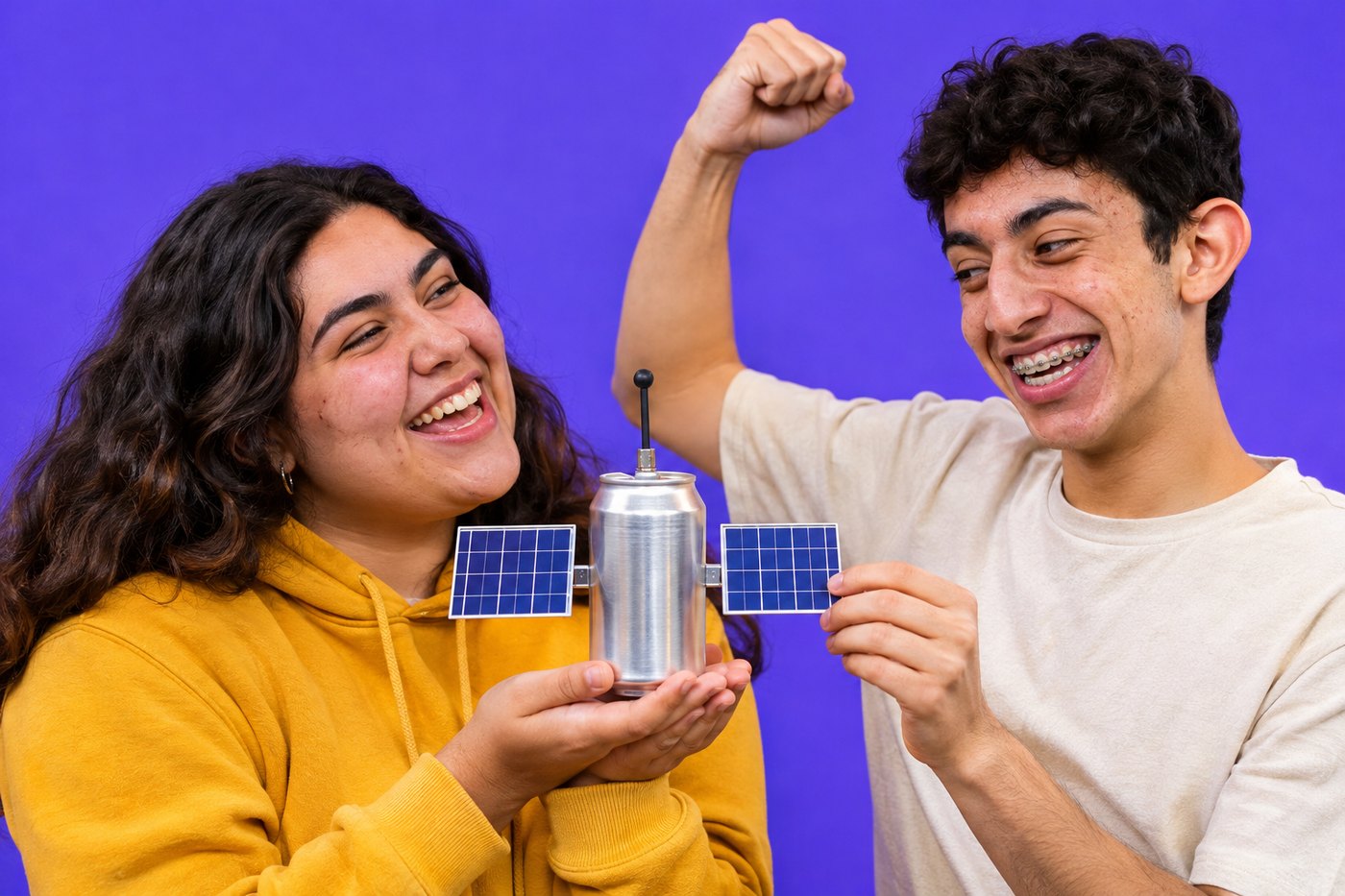
Teams of students aged 14 to 19 build a model satellite the size of a drinks can. It never reaches space, but it still has to do real science.
Warm up3 questions
- Would you rather build a tiny satellite or design a game?
- What role would you choose in a team making something new?
- What would you want to measure if you could send a sensor into the sky?
Sentence help (optional): I'd choose ... because ... · For me, ... · I think ... because ...
Warm up3 questions
- Would you rather build a tiny satellite or design a game?
- What role would you choose in a team making something new?
- What would you want to measure if you could send a sensor into the sky?
Warm up3 questions
- Would you rather build a tiny satellite or design a game?
- What role would you choose in a team making something new?
- What would you want to measure if you could send a sensor into the sky?
Core version
Hold a drinks can in your hand. Now imagine that this can is a model satellite. It is small, light and a little silly. But in the European Space Agency's CanSat project, a model satellite the size and shape of a can is a real school challenge.
A CanSat is a model of a real satellite, built to match the size and shape of a soft drink can. It doesn't go into orbit. Students design it, build it, test it and launch it, and ESA helps to coordinate the project. Teams have three to six students aged 14 to 19, and a teacher or mentor guides them.
Every CanSat must do one job: measure temperature and pressure. Then each team chooses a second job of its own. The ESA article doesn't say what those jobs were, so we can only imagine them. This is the part where a team can ask a question that it finds interesting.
The can is launched to about one kilometre above the ground. It can also be released from something like a drone, a platform or a balloon.
In June 2026, about 170 students and teachers from 26 countries met in the Netherlands, at ESA's technology centre. The event was called CanSat Space Engineer for a Day. National competitions were held in those countries before that. ESA says the event itself was not a competition. On the last day, each group presented a feasibility study, which is a plan that explains whether an idea could really work.
This is a report of a past event, not an invitation to join it. Not every country takes part, and you can't build a CanSat just by reading about it. A CanSat is also not a real satellite in orbit.
So here is your challenge on paper. Your model satellite can measure one extra thing. What would you choose? And which job would you like in the team: designer, builder, tester or presenter?
Intermediate version
Take a soft drink can and imagine that it has to do the work of a satellite. It sounds like a joke until you read how seriously the European Space Agency (ESA) treats it. In the CanSat project, a can-sized satellite is the whole challenge.
A CanSat is a simulation of a real satellite, built to match the size and shape of a soft drink can. It doesn't go into orbit. Instead, students design, build, test and launch it as a school project that brings several subjects together, and ESA coordinates the programme. Teams of three to six students aged 14 to 19 work with a teacher or mentor.
The rules are simple. Every CanSat has to measure temperature and pressure. On top of that, each team chooses and completes a second mission of its own. The ESA article gives no examples, so the choice stays open: a team can decide what question is worth answering. The can is launched to about one kilometre up, or it can be deployed from a drone, a platform or a balloon.
In June 2026, ESA held the CanSat Space Engineer for a Day event at its technology centre in the Netherlands. About 170 students and teachers from 26 countries took part. National competitions had been held in 22 ESA member states and in Canada, Lithuania, Slovakia and Malta, but the event itself was described as non-competitive. On the final day, every group presented a feasibility study, an honest plan about whether its idea could really work.
That detail is interesting. A feasibility study rewards a team that can explain its choices and its limits, not only one that gets a dramatic result. A team with a modest measurement that it understands well may learn more than a team with an exciting idea that it can't test.
Remember what this story is. It reports a past event, it isn't an invitation to join, and not every country takes part. A CanSat is a simulation on the edge of the atmosphere, not a satellite in orbit.
So if your team could add one measurement, what would you choose, and which job would you want: designing, building, testing or presenting?
Advanced version
The constraint is almost comically small: a satellite that has to fit inside a soft drink can. Constraints like this are useful in engineering because they force choices. You can't carry everything, so you have to decide what matters.
That is the idea behind the CanSat project run by the European Space Agency (ESA). A CanSat is a simulation of a real satellite, built to match the size and shape of a soft drink can, and it doesn't go into orbit. Students design, build, test and launch it as a school project that brings several subjects together, working in teams of three to six aged 14 to 19 with a teacher or mentor.
Every CanSat has a compulsory mission: it must measure temperature and pressure. Each team then selects and completes a secondary mission of its own, and ESA's article gives no examples, which leaves the real decision to the students. Deployment is modest by space standards. The can is launched to about one kilometre or released from a drone, a platform or a balloon.
In June 2026, about 170 students and teachers from 26 countries gathered at ESA's technology centre in the Netherlands for CanSat Space Engineer for a Day. National competitions had been held in 22 ESA member states and in Canada, Lithuania, Slovakia and Malta, yet ESA described the event itself as non-competitive. On the final day, each group presented a feasibility study.
That choice of final task says a lot. A feasibility study asks a different question from a contest. It asks whether the idea could work, what it would need and where it could fail. It doesn't ask whose can went highest. It treats a team as a group of engineers explaining a plan, and it values an honest account of risk as much as a successful launch.
The team size matters too. Three to six students is small enough for everyone to have a real job, and big enough that nobody can do everything. A designer imagines the can, a builder fits the parts together, a tester tries to break it and a presenter explains it to people who weren't there. Disagreement about the second mission is almost guaranteed, because two good ideas rarely fit into one can.
A feasibility study also changes what success means when something goes wrong. If a first test fails, a team that only wanted to win has little to say. A team that was asking a question can ask which measurement failed, what the design didn't allow for, and what it would change. That is much closer to how real projects work.
A CanSat simulates parts of a satellite mission; it does not go into orbit. The small space forces a real engineering choice: what is worth fitting inside? So on paper, which extra measurement would you add, and what would you want to find out if the first test failed?
Study this story
Save the words you want to keep, talk about the story, then practise the language.
Highlights0 saved
Highlights0 saved
Highlights0 saved
Talk about it3 questions
- What could make this project fun for someone who was not keen on science?
- Would a project still be a success if the device failed but the team learned a lot?
- What local problem could students investigate with a simple invention?
Sentence help (optional): I think ... because ... · One reason is ... · For me, ...
You can talk about people in general instead of yourself, and you can pass on any question.
Talk about it3 questions
- What could make this project fun for someone who was not keen on science?
- Would a project still be a success if the device failed but the team learned a lot?
- What local problem could students investigate with a simple invention?
You can talk about people in general instead of yourself, and you can pass on any question.
Try it
On paper, design a can-sized research device. Write down its question, one measurement it makes, one limit on its design and four team roles. Then present it to another pair. You don't need electronics, rockets or any real launch, because the whole project is a plan on paper.
Exercises4 exercises
1. Complete the sentences
Drag a word into each gap, or tap a word and then tap a gap. Tap a filled gap to put the word back. Two words are not needed.
- A CanSat doesn't go into .
- A teacher or guides each team.
- Every CanSat must measure temperature and .
- The can is to about one kilometre above the ground.
- A study is a plan that explains whether an idea could really work.
2. Match the meaning
Choose the meaning of each word or phrase as it is used in the article.
- satellite
- drone
- invitation
- balloon
Write the letter of the meaning next to each word.
- A a small flying machine with no pilot inside
- B a request to come to something
- C a bag filled with gas that floats in the air
- D an object that travels around the Earth
3. Put the verb in the right form
Write the correct form of the verb in brackets.
- Teams three to six students. (have)
- ESA to coordinate the project. (help)
- In June 2026, about 170 students and teachers in the Netherlands. (meet)
- The event called CanSat Space Engineer for a Day. (be)
- A team can ask a question that it interesting. (find)
4. True, false or not given
Choose Not given if the article does not say, even when you think the statement is probably true.
- A CanSat has the size and shape of a soft drink can.
The text says: "A CanSat is a model of a real satellite, built to match the size and shape of a soft drink can."
- A CanSat goes into orbit around the Earth.
The text says the opposite: "It doesn't go into orbit."
- Each team has between three and six students.
The text says: "Teams have three to six students aged 14 to 19, and a teacher or mentor guides them."
- ESA says the event itself was a competition.
The text says the opposite: "ESA says the event itself was not a competition."
- Every team built a CanSat that measured wind speed.
Not stated. This version does not give this information.
Your score
Do all four, then add them up.
Answer key
- Complete the sentences1 orbit · 2 mentor · 3 pressure · 4 launched · 5 feasibility
- Match the meaning1 satellite = D · 2 drone = A · 3 invitation = B · 4 balloon = C
- Put the verb in the right form1 have · 2 helps · 3 met · 4 was · 5 finds
- True, false or not given1 True · 2 False · 3 True · 4 False · 5 Not given
1. Complete the sentences
Drag a word into each gap, or tap a word and then tap a gap. Tap a filled gap to put the word back. Two words are not needed.
- A CanSat is a of a real satellite.
- A feasibility study a team that can explain its choices and its limits.
- Each team chooses a second of its own.
- It may also be from a drone, a platform or a balloon.
- The event itself was described as .
2. Match the meaning
Choose the meaning of each word or phrase as it is used in the article.
- feasibility study
- atmosphere
- honest
- mentor
Write the letter of the meaning next to each word.
- A the layer of gases around the Earth
- B an experienced person who gives advice and help
- C a plan that checks whether an idea could really work
- D truthful, and not hiding problems
3. Put the verb in the right form
Write the correct form of the verb in brackets.
- Students design, build, test and the CanSat. (launch)
- ESA the programme. (coordinate)
- In June 2026, ESA the CanSat Space Engineer for a Day event. (hold)
- National competitions been held in 22 ESA member states. (have)
- On the final day, every group a feasibility study. (present)
4. True, false or not given
Choose Not given if the article does not say, even when you think the statement is probably true.
- The event took place in June 2026.
The text says: "In June 2026, ESA held the CanSat Space Engineer for a Day event at its technology centre in the Netherlands."
- About 170 students and teachers from 12 countries took part.
The text says the opposite: "About 170 students and teachers from 26 countries took part."
- ESA described the event as non-competitive.
The text says: "the event itself was described as non-competitive"
- The text says a CanSat is a satellite in orbit.
The text says the opposite: "A CanSat is a simulation on the edge of the atmosphere, not a satellite in orbit."
- ESA pays for the cost of building each CanSat.
Not stated. This version does not give this information.
Your score
Do all four, then add them up.
Answer key
- Complete the sentences1 simulation · 2 rewards · 3 mission · 4 deployed · 5 non-competitive
- Match the meaning1 feasibility study = C · 2 atmosphere = A · 3 honest = D · 4 mentor = B
- Put the verb in the right form1 launch · 2 coordinates · 3 held · 4 had · 5 presented
- True, false or not given1 True · 2 False · 3 True · 4 False · 5 Not given
1. Complete the sentences
Drag a word into each gap, or tap a word and then tap a gap. Tap a filled gap to put the word back. Two words are not needed.
- Constraints like this are useful because they force .
- Every CanSat has a mission: it must measure temperature and pressure.
- ESA's article gives no of the second missions.
- A feasibility study values an honest account of .
- Disagreement about the second mission is almost .
2. Match the meaning
Choose the meaning of each word or phrase as it is used in the article.
- feasibility study
- constraints
- secondary mission
- modest
Write the letter of the meaning next to each word.
- A limits on what you can do or use
- B a plan that checks whether an idea could really work
- C fairly small, not extreme or showy
- D an extra task chosen by the team
3. Make the right word
Use the word in brackets to make a word that fits the gap.
- ESA described the event as non-. (COMPETE)
- Teams are treated as explaining a plan. (ENGINEER)
- The real is left to the students. (DECIDE)
- What counts as changes when something goes wrong. (SUCCEED)
- is modest by space standards. (DEPLOY)
4. True, false or not given
Choose Not given if the article does not say, even when you think the statement is probably true.
- A CanSat does not go into orbit.
The text says: "and it doesn't go into orbit"
- Teams have between eight and ten students.
The text says the opposite: "working in teams of three to six aged 14 to 19"
- About 170 students and teachers gathered at the event.
The text says: "about 170 students and teachers from 26 countries"
- ESA's article gives examples of the teams' second missions.
The text says the opposite: "ESA's article gives no examples"
- ESA plans to hold the event again in 2027.
Not stated. This version does not give this information.
- A feasibility study asks whether an idea could work.
The text says: "It asks whether the idea could work, what it would need and where it could fail."
Your score
Do all four, then add them up.
Answer key
- Complete the sentences1 choices · 2 compulsory · 3 examples · 4 risk · 5 guaranteed
- Match the meaning1 feasibility study = B · 2 constraints = A · 3 secondary mission = D · 4 modest = C
- Make the right word1 competitive · 2 engineers · 3 decision · 4 success · 5 deployment
- True, false or not given1 True · 2 False · 3 True · 4 False · 5 Not given · 6 True
Continue reading
School life
Would You Choose a Later Start to School?
A Swiss school offered students a choice between an early start and a later one. Researchers asked what happened to their sleep.
Science & making
Can Dogs Smell When People Are Stressed?
Researchers tested whether the smell of a stressed person changes how dogs behave. The result is interesting, but it is smaller than the headlines might suggest.
School life
AI Did the Homework. Who Did the Learning?
More than half of UK children aged 8 to 17 use AI, according to Ofcom. What should a student still do for themselves?


Read this article online: johnplusnews.com/articles/could-you-build-a-satellite-that-fits-in-a-can/