News lesson15 July 2026
Greenwashing: When Eco-Friendly Claims Do Not Add Up
Shoppers respond to the story an advertisement tells, not to a company's full environmental record. That gap is where the claim does its work.
Before you read
1Warm up3 questions
Talk about these questions with a partner.
- Which words on a product make it sound environmentally friendly?
- Do you trust a simple green label or want more detail?
- Would a smaller choice of well-explained products make shopping easier?
2Key words8 words
These words are in the article. Choose the letter of the meaning for each one.
- greenwashing
- label
- recycled
- regulator
- compensate
- emissions
- proof
- claim
- Agases that go into the air from cars, planes and factories
- Bmaking a product sound better for nature than it really is
- Can official group that checks companies follow the rules
- Da piece of paper on a product with information about it
- Esomething that shows clearly that a thing is true
- Fmade again from old things, like old plastic
- Gto do something good to make up for something bad
- Ha statement that says something is true
1Warm up3 questions
Talk about these questions with a partner.
- Which words on a product make it sound environmentally friendly?
- Do you trust a simple green label or want more detail?
- Would a smaller choice of well-explained products make shopping easier?
2Key words8 words
These words are in the article. Choose the letter of the meaning for each one.
- impression
- emissions
- regulator
- complaints
- legislation
- offsetting
- sustainable
- selective
- Aan official body that makes sure companies follow the rules
- Blaws made by a government
- Cbalancing harm by paying for something good elsewhere
- Dgases released into the air by vehicles, factories and planes
- Ethe idea or feeling you get about something
- Fchoosing only some things and ignoring others
- Gable to continue without damaging the environment
- Hstatements that you are not happy about something
1Warm up3 questions
Talk about these questions with a partner.
- Which words on a product make it sound environmentally friendly?
- Do you trust a simple green label or want more detail?
- Would a smaller choice of well-explained products make shopping easier?
2Key words8 words
These words are in the article. Choose the letter of the meaning for each one.
- muted
- exploits
- defensible
- offsetting
- trade-offs
- initiatives
- assertions
- upheld
- Auses something unfairly for your own benefit
- Bsituations where you give up one good thing to get another
- Cnew plans or actions to solve a problem
- Dsoft and not bright
- Eable to be supported with good reasons
- Fdecided that a complaint was right
- Gbalancing out damage by paying for good work elsewhere
- Hstrong statements that something is true
Read
3Read the article
The paragraphs are numbered. Look out for the key words from task 2.
Core version
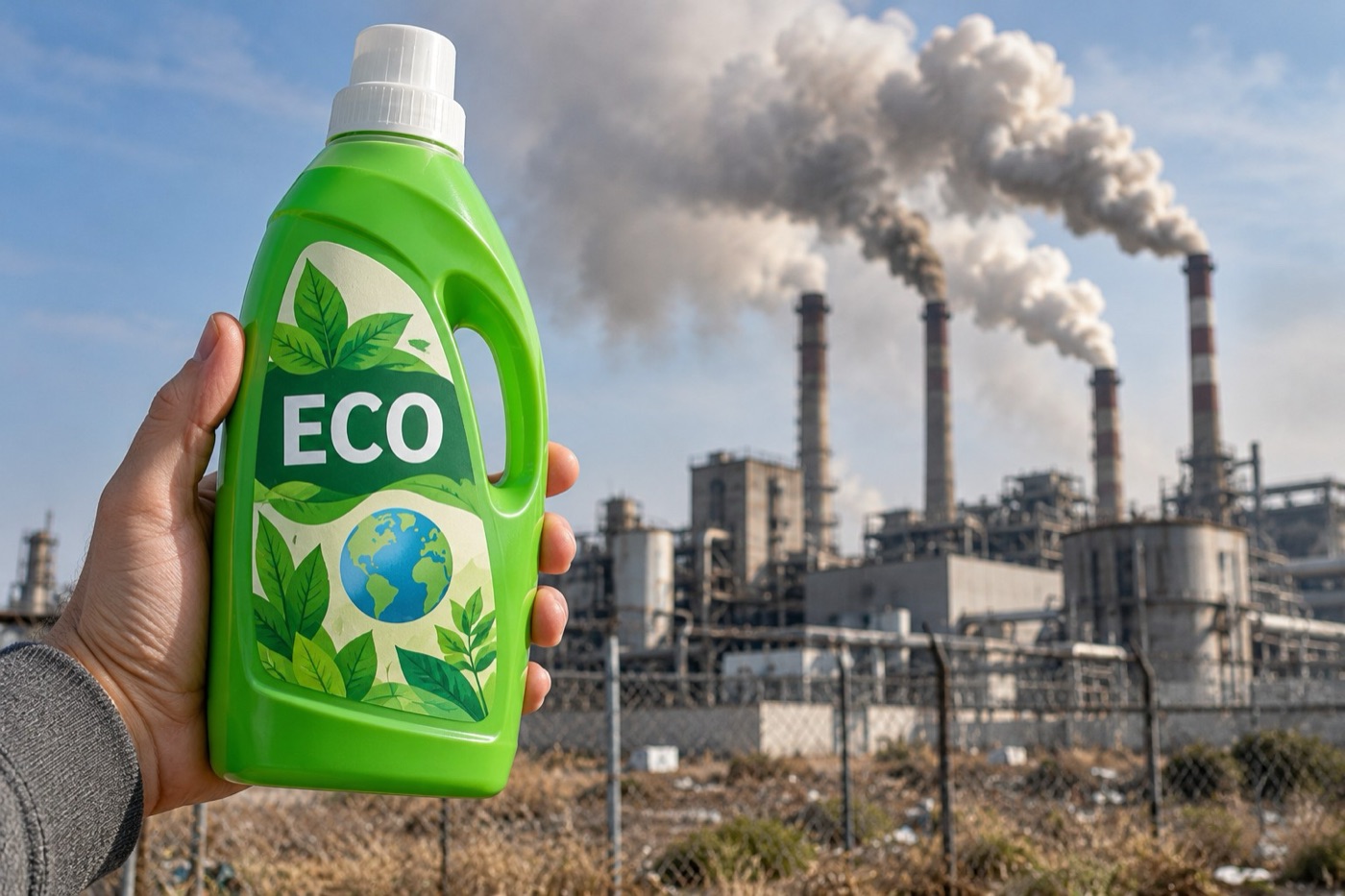
You are standing in a supermarket with two bottles of shampoo. One is plain. The other has green leaves on the label and says it is good for the planet. You reach for the greener-looking bottle, then notice that the label never explains what has actually improved. That small moment is exactly why environmental advertising can be so powerful. It can make us feel that we are choosing well before we have seen any proof.
Take a claim that sounds good but proves little. A bottle might use some recycled plastic but still create a great deal of waste. An airline might invite passengers to support environmental projects, although that payment does not stop the aircraft producing pollution. When a company makes a product seem better for the environment than it really is, this is called greenwashing. Green packaging is not wrongdoing in itself. The problem is a claim that hides the larger problem.
In July 2026, the UK's advertising regulator criticised advertisements from Eurowings and Qatar Airways. The companies had made claims about paying to compensate for flight emissions. The regulator decided that the adverts gave customers a misleading impression of how much environmental damage could be cancelled out. The airlines were told not to use those claims in the same way again.
The European Union has also brought in stronger rules against unclear environmental advertising. Since September 2026, businesses have faced restrictions on general green claims that do not have proper evidence. Labels cannot simply promise that a product is environmentally friendly without showing what that means. These rules aim to make it easier for customers to compare products fairly.
For shoppers, the best question is often a simple one: what exactly has improved? If packaging says it is recycled, find out how much recycled material it contains. If a company says it has reduced pollution, ask what figures support the claim. Not every business using green advertising is dishonest, and small improvements are worth making. But a leaf on a label is not proof that a product is good for the planet. Real progress needs more than a nice picture.
Intermediate version
A shopper reaches for the bottle with leaves on the label. A traveller chooses the flight described as climate-conscious. Neither person has time to investigate a company's entire environmental record; they respond to the story the advertisement tells. That is what makes greenwashing effective. The claim does not always need to be completely false. It only needs to create a greener impression than the evidence can support.
Sometimes the trick is selective attention. A fashion brand promotes recycled packaging while saying little about the volume of clothes it produces. A retailer celebrates one sustainable collection while encouraging customers to buy more than they need. The positive detail may be genuine, but it can distract from a much larger environmental cost. What is left out of the frame matters as much as what is put in it. A single green detail can carry a whole advertisement, even when the rest of the business has barely changed.
Air travel offers a useful example. In July 2026, Britain's Advertising Standards Authority upheld complaints about environmental claims made by Eurowings and Qatar Airways. Their advertisements gave the impression that customers could pay towards projects that fully compensated for the emissions from flights. The regulator found that the companies had not provided enough evidence to support that impression. Environmental projects may do valuable work, but they do not automatically cancel out the impact of a particular journey.
Regulators have become increasingly concerned about vague promises. New European Union consumer rules, which began applying in September 2026, restrict general environmental claims that companies cannot properly support. The legislation also addresses unreliable sustainability labels and certain claims of climate neutrality based on offsetting. The aim is to stop companies gaining an advantage simply by choosing attractive green language.
However, understanding environmental impact is not always straightforward. A product may use less plastic but require more energy to make. A delivery company may reduce emissions on one route while expanding its overall business. Consumers cannot be expected to become experts in climate science every time they shop, which is why accurate information and independent checks matter. Without them, the most confident advertiser tends to win out, rather than the most responsible one.
There are practical ways to be more careful. Look for specific figures rather than broad promises, and check whether a claim has been independently verified. Ask whether the advertised improvement concerns the whole product or just one part of it. Companies deserve recognition for genuine progress, but they also need to acknowledge what has not improved. Buying something with a green label should not require an act of faith. If a business makes an environmental promise, it should be able to back it up.
Advanced version
The most persuasive environmental claim may be the one a consumer barely notices. A muted green label, a photograph of leaves and a reassuring phrase about sustainability can turn an ordinary purchase into something that feels almost ethical. Few shoppers can investigate the full history of every product, so they rely on signals. Greenwashing exploits that reliance: it offers the comfort of a responsible choice before the evidence has earned it. The visual language does part of the argument without ever becoming a claim that can easily be tested.
Its most effective forms are rarely crude lies. A manufacturer may truthfully advertise recycled packaging while glossing over the resources consumed by the product itself. An airline may invite passengers to fund climate projects without explaining the uncertainty around their benefits. Each statement can contain a defensible fragment of truth while the overall impression remains flattering, selective and misleading. The distinction matters because a regulator may need to judge not only the literal wording but the conclusion an ordinary customer is likely to draw from it.
In July 2026, Britain's Advertising Standards Authority upheld rulings against environmental advertisements from Eurowings and Qatar Airways. The regulator found that claims concerning carbon offsetting risked persuading customers that they could pay to compensate fully for the emissions associated with particular flights, without adequate evidence. An offset scheme may fund useful work, but the questions are practical: would the work happen anyway, will the benefit last and can it be measured? A promise to compensate for emissions is not equivalent to preventing the emissions in the first place. That distinction rarely troubles a passenger at the point of booking, which is precisely where the claim does its work.
Regulators are attempting to narrow the gap between marketing language and substantiated performance. Since September 2026, EU consumer rules have restricted vague environmental claims and unreliable sustainability labels, while addressing certain claims of climate neutrality based on offsetting. The shift places greater responsibility on businesses to explain their environmental credentials rather than falling back on broad, emotionally appealing phrases. It also recognises that consumers rarely possess the information required to challenge complicated scientific assertions on their own. The burden of proof, in other words, has shifted towards the companies whose claims must now stand up to scrutiny.
The challenge is that environmental performance involves trade-offs that resist simple labels. A reusable product may have a higher manufacturing footprint but a lower impact over time. Recycled materials may reduce pressure on natural resources without eliminating energy consumption or pollution. An advertising system that reduces such questions to a cheerful green symbol risks creating false confidence even when genuine improvements have occurred. Simplification is not dishonest in itself; it becomes so when the complications are quietly set aside.
There is a danger, too, that fear of regulatory action encourages companies to say nothing about worthwhile initiatives. The solution is not to ban environmental communication but to tighten it up. Claims should identify the specific benefit, the evidence supporting it and the limitations of the improvement. Consumers are entitled to know whether a company has substantially reduced harm or merely found a flattering way to describe a modest change. Sustainability cannot become credible while remaining principally a matter of choosing the right adjectives.
After you read
4True, false or not given5 statements
Choose T (true), F (false) or NG (the article does not say).
- The airlines were told not to use those claims in the same way again.
The text says: "The airlines were told not to use those claims in the same way again."
- The label on the shampoo bottle explains what has improved.
The text says: "the label never explains what has actually improved".
- The airlines had to pay a fine.
Not stated. The text does not mention any fine.
- Every company that uses green advertising is dishonest.
The text says: "Not every business using green advertising is dishonest".
- The writer says small improvements are worth making.
The text says: "small improvements are worth making".
5Vocabulary5 gaps
Complete the sentences with words from the box. Two words are not needed.
evidenceimpressionpackagingpassengerspaymentpollutionrestrictions
- Many shops now sell food in paper instead of plastic.
- Cars and factories cause in big cities.
- Before you believe a claim, ask what supports it.
- The city has put on cars in the centre, so fewer people drive there.
- My first of the new teacher was very good.
6Verb forms5 gaps
Write the correct form of the verb in brackets.
- You are in a supermarket with two bottles of shampoo. (STAND)
- When a company a product seem better than it is, this is greenwashing. (MAKE)
- In July 2026, the UK regulator advertisements from two airlines. (CRITICISE)
- The airlines not to use those claims again. (TELL)
- Since September 2026, businesses restrictions on vague green claims. (FACE)
7Language focuslinking words
Complete the sentences with words from the box. Two words are not needed. Linking words join ideas. Use but and although for a difference, because for a reason and so for a result.
althoughbecausebuthoweverotherwisesounless
- The label used green leaves, it did not say what had improved.
- The airlines were criticised their adverts gave a misleading impression.
- The shop sells cheap soap. , it is not made from recycled plastic.
- The new rules are clear, shoppers can compare products more easily.
- the bottle looked green, it was not a better choice.
4True, false or not given5 statements
Choose T (true), F (false) or NG (the article does not say).
- The regulator decided that Eurowings and Qatar Airways had provided enough evidence for their claims.
The text says: "the companies had not provided enough evidence to support that impression".
- An advertisement can seem green because of one detail, even if the rest of the business has barely changed.
The text says: "A single green detail can carry a whole advertisement, even when the rest of the business has barely changed."
- Most airlines have stopped using offsetting claims since July 2026.
Not stated. The text does not say what airlines in general have done.
- A product that uses less plastic always has a lower overall environmental impact.
The text says a product "may use less plastic but require more energy to make".
- The new European Union rules also cover unreliable sustainability labels.
The text says: "The legislation also addresses unreliable sustainability labels".
5Vocabulary6 gaps
Complete the sentences with words from the box. Two words are not needed.
acknowledgeadvantagedistractgenuineoverlookreluctantvagueverified
- She felt sure the manager's concern for the environment was , not just good public relations.
- 'Kinder to nature' is too to tell shoppers anything useful.
- Before you trust a figure, check that it has been independently .
- The company should that some parts of the product still harm the environment.
- A flashy slogan can shoppers from the real cost of a product.
- A business that appears greener can gain an over its competitors.
6Verb forms5 gaps
Write the correct form of the verb in brackets.
- By the time she reached the till, the shopper to buy the greener bottle. (DECIDE)
- Claims that cannot be proved under the new rules. (RESTRICT)
- At the moment the message arrived, the shopper two bottles. (COMPARE)
- In July 2026, Britain's regulator complaints about two airlines. (UPHOLD)
- Regulators increasingly concerned about vague promises. (BECOME)
7Language focuslinking words
Complete the sentences with words from the box. Two words are not needed. Check the logic. Whereas shows a contrast between two things, provided adds a condition, and despite needs a noun or an -ing form.
despitehoweverotherwiseprovidedthereforeunlesswhereas
- being technically accurate, the advert left a false impression.
- Some shoppers read every label, others simply trust the packaging.
- Customers cannot check every claim; , independent checks are important.
- A product may use less plastic. , it may need more energy to make.
- Companies can advertise their progress, they stay honest about the limits.
4True, false or not given5 statements
Choose T (true), F (false) or NG (the article does not say).
- A company could be criticised for an advert in which every individual statement is true.
The text says each statement can be true while "the overall impression remains flattering, selective and misleading".
- The writer believes offsetting schemes never fund useful work.
The text says: "An offset scheme may fund useful work".
- The airlines appealed against the rulings of the Advertising Standards Authority.
Not stated. The text does not say how the airlines responded.
- The writer argues that simplifying environmental information is dishonest in every case.
The text says: "Simplification is not dishonest in itself".
- Judging a product only by the emissions from making it could give a misleading picture.
The text says a reusable product may have "a higher manufacturing footprint but a lower impact over time".
5Vocabulary6 gaps
Complete the sentences with words from the box. Two words are not needed.
adequatecomplacencycredentialsequivalentflatteringnegligiblescrutinysubstantially
- Any company making bold environmental promises should expect close from journalists and regulators.
- The portrait of the factory was so that it ignored its pollution record entirely.
- Paying for a tree to be planted is not to cutting your own emissions.
- The data supplied was not to justify so sweeping a claim.
- A brand that wants to demonstrate its environmental should publish independent results.
- Emissions at the plant have fallen since the new system was installed, though not to zero.
6Word forms5 gaps
Use the word in brackets to make a word that fits the gap.
- The company's refusal to publish data raised doubts about the of its claims. (CREDIBLE)
- Critics described the slogan as , since it implied a benefit that did not exist. (DECEIVE)
- Stricter should discourage companies from exaggerating their achievements. (REGULATE)
- Offsetting schemes are often criticised for their lack of . (TRANSPARENT)
- The firm's to admit the limits of its product damaged public trust. (RELUCTANT)
7Language focuslinking words
Complete the sentences with words from the box. Two words are not needed. These are formal. Albeit introduces a contrast, hence gives a result after a semicolon, and notwithstanding is followed by a noun.
albeithencelestnonethelessnotwithstandingtherebywhereby
- The advert was accurate in its wording, misleading in its effect.
- the airline's good intentions, the claim could not be defended.
- Most customers do not read the small print; , vague slogans carry far more weight than detailed data.
- The EU introduced a system companies must explain their claims with evidence.
- Offsetting can fund useful projects; , it does not remove the emissions already produced.
Speak
8Talk about it3 questions
Discuss in pairs or small groups. Give reasons for your answers.
- What would a useful environmental label actually tell you?
- Who should have to prove a green claim is true?
- Would you trust a brand more if it admitted where it still caused harm?
8Talk about it3 questions
Discuss in pairs or small groups. Give reasons for your answers.
- What would a useful environmental label actually tell you?
- Who should have to prove a green claim is true?
- Would you trust a brand more if it admitted where it still caused harm?
8Talk about it3 questions
Discuss in pairs or small groups. Give reasons for your answers.
- What would a useful environmental label actually tell you?
- Who should have to prove a green claim is true?
- Would you trust a brand more if it admitted where it still caused harm?
9Role-play: which bottle should we buy?
Work in pairs. Read your card, then have the conversation. Swap roles and do it again.
Student A · the shopper
You are in a shop with a friend. You want to buy the bottle with green leaves and the word eco on it. Explain why you like it and why you think it is a good choice.
Student B · the friend
You are not sure the label is true. Ask what the label really proves. Ask at least two questions, then decide together which bottle to buy.
Useful phrases
- I'd like to buy this one, it looks greener.
- What's the label actually telling us?
- That doesn't prove anything.
- I'm not sure we can trust it.
- Let's check the figures before we decide.
- Shall we buy the plain one instead?
Afterwards, tell the class which bottle you chose and why.
Your words
Highlights0 saved
Highlights0 saved
Highlights0 saved
Was this lesson useful? Support johnplusnews on Ko-fi
Continue reading
Language
Did Writing Really Make Languages More Complicated?
A large study of about 100,000 sentences in 30 languages found no universal pattern showing that writing makes sentences more complex. It does not say that writing never changes a language.
Relationships
Would You Sign a Contract Before Getting Married?
More young Americans are signing prenuptial agreements before their weddings. Is planning for a divorce unromantic, or is it honest and sensible?
Work
They Still Have Their Jobs. They Are Leaving Anyway
Nobody made these workers redundant. AI changed what their work felt like, and they walked out on careers they had spent a decade building.