News lesson2 August 2026
Have We Lost the Habit of Reading?
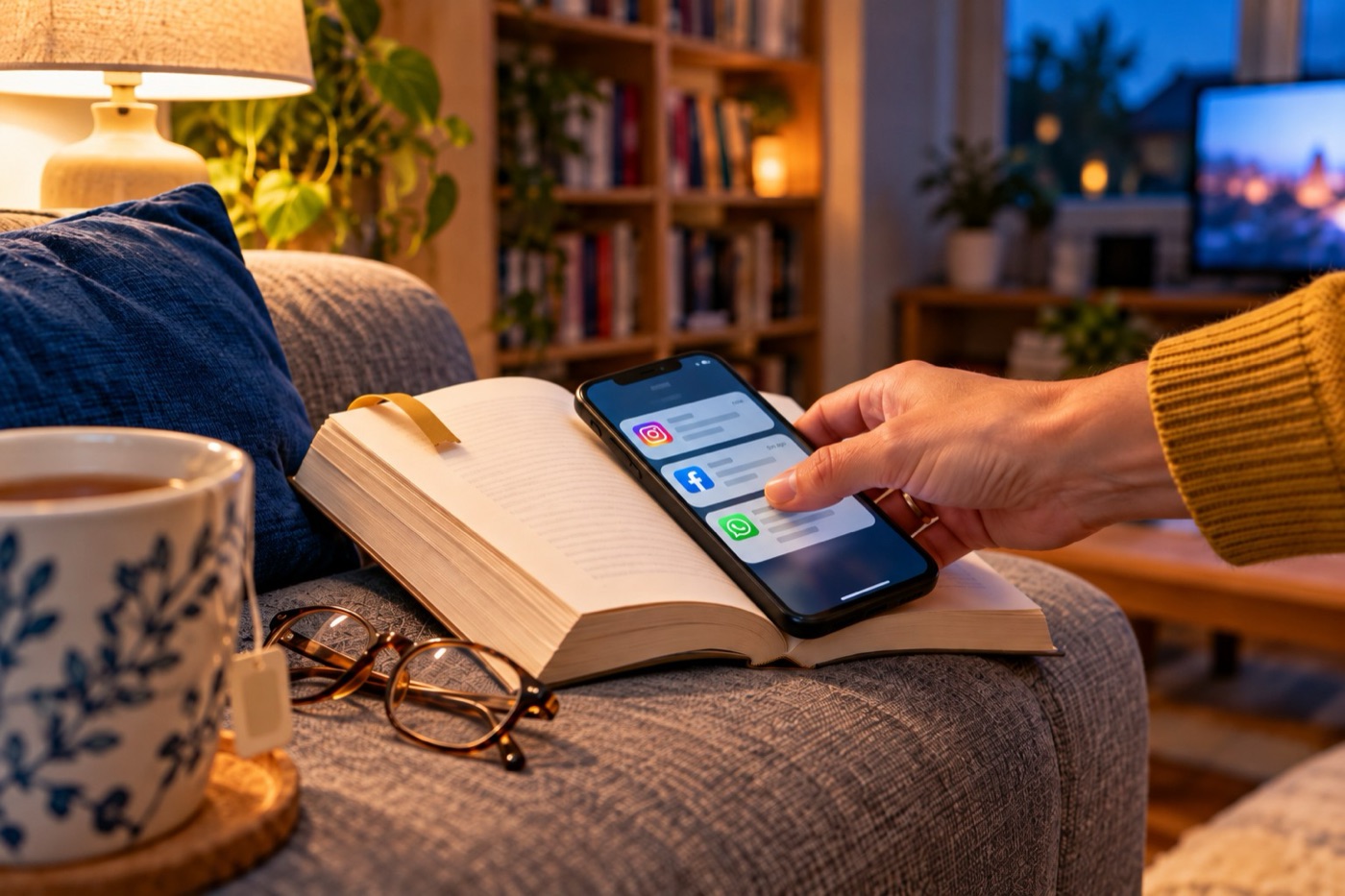
One message, and the paragraph has to be read again. The wish to read is still there; the uninterrupted half hour is not.
Before you read
1Warm up3 questions
Talk about these questions with a partner.
- What makes you put a book down after a few pages?
- Would you rather reread a favourite or try something unfamiliar?
- Where do you find it easiest to pay attention?
2Key words8 words
These words are in the article. Choose the letter of the meaning for each one.
- achievement
- ordinary
- habit
- programme
- regular
- excited
- practice
- subject
- Adoing something again and again to get better
- Bsomething you do again and again without thinking
- Chappening often, at the same times
- Dnormal, not special
- Ehappy and full of energy about something
- Fthe thing a book or a talk is about
- Ga plan of things to do, step by step
- Hsomething good you did with hard work
1Warm up3 questions
Talk about these questions with a partner.
- What makes you put a book down after a few pages?
- Would you rather reread a favourite or try something unfamiliar?
- Where do you find it easiest to pay attention?
2Key words8 words
These words are in the article. Choose the letter of the meaning for each one.
- protected
- sustained
- inspired
- gradually
- struggle
- classic
- lifestyle
- approach
- Afind something very hard to do
- Bslowly, a little at a time
- Cgiven an idea by something else
- Dcontinuing for a long time without stopping
- Ekept safe so that nothing can disturb it
- Fa famous book that people still read
- Ga way of doing something
- Hthe way a person lives every day
1Warm up3 questions
Talk about these questions with a partner.
- What makes you put a book down after a few pages?
- Would you rather reread a favourite or try something unfamiliar?
- Where do you find it easiest to pay attention?
2Key words8 words
These words are in the article. Choose the letter of the meaning for each one.
- inherently
- comparatively
- disarmingly
- succession
- exhaustion
- analogy
- virtuous
- novelty
- Aa number of things coming one after another
- Bin a way that is so simple or honest that it removes doubt
- Cby its very nature
- Da comparison that explains one thing by another
- Ewhen you compare it with something else
- Fmorally good
- Ga state of being extremely tired
- Hthe quality of being new and interesting
Read
3Read the article
The paragraphs are numbered. Look out for the key words from task 2.
Core version
You read the same paragraph twice, but it still does not make sense. Your phone made a sound a few minutes ago; one message became a video, then another. The book is still open, but the story has disappeared from your mind. Many people say they want to read more and even buy books they are excited about. The difficult part is staying with one page when a screen keeps offering something new.
Reading for pleasure has become less common in some places. A study published in 2025 looked at how Americans spent their time between 2003 and 2023. It found that the number of people reading for pleasure on an average day had fallen. However, other research shows that many Americans still read at least one book in a year, including e-books and audiobooks. The first measures an ordinary day. The second asks about a whole year, so the two results do not contradict each other.
Phones may be part of the problem. They offer messages, games, videos and news at any moment. A book asks us to stay with one story or subject for longer. That can feel difficult when we are used to changing activities every few seconds. But reading is not only about concentration. People also need time, quiet places and books they find interesting.
In August 2026, the novelist Naomi Alderman described an eight-week plan to help people get back into reading. The idea was similar to a beginner's exercise programme: start with a short time each day and slowly increase it. Someone might begin with ten minutes and then work towards longer reading sessions. The aim was not to finish as many books as possible, but to enjoy the habit again.
There are plenty of ways to make reading easier. Choose a book that interests you rather than one you think you should read. Switch your phone off for a while, or listen to an audiobook when travelling. Reading with a friend can also help. Finishing a chapter may not seem like a huge achievement, but regular practice can make it easier to concentrate. A book does not need to compete with everything on your phone. Sometimes it simply needs ten quiet minutes.
Intermediate version
You return to the novel after checking one message and realise that you have forgotten who is speaking. The same paragraph must be read again. Nothing is wrong with the book, and the desire to read is still there; the protected attention has gone. For people who once became absorbed in stories for hours, that change can feel less like a new habit than the loss of an old ability.
There is evidence that reading patterns have changed. A 2025 study used American time-use records from 2004 to 2023. It found that the share of people reading for pleasure on an average day fell from about 28% to 16%. However, a 2026 Pew Research Center survey found that about three-quarters of American adults had read at least part of a book in the previous year. The findings are not contradictory: reading something during a whole year is very different from reading regularly.
Smartphones are an obvious suspect. They offer endless opportunities to switch activities, while a book requires sustained attention. But it would be too simple to blame every change on technology. Long working hours, financial pressures and family responsibilities also leave people tired. Some readers struggle to find books that interest them; others feel they should be reading difficult or important titles instead of something they might actually enjoy.
In August 2026, novelist Naomi Alderman proposed an eight-week reading programme inspired by the popular Couch to 5K approach to running. The idea was to rebuild reading stamina gradually, beginning with manageable sessions before increasing the time spent with a book. It treats concentration as something that can improve with practice, rather than a talent a person either has or lacks.
That approach may be particularly useful for people who have fallen out of the habit. Choosing a short, enjoyable book is often better than forcing yourself through a classic that feels like homework. Keeping your phone out of reach, reading on public transport or joining a small book group can also make regular reading easier. Audiobooks and e-books offer other ways to enjoy stories, especially for people whose lives are already busy.
The real concern is not that everyone should spend hours reading novels. It is that losing the habit of sustained attention may make longer, more complex writing feel increasingly difficult. Books give us time to follow ideas and characters without constant interruption. Recovering that experience does not require a dramatic lifestyle change. It may start with putting the phone away, opening a book and allowing ourselves to be bored for a few minutes before the story takes over.
Advanced version
The novel is open and the intention is sincere. Then a notification interrupts, one message leads to a headline and the reader returns unable to remember the previous paragraph. The book has not become less interesting in ten minutes; the thread of attention has been cut. Increasing numbers of people describe this experience even when reading was once one of their favourite activities. The problem may be less a rejection of books than the disappearance of the routine that once protected them.
Research suggests a more complicated picture than the familiar claim that nobody reads any more. A 2025 study drawing on two decades of American Time Use Survey data found that the proportion of adults reading for pleasure on an average day fell from approximately 28% in 2004 to 16% in 2023. The survey asks people what they did on a particular day, so it measures reading on an ordinary day, not whether anyone read at all during the year.
Yet Pew Research Center reported in 2026 that around 75% of American adults had read at least some of a book during the previous year, a measure that has remained comparatively stable. Both findings can be true. Occasional reading may persist even as the practice of reading regularly becomes less common.
Smartphones undoubtedly compete for attention, offering constant opportunities for novelty and interruption. A novel asks readers to remain within an unfolding argument or imagined world; a phone promises a succession of immediate rewards. But attributing every change to digital technology glosses over other pressures. Exhaustion, precarious working lives, limited access to books and the absence of quiet spaces can all undermine the habit. Reading also becomes less inviting when treated as a test of cultural sophistication rather than a source of pleasure.
In August 2026, the novelist Naomi Alderman proposed a programme modelled on the Couch to 5K running scheme. Her eight-week approach encouraged people to rebuild reading stamina through progressively longer sessions, beginning with manageable periods rather than ambitious targets. The analogy is useful because it replaces an unhelpful moral judgement with the idea of practice. Someone who struggles to concentrate is not necessarily lazy or incapable; they may simply have lost a routine that needs rebuilding.
There is reason to avoid romanticising books as inherently virtuous or dismissing audiobooks and digital formats as inferior. Reading takes different forms, and sustained engagement with a complex text can occur on a screen as well as on paper. Nor is finishing more novels automatically a measure of intelligence. The more persuasive argument concerns the capacity to follow ideas over time, tolerate uncertainty and resist the expectation of constant stimulation. Those abilities matter beyond literature, including in education and public debate.
The practical response may be disarmingly modest. Read something genuinely appealing, set aside a short period free from notifications and allow the habit to develop without turning it into another productivity target. A book need not compete with a phone on the phone's terms. Its pleasures are slower, less immediate and sometimes demanding. That difference is precisely what makes reading worth preserving, not as a badge of refinement, but as a way of paying attention to something long enough for it to change how we think.
After you read
4True, false or not given5 statements
Choose T (true), F (false) or NG (the article does not say).
- Naomi Alderman's plan lasted eight weeks.
The text says: "In August 2026, the novelist Naomi Alderman described an eight-week plan to help people get back into reading."
- A 2025 study looked at how Americans spent their time from 2003 to 2023.
The text says: "A study published in 2025 looked at how Americans spent their time between 2003 and 2023."
- Naomi Alderman's plan aimed to help people finish as many books as possible.
The text says the opposite: "The aim was not to finish as many books as possible, but to enjoy the habit again."
- The plan has been tried by thousands of readers.
Not stated. The text does not say how many people have tried the plan.
- The text says phones are the only reason people read less.
The text says phones "may be part of the problem" and that people also need time, quiet places and interesting books.
5Vocabulary5 gaps
Complete the sentences with words from the box. Two words are not needed.
avoidcompeteconcentratecontradictdisappearedincreaseoffer
- The two reports measure different things, so they do not each other.
- It is hard to on homework when your phone keeps making noise.
- A slow story can find it hard to with a funny video.
- My free evening quickly while I watched videos.
- If you want to read more, you could the time you spend on books each week.
6Verb forms5 gaps
Write the correct form of the verb in brackets.
- Your phone a sound a few minutes ago. (MAKE)
- A study in 2025 looked at how Americans spent their time. (PUBLISH)
- A book asks us with one story for longer. (STAY)
- That can feel difficult when we are used to activities often. (CHANGE)
- The study found that the number of people reading for pleasure had . (FALL)
7Language focusphrasal verbs
Complete the sentences with words from the box. Two words are not needed. A phrasal verb is a verb plus a small word. The small word changes the meaning, so learn them together.
alongbackdownofftowardsupwith
- Someone might begin with ten minutes and then work longer reading sessions.
- Switch your phone for a while if you want to read.
- The writer described a plan to help people get into reading.
- A book asks us to stay one story for longer.
- Keep your phone out of reach so you do not pick it every minute.
4True, false or not given5 statements
Choose T (true), F (false) or NG (the article does not say).
- The 2025 study and the Pew survey measure the same thing.
The study counts reading on an average day; Pew counts adults who read at least part of a book in a year.
- The writer thinks technology is not the only reason people read less.
The text says it "would be too simple to blame every change on technology".
- Alderman's programme gives people a fixed list of books to read.
Not stated. The text only says the programme builds reading time gradually.
- Reading at least part of a book in a year is more common than reading on a typical day.
About three-quarters read part of a book in a year, but only about 16% read on an average day.
- The writer says everyone should spend hours reading novels.
The text says "The real concern is not that everyone should spend hours reading novels."
5Vocabulary6 gaps
Complete the sentences with words from the box. Two words are not needed.
desireevidencefindingspressuresrewardstaminatalenttarget
- She has the physical to run for an hour without needing a rest.
- The police said they had found no that anyone had broken in.
- Work, money and family are common that leave people too tired to read.
- Her as a pianist was obvious when she was six, and teachers soon noticed it.
- He felt a strong to leave his job and travel the world.
- The latest are surprising: they show a rise in some groups and a fall in others.
6Verb forms5 gaps
Write the correct form of the verb in brackets.
- By the time she opened the novel again, she who was speaking. (FORGET)
- When I was a child, a story to me every night. (READ)
- Reading habits a lot in recent years. (CHANGE)
- If I switched my phone off, I much more. (READ)
- While I my messages, the story slipped from my mind. (CHECK)
7Language focusphrasal verbs
Complete the sentences with words from the box. Two words are not needed. Many phrasal verbs have a meaning you cannot guess from the parts. Check what the whole phrase means in the sentence.
alongawayoutoverroundthroughup
- Be patient: after a few pages, the story will take and you will stop checking the time.
- Many adults have fallen of the habit of reading since they left school.
- When you want to focus, put your phone in a drawer.
- I forced myself the first fifty pages, and then the book became exciting.
- Sign for a library card, and borrowing books costs nothing.
4True, false or not given5 statements
Choose T (true), F (false) or NG (the article does not say).
- Someone who read a few pages of one book last year could count in Pew's figure without being counted in the daily-reading figure.
Pew counts adults who read "at least some of a book" in a year; the study counts reading on an average day.
- The writer regards audiobooks as a poorer way to read than print.
The text warns against "dismissing audiobooks and digital formats as inferior".
- Alderman's programme asks participants to keep a reading diary.
Not stated. The text only mentions progressively longer sessions.
- The writer implies that difficulty concentrating does not necessarily show a personal failing.
The text says someone who struggles is "not necessarily lazy or incapable".
- The writer argues that smartphones are the only pressure on reading.
The text says blaming digital technology for everything "glosses over other pressures".
5Vocabulary6 gaps
Complete the sentences with words from the box. Two words are not needed.
attributingdismissingpersistprolongprovokeresisttolerateundermine
- Constant interruptions can a reader's confidence long before the last chapter.
- Few readers can a book that makes no effort to hold their interest.
- Even keen readers find it hard to the pull of a glowing screen.
- Even as screens multiply, the habit of reading aloud to children continues to in many families.
- Critics are wrong in the decline in reading entirely to one cause.
- Teachers who insist on comic books as lightweight may put off reluctant readers.
6Word forms5 gaps
Use the word in brackets to make a word that fits the gap.
- Treating reading as a test of cultural makes it less inviting. (SOPHISTICATED)
- Few readers found the critic's claim , since it ignored the survey data. (PERSUADE)
- Critics accused the film of a harsh period of history. (ROMANTIC)
- The offered by a phone is far more immediate than that of a novel. (STIMULATE)
- Someone who skips a chapter is not lazy. (NECESSARY)
7Language focusphrasal verbs
Complete the sentences with words from the box. Two words are not needed. At this level, many phrasal verbs are idiomatic and fairly formal. Notice that the particle stays in the sentence and you supply the verb.
brushfixglossplayruleshytie
- Politicians often over the awkward details of their plans.
- Doctors could not out stress as a cause of the headaches.
- Many adults away from long novels because they fear losing the thread.
- He tends to aside any criticism of his habits.
- Publishers may down how few people finish what they buy.
Speak
8Talk about it3 questions
Discuss in pairs or small groups. Give reasons for your answers.
- What would make reading feel like a pleasure again?
- Does an audiobook give you what you want from a book?
- Would reading ten pages happily beat finishing a book you disliked?
8Talk about it3 questions
Discuss in pairs or small groups. Give reasons for your answers.
- What would make reading feel like a pleasure again?
- Does an audiobook give you what you want from a book?
- Would reading ten pages happily beat finishing a book you disliked?
8Talk about it3 questions
Discuss in pairs or small groups. Give reasons for your answers.
- What would make reading feel like a pleasure again?
- Does an audiobook give you what you want from a book?
- Would reading ten pages happily beat finishing a book you disliked?
9Role-play: ten minutes a day
Work in pairs. Read your card, then have the conversation. Swap roles and do it again.
Student A · the friend who wants to read more
You've bought lots of books but you hardly open them. Ask your friend to join you for ten quiet minutes of reading every evening, with phones off. Explain why it would help.
Student B · the friend who loves scrolling
You're tired after work and scrolling relaxes you. Ask questions and explain your worries. You can say yes, no, or yes with a different plan.
Useful phrases
- I'd love to get back into reading.
- Could we try ten minutes a day?
- I'm too tired by the evening.
- What if we switched our phones off?
- That's a fair point, but I'd rather start small.
- Let's give it a week and see how it goes.
Afterwards, tell the class: did you agree a plan, and is it realistic?
Your words
Highlights0 saved
Highlights0 saved
Highlights0 saved
Was this lesson useful? Support johnplusnews on Ko-fi
Continue reading
Technology
Can You Be Emotionally Close to Someone Who Is Not Human?
A survey of 463 adults in the United States found that people in relationships with AI chatbots can feel as emotionally close as other couples, but the link between closeness and loneliness looked different.
Work
They Still Have Their Jobs. They Are Leaving Anyway
Nobody made these workers redundant. AI changed what their work felt like, and they walked out on careers they had spent a decade building.
Food
The Chef Who Lost His Job Over Pineapple
An Italian chef in Australia was sacked for refusing to add pineapple. A food historian says the rule he was defending is younger than he thinks.