News lesson13 October 2026
A Message from the Man Who Held Him Hostage
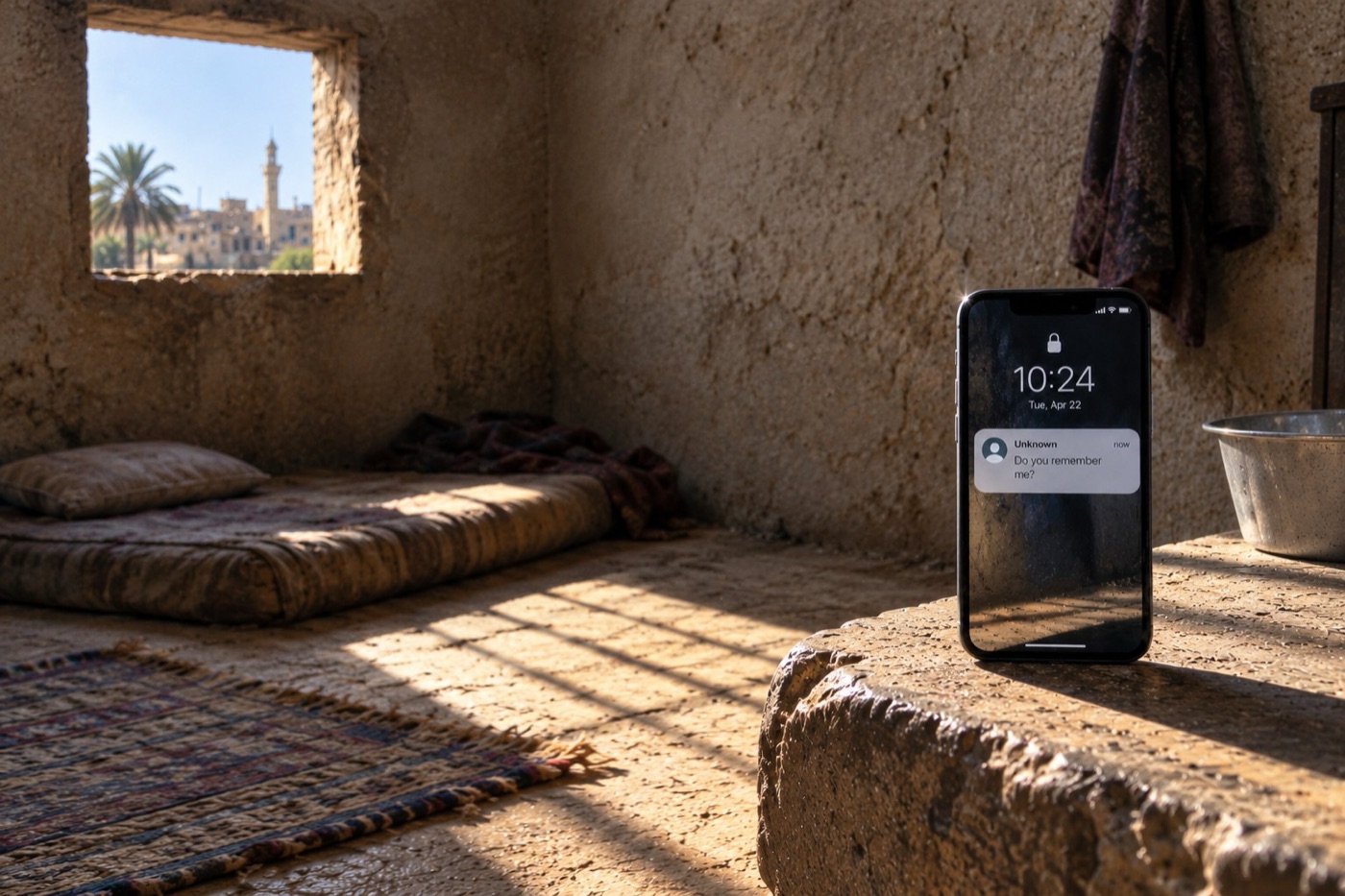
Michael Scott Moore went on replying to his former guard, then told the FBI. Federal agents were waiting when Mohamed Tahlil arrived in New York.
Before you read
1Warm up3 questions
Talk about these questions with a partner.
- What makes a story about a real person stay with you?
- Can you understand someone's actions without forgiving them?
- When does replying to an unwanted message make things harder?
2Key words8 words
These words are in the article. Choose the letter of the meaning for each one.
- journalist
- captors
- ransom
- hijacked
- guards
- trial
- forgiveness
- justice
- Aa person who writes news stories for a living
- Bthe people who keep someone as a prisoner
- Cmoney paid to free a prisoner
- Da meeting in a court to decide if someone is guilty
- Estopping being angry with someone who did wrong
- Ffair treatment by the law
- Gtaken by force by criminals
- Hpeople who watch a prisoner all the time
1Warm up3 questions
Talk about these questions with a partner.
- What makes a story about a real person stay with you?
- Can you understand someone's actions without forgiving them?
- When does replying to an unwanted message make things harder?
2Key words8 words
These words are in the article. Choose the letter of the meaning for each one.
- captivity
- hijacked
- federal
- prosecutors
- defendant
- ransom
- accountability
- forgiveness
- Aa person who is accused of a crime in court
- Btaken by force by criminals
- Cmoney paid to free a prisoner
- Dthe state of being held as a prisoner
- Elawyers who try to prove that someone is guilty
- Fto do with the national government, not a local one
- Gstopping being angry with someone who did wrong
- Hbeing responsible for what you did and having to explain it
1Warm up3 questions
Talk about these questions with a partner.
- What makes a story about a real person stay with you?
- Can you understand someone's actions without forgiving them?
- When does replying to an unwanted message make things harder?
2Key words8 words
These words are in the article. Choose the letter of the meaning for each one.
- acquaintance
- correspondence
- motives
- closure
- mercy
- narrative
- prosecutors
- defendant
- Athe feeling that a painful matter has finally ended
- Bletters or messages sent between people
- Ckindness shown by not punishing someone as harshly as you could
- Da person who is accused of a crime in court
- Ethe reasons why someone does something
- Fa story, or a way of telling events
- Ga person you know a little but who is not a close friend
- Hlawyers who try to prove that someone is guilty
Read
3Read the article
The paragraphs are numbered. Look out for the key words from task 2.
Core version
Michael Scott Moore, a journalist, set off for Somalia in January 2012 to research a book about piracy. He was kidnapped shortly after arriving and held for 977 days, more than two and a half years. His captors moved him between buildings, outdoor camps and a hijacked fishing boat. He often felt frightened and alone. He was sometimes beaten, and armed guards controlled his daily life. In September 2014, a large ransom payment finally secured his release.
Two months after his release, Moore received an extraordinary Facebook message out of the blue. It came from Mohamed Tahlil, one of the men who had guarded him. Tahlil said he was pleased that Moore was free and described himself as a friend. Someone involved in that terrible experience now wanted to talk to him online.
During the early part of his captivity, Tahlil had seemed calmer than some of the other guards. Moore did not trust him, but he remembered their conversations. When Tahlil got in touch on Facebook, Moore decided to reply because he wanted to find out more. The two exchanged messages, and Tahlil provided some information that helped Moore write his book about the experience.
However, Tahlil also wanted something in return. He hoped Moore could help him travel to the United States. Moore had already been speaking to the FBI, which was investigating his kidnapping. He told the agents about their messages. In 2018, Tahlil flew to New York believing he would receive help. Instead, FBI officers arrested him when he turned up.
The case became more complicated during the trial. Evidence showed that Tahlil had played a more important role in the pirate group than Moore had originally understood. Another man, Abdi Yusuf Hassan, had also been involved. In 2023, both were convicted of serious crimes connected with the kidnapping. In 2024, they each received a 30-year prison sentence.
Moore has written openly about the difficult question of forgiveness. During captivity, trying not to hate his guards helped him survive. But forgiving someone does not mean pretending that their actions were acceptable. He still wanted justice, even when he felt uncomfortable about harsh punishment. A person can want answers, peace and accountability at the same time.
Intermediate version
Imagine receiving a Facebook message from someone who had helped keep you prisoner for almost three years. Would you delete it, report it to the police or reply? American journalist Michael Scott Moore faced that decision in late 2014, just two months after being released from captivity in Somalia. The message came from Mohamed Tahlil, a man Moore remembered as one of his less aggressive guards. Tahlil greeted him almost as an old friend. After everything he had suffered, Moore found that friendliness difficult to believe.
Moore had travelled to Somalia in January 2012 to investigate piracy and its effects on the region. Soon afterwards, armed men kidnapped him. Over the next 977 days he was moved between makeshift prisons, outdoor camps and a hijacked fishing vessel. He endured isolation, fear and violence, often kept in the dark about when, or whether, he would see his family again. Early on, Tahlil had seemed comparatively gentle, teaching Moore Somali words and presenting himself as different from other guards. Moore doubted how genuine this kindness was.
After his release in September 2014, Moore wanted to understand what had happened. Rather than immediately cutting off contact, he began exchanging messages with Tahlil. The conversations supplied details that helped him research The Desert and the Sea, his book about captivity. Yet Tahlil had his own reasons for staying in touch. Tahlil told Moore that he was frightened in Somalia and wanted to find a way to reach the United States. Moore told the FBI, the American federal agency that was already investigating the kidnapping. Eventually he agreed to help set up an operation to bring Tahlil to the United States.
In August 2018, Tahlil arrived in New York expecting a new opportunity. Federal agents arrested him instead. At first, Moore felt uneasy about having played a part in the arrest. He had sometimes seen Tahlil as a minor figure, rather than one of the people responsible for organising the violence. Later court evidence turned out to tell a different story. Prosecutors presented Tahlil as a more influential participant who had controlled weapons used by the pirate group. Another defendant, Abdi Yusuf Hassan, was linked to the operation and its ransom demands.
Both men were convicted in 2023 of serious crimes connected with the kidnapping and were sentenced to 30 years in prison in 2024. Moore supported accountability, but the outcome did not bring him the simple satisfaction outsiders might expect. He questioned whether every offender deserved the same punishment and whether a courtroom could provide the peace that years of captivity had taken from him. His views had changed, but questions about forgiveness remained.
The experience raises an uncomfortable distinction. Forgiving someone does not require forgetting what they did or protecting them from the consequences. For Moore, trying to let go of hatred had helped him survive long before the trials began. Justice was a public process involving judges and evidence; recovery was far more personal. The strange Facebook message connected those two worlds, but could not offer an easy ending to either.
Advanced version
In November 2014, a few weeks after reclaiming his freedom, American journalist Michael Scott Moore received a Facebook message from a man who had helped oversee his imprisonment. The sender, Mohamed Tahlil, addressed him with the familiarity of an old acquaintance. Moore had spent 977 days in the hands of Somali pirates, enduring violence, isolation and deep uncertainty. Yet the man contacting him seemed to imagine that their relationship could simply resume as a friendly exchange. The correspondence eventually drew Moore into an FBI operation against his former captor.
Moore went to Somalia in January 2012 to report on piracy and was kidnapped within days. He was held in several places, including a hijacked fishing vessel. Tahlil sometimes spoke gently and claimed to belong to a less brutal group, but Moore could not rely on those distinctions. He was released in September 2014 after a ransom funded by family and supporters.
The unexpected messages presented both an emotional challenge and a professional opportunity. Moore wanted to reconstruct parts of his experience for a book, and Tahlil could supply details unavailable during captivity. Their correspondence continued even as Moore questioned his former guard's motives. Tahlil eventually asked for help reaching the United States, saying he feared for his safety in Somalia. Moore had already tipped off federal investigators about the communication. He subsequently helped facilitate an operation through which Tahlil travelled to New York, where FBI agents arrested him in August 2018.
Moore's participation left him profoundly ambivalent. He wanted those responsible for the kidnapping held accountable, but he was uncomfortable with the possibility that a seemingly subordinate guard might face a severe punishment while more senior figures remained beyond reach. Trial evidence complicated that sympathy. Prosecutors demonstrated that Tahlil had exercised greater authority than Moore had understood, including responsibility for weapons used by the pirates. A second defendant, Abdi Yusuf Hassan, had used his government position in ways that facilitated the hostage-taking operation. Both men were convicted in 2023 and received 30-year prison sentences the following year.
The case might appear to offer a narrative of justice eventually catching up with its targets. Moore's account is more unsettled. He does not dispute the seriousness of the crimes, but he questions the assumption that punishment automatically supplies psychological closure. During captivity he had found that loosening his grip on anger could preserve a measure of independence in circumstances designed to strip him of control. That private understanding of forgiveness was quite separate from acquitting a captor of responsibility, or agreeing that every participant deserved an identical sentence.
His experience challenges the assumption that sympathy for a captor always reflects manipulation. Victims may distinguish between individuals, change their assessments as evidence emerges and still resist the desire for vengeance. None of those responses necessarily diminishes the harm they suffered. The Facebook correspondence forced Moore to confront uncomfortable questions about trust, complicity and mercy, but it did not bring about a tidy reconciliation. Sometimes the struggle to understand the past continues long after the legal case has ended.
After you read
4True, false or not given5 statements
Choose T (true), F (false) or NG (the article does not say).
- Tahlil and Hassan each received a 30-year sentence.
The text says: "In 2024, they each received a 30-year prison sentence."
- Moore was a hostage for more than two and a half years.
The text says: "He was kidnapped shortly after arriving and held for 977 days, more than two and a half years."
- Moore has visited Tahlil in prison.
Not stated. The text does not say whether Moore has ever visited Tahlil in prison.
- Tahlil received help to settle in the United States.
The text says the opposite: "Instead, FBI officers arrested him when he turned up."
- The messages from Tahlil helped Moore write his book.
The text says Tahlil "provided some information that helped Moore write his book".
5Vocabulary5 gaps
Complete the sentences with words from the box. Two words are not needed.
complicatedconvictedextraordinaryfrightenedharmlesshopefulinvestigating
- Surviving two and a half years as a hostage is an achievement.
- The children were too to go into the dark room alone.
- The case became more when new facts appeared.
- Police are the robbery and looking for the thief.
- A jury found the manager guilty, and he was of fraud.
6Verb forms5 gaps
Write the correct form of the verb in brackets.
- The message from one of the men who had guarded him. (COME)
- He shortly after arriving in Somalia. (KIDNAP)
- FBI officers Tahlil when he turned up in New York. (ARREST)
- In 2018, Tahlil flew to New York he would receive help. (BELIEVE)
- Forgiving someone does not mean their actions were acceptable. (PRETEND)
7Language focuscollocations
Complete the sentences with words from the box. Two words are not needed. Some words go together as a pair. Learn the pair, not just the word.
holdkeepmakepayservestrongtell
- Moore had to a hard decision about whether to reply.
- Both men must a 30-year sentence in prison.
- A family may have to a ransom to free a hostage.
- A witness must promise to the truth in court.
- The lawyers showed evidence that the man was guilty.
4True, false or not given5 statements
Choose T (true), F (false) or NG (the article does not say).
- One of the guards taught Moore a few Somali words.
The text says: "Early on, Tahlil had seemed comparatively gentle, teaching Moore Somali words and presenting himself as different from other guards."
- Court evidence connected a second man to the ransom demands.
The text says: "Another defendant, Abdi Yusuf Hassan, was linked to the operation and its ransom demands."
- Moore kept the Facebook messages secret from the FBI.
The text says the opposite: "Moore told the FBI, the American federal agency that was already investigating the kidnapping."
- Moore's book became a bestseller.
Not stated. The text does not say how well Moore's book sold.
- The court evidence changed how Moore saw Tahlil's part in the kidnapping.
Moore had seen Tahlil as a minor figure, but "later court evidence turned out to tell a different story".
5Vocabulary6 gaps
Complete the sentences with words from the box. Two words are not needed.
comparativelyconvicteddemandedenduredgenuinereluctantlysupplieduneasy
- The workers months of low pay before the company finally listened.
- The flat was cheap for the area, though it still cost a lot.
- She seemed so friendly that nobody doubted her kindness was .
- The witness the police with several useful details.
- I felt about walking home alone through the empty car park.
- Once a court has someone, they can still appeal against the decision.
6Verb forms5 gaps
Write the correct form of the verb in brackets.
- By the time Tahlil wrote, Moore free for two months. (BE)
- Over those 977 days, he in several different places. (HOLD)
- Tahlil a new opportunity when he flew to New York. (EXPECT)
- If the guard that friendly message, the FBI operation would never have begun. (NOT SEND)
- Writers for centuries about whether some acts can ever be forgiven. (ARGUE)
7Language focuscollocations
Complete the sentences with words from the box. Two words are not needed. Pay attention to the verb that goes with each noun. Another verb may sound fine but is not the natural choice.
doimposepayreachedshedstagewear
- After two weeks, the jury finally a verdict.
- The judge may a heavy sentence on anyone found guilty of kidnapping.
- A good journalist tries to light on stories that others ignore.
- Could you me a favour and read this message before I reply?
- Few families can afford to a ransom of millions of dollars.
4True, false or not given5 statements
Choose T (true), F (false) or NG (the article does not say).
- Moore's unease about the sentence was partly that more senior figures might escape punishment.
The text says he was uncomfortable that a subordinate guard might be punished "while more senior figures remained beyond reach".
- The FBI first heard about the contact with Tahlil through the trial evidence.
Moore had "already tipped off federal investigators" before the operation, long before the trial.
- Moore treated letting go of anger as the same thing as excusing his captors.
The text calls his private understanding of forgiveness "quite separate from acquitting a captor of responsibility".
- Moore has campaigned for shorter sentences for his captors.
Not stated. The text does not say whether Moore has campaigned about sentence lengths.
- Moore's sympathy for Tahlil became harder to sustain once the trial evidence emerged.
The text says "Trial evidence complicated that sympathy", showing Tahlil held greater authority than Moore had understood.
5Vocabulary6 gaps
Complete the sentences with words from the box. Two words are not needed.
complicitydiminishesfacilitatedoverseeprofoundlyreconstructresumevengeance
- The announcement left the whole community shaken.
- Historians had to the course of the battle from a handful of letters and diaries.
- A corrupt customs officer the smuggling by quietly ignoring suspicious cargo.
- Years of humiliation had hardened into a thirst for against those who had wronged him.
- Her generosity afterwards in no way the damage she had caused.
- The inquiry uncovered the company's in the cover-up.
6Word forms5 gaps
Use the word in brackets to make a word that fits the gap.
- The committee questioned the of the witness's account. (RELIABLE)
- The decision caused growing among the prisoners' families. (RESENT)
- The prosecution stressed the of the defendant's role. (SIGNIFICANT)
- The sentence seemed wholly to the harm that had been caused. (PROPORTION)
- The inquiry accused the officials of in handling the evidence. (NEGLIGENT)
7Language focuscollocations
Complete the sentences with words from the box. Two words are not needed. At this level, test the adjective or verb against the noun: only one partner in the box sounds natural.
brokerfraughtharbourlevylodgeunanimouswage
- The jury returned a verdict after only two hours.
- The defence has said it will an appeal against the sentence.
- Some victims doubts about whether prison brings any peace.
- Hostage negotiations are often with risk for everyone involved.
- Mediators struggled to a settlement between the two sides.
Speak
8Talk about it3 questions
Discuss in pairs or small groups. Give reasons for your answers.
- Should someone who has suffered a crime feel any pressure to forgive?
- What do journalists owe people when they retell a painful story?
- Can a court judgment give a story a clear ending?
8Talk about it3 questions
Discuss in pairs or small groups. Give reasons for your answers.
- Should someone who has suffered a crime feel any pressure to forgive?
- What do journalists owe people when they retell a painful story?
- Can a court judgment give a story a clear ending?
8Talk about it3 questions
Discuss in pairs or small groups. Give reasons for your answers.
- Should someone who has suffered a crime feel any pressure to forgive?
- What do journalists owe people when they retell a painful story?
- Can a court judgment give a story a clear ending?
9Role-play: should I reply?
Work in pairs. Read your card, then have the conversation. Swap roles and do it again.
Student A · the person who got the message
An old classmate who treated you badly has sent you a friendly message after many years. You are curious and want to reply. Explain why, and say what worries you.
Student B · the friend
You think your friend should be careful. Ask questions, give your opinion, and suggest what to do. You can say reply, ignore it, or reply with conditions.
Useful phrases
- I've just had a message from someone I haven't heard from for years.
- Part of me wants to find out why they wrote.
- I'd think twice before answering.
- What if they're only after something?
- Maybe you could reply, but keep it short.
- I'm still angry, but I don't want to be bitter.
Afterwards, tell the class: what did your pair decide, and why?
Your words
Highlights0 saved
Highlights0 saved
Highlights0 saved
Was this lesson useful? Support johnplusnews on Ko-fi
Continue reading
Language
Did Writing Really Make Languages More Complicated?
A large study of about 100,000 sentences in 30 languages found no universal pattern showing that writing makes sentences more complex. It does not say that writing never changes a language.
Relationships
Would You Sign a Contract Before Getting Married?
More young Americans are signing prenuptial agreements before their weddings. Is planning for a divorce unromantic, or is it honest and sensible?
Work
They Still Have Their Jobs. They Are Leaving Anyway
Nobody made these workers redundant. AI changed what their work felt like, and they walked out on careers they had spent a decade building.