If Everyone Else Breaks the Rules, Would You?
A study found that seeing someone break a rule badly can make other people break it too, and sometimes go even further. Does that mean bad behaviour spreads like a cold?
Warm up3 questions
- What rules do people often ignore at school or in public?
- Have you ever felt pressure to copy someone else's behaviour?
- Can breaking a rule ever be the right thing to do?
Sentence help (optional): I'd choose ... because ... · For me, ... · I think ... because ...
Warm up3 questions
- What rules do people often ignore at school or in public?
- Have you ever felt pressure to copy someone else's behaviour?
- Can breaking a rule ever be the right thing to do?
Warm up3 questions
- What rules do people often ignore at school or in public?
- Have you ever felt pressure to copy someone else's behaviour?
- Can breaking a rule ever be the right thing to do?
Core version
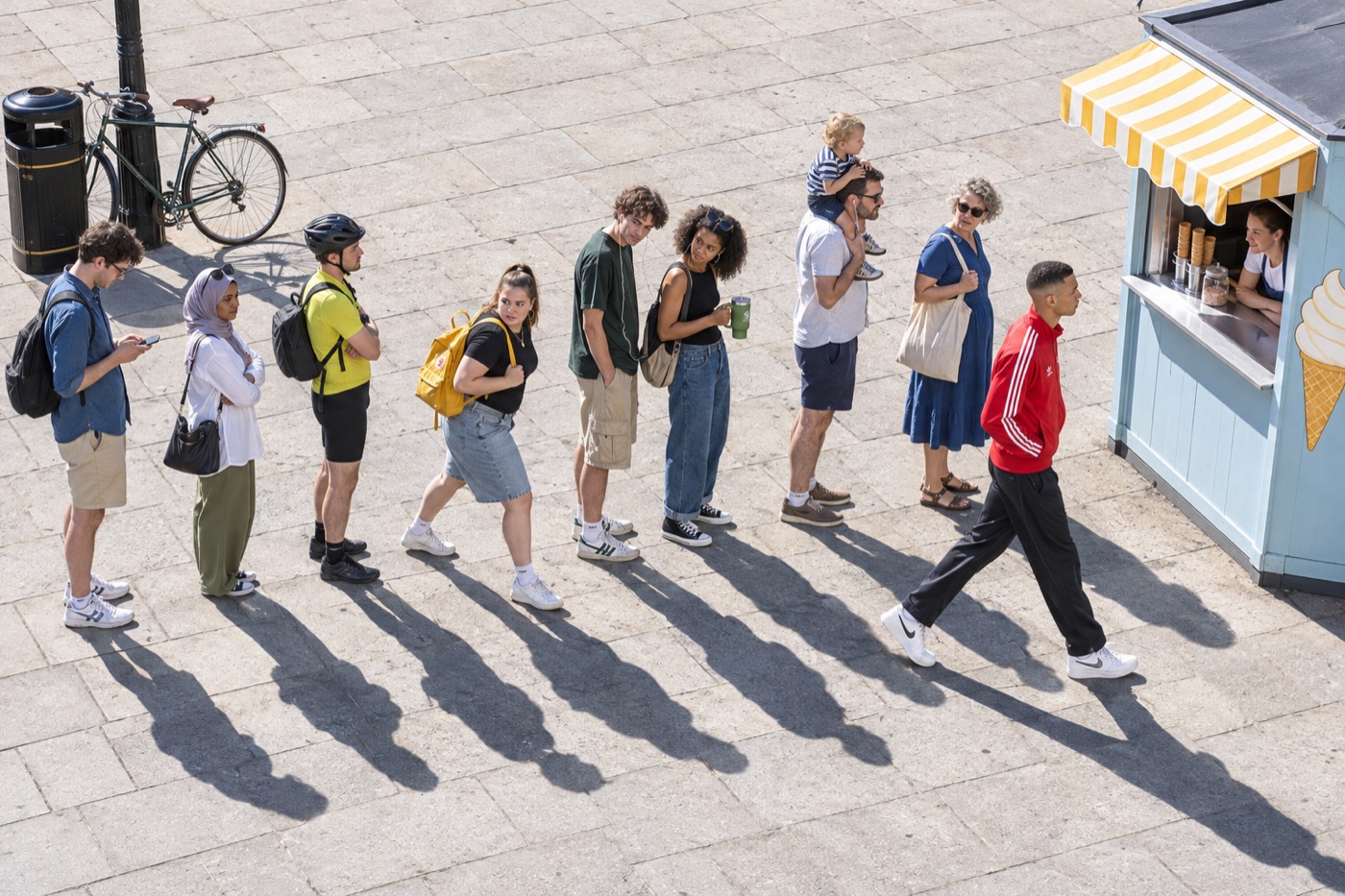
You're waiting in a long queue. Everyone has been standing there for minutes. Suddenly, someone walks straight to the front. Someone follows. What do you do? You might get annoyed and stay where you are. Or you might think that following the rules is pointless if other people are breaking them. A new study suggests that seeing other people behave badly can change the way we act.
Researchers from the University of Amsterdam investigated this question in a study published in October 2026. They used computer models and an online experiment with 750 people. The participants had to make choices in a task that had a rule. They also saw information about what another participant had done. The researchers wanted to know whether seeing a small or large rule break would affect the next person's decision.
One result stood out. When people saw someone breaking a rule seriously, they were more likely to break it themselves. Sometimes the new person went even further than the person before them. The researchers called this escalation. Their computer models suggested that a few people going further could sometimes lead to many more people doing the same thing.
You can imagine this happening at school. Perhaps a student starts talking during a test. If nobody reacts, other students may decide it is acceptable to talk too. Something similar could happen in an online game when one player starts cheating, or on public transport when people push past a queue. One action can set off a chain reaction, especially when nobody seems ready to speak up.
However, the study does not show that everyone copies bad behaviour. About a third of the participants followed the rules every time, even though it meant a smaller reward. The experiment was also an online task, not real life. Breaking a rule means different things in different situations. Refusing an unfair rule can sometimes be brave, while breaking a useful rule may hurt others. It is important to ask why the rule exists and what happens when people ignore it.
The interesting part is that our decisions are not always as independent as we think. We look around, notice what others are doing and decide what seems normal. That can work in a positive direction as well. If one person picks up rubbish or includes a lonely classmate, others might follow their example. The next time someone breaks a rule in front of you, will you follow the crowd or make up your own mind?
Intermediate version
Imagine standing in a queue when someone pushes past everyone and goes straight to the front. At first, the other people look annoyed but say nothing. Then a second person does exactly the same thing. Would you continue waiting patiently, or begin to wonder why you are the only one following the rules? Researchers have explored this familiar problem and found that rule-breaking can spread more easily than we might expect.
A study published in Proceedings of the Royal Society B on 21 October 2026 combined computer simulations with an online behavioural experiment involving 750 participants. Researchers examined what happened when people made decisions after observing how another person had followed or broken a rule. They were especially interested in the size of the violation. Did people react differently when someone broke a rule slightly compared with someone who ignored it altogether?
The results suggested that serious violations were particularly influential. People who observed someone breaking a rule by a large amount tended to break it more themselves. In some cases, participants went beyond the behaviour they had seen rather than simply copying it. The researchers' simulations suggested that even occasional increases of this kind could push a group from generally following the rules towards widespread disobedience. A single person may not cause much trouble, but the effect can build up across a crowd.
The idea is easy to recognise in everyday life. One student starts looking at a phone during a lesson, then another checks a message, and soon several people have stopped listening. In a multiplayer game, a few players may use an unfair trick until everyone else feels pressure to join in. Similar behaviour can occur when people drop litter or jump a queue. Once it seems that nobody respects the rules, following them can begin to feel like a disadvantage.
Still, we should be careful about applying the findings to every situation. The researchers tested decisions in a controlled experiment, not in a real school, street or online community. About a third of the participants followed the rules throughout, even though it did not give them the biggest reward. People also have reasons for challenging rules, and not all rules are fair. There is a difference between cheating to gain an advantage and peacefully refusing a rule that causes harm. The study helps explain social influence, but it cannot tell us which rules deserve our support.
Perhaps the most useful lesson is that behaviour can set an example in both directions. We often notice rule-breakers because they stand out, yet someone who calmly does the right thing can influence a group too. Students, teachers and team captains may be able to prevent bad habits from catching on by making expectations clear. When you see others crossing a line, do you feel tempted to join them, or does it make you more determined to do things properly?
Advanced version
You have been waiting patiently in a queue when somebody strolls straight to the front. Nobody challenges them, and moments later another person follows suit. Before long, those who have respected the system appear to be losing out. Would you stick to your principles, or begin to think that playing by the rules has become a mug's game? A recent psychological study suggests that the answer may depend partly on the behaviour we observe around us.
Published in Proceedings of the Royal Society B on 21 October 2026, the research combined mathematical simulations with an online behavioural experiment involving 750 participants. The team investigated how people respond to examples of compliance and different degrees of rule-breaking. Crucially, they were not simply asking whether people imitate each other. They wanted to understand whether observing a violation might encourage someone to go a step further, creating a process in which relatively small acts of disobedience gradually escalate.
Their findings indicated that conspicuous violations can have a powerful influence on subsequent behaviour. Participants who observed major rule-breaking tended to commit larger violations themselves, while some exceeded the example they had been shown. The simulations suggested that relatively rare episodes of escalation could, under certain conditions, tip an otherwise compliant group towards widespread rule-breaking. In other words, a few people do not necessarily need to convince everybody directly. Their actions can alter what others regard as normal, setting off a sequence that gathers momentum.
The mechanism is easy to imagine, whether in a classroom, an online game or a crowded station. If a handful of students openly use phones during a lesson without consequences, classmates may start to question why they should put theirs away. If cheating becomes common in a competitive game, honest players might feel they are being punished for following the rules. What begins as a personal decision can turn into a collective problem as expectations shift and trust starts to break down.
Yet social influence is not the whole story. This was a controlled study of a specific decision-making task, with no penalty for rule-breaking, so it cannot establish exactly how people will behave in complicated real-world settings. About a third of participants consistently followed the rules even when it cost them the largest reward. Nor should the findings be used to argue that every act of disobedience is harmful. Some rules are unfair or outdated, and challenging them can be morally justified. The important distinction lies between questioning a rule for good reasons and abandoning it merely because everyone else seems to be getting away with something. Such decisions require judgement, courage and careful consideration of the consequences.
The research also invites a more hopeful interpretation. If norms can deteriorate, they can potentially be strengthened through visible examples of cooperation, fairness and courage. The person who refuses to cheat, picks up litter or speaks out when a classmate is excluded may make an unpopular choice feel possible for someone else. We tend to imagine our moral decisions as entirely personal, yet our behaviour helps shape the environment in which other people decide. When a crowd begins crossing the line, who has the responsibility to draw it again?
Study this story
Save the words you want to keep, talk about the story, then practise the language.
Highlights0 saved
Highlights0 saved
Highlights0 saved
Talk about it3 questions
- Why might seeing one person cheat make other people cheat too?
- Would you say something to someone who jumped a queue?
- How could one student help a whole class behave better?
Sentence help (optional): I think ... because ... · One reason is ... · For me, ...
You can talk about people in general instead of yourself, and you can pass on any question.
Talk about it3 questions
- Why might seeing one person cheat make other people cheat too?
- Would you say something to someone who jumped a queue?
- How could one student help a whole class behave better?
You can talk about people in general instead of yourself, and you can pass on any question.
Talk about it3 questions
- Why might seeing one person cheat make other people cheat too?
- Would you say something to someone who jumped a queue?
- How could one student help a whole class behave better?
You can talk about people in general instead of yourself, and you can pass on any question.
Try it
In groups of three, think of a rule at school that some students ignore, such as using phones in lessons or leaving litter. One person describes how one student could start ignoring the rule, and how others might copy. The second person suggests what a student could say or do to stop it spreading. The third person decides whether the rule is a good one and explains why. Then swap roles and try a different rule. Use only made-up examples, not real people.
Exercises4 exercises
1. Complete the sentences
Drag a word into each gap, or tap a word and then tap a gap. Tap a filled gap to put the word back. Two words are not needed.
- Researchers from the University of studied this question.
- The online experiment had 750 .
- A student may start talking during a .
- One action can set off a chain .
- About a third of the participants followed the rules every .
2. Match the meaning
Choose the meaning of each word or phrase as it is used in the article.
- queue
- participants
- escalation
- cheating
Write the letter of the meaning next to each word.
- A people who take part in a study
- B a change that makes something bigger or worse
- C a line of people waiting for something
- D breaking the rules to win
3. Put the verb in the right form
Write the correct form of the verb in brackets.
- Researchers from the University of Amsterdam this question. (investigate)
- Suddenly, someone straight to the front. (walk)
- The researchers to know whether a rule break would affect the next person. (want)
- Sometimes the new person even further than the person before them. (go)
- Refusing an unfair rule can sometimes brave. (be)
4. True, false or not given
Choose Not given if the article does not say, even when you think the statement is probably true.
- The study was published in October 2026.
The text says: "in a study published in October 2026"
- All the participants broke the rules.
The text says: "About a third of the participants followed the rules every time"
- The participants were all students.
The text does not say who the participants were.
- People who saw a serious rule break were more likely to break the rule themselves.
The text says: "When people saw someone breaking a rule seriously, they were more likely to break it themselves"
- Breaking a rule is always wrong.
The text says: "Refusing an unfair rule can sometimes be brave"
Your score
Do all four, then add them up.
Answer key
- Complete the sentences1 Amsterdam · 2 people · 3 test · 4 reaction · 5 time
- Match the meaning1 queue = C · 2 participants = A · 3 escalation = B · 4 cheating = D
- Put the verb in the right form1 investigated · 2 walks · 3 wanted · 4 went · 5 be
- True, false or not given1 True · 2 False · 3 Not given · 4 True · 5 False
1. Complete the sentences
Drag a word into each gap, or tap a word and then tap a gap. Tap a filled gap to put the word back. Two words are not needed.
- The study combined computer with an online experiment.
- The researchers were especially interested in the of the violation.
- In a multiplayer game, a few players may use an unfair .
- Someone who calmly does the right thing can a group too.
- Students, teachers and team captains may be able to bad habits from catching on.
- Not all rules are .
2. Match the meaning
Choose the meaning of each word or phrase as it is used in the article.
- violation
- disobedience
- widespread
- pressure
Write the letter of the meaning next to each word.
- A refusing to follow rules
- B a strong feeling that you must do something
- C an act of breaking a rule
- D found in many places or among many people
3. Put the verb in the right form
Write the correct form of the verb in brackets.
- A study published on 21 October 2026 simulations with an experiment. (combine)
- People who someone breaking a rule tended to break it more themselves. (observe)
- Participants went beyond the behaviour they . (see)
- Once it seems that nobody the rules, following them can feel like a disadvantage. (respect)
- The researchers decisions in a controlled experiment. (test)
4. True, false or not given
Choose Not given if the article does not say, even when you think the statement is probably true.
- The experiment had 750 participants.
The text says: "an online behavioural experiment involving 750 participants"
- The researchers tested decisions in a real school.
The text says: "The researchers tested decisions in a controlled experiment, not in a real school, street or online community"
- The participants all lived in the Netherlands.
The text does not say where the participants lived.
- About a third of the participants kept following the rules.
The text says: "About a third of the participants followed the rules throughout"
- The study can tell us which rules deserve our support.
The text says: "it cannot tell us which rules deserve our support"
Your score
Do all four, then add them up.
Answer key
- Complete the sentences1 simulations · 2 size · 3 trick · 4 influence · 5 prevent · 6 fair
- Match the meaning1 violation = C · 2 disobedience = A · 3 widespread = D · 4 pressure = B
- Put the verb in the right form1 combined · 2 observed · 3 had seen or saw · 4 respects · 5 tested
- True, false or not given1 True · 2 False · 3 Not given · 4 True · 5 False
1. Complete the sentences
Drag a word into each gap, or tap a word and then tap a gap. Tap a filled gap to put the word back. Two words are not needed.
- Their actions can alter what others as normal.
- Honest players might feel they are being for following the rules.
- The simulations suggested that rare escalation could tip an otherwise group towards rule-breaking.
- This was a controlled study of a specific decision-making .
- Some rules are unfair or .
- The person who refuses to cheat may make an choice feel possible for someone else.
2. Match the meaning
Choose the meaning of each word or phrase as it is used in the article.
- conspicuous
- momentum
- norms
- deteriorate
Write the letter of the meaning next to each word.
- A the force that keeps something growing or moving
- B become worse
- C easy to notice
- D the usual rules about how people behave
3. Make the right word
Use the word in brackets to make a word that fits the gap.
- The research combined mathematical with a behavioural experiment. (SIMULATE)
- The team studied how people respond to examples of and rule-breaking. (COMPLY)
- Challenging unfair rules can be morally . (JUSTIFY)
- Such decisions require and careful consideration of the consequences. (JUDGE)
- What begins as a personal decision can turn into a problem. (COLLECT)
4. True, false or not given
Choose Not given if the article does not say, even when you think the statement is probably true.
- The study was published on 21 October 2026.
The text says: "Published in Proceedings of the Royal Society B on 21 October 2026"
- The study proves that every act of disobedience is harmful.
The text says: "Nor should the findings be used to argue that every act of disobedience is harmful"
- The participants were paid in cash.
The text does not say how the participants were paid.
- The simulations suggested that a few escalating people could change a whole group.
The text says: "relatively rare episodes of escalation could, under certain conditions, tip an otherwise compliant group towards widespread rule-breaking"
- The study was carried out in real classrooms.
The text says: "This was a controlled study of a specific decision-making task"
Your score
Do all four, then add them up.
Answer key
- Complete the sentences1 regard · 2 punished · 3 compliant · 4 task · 5 outdated · 6 unpopular
- Match the meaning1 conspicuous = C · 2 momentum = A · 3 norms = D · 4 deteriorate = B
- Make the right word1 simulations · 2 compliance · 3 justified · 4 judgement · 5 collective
- True, false or not given1 True · 2 False · 3 Not given · 4 True · 5 False
Continue reading
Games & online life
Who Makes the Rules in a Group Chat?
A UNICEF guide for teenagers in Argentina came with a glossary of more than 100 expressions that young people use online. Chat messages can mean different things in different groups.
Places & people
Who Decides Where Teenagers Can Hang Out?
A pilot project in Barcelona asks teenagers how public spaces should work. Who should decide, and what would you change near you?
Music & style
Why Taylor Swift Bought Back Her Recordings
A famous singer announced that she had bought the original recordings of her first six albums. How can you make something and still not own it?

Read this article online: johnplusnews.com/articles/if-everyone-else-breaks-the-rules-would-you/