Who Decides Where Teenagers Can Hang Out?
A pilot project in Barcelona asks teenagers how public spaces should work. Who should decide, and what would you change near you?
Warm up3 questions
- Where can friends spend an hour without buying anything?
- What makes a place feel welcoming to teenagers?
- Would you choose more seats, more shade or more space to play?
Sentence help (optional): I'd choose ... because ... · For me, ... · I think ... because ...
Warm up3 questions
- Where can friends spend an hour without buying anything?
- What makes a place feel welcoming to teenagers?
- Would you choose more seats, more shade or more space to play?
Warm up3 questions
- Where can friends spend an hour without buying anything?
- What makes a place feel welcoming to teenagers?
- Would you choose more seats, more shade or more space to play?
Core version
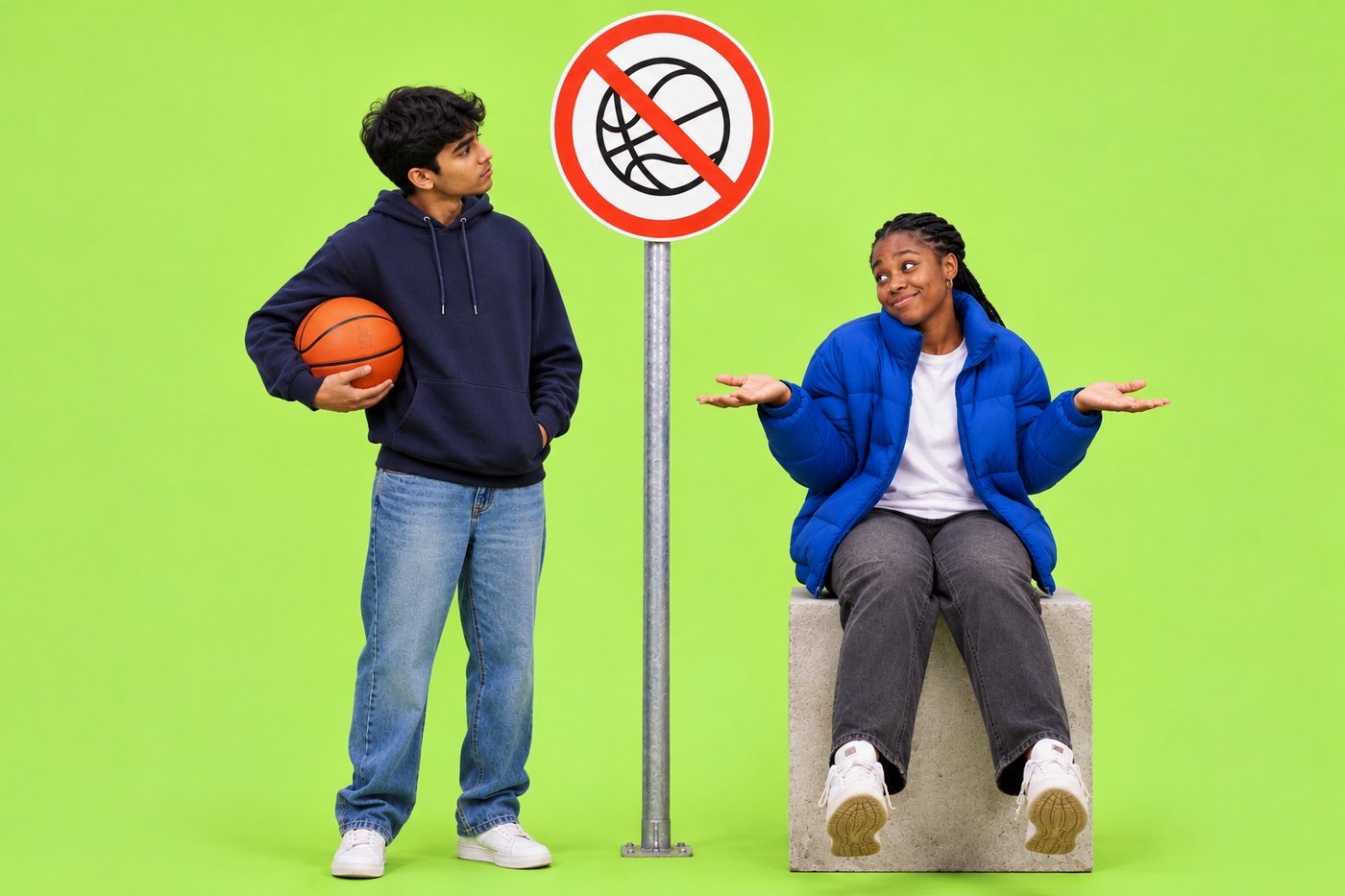
Imagine four friends who want to sit and talk for an hour after school. The café costs money. The park has no seats. In the square, a sign says no ball games. Where do they go?
One project in Barcelona's 2026 architecture programme is called +Ciutat Jugable. "Ciutat Jugable" is Catalan for "Playable City". The project asks teenagers how public places should work. Its page says that the needs and experiences of teenagers are often missing from plans for streets and squares.
It is a pilot, which means a small test. It started from the ideas of a group of teenagers in a part of Barcelona that is changing a lot. Four groups of students at a secondary school take part. They are in the fourth year of ESO, the last year of compulsory secondary school in Spain.
The plan has three stages. First, the students look at how public places are used now. Second, they design and build prototypes, which are first versions that other places could copy. Third, there are walks and a round table for the public. The first two stages were planned for January to June 2026, and the third for October 2026.
The big idea is that young people should help to decide what public space is for. Not everything has to cost money. A place can be good because it has seats, shade, light or room to move.
But remember the limits. The project page describes plans, not results. It doesn't say what was built or whether it worked. And it is one project in one city, so it can't tell us what teenagers in all of Spain want.
So now it's your turn. Imagine you can add one thing to a small square near your home: seats, shade, lights or a sports area. What would you choose, and who else would need to agree?
Intermediate version
Picture four friends with an hour to spare after school and no money to spend. The café is out. The park has no seats. The square has a sign saying no ball games, and a neighbour who doesn't like noise. They aren't doing anything wrong, but there is nowhere that clearly says they are welcome.
A project in Barcelona is asking teenagers about exactly this kind of problem. It is called +Ciutat Jugable ("Ciutat Jugable" is Catalan for "Playable City"), and it is part of Barcelona's 2026 architecture programme. The organisers, B-Murals and El Globus Vermell, want to design more inclusive public spaces together with the people who use them. They start from the needs and experiences of teenagers, which, according to the project page, are often missing from planning.
It is described as a pilot, a small test. It began from the reflections of a group of teenagers in the Marina del Prat Vermell neighbourhood, an area going through a major transformation. Four groups of students take part at the Institut Domènech i Muntaner, as part of a school subject called Projectes. They are in the fourth year of ESO, the last year of compulsory secondary school in Spain.
The plan has three stages. First, students look at how public spaces are used now. Then they design and test ideas that could be repeated elsewhere. In the final stage, there are walking routes and a round table for the general public. The first two stages were planned for January to June 2026, and the last for October 2026.
The page also connects the pilot with several city plans, including one about play and the United Nations goal of sustainable cities. Its idea of a "playable city" goes beyond young children: it asks whether older teenagers also need places that are made for them.
Any public space has to work for more than one group. A neighbour who likes quiet and a group who want music need the same square. Seats attract people who sit and talk, while a sports area attracts people who run and shout. Every design is a compromise, and someone has to choose. Asking young people helps, but it doesn't guarantee that everybody will be happy.
The page describes plans, not results, so we can't say what was built or whether it worked, and one project in one city can't speak for all of Spain. So if students helped to redesign a small square near you, which decision should they be allowed to make themselves?
Advanced version
Imagine having an hour after school to spend with friends and nowhere obvious to go. The café means buying something. The playground is for younger children. A square might have room, but no seats or shade. You do not need a grand new attraction. A comfortable place to sit together would do.
A project in Barcelona starts with teenagers' ideas about that kind of space. Called +Ciutat Jugable, or Playable City, it forms part of the city's 2026 architecture programme. The organisers, B-Murals and El Globus Vermell, say young people's needs are often missing from decisions about streets and squares. They want students to help make those decisions instead of simply living with the result.
The pilot involves four groups of students at the Institut Domènech i Muntaner. They are in the fourth year of ESO, the final year of compulsory secondary education in Spain. It began with ideas from teenagers in Marina del Prat Vermell, a Barcelona neighbourhood undergoing major change. The aim is to connect what students notice in everyday life with what could actually be designed.
First, the plan asks students to look at how public spaces are used. Next comes designing and building ideas that could also be tried elsewhere. Public walks and a round-table discussion are part of the programme too. The first stages were scheduled for January to June 2026, with the public activities in October. The project page describes that plan; it does not report what was eventually built or how well it worked.
The phrase Playable City usually brings children to mind. For older teenagers, it might mean something different: a seat in the shade, enough light to feel comfortable or space to move without paying for an activity. Asking the people who would use a place can reveal needs that are easy to miss from a planning desk.
But a square belongs to more than one group. Music can make it welcoming to friends and tiring for a neighbour. A sports area takes space that someone else might want for sitting. Giving students a voice will not remove those disagreements. It can make the choices clearer, and let teenagers help shape a place they are expected to share.
Study this story
Save the words you want to keep, talk about the story, then practise the language.
Highlights0 saved
Highlights0 saved
Highlights0 saved
Talk about it3 questions
- What would you add to a small square near your school?
- How could a hangout work for both teenagers and neighbours who want quiet?
- Which decision about a local space should students help make?
Sentence help (optional): I think ... because ... · One reason is ... · For me, ...
You can talk about people in general instead of yourself, and you can pass on any question.
Talk about it3 questions
- What would you add to a small square near your school?
- How could a hangout work for both teenagers and neighbours who want quiet?
- Which decision about a local space should students help make?
You can talk about people in general instead of yourself, and you can pass on any question.
Try it
On paper, redesign an invented small square or school courtyard. Include two different groups of users, one low-cost improvement and one compromise between them. Then give a one-minute pitch to another pair. You don't need to visit anywhere or contact anyone, so choose an imaginary place.
Exercises4 exercises
1. Complete the sentences
Drag a word into each gap, or tap a word and then tap a gap. Tap a filled gap to put the word back. Two words are not needed.
- The project asks teenagers how public should work.
- A is a small test of a new idea.
- Students design and build , which are first versions that other places could copy.
- The project page describes plans, not .
- A place can be good because it has seats, shade, light or to move.
2. Match the meaning
Choose the meaning of each word or phrase as it is used in the article.
- round table
- compulsory
- shade
- take part
Write the letter of the meaning next to each word.
- A something you must do because of a rule
- B a cool area where the sun's light does not reach
- C to join in an activity with other people
- D a meeting where people sit together and discuss a topic
3. Put the verb in the right form
Write the correct form of the verb in brackets.
- The café money. (cost)
- One project in Barcelona's 2026 architecture programme called +Ciutat Jugable. (be)
- It from the ideas of a group of teenagers. (start)
- Four groups of students at the school part. (take)
- The first two stages were for January to June 2026. (plan)
4. True, false or not given
Choose Not given if the article does not say, even when you think the statement is probably true.
- The project is a small test, called a pilot.
The text says: "It is a pilot, which means a small test."
- The project page says teenagers' needs are already well included in plans.
The text says the opposite: "Its page says that the needs and experiences of teenagers are often missing from plans for streets and squares."
- The students are in the last year of compulsory secondary school in Spain.
The text says: "They are in the fourth year of ESO, the last year of compulsory secondary school in Spain."
- The project page reports what was built and whether it worked.
The text says the opposite: "The project page describes plans, not results."
- The students chose to build a skate park.
Not stated. This version does not give this information.
Your score
Do all four, then add them up.
Answer key
- Complete the sentences1 places · 2 pilot · 3 prototypes · 4 results · 5 room
- Match the meaning1 round table = D · 2 compulsory = A · 3 shade = B · 4 take part = C
- Put the verb in the right form1 costs · 2 is · 3 started · 4 take · 5 planned
- True, false or not given1 True · 2 False · 3 True · 4 False · 5 Not given
1. Complete the sentences
Drag a word into each gap, or tap a word and then tap a gap. Tap a filled gap to put the word back. Two words are not needed.
- They aren't doing anything wrong, but nowhere clearly says they are .
- The organisers want to design more public spaces.
- Asking young people helps, but it doesn't that everybody will be happy.
- Every design is a , and someone has to choose.
- The neighbourhood is going through a major .
2. Match the meaning
Choose the meaning of each word or phrase as it is used in the article.
- compulsory
- pilot
- sustainable
- round table
Write the letter of the meaning next to each word.
- A a small test of a new idea
- B something you must do because of a rule
- C a meeting where people sit together and discuss a topic
- D able to continue without using up resources or harming the environment
3. Put the verb in the right form
Write the correct form of the verb in brackets.
- The page the pilot with several city plans. (connect)
- They in the fourth year of ESO. (be)
- A sports area people who run and shout. (attract)
- It from the reflections of a group of teenagers. (begin)
- The first two stages were for January to June 2026. (plan)
4. True, false or not given
Choose Not given if the article does not say, even when you think the statement is probably true.
- Barcelona's 2026 architecture programme includes the project.
The text says: "it is part of Barcelona's 2026 architecture programme"
- The students in the project are in their first year of secondary school.
The text says the opposite: "They are in the fourth year of ESO, the last year of compulsory secondary school in Spain."
- The last stage of the project was planned for October 2026.
The text says: "The first two stages were planned for January to June 2026, and the last for October 2026."
- The page says the pilot proved that the students' designs work.
The text says the opposite: "The page describes plans, not results"
- The students voted on which square to redesign.
Not stated. This version does not give this information.
Your score
Do all four, then add them up.
Answer key
- Complete the sentences1 welcome · 2 inclusive · 3 guarantee · 4 compromise · 5 transformation
- Match the meaning1 compulsory = B · 2 pilot = A · 3 sustainable = D · 4 round table = C
- Put the verb in the right form1 connects · 2 are · 3 attracts · 4 began · 5 planned
- True, false or not given1 True · 2 False · 3 True · 4 False · 5 Not given
1. Complete the sentences
Drag a word into each gap, or tap a word and then tap a gap. Tap a filled gap to put the word back. Two words are not needed.
- Asking the people who would use a place can needs that are easy to miss.
- Giving students a voice will not remove those , but it can make the choices clearer.
- The first stages were for January to June 2026.
- Music can make a square to friends and tiring for a neighbour.
- The aim is to what students notice in everyday life with what could be designed.
2. Match the meaning
Choose the meaning of each word or phrase as it is used in the article.
- pilot
- compulsory
- undergoing
- eventually
Write the letter of the meaning next to each word.
- A required by a rule or law, so you cannot choose
- B a small trial of an idea before it is used more widely
- C after a long time, or at the end of a process
- D going through a process or a big change
3. Make the right word
Use the word in brackets to make a word that fits the gap.
- The pilot began with ideas from teenagers in a Barcelona . (NEIGHBOUR)
- A place to sit together would do. (COMFORT)
- The idea of a city usually brings children to mind. (PLAY)
- The organisers want students to help make those . (DECIDE)
- Public walks and a round-table are part of the programme too. (DISCUSS)
4. True, false or not given
Choose Not given if the article does not say, even when you think the statement is probably true.
- The first stages of the plan were scheduled for the first half of 2026.
The text says: "The first stages were scheduled for January to June 2026, with the public activities in October."
- The project page reports how well the students' ideas worked.
The text says the opposite: "it does not report what was eventually built or how well it worked"
- The organisers say young people's needs are often missing from decisions about public places.
The text says: "say young people's needs are often missing from decisions about streets and squares"
- The students are in the first year of secondary school.
The text says the opposite: "They are in the fourth year of ESO, the final year of compulsory secondary education in Spain."
- The city council pays for the project.
Not stated. The text does not say who pays for the project.
- Giving students a voice will not end every disagreement about a square.
The text says: "Giving students a voice will not remove those disagreements."
Your score
Do all four, then add them up.
Answer key
- Complete the sentences1 reveal · 2 disagreements · 3 scheduled · 4 welcoming · 5 connect
- Match the meaning1 pilot = B · 2 compulsory = A · 3 undergoing = D · 4 eventually = C
- Make the right word1 neighbourhood · 2 comfortable · 3 playable · 4 decisions · 5 discussion
- True, false or not given1 True · 2 False · 3 True · 4 False · 5 Not given · 6 True
Continue reading
Music & style
Why a Great Song Doesn't Need Your Language
Songs in 16 languages reached a streaming service's global top 50 in 2025. What makes a song travel, and what gets lost on the way?
Games & online life
Who Makes the Rules in a Group Chat?
A UNICEF guide for teenagers in Argentina came with a glossary of more than 100 expressions that young people use online. Chat messages can mean different things in different groups.
Music & style
Would You Wear a Rival Team's Shirt?
A writer argues that fashion has discovered the football shirt. So what are you saying when you wear one, and who decides what it means?



Read this article online: johnplusnews.com/articles/who-decides-where-teenagers-can-hang-out/