News lessonOctober 2026
Is Instagram Choosing Our Holidays?
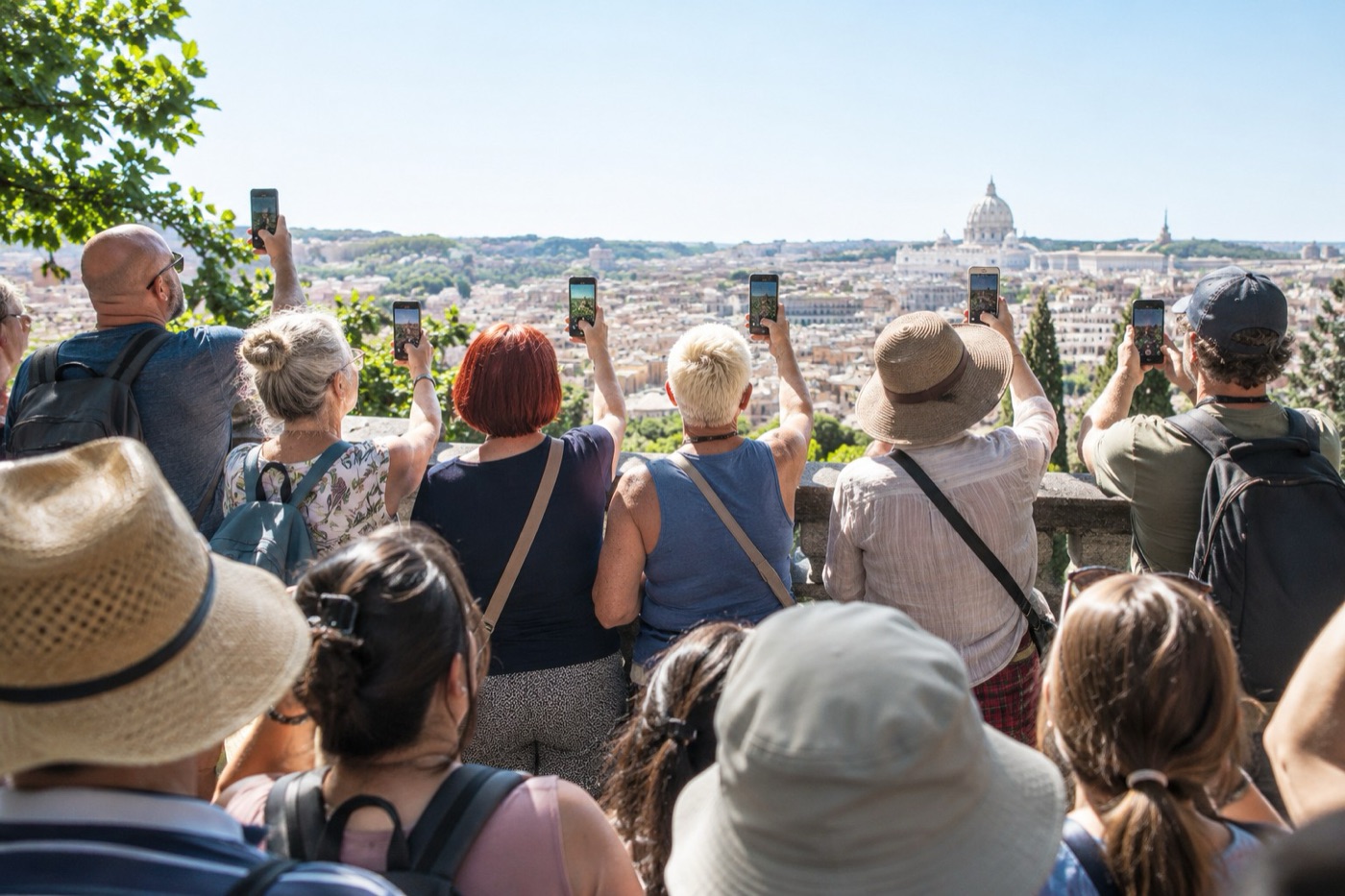
A beautiful image can send you across the world. It can also send several thousand other people to the same railing.
Before you read
1Warm up3 questions
Talk about these questions with a partner.
- Have you ever seen a photo that made you want to visit a place?
- Do you take many pictures when you travel?
- What makes a holiday a good one for you?
2Key words8 words
These words are in the article. Choose the letter of the meaning for each one.
- imagine
- empty
- recognise
- mainly
- view
- welcome
- worry
- traffic
- Afor the most part
- Bto know something because you have seen it before
- Cto make a picture of something in your head
- Dto be happy to see someone arrive
- Ethe cars and buses on a road
- Fwith nothing or nobody in it
- Gto feel afraid that something bad will happen
- Hwhat you can see from a place
1Warm up3 questions
Talk about these questions with a partner.
- Where do your holiday ideas usually come from?
- Can a photograph tell you whether you would enjoy a place?
- Have you ever arrived somewhere that looked different from its pictures?
2Key words8 words
These words are in the article. Choose the letter of the meaning for each one.
- desirable
- genuinely
- commissioned
- respondents
- selective
- outrank
- extraordinary
- invented
- Achoosing only some things and leaving others out
- Bin a real way, not pretending
- Cmade up, not real
- Dsomething you want to have or visit
- Easked and paid someone to do a piece of work
- Fvery unusual and impressive
- Gto be more important than something else
- Hpeople who answer a set of questions
1Warm up3 questions
Talk about these questions with a partner.
- Does being influenced by an image make a choice less genuine?
- What does a travel photograph usually leave outside the frame?
- Who benefits when a place becomes famous online?
2Key words8 words
These words are in the article. Choose the letter of the meaning for each one.
- persuasive
- encountered
- excludes
- decorate
- outlast
- concentrate
- rewards
- arranged
- Aput in a certain position
- Bmet or found, often by chance
- Cgood at making you want to do something
- Dleaves out
- Eto make something look nicer
- Fto continue for longer than something else
- Gto bring many people or things into one place
- Hgives something good to
Read
3Read the article
The paragraphs are numbered. Look out for the key words from task 2.
Core version
Imagine you are at home one evening, moving through videos on your phone. One of them shows a small beach somewhere warm. The sea is bright blue, the sand is almost empty, and for fifteen seconds you forget the weather outside your window. You save the video. You tell yourself that one day you will go.
Months later, you are standing on that beach. It is real and it is beautiful. There is also a line of about twenty people waiting to stand exactly where the camera stood.
That traveller is imagined, but the situation is easy to recognise. Social media has made the world feel closer. A short clip can show you a town you had never heard of, or a market you would never find in a guidebook. For a lot of people, watching those videos is part of the pleasure of planning a trip, and sometimes it is the only trip they take that year.
The difficulty is that a camera only shows what is inside the picture. The car park is outside it. So is the traffic and the hour somebody waited for the light to be right. A quiet street at six in the morning looks very different at midday. The street has not changed. The photograph simply showed one small part of it.
Pictures can also change what you do when you get there. One survey of travellers in Spain, Italy and the UK found that nearly four in ten had visited a place mainly in order to take a photo or a video. You may spend an afternoon looking for a view instead of enjoying the one in front of you. One friend wants to wait for the sunset. Another wants to put the phone away and order lunch.
None of this makes photographs the enemy. They help us remember a good day and show it to people who could not come. A video can bring customers to a small restaurant that needed them. People who live in busy places may welcome visitors, worry about the crowds, or feel both things on the same afternoon.
So perhaps the question is not whether to take pictures. It is what you want from the trip before you arrive. A famous view can be wonderful. So can a slow lunch in a place nobody told you to visit.
Intermediate version
The water is impossibly blue. A table for two sits on an empty terrace. Somebody turns towards the camera with a village and a mountain behind them. You save it. One day, you think.
When that imagined traveller finally arrives, the view is exactly as promised. So is the queue of thirty people waiting for their turn in front of it.
That scene is invented, but it describes something most travellers now recognise. Social media can make a place feel desirable long before we know anything about it. A few seconds of video can introduce a beach, a night train or a café on the other side of the world, and for someone at home on a grey Tuesday, the possibility of being somewhere else is genuinely powerful.
The influence does not stop once the flight is booked. In a survey commissioned by the travel company TUI Musement, 39% of respondents said they had visited a tourist site mainly to take a photo or record a video. That survey covered travellers in Spain, Italy and the UK, and it cannot explain why any individual travels, but the behaviour is familiar: at some point the picture became part of the plan.
The trouble is that photographs are selective by nature. A frame may leave out a car park, a crowd or the ninety minutes somebody spent waiting for the light. That is not dishonesty. Every photographer chooses what to include. It becomes a problem only when we see nothing but the best moments and then arrive expecting a private experience in a very public place.
For the people who live there, the attention cuts in several directions at once. A café that appears in a popular video may suddenly be serving visitors from countries its owner has never been to. The same week, a neighbour may spend twenty minutes getting down a street that used to take two. Residents are not one group with one opinion, and a busy summer is not the same problem for everybody in town.
Nor is photographing a holiday the opposite of enjoying it. Pictures hold on to things we would otherwise lose. The awkward moment arrives when getting the shot starts to outrank deciding what you actually want to do with the afternoon. Does everyone in the group want to wait for it? And the harder question underneath: would you still have come if there were nothing to post?
There is room for the famous view and the unplanned afternoon in the same week. A recommendation might take you somewhere extraordinary. So might a wrong turn. Perhaps the best thing to bring home is not evidence that you went to the right place, but an afternoon that belongs to you whether or not anyone else ever sees it.
Advanced version
First comes the image: a quiet cove, a breakfast table angled towards the sea, a narrow street with nobody in it. Then comes the thought that makes travel so persuasive, which is simply imagine being there. Months later the traveller arrives and finds nine other people waiting to photograph the same doorway. The street is still beautiful. It is just less private than twelve seconds of video suggested.
That traveller is invented, but the shape of the experience is widely shared. Social media has given travel inspiration an extraordinary reach. A short clip can introduce someone to a landscape, a neighbourhood or a dish they would otherwise never have encountered, and it can turn an ordinary evening at home into a small act of escape.
A feed also teaches us what a place is supposed to look like. It rewards the image understood in a second: the clear water, the empty street, the viewpoint at the exact hour. The coach park, the queue and the twenty minutes outside the café rarely make the cut. This is not deception, since every photograph excludes almost everything. The difficulty begins when the frame quietly becomes the whole of our expectation.
For some travellers the photograph is not a distraction from the experience but a genuine part of it. In a survey commissioned by TUI Musement, 39% of travellers in Spain, Italy and the UK said they had visited a tourist site mainly in order to photograph or film it. That is one industry survey reporting what people say about themselves, not proof that nobody looks at anything. It does suggest that the desire for an image can shape an itinerary rather than merely decorate it.
The effects reach well beyond the visitor. A single popular post can bring badly needed custom to a restaurant. It can also concentrate several hundred people onto one footbridge at the same hour. Social media is one part of a much larger tourism economy, and the people inside it do not share a single view. The owner of a full café and the neighbour trying to park are having different afternoons on the same street.
There is a quieter version of the same tension inside the holiday group. One person wants to photograph the sunset. Another wants to watch it without being arranged in front of it. Neither is wrong. Images make us look harder at things, and they keep days alive long after the details have gone. They can also turn into another task on the list, particularly once the imagined audience starts to matter more than the people actually present.
The answer is unlikely to be a ban on phones, or a hunt for somewhere nobody has found, since that hunt is what empties the quiet places. It may be enough to ask what drew you there, and whether you have left room to be surprised. A crowded beach can still be worth the journey. An unplanned conversation can outlast every photograph from the trip. The question worth carrying is whose idea of a good holiday you are following.
After you read
4True, false or not given5 statements
Choose T (true), F (false) or NG (the article does not say).
- In the video, the sand on the beach looks almost empty.
The text says: "the sand is almost empty".
- When the traveller arrives at the beach, nobody else is there.
The text says there is "a line of about twenty people" waiting.
- The traveller takes a photo on the beach.
The text does not say whether the traveller takes a photo.
- In the survey, nearly four in ten travellers had visited a place mainly to take a photo or video.
The text says: "nearly four in ten had visited a place mainly in order to take a photo or a video".
- The writer says photographs are bad for every holiday.
The text says: "None of this makes photographs the enemy".
5Vocabulary5 gaps
Complete the sentences with words from the box. Two words are not needed.
crowdcustomersdifficultyenemyluggagepleasuresouvenirs
- Looking at maps before a trip gives many people real , and they smile as they plan.
- A small restaurant cannot stay open without enough who pay for their meals.
- The biggest of travelling with small children is keeping them busy on long journeys.
- Some people think tourists are the of a quiet village, but others say they bring money.
- We left the viewpoint early because the of people made it impossible to see anything.
6Verb forms5 gaps
Write the correct form of the verb in brackets.
- Last summer we to a small beach that we saw in a video. (GO)
- A friend me a video of a town in Italy yesterday. (SEND)
- He a lovely view and stopped to take a photo. (SEE)
- Before the video, we anything about that beach. (NOT KNOW)
- After the long queue, everyone tired and hungry. (FEEL)
7Language focusprepositions
Complete the sentences with words from the box. Two words are not needed. Some words always go with one small word. Learn them as a pair: afraid of, depend on, interested in.
atforfrominofonto
- Many travellers are afraid missing the best view.
- Choosing a hotel often depends the price and the view.
- I'm terrible taking photos in the dark.
- She is interested villages that tourists don't know.
- The village is famous its beautiful old bridge.
4True, false or not given5 statements
Choose T (true), F (false) or NG (the article does not say).
- Fewer than half of the travellers surveyed said they had visited a tourist site mainly to take a photo or video.
The text gives the figure as 39%, which is under half.
- The writer says taking photographs of a holiday stops people enjoying it.
The text says: "Nor is photographing a holiday the opposite of enjoying it".
- Most of the travellers in the survey were under thirty.
The text does not give the ages of the travellers.
- The text says a café can end up serving visitors from countries its owner has never been to.
The text says a popular video can bring "visitors from countries its owner has never been to".
- The text says all residents agree that a busy summer is a problem.
The text says: "Residents are not one group with one opinion".
5Vocabulary6 gaps
Complete the sentences with words from the box. Two words are not needed.
behaviourcapacitydishonestyevidenceinfluencepossibilityreputationresidents
- Several complained that the new viewpoint had made their quiet street impossible to walk along.
- Cropping a photo to hide a crowd is not necessarily ; most photographers simply choose the best part of the scene.
- Photos are often shown to friends as that a trip really happened.
- The of social media on where people choose to travel is hard to measure exactly.
- Taking twenty photos of the same plate is quite normal these days, and nobody finds it strange.
- Booking the flight made the of seeing the island feel real for the first time.
6Verb forms5 gaps
Write the correct form of the verb in brackets.
- By the time we reached the viewpoint, the sun already. (SET)
- The street so often that everyone recognises it. (PHOTOGRAPH)
- If we about the crowds, we would have chosen another beach. (KNOW)
- You to hurry; the viewpoint stays open until midnight. (NOT NEED)
- If the crowds keep growing, the town a limit on visitors. (INTRODUCE)
7Language focusprepositions
Complete the sentences with words from the box. Two words are not needed. Many verbs need a fixed preposition after them: object to, benefit from, rely on. Learn the verb and the preposition together.
againstforfromofontowith
- Many locals object crowds blocking their streets.
- Small businesses often benefit a sudden rise in visitors.
- Residents protested the closure of their local bakery to make room for a souvenir shop.
- Travel writers are sometimes blamed spoiling quiet villages.
- Many visitors rely their phones to find the way.
4True, false or not given5 statements
Choose T (true), F (false) or NG (the article does not say).
- The writer is cautious about how much the 39% survey result proves.
The text calls it "one industry survey reporting what people say about themselves, not proof".
- The writer thinks the disagreement over the sunset is best settled by deciding which traveller is right.
The text says: "Neither is wrong".
- The writer believes social media will eventually reduce the number of people who travel.
The text makes no prediction about how many people will travel.
- The text suggests that a popular post can be good news for one person and bad news for another on the same street.
The post can bring "badly needed custom" to a restaurant yet leave a neighbour "trying to park".
- The writer recommends searching for an undiscovered place as a way of avoiding crowds.
The text says that hunt "is what empties the quiet places".
5Vocabulary6 gaps
Complete the sentences with words from the box. Two words are not needed.
backlashcustomdeceptionhuntitinerarynoveltyreachtension
- Editing out the crowd is hardly when every viewer knows that a photograph shows only part of a scene.
- The group's was so packed with famous viewpoints that nobody had a free afternoon.
- Without the festival, many family restaurants would have struggled to attract enough in winter.
- There was a noticeable between those who wanted to linger and those who wanted to keep moving.
- The for an undiscovered village often ends with a crowd arriving in the same lanes.
- Short videos have an astonishing , travelling far beyond the audience of the person who posted them.
6Word forms5 gaps
Use the word in brackets to make a word that fits the gap.
- Her on waiting for perfect light tested the whole group's patience. (INSIST)
- The idea that a place can stay secret for ever is simply once a video has been posted. (REALISTIC)
- Local shopkeepers have mixed feelings about the sudden of their street. (POPULAR)
- Viewers tend to how peaceful a place will be when they have only seen it in a photograph. (ESTIMATE)
- It is to arrive early if you want a clear view of the footbridge. (ADVISE)
7Language focusprepositions
Complete the sentences with words from the box. Two words are not needed. At C1, adjectives often take a fixed preposition that is hard to guess: tantamount to, fraught with, contingent on. Treat each pair as one unit.
atbyinofontowith
- Choosing a destination only because it is popular online is tantamount letting a stranger plan your holiday.
- The journey proved fraught small frustrations, from cancelled trains to a closed viewpoint.
- Whether a village copes with sudden fame is contingent how far its residents are consulted.
- A harbour bereft its fishing boats may look tidy in photographs but loses part of its character.
- The long climb culminated a breathtaking view of the harbour.
Speak
8Talk about it3 questions
Discuss in pairs or small groups. Give reasons for your answers.
- Would you visit a beautiful place if you could not take any pictures?
- Is it a problem to go somewhere mainly for a photograph?
- What matters more on holiday: the place or the people you are with?
8Talk about it3 questions
Discuss in pairs or small groups. Give reasons for your answers.
- Would you still go somewhere if there were nothing to post about it?
- How many photos is too many on a holiday, or is there no such number?
- What do people who live in a popular place gain, and what do they lose?
8Talk about it3 questions
Discuss in pairs or small groups. Give reasons for your answers.
- The article says a feed teaches us what a place is supposed to look like. Is that fair?
- Is looking for an undiscovered place part of the same problem?
- What would you want to remember from a trip if you took no pictures at all?
9Role-play: one famous beach or a quiet day
Work in pairs. Read your card, then have the conversation. Swap roles and do it again.
Student A · the friend with the video
You saw a video of a beautiful beach and you saved it. You want to spend the whole day there and take photos. Explain why it matters to you, and listen to your friend's worries.
Student B · the friend who wants a quiet day
You've heard the beach will be packed. You'd prefer a slow lunch somewhere nobody told you about. Say what worries you, then suggest a plan you can both accept.
Useful phrases
- I'd love to see that beach from the video.
- It's going to be packed, though.
- We don't have to take a hundred photos.
- How about half a day there and half somewhere quiet?
- That's fair, I'm happy to compromise.
- What matters most to you on this trip?
Afterwards, tell the class: where did you decide to go, and how did you share the time?
Your words
Highlights0 saved
Highlights0 saved
Highlights0 saved
Was this lesson useful? Support johnplusnews on Ko-fi
Continue reading
Language
Did Writing Really Make Languages More Complicated?
A large study of about 100,000 sentences in 30 languages found no universal pattern showing that writing makes sentences more complex. It does not say that writing never changes a language.
Relationships
Would You Sign a Contract Before Getting Married?
More young Americans are signing prenuptial agreements before their weddings. Is planning for a divorce unromantic, or is it honest and sensible?
Work
They Still Have Their Jobs. They Are Leaving Anyway
Nobody made these workers redundant. AI changed what their work felt like, and they walked out on careers they had spent a decade building.