News lesson28 January 2026
Could the Sauna Be a New Place to Meet?
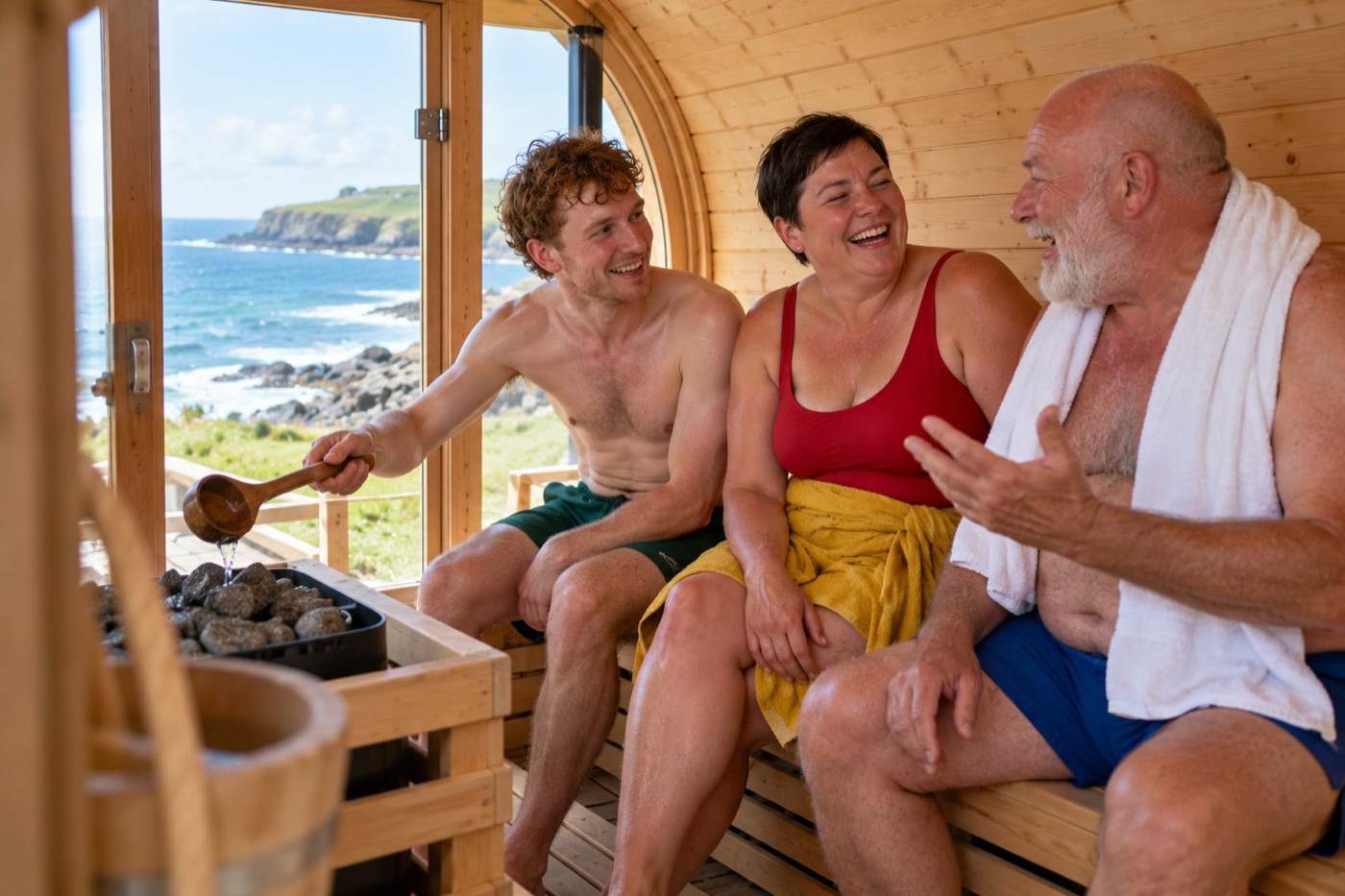
Small cabins along the coast offer heat, a cold dip and conversation without alcohol. Regulars drop in at the same time each week, so familiar faces soon appear.
Before you read
1Warm up3 questions
Talk about these questions with a partner.
- Would you try a sauna by the sea on a cold day?
- What makes a place feel like somewhere people belong?
- Would you rather relax in silence or with a friendly conversation?
2Key words8 words
These words are in the article. Choose the letter of the meaning for each one.
- session
- neighbours
- community
- temperatures
- celebrate
- suitable
- friendship
- noise
- Ahow hot or cold things are
- Bloud or unpleasant sound
- Ca group of people who live in the same place
- Ddo something special on a happy day
- Ea close, friendly link between two people
- Fpeople who live near you
- Gright or good for a person or purpose
- Ha fixed period of time for an activity
1Warm up3 questions
Talk about these questions with a partner.
- Would you try a sauna by the sea on a cold day?
- What makes a place feel like somewhere people belong?
- Would you rather relax in silence or with a friendly conversation?
2Key words8 words
These words are in the article. Choose the letter of the meaning for each one.
- associated
- regulars
- socialising
- loneliness
- wellbeing
- gather
- uncomfortable
- limited
- Aspending time with other people for fun
- Bconnected in people's minds with something
- Csmall in number or amount
- Dthe sad feeling of having nobody to talk to
- Epeople who go to a place often
- Fbeing healthy and happy
- Gcome together in one place
- Hnot feeling at ease
1Warm up3 questions
Talk about these questions with a partner.
- Would you try a sauna by the sea on a cold day?
- What makes a place feel like somewhere people belong?
- Would you rather relax in silence or with a friendly conversation?
2Key words8 words
These words are in the article. Choose the letter of the meaning for each one.
- gossip
- plunge
- ritual
- sociability
- barriers
- encounter
- domestic
- unplanned
- Arelating to the home
- Bcasual talk about other people's private lives
- Ca set of actions done regularly in the same way
- Da meeting, often a short and unplanned one
- Ethings that stop people from meeting or understanding each other
- Fnot arranged in advance
- Gthe quality of enjoying being with other people
- Ha sudden jump or dive into water
Read
3Read the article
The paragraphs are numbered. Look out for the key words from task 2.
Core version
On a cold winter morning in Ireland, a group of people sit together inside a small wooden room. Outside, the wind blows across the sea and the water looks freezing. Inside, it is very hot. They are not at a gym or a luxury hotel. They have come to a sauna near the beach, and some of them have never met before.
Saunas have become much more popular in Ireland in recent years. Some are beside the sea, while others are in town centres or at special events. Visitors usually book a short session and pay for it before they arrive. They sit in the heat, talk quietly and sometimes go outside for a quick swim in cold water. Plenty of people turn up on their own and join in anyway.
For a long time, the pub has been an important place in Irish social life. Friends meet there after work, families celebrate special occasions and neighbours catch up on local news. But a pub does not suit everybody. Some people do not drink alcohol, others find the noise tiring, and a few simply want a different way to spend time together.
A sauna offers something unusual: people can talk without loud music, televisions or phones. Everyone puts their phone away before going in. They might discuss work, the weather or nothing important at all. A person who arrives alone may leave having spoken to several strangers. That is one reason some people see saunas as a new kind of community space, a relaxed place where it is easy to get to know somebody.
Of course, a sauna cannot replace everything a pub does. It costs money, the high temperatures are not suitable for everybody, and it is not a place to spend an entire evening. There is also a big difference between enjoying a new activity and making a friendship that lasts for years.
Still, the popularity of seaside saunas suggests that many people want more welcoming places where they can relax and meet others. Ireland is not necessarily saying goodbye to the pub. It may simply be finding another way to bring people together.
Intermediate version
It is a curious picture of modern Ireland: strangers sitting shoulder to shoulder in a wooden sauna while Atlantic waves crash a few metres away. Some have come for the heat, some for a cold-water dip, and others simply for a conversation. What they all share is a desire to wind down somewhere that is neither home nor work.
Saunas have been springing up along the Irish coast and in towns, often as compact cabins that can be booked for a short session. The tradition is strongly associated with Finland. In Ireland, its popularity has a distinctly local character: dramatic weather, sea swimming and the chance to exchange a few words with people you would otherwise never meet. Because a session is short, it is easy to fit around work or family, and nobody is signing up for a whole evening. Regulars tend to drop in at the same time each week, so familiar faces soon appear.
The trend has encouraged comparisons with the Irish pub. For generations, pubs have offered much more than alcohol. They have been places to celebrate, exchange news and keep friendships alive. Yet anyone who is avoiding alcohol, watching their spending or tired of noisy evenings may struggle to find a similarly welcoming alternative, particularly in a small town where the options are limited.
A shared sauna changes the usual rules of socialising. Phones are put away, people are dressed simply and nobody needs to organise a formal activity. Conversation can develop naturally, and it is unusually easy to strike up a conversation with a stranger when everyone is sitting still, waiting for the heat to build.
Social researchers sometimes call such informal gathering places "third places", meaning spaces outside the home and workplace that help communities stay connected. The argument behind the term is straightforward: without somewhere easy to drop into, people rely entirely on arranged meetings, and those tend to fall away as life gets busier.
That does not mean saunas are an answer to Ireland's loneliness problem. A paid session is not necessarily affordable, especially for anyone who would like to go every week, and the experience may be uncomfortable or medically unsuitable for some people. A fifteen-minute chat with a stranger is also very different from building a dependable social network, the kind that people fall back on when something goes wrong.
The interesting question is not whether saunas will replace pubs. It is why so many people welcome another way to gather. Perhaps the popularity of these cabins reflects a wider shift towards alcohol-free socialising, wellbeing and activities that feel a little less organised than everyday life. Perhaps it simply reflects how pleasant it is to be warm while the weather does its worst outside.
Advanced version
Picture a winter morning on Ireland's Atlantic coast. Rain moves across the horizon, the water is bitterly cold and, inside a timber cabin, half a dozen strangers are discussing everything from local gossip to their working lives. For some visitors, the attraction is company as well as heat. A shared cabin offers a place to talk without a drink in anyone's hand.
Sauna operators have found enthusiastic customers in coastal communities and urban areas alike. Sessions typically combine intense heat with time outdoors, sometimes including a brief plunge into the sea. The contrast between the two appears to be central to the attraction. While the ritual draws on northern European tradition, its appeal in Ireland seems to rest as much on sociability as on physical relaxation. What brings some people back may be the company as much as the temperature.
The pub remains a culturally significant institution, but it does not meet everybody's needs. Those abstaining from alcohol, or simply seeking a quieter atmosphere, may find that opportunities for informal face-to-face contact are surprisingly limited. The sauna offers an alternative setting in which conversation is neither the stated purpose nor an awkward interruption, and in which nobody is obliged to explain why they are not drinking. That absence of obligation is easily underestimated: in a pub, turning down a round invites comment, whereas in a sauna there is nothing to turn down.
Urban sociologists have long emphasised the importance of "third places": accessible environments beyond domestic and professional life where relationships develop without elaborate planning. A sauna is by no means accessible in the economic sense, since every visit has to be paid for, yet the shared physical experience does strip away some familiar social barriers. Titles and occupations count for little when everyone is sitting in a towel, waiting for the next wave of heat, and the usual markers of status give way to something more level. Conversation that would feel intrusive across an office desk becomes unremarkable.
There are limits to the comparison. Commercial wellness businesses cannot simply take over from enduring community institutions, and confident claims about health benefits should not disguise the fact that intense heat and cold-water immersion carry real risks for some individuals. Nor can an hour booked in advance quite replicate the unplanned dropping-in that made the pub a social institution in the first place. A pleasant encounter on a Saturday morning does not guarantee a deeper sense of belonging either. Warmth and sociability, agreeable though they are, are not the same thing as community.
Nevertheless, the trend raises a more substantial question than whether saunas are fashionable. If people increasingly seek out spaces free from screens, alcohol and organised entertainment, what does that reveal about the opportunities for connection in ordinary public life? The answer is unlikely to be especially flattering to the places most people pass through every day. Ireland's new social ritual may be telling us as much about what has quietly disappeared elsewhere as about the pleasures of getting warm.
After you read
4True, false or not given5 statements
Choose T (true), F (false) or NG (the article does not say).
- People put their phones away before going into the sauna.
The text says: "Everyone puts their phone away before going in."
- Most sauna visitors are under thirty.
Not stated. The text does not say how old the visitors are.
- In Ireland, you can find saunas in town centres.
The text says: "Some are beside the sea, while others are in town centres or at special events."
- A sauna can do everything a pub does.
The text says the opposite: "Of course, a sauna cannot replace everything a pub does."
- Visitors usually pay for a session after it has finished.
The text says visitors "pay for it before they arrive".
5Vocabulary5 gaps
Complete the sentences with words from the box. Two words are not needed.
alcoholcrowdedfreezingluxurynoisyreplaceunusual
- In January the water is so cold that it is almost .
- Some people do not drink , so they avoid pubs.
- A hotel with a spa is a that not everyone can pay for.
- Talking to strangers about your day is in a big city, where most people look at their phones.
- A video call can never fully meeting a friend in person.
6Verb forms5 gaps
Write the correct form of the verb in brackets.
- Saunas much more popular in Ireland in recent years. (BECOME)
- Last winter, I to a sauna beside the sea for the first time. (GO)
- A person who arrives alone may leave to several strangers. (SPEAK)
- Outside, the wind across the sea. (BLOW)
- Last week my friends and I a short session online. (BOOK)
7Language focuslinking words
Complete the sentences with words from the box. Two words are not needed. Linking words join ideas. Ask yourself: is the second idea a contrast, a reason, a result or a condition?
becausedespitehoweverifsounlesswhile
- Some saunas are beside the sea, others are in town centres.
- Saunas are very popular. , they are not suitable for everybody.
- Many people like saunas there is no loud music or television.
- I do not drink alcohol, I prefer the sauna to the pub.
- you arrive alone, you may still make new friends.
4True, false or not given5 statements
Choose T (true), F (false) or NG (the article does not say).
- Finland is closely linked with the sauna tradition.
The text says: "The tradition is strongly associated with Finland."
- Researchers use the term third places for informal spaces that are neither home nor work.
The text says: "meaning spaces outside the home and workplace that help communities stay connected."
- The writer says saunas solve Ireland's loneliness problem.
The text says the opposite: "That does not mean saunas are an answer to Ireland's loneliness problem."
- Sauna bookings in Ireland doubled during 2026.
Not stated. The text gives no figures for how many people book saunas.
- To join a sauna session, you have to give up a whole evening.
The text says "nobody is signing up for a whole evening".
5Vocabulary6 gaps
Complete the sentences with words from the box. Two words are not needed.
alternativecomparisonsdependabledramaticelaborategradualinformalshift
- The weather on the west coast can be , with storms arriving within minutes.
- A friend is someone you can always rely on.
- Many people prefer meetings with friends to formal events with a fixed programme.
- Cafes are a popular to the pub for people who do not drink.
- There has been a towards alcohol-free socialising in recent years.
- People often make between the sauna and the pub, since both are places to talk.
6Verb forms5 gaps
Write the correct form of the verb in brackets.
- Over the last few years, many new saunas along the coast. (OPEN)
- By the time we arrived, the earlier group . (LEAVE)
- Most sessions online in advance. (BOOK)
- If more people lived near the sea, they saunas more often. (VISIT)
- For generations, the pub the heart of village life. (BE)
7Language focuslinking words
Complete the sentences with words from the box. Two words are not needed. Decide what the link does: give a reason, show a contrast, or warn about a result. Check the punctuation too.
becausehoweverinsteadotherwisesounlesswhereas
- a session is short, it is easy to fit around work or family.
- Pubs offer food and music, a sauna offers heat and quiet.
- Pubs have been popular for generations. , not everyone enjoys them.
- The session is short and cheap, some people go every week.
- Visitors should book ahead; , there may be no free place.
4True, false or not given5 statements
Choose T (true), F (false) or NG (the article does not say).
- The writer implies that the lack of drinking is part of the sauna's appeal for some visitors.
The text says nobody in a sauna "is obliged to explain why they are not drinking".
- The text shows that saunas are cheaper to visit than pubs.
Not stated. The text says saunas are not economically accessible but never compares prices with pubs.
- The writer believes one pleasant Saturday session shows that a person has found a community.
The text says such an encounter "does not guarantee a deeper sense of belonging".
- According to the text, what people wear and where they sit helps to reduce differences in status.
The text says titles count for little "when everyone is sitting in a towel".
- The writer concludes that the trend shows Irish public life is thriving.
The text says the answer is "unlikely to be especially flattering" and points to what has "quietly disappeared elsewhere".
5Vocabulary6 gaps
Complete the sentences with words from the box. Two words are not needed.
abstainingdisguiseimmersioninstitutionintrusivereluctantreplicatetentative
- Guests who are from alcohol often welcome a setting where nobody comments on their choice.
- A glossy advertising campaign can the fact that the experience is unsuitable for some people.
- No video call, however polished, can fully the warmth of a shared room.
- A guest who keeps probing into someone's private life can seem .
- Sudden in icy water can shock the body.
- The village hall is an that generations of locals have relied on.
6Word forms5 gaps
Use the word in brackets to make a word that fits the gap.
- That absence of obligation is easily . (ESTIMATE)
- Questions that would sound nosy in a meeting become in a sauna. (REMARK)
- Urban have long studied how informal spaces build community. (SOCIOLOGY)
- The sauna is not to people on very low incomes. (ACCESS)
- The report offers no evidence that saunas improve wellbeing. (SUBSTANCE)
7Language focuslinking words
Complete the sentences with words from the box. Two words are not needed. Watch the structure. Some linkers need a clause, some start a sentence, and some force the subject and verb to swap places.
albeitlestneverthelessnorsincethoughwhereas
- Saunas charge for every session. , they attract people who feel excluded by pub culture.
- In a pub, refusing a drink often prompts comment, nobody in a sauna has anything to refuse.
- A sauna does not guarantee lasting friendships, does it solve loneliness.
- The cabins are rarely empty at weekends, a booked slot is hard to find at short notice.
- Pleasant a single chat may be, it does not amount to belonging.
Speak
8Talk about it3 questions
Discuss in pairs or small groups. Give reasons for your answers.
- What could make a new social space welcoming to people who arrive alone?
- Would a regular shared ritual make it easier to form friendships?
- Could a place stay special once it became a popular tourist stop?
9Role-play: sauna or pub?
Work in pairs. Read your card, then have the conversation. Swap roles and do it again.
Student A · the sauna fan
You want to meet your friend at a sauna by the sea on Saturday morning. Explain why you like it. Try to answer your friend's worries about the cost and the cold.
Student B · the pub fan
You usually meet friends at the pub on Saturday night. You are not sure about a sauna. Ask about the price, the heat and whether you can talk. Decide if you will go.
Useful phrases
- I was hoping we could try something new.
- I'm not sure it's really my thing.
- It's quiet, so we can actually talk.
- That's fair, but it's not cheap.
- Why don't we do both?
- I'll give it a go, if you buy the first coffee.
Afterwards, tell the class: where did you decide to meet, and who gave way?
Your words
Highlights0 saved
Highlights0 saved
Highlights0 saved
Was this lesson useful? Support johnplusnews on Ko-fi
Continue reading
Work
Could a Better Job Be About Time, Not Money?
A global survey of 40,500 workers found that work-life balance has overtaken salary as the main reason people would consider leaving a job. What does that tell us about how people want to live?
Language
Did Writing Really Make Languages More Complicated?
A large study of about 100,000 sentences in 30 languages found no universal pattern showing that writing makes sentences more complex. It does not say that writing never changes a language.
Relationships
Would You Sign a Contract Before Getting Married?
More young Americans are signing prenuptial agreements before their weddings. Is planning for a divorce unromantic, or is it honest and sensible?


