News lesson3 August 2025
The Grandmother You Book by the Hour
OK! Obaachan has matched customers with experienced older women since 2011. For the workers it can mean income, variety and a reason to leave the house.
Before you read
1Warm up3 questions
Talk about these questions with a partner.
- What practical skill would you like an older person to teach you?
- Can someone feel like family without being related?
- Would you ask for advice from someone with a very different life?
2Key words8 words
These words are in the article. Choose the letter of the meaning for each one.
- customers
- ageing
- population
- genuinely
- journalists
- carers
- knowledge
- activity
- Apeople who buy a product or a service
- Bpeople whose job is to look after others
- Cpeople who write news stories
- Dgetting older, with more old people in the country
- Eall the people who live in a place
- Fwhat you know about a subject
- Greally, in a true way
- Hsomething you do, often with other people
1Warm up3 questions
Talk about these questions with a partner.
- What practical skill would you like an older person to teach you?
- Can someone feel like family without being related?
- Would you ask for advice from someone with a very different life?
2Key words8 words
These words are in the article. Choose the letter of the meaning for each one.
- variety
- guidance
- demanding
- awkward
- accidental
- foolish
- separated
- challenges
- Aa number of different things or experiences
- Bhelp and advice about what to do
- Csilly, or showing poor judgement
- Dtests whether an idea is true or fair
- Edifficult, or making you feel uncomfortable
- Fkept apart, not together
- Gneeding a lot of time or effort
- Hhappening by chance, not planned
1Warm up3 questions
Talk about these questions with a partner.
- What practical skill would you like an older person to teach you?
- Can someone feel like family without being related?
- Would you ask for advice from someone with a very different life?
2Key words8 words
These words are in the article. Choose the letter of the meaning for each one.
- shorthand
- overlapping
- explicitly
- judgement
- inequality
- mentors
- admission
- relieves
- Ain a clear and direct way, with nothing hidden
- Bcriticism, or a negative opinion of someone
- Cremoves a duty or a worry from someone
- Da short, quick way of describing something
- Ea statement that something bad is true
- Fexperienced people who give advice to others
- Gan unfair difference in wealth or opportunity
- Hpartly the same, sharing some parts
Read
3Read the article
The paragraphs are numbered. Look out for the key words from task 2.
Core version
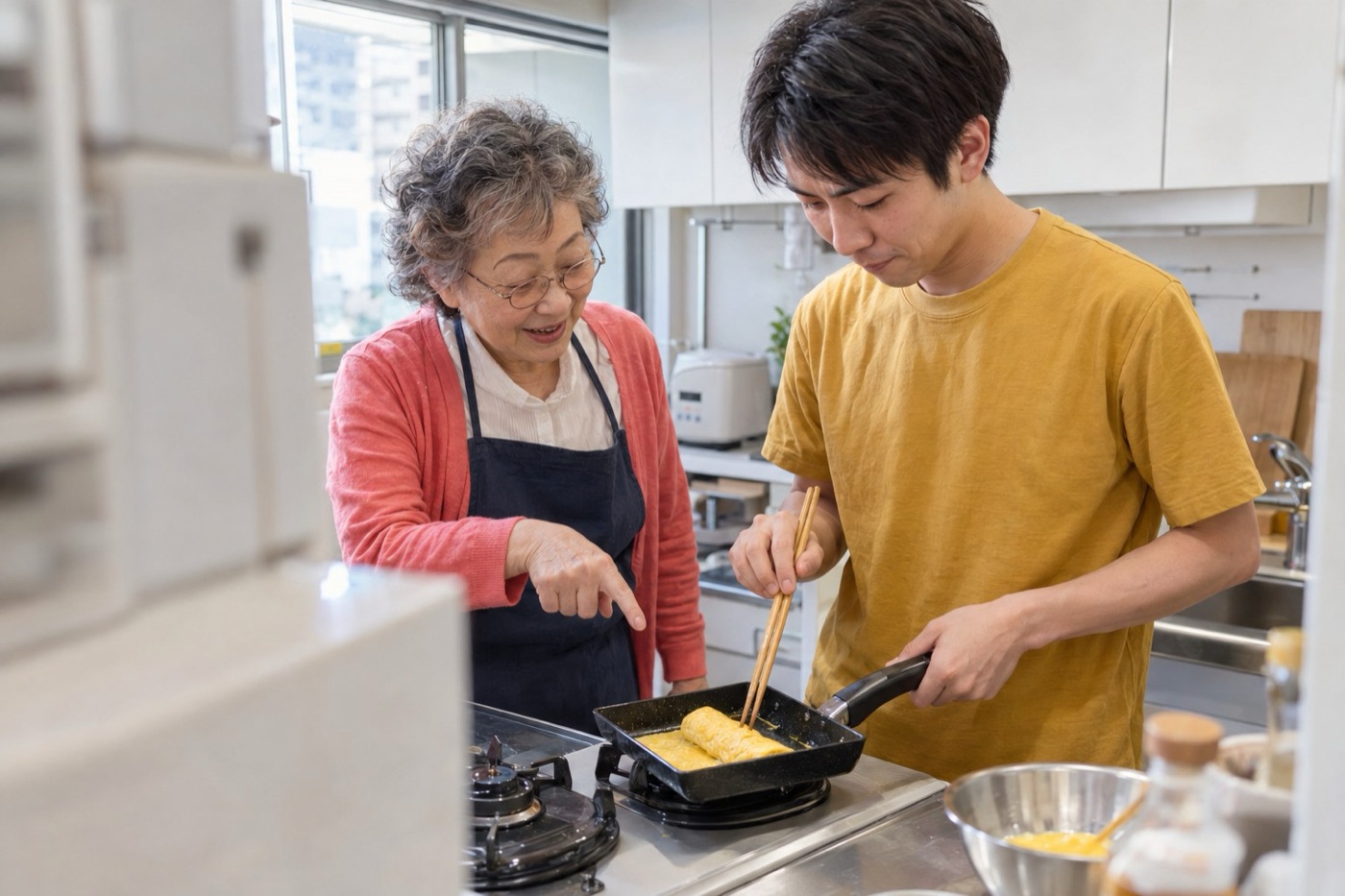
What if you could hire a grandmother for an afternoon? In Japan, there is a real service that lets people do something very similar. Customers can ask an older woman to cook a meal, help organise their home, teach them a skill or simply spend time with them.
The service is called OK! Obaachan, which means something like "OK! Grandma". It started in 2011 and is run by a company called Client Partners. Not every worker is actually a grandmother, and the service is not only for people who feel lonely. Some customers just need practical help with a job they cannot manage on their own, and they want someone patient who has done it many times before.
One woman working for the service, Taeko Kaji, was 69 when she spoke to Australian journalists in 2025. She said she enjoyed going to different places and trying new experiences. For older workers, a job like this can bring in money, fill the day with activity and give them a chance to meet new people.
Japan has an ageing population, which means there are a lot of older people compared with younger ones, and many of them live alone. Some families also live far away from one another, so it is not easy to drop in for an hour. In this situation, a service that brings the generations together may be genuinely useful. A younger person can pick up a skill from somebody with years of experience, while the older worker may enjoy feeling needed again.
However, money changes the relationship. A paid visitor is doing a job, even if they are kind and friendly, and the visit ends when the time is up. It is important to be clear about what the service offers. Hiring somebody for company is not the same as having a family member who has known you all your life.
The idea may sound strange at first, but people already pay teachers, carers and guides for their knowledge and their time. Perhaps the most interesting question is not why anyone would hire a grandmother. It is why spending time with older people has become so difficult to arrange.
Intermediate version
Japan has an unusual answer to the problem of needing a calm, experienced person nearby: hire a grandmother. Through a service called OK! Obaachan, customers can arrange for an older woman to visit them, help with everyday tasks or pass on practical knowledge. The idea sounds like a comedy sketch, but the business has been running since 2011.
The company behind the service, Client Partners, provides a wide range of personal assistance. Workers may cook, sort out belongings, offer guidance or accompany somebody on an outing. Some customers are looking for companionship, while others simply need a hand from someone patient and experienced who will not make them feel foolish. The women are paid professionals, and the company does not pretend they are substitutes for a customer's relatives.
In a 2025 Australian news interview, worker Taeko Kaji described enjoying the variety the job brings. For older people, employment of this kind can mean extra income as well as a sense of purpose. Work of this sort keeps people moving, out of the house and in regular contact with others, which matters when the alternative is a long and very quiet day. It also challenges the assumption that retirement means stepping away from useful work.
The service has attracted attention partly because of Japan's ageing population and growing concerns about social isolation. Families may be separated by distance, demanding work schedules or personal circumstances, and keeping in touch takes effort that busy people do not always have. Meanwhile, younger adults rarely get the chance to spend meaningful time with anyone several decades older than themselves.
Critics might argue that companionship should never be turned into a product. There is an uncomfortable difference between being listened to by someone who chooses to be there and someone whose time is being paid for by the hour. Yet plenty of valuable relationships already involve professional boundaries, including those with teachers, counsellors and care workers, and few people regard those as fake. The discomfort many of us feel may say rather more about our expectations of friendship than about the service itself.
Perhaps the service is best understood not as friendship for sale but as a practical way of connecting people whose needs happen to fit together. Its success raises an awkward question for every society: if contact between the generations is genuinely valuable, why do we so often leave it to chance? Schools, workplaces and neighbourhoods rarely bring young and old together on purpose, so whatever contact does happen tends to be accidental.
Advanced version
In Japan, a service called OK! Obaachan lets customers hire older women for practical help and company. The attention-grabbing shorthand is "rent a grandma". What people actually book is more ordinary: time with someone whose experience may be useful, whether for a household task or a patient conversation.
Set up by Client Partners in 2011, the service matches customers with women who can provide practical assistance, companionship and accumulated life experience. Their work might involve preparing food, helping with household tasks or accompanying a client on an outing. The relationship is explicitly professional, even when the experience feels warm and informal, and neither side pretends otherwise. What the customer is buying, in effect, is competence and patience, two qualities that are difficult to advertise and impossible to hurry.
Its appeal reflects several overlapping social changes. Japan has a large older population, while smaller households, demanding work schedules and geographical separation can make routine contact between the generations far less common than it once was. Some customers want help with a specific task. Others may value the reassuring presence of somebody older who is willing to listen without judgement, and who has probably encountered the same difficulty several times before. The two motives can overlap, but neither makes the visitor a relative.
The arrangement can be beneficial to the women providing the service as well. In an Australian interview published in 2025, worker Taeko Kaji spoke positively about the activities and variety the role brought into her life. That is worth dwelling on, because it challenges a persistent assumption that older people should be regarded primarily as recipients of care rather than as skilled and independent contributors with something to offer. Framed that way, the business looks less like an admission of social failure than a modest correction to the way older workers are valued.
Nevertheless, paid companionship raises uncomfortable questions about authenticity and inequality. If emotional reassurance becomes another service to be bought, those of limited means may find themselves priced out of something that ought to be freely available. A professional visit cannot replicate the history, the mutual obligations and the sheer unpredictability that characterise an enduring family relationship, however skilled the visitor. There is a further risk that a commercial solution quietly relieves families, employers and public services of obligations they might otherwise be expected to meet.
But writing the business off as evidence of social decline would be too easy. People have always sought wisdom and support beyond their immediate families, falling back on neighbours, mentors and local institutions when relatives were unavailable or unsuitable. Perhaps what is genuinely new here is not the arrangement itself but the honesty of its financial terms. Japan's rentable grandmothers point to both the value of experience and the difficulty, in a busy and dispersed society, of creating ordinary places where the generations can meet without anybody having to make an appointment.
After you read
4True, false or not given5 statements
Choose T (true), F (false) or NG (the article does not say).
- The service began in 2011.
The text says: "It started in 2011 and is run by a company called Client Partners."
- The service is the largest of its kind in Japan.
Not stated. The text does not say how big the service is compared with others.
- Every worker in the service is a real grandmother.
The text says the opposite: "Not every worker is actually a grandmother, and the service is not only for people who feel lonely."
- Taeko Kaji was 69 when she spoke to journalists in 2025.
The text says: "One woman working for the service, Taeko Kaji, was 69 when she spoke to Australian journalists in 2025."
- It is easy for families who live far away to drop in for an hour.
The text says: "Some families also live far away from one another, so it is not easy to drop in for an hour."
5Vocabulary5 gaps
Complete the sentences with words from the box. Two words are not needed.
advicegenerationsmanageorganisepracticalrelationshipskill
- Can you help me my papers into neat piles?
- The box is heavy, and I can't it on my own.
- A plumber gives help, not just advice.
- In some homes, three live together: children, parents and grandparents.
- A good with your neighbours makes life easier.
6Verb forms5 gaps
Write the correct form of the verb in brackets.
- The service OK! Obaachan. (CALL)
- It in 2011 and is run by a company called Client Partners. (START)
- Taeko Kaji to Australian journalists in 2025. (SPEAK)
- She said she enjoyed to different places and trying new experiences. (GO)
- Customers can ask an older woman a meal. (COOK)
7Language focusphrasal verbs
Complete the sentences with words from the box. Two words are not needed. A phrasal verb is a verb plus a small word such as up or out. The small word changes the meaning, so learn the two words together.
afterawayoffonoutthroughup
- Her granddaughter looks her when she is ill.
- Can you help me find when the next bus leaves?
- Please carry with your story; I'm listening.
- He was born in Osaka, but he grew in Tokyo.
- Please turn the oven; it is too hot in here.
4True, false or not given5 statements
Choose T (true), F (false) or NG (the article does not say).
- The writer says professional relationships are always fake.
The text says the opposite: "Yet plenty of valuable relationships already involve professional boundaries, including those with teachers, counsellors and care workers, and few people regard those as fake."
- Taeko Kaji liked the variety in her work.
The text says: "worker Taeko Kaji described enjoying the variety the job brings."
- The service has expanded outside Japan.
Not stated. The text does not say whether the service operates outside Japan.
- The company is clear that the workers are not family substitutes.
The text says: "the company does not pretend they are substitutes for a customer's relatives."
- The writer thinks schools and workplaces usually bring young and old together on purpose.
The text says they "rarely bring young and old together on purpose".
5Vocabulary6 gaps
Complete the sentences with words from the box. Two words are not needed.
assumptionboundariesemploymentisolationoutingreassuranceretirementsubstitutes
- Many people hold the that older workers cannot learn new skills.
- Living alone, far from family, can lead to loneliness and social .
- After years of full-time , she wanted something less stressful.
- Teachers and doctors keep clear professional with the people they help.
- Friends and neighbours are rarely for trained care workers.
- At 65, many people look forward to and more free time.
6Verb forms5 gaps
Write the correct form of the verb in brackets.
- The business since 2011, and customers still book it. (RUN)
- If families lived closer together, they in touch more easily. (KEEP)
- The company that its workers can replace a family. (NOT PRETEND)
- The grandmothers by the hour, not by the day. (BOOK)
- Customers that the visit is a paid job. (SHOULD / UNDERSTAND)
7Language focusphrasal verbs
Complete the sentences with words from the box. Two words are not needed. Many phrasal verbs have a meaning you cannot guess from the parts. Learn the whole verb, and notice whether it takes an object.
comecutfallholdlooksettake
- Researchers will into why so many older people live alone.
- Two friends decided to up a service like this in their own city.
- While travelling, you may across all kinds of people.
- Many older people on part-time work after they retire.
- He decided to down his working hours to spend more time with family.
4True, false or not given5 statements
Choose T (true), F (false) or NG (the article does not say).
- The writer implies that customers should not expect a hired visitor to become a relative.
The text says the relationship is "explicitly professional" and that neither motive "makes the visitor a relative".
- The writer argues that the service will push families to take on more responsibility for older relatives.
The text warns that a commercial solution "quietly relieves families" of obligations.
- Most of the women who work for the service used to have jobs in caring.
Not stated. The text says nothing about the women's earlier careers.
- Taeko Kaji's experience supports the view that older people can be skilled contributors.
The text says her positive account "challenges a persistent assumption" that older people are mainly recipients of care.
- The writer regards paying for support outside the family as a modern invention.
The text says people "have always sought wisdom and support beyond their immediate families"; only the honesty of the financial terms may be new.
5Vocabulary6 gaps
Complete the sentences with words from the box. Two words are not needed.
competencedispersedelusivemodestpersistentrecipientsreplicatetemporary
- No amount of training can fully the warmth of a relationship built over decades.
- Despite repeated evidence to the contrary, the belief that older workers are slow has survived.
- What distinguishes a good surgeon is not charm but , the reliable skill to do the job properly.
- The profits were , enough to pay the rent and little more.
- With the family now across three countries, they see one another once a year.
- Charities often treat the elderly as passive of help rather than as contributors.
6Word forms5 gaps
Use the word in brackets to make a word that fits the gap.
- Paid companionship raises uncomfortable questions about and inequality. (AUTHENTIC)
- Part of a family's charm is its sheer , since nobody knows what the next visit will bring. (PREDICT)
- Customers appreciate about what they are paying for. (TRANSPARENT)
- The view that old age means dependence is increasingly challenged. (CONVENTION)
- Poorer households may find the fees , however valuable the visits. (AFFORD)
7Language focusphrasal verbs
Complete the sentences with words from the box. Two words are not needed. At this level many phrasal verbs are idiomatic, so the literal meaning of the parts will not help. Learn each one with the particle it needs.
brushfallglossplaystandtidewear
- Governments that aside the loneliness problem risk finding that it grows.
- When the family cannot help, older people often back on savings or friends.
- Critics down the benefits by calling the visits a gimmick.
- Rather than over the awkward questions, a good report confronts them.
- A paid visitor can in for an absent relative, but cannot replace the family.
Speak
8Talk about it3 questions
Discuss in pairs or small groups. Give reasons for your answers.
- What could make paid help feel warm without pretending it was family?
- Which kinds of experience become more valuable with age?
- What could different generations enjoy doing together?
8Talk about it3 questions
Discuss in pairs or small groups. Give reasons for your answers.
- What could make paid help feel warm without pretending it was family?
- Which kinds of experience become more valuable with age?
- What could different generations enjoy doing together?
8Talk about it3 questions
Discuss in pairs or small groups. Give reasons for your answers.
- What could make paid help feel warm without pretending it was family?
- Which kinds of experience become more valuable with age?
- What could different generations enjoy doing together?
9Role-play: should we hire a grandmother?
Work in pairs. Read your card, then have the conversation. Swap roles and do it again.
Student A · the daughter
Your father lives alone and you live far away. You want to book a paid visitor from a service like OK! Obaachan for two hours a week. Explain why it could help, listen to his worries and try to agree a plan.
Student B · the father
You're proud and independent. You think paid company is strange, and you'd rather see your family. Say what worries you. You can say no, or agree to try it if the conditions are right.
Useful phrases
- I'm worried you're on your own too much.
- It's only a trial, so we could try it once.
- I don't want a stranger in my house.
- She'd help with the cooking, and she'd be good company.
- I'd rather see you than pay someone.
- Let's try it for a month and see how it goes.
Afterwards, tell the class: did the father agree, and what changed his mind?
Your words
Highlights0 saved
Highlights0 saved
Highlights0 saved
Was this lesson useful? Support johnplusnews on Ko-fi
Continue reading
Language
Did Writing Really Make Languages More Complicated?
A large study of about 100,000 sentences in 30 languages found no universal pattern showing that writing makes sentences more complex. It does not say that writing never changes a language.
Technology
Can You Be Emotionally Close to Someone Who Is Not Human?
A survey of 463 adults in the United States found that people in relationships with AI chatbots can feel as emotionally close as other couples, but the link between closeness and loneliness looked different.
Relationships
Would You Sign a Contract Before Getting Married?
More young Americans are signing prenuptial agreements before their weddings. Is planning for a divorce unromantic, or is it honest and sensible?