News lesson19 October 2026
When Restaurants Say No to Photoshoots
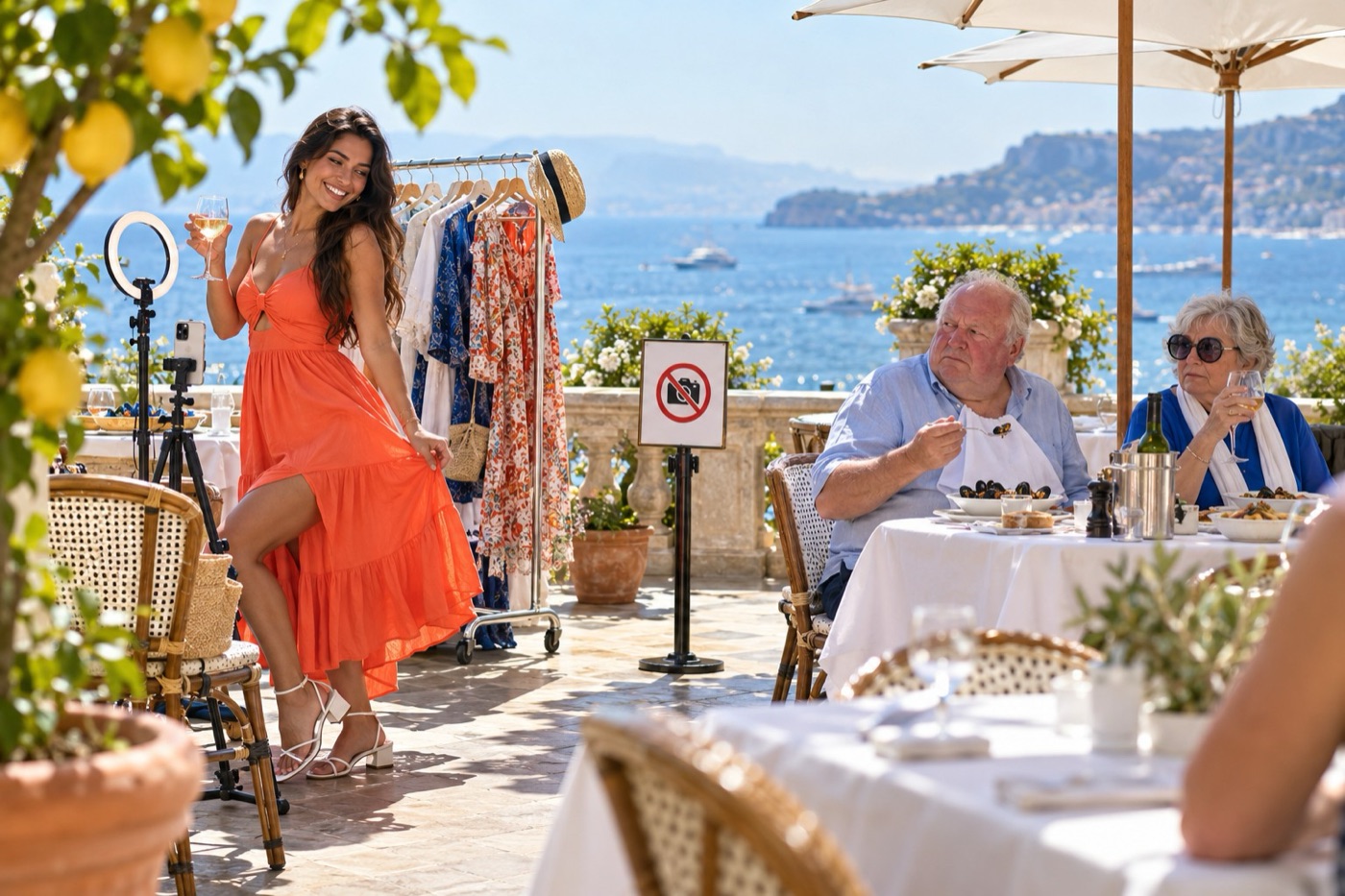
A famous hotel on the French Riviera now requires permission for organised shoots. A Cheshire farm shop has restricted filming during its busiest hours.
Before you read
1Warm up3 questions
Talk about these questions with a partner.
- When does taking a photo start to spoil a meal?
- Would a photo of a restaurant persuade you to try it?
- Should you ask before including a stranger in a video?
2Key words8 words
These words are in the article. Choose the letter of the meaning for each one.
- organised
- jewellery
- atmosphere
- strict
- queuing
- ban
- content
- aim
- Athe feeling of a place
- Bplanned carefully, with many people or things
- Crings, necklaces and other things you wear for decoration
- Dthe thing you want to do
- Enot allowing people to break rules
- Fan official rule that says you cannot do something
- Gvideos and pictures that people put online
- Hstanding in a line to wait
1Warm up3 questions
Talk about these questions with a partner.
- When does taking a photo start to spoil a meal?
- Would a photo of a restaurant persuade you to try it?
- Should you ask before including a stranger in a video?
2Key words8 words
These words are in the article. Choose the letter of the meaning for each one.
- backdrop
- clash
- rethink
- unwritten
- complication
- dedicated
- unofficial
- frustrated
- Aused only for one purpose
- Ba strong disagreement between two groups or ideas
- Cannoyed because you cannot do what you want
- Dnot approved by an authority
- Ethink again about a plan or idea
- Faccepted by everyone but never officially written down
- Gthe scene behind something, such as in a photo
- Ha new problem that makes things harder
1Warm up3 questions
Talk about these questions with a partner.
- When does taking a photo start to spoil a meal?
- Would a photo of a restaurant persuade you to try it?
- Should you ask before including a stranger in a video?
2Key words8 words
These words are in the article. Choose the letter of the meaning for each one.
- intrusive
- authorisation
- phenomenon
- vain
- designated
- consent
- intimate
- objectionable
- Aprivate and personal, usually with few people
- Bdisturbing people's privacy or peace without being invited
- Cunpleasant enough that people complain about it
- Dtoo proud of how you look or what you do
- Eofficially chosen for a particular purpose
- Fofficial permission
- Gsomething that happens or exists and is noticed by many people
- Hagreement to let something happen
Read
3Read the article
The paragraphs are numbered. Look out for the key words from task 2.
Core version
Imagine booking a table at a beautiful restaurant. You sit down, look at the menu and get ready for a relaxing lunch. But at the next table, someone is changing clothes, moving chairs and taking photographs of every corner. They are not making a family album. They are creating content for social media. Some businesses have decided that enough is enough.
In October 2026, reports described hotels, restaurants and shops that were putting limits on photography. One famous hotel in Antibes, on the French coast, now requires permission for organised photoshoots. According to reports, some visitors had booked a meal and then turned up with bags of clothes and jewellery. They spent their time taking pictures instead of enjoying lunch. Other guests wanted a little privacy.
A smaller business in England has made a similar decision. The Hollies, a farm shop in Cheshire, became popular with social media visitors. It introduced restrictions on filming and taking photographs during busy daytime hours, from ten until four. The aim is to let staff get on with their work and to make shopping more pleasant for everyone.
Of course, social media is not always a problem. A lovely photograph can help a small restaurant attract new customers. Travellers often look up places online before making plans. A café that appears in a popular video may suddenly have people queuing outside. For a new business, that attention can be worth a lot of money.
But there is a difference between taking one quick picture of your cake and turning a dining room into a film studio. Flashing lights, long photoshoots and strangers appearing in videos can spoil the atmosphere. Staff may have to deal with unhappy customers, while other visitors feel uncomfortable. Nobody expects perfect silence in a restaurant, but most people want to eat in peace.
So where should businesses draw the line? A complete ban may seem too strict, especially for customers who simply want a memory of a special day. Clear rules could be a better answer: no large equipment, no filming strangers and no blocking the way.
Intermediate version
Picture a lunch on the French Riviera. Then a group at the next table starts unpacking several outfits, rearranging furniture and taking photographs from every possible angle. For them, the hotel is a backdrop. For everyone else, it is somewhere to relax. That clash has persuaded some businesses to rethink their relationship with influencers.
In October 2026, the Guardian reported that hotels, restaurants and tourist destinations were introducing restrictions on photography. At the famous Hotel du Cap-Eden-Roc in Antibes, organised photoshoots now require permission. Reports suggest some visitors had booked tables for lunch, only to spend their reservations changing clothes and producing social media content. Management wanted to protect the privacy of other guests and preserve the atmosphere people had paid to enjoy.
The problem is not limited to exclusive hotels. The Hollies, a farm shop in Cheshire, imposed restrictions on photographing and filming between 10am and 4pm. The business had become a popular social media destination after being featured by a celebrity. When visitors turn up primarily for a photograph, ordinary customers may struggle to get on with their shopping. Even somewhere as simple as a farm shop can become an unofficial film set.
There is an obvious complication: businesses often benefit enormously from social media publicity. A short video can put an unknown café on the map, especially if the food looks irresistible. Restaurants use attractive photographs in their own advertising, so telling paying customers to put their phones away may seem rather hypocritical. Influencers also point out that their work involves real planning, editing and promotion, not merely taking a few selfies.
Yet the atmosphere of a public place depends on unwritten rules. Taking a quick photograph of a dessert is very different from blocking a corridor for twenty minutes or including strangers in a video without their agreement. Customers may have paid for a peaceful meal, not an unexpected appearance on somebody else's channel.
Staff can end up caught in the middle, expected to satisfy content creators and frustrated guests simultaneously. For employees, the problem may begin with an innocent request for a better angle, then build up into an argument about blocked tables, privacy and whose enjoyment matters most. Small interruptions can change the character of a whole meal.
The sensible answer may lie between an unrestricted photoshoot and a blanket ban. Businesses could set clear limits, offer dedicated photography periods or ask creators to arrange filming in advance. Customers, meanwhile, could consider whether their perfect image comes at somebody else's expense. Social media can bring people together and help independent businesses thrive. But if everyone is performing for an audience, who is actually enjoying the place they came to visit?
Advanced version
Imagine settling down for lunch on a Mediterranean terrace, only for the next table to turn into a photoshoot. Clothes come out, furniture moves and the meal becomes a backdrop. Some guests want pictures; others want a quiet afternoon. For restaurants and hotels, deciding whose experience comes first is becoming a business decision.
An October 2026 report in the Guardian described a growing number of venues clamping down on intrusive photography, and the businesses involved were hardly confined to one country or one luxury market. Hotel du Cap-Eden-Roc, the celebrated property in Antibes, requires prior authorisation for organised photoshoots. According to reporting, some visitors had secured lunch reservations only to spend much of their time changing outfits and creating content. What might look like free publicity to an outside observer can become an operational headache for staff trying to maintain a discreet, luxurious environment.
The phenomenon extends well beyond glamorous resorts. The Hollies farm shop in Cheshire has restricted photography and filming during its busiest daytime hours after becoming a social media destination. A shop built around selling everyday goods can suddenly find itself hosting visitors whose main objective is to produce a reel. As crowds gather and cameras come out, regular customers may feel that the business has been transformed without their consent. In such cases, the question is not whether photography is inherently objectionable, but whose needs take priority.
There is, however, a striking contradiction at the heart of these bans. The hospitality industry depends on visual appeal, from carefully presented food to beautifully designed interiors. Countless independent businesses owe their success to customers who shared a photograph that caught on. Influencers can also provide valuable promotional work, particularly when traditional advertising is beyond a small company's budget. Dismissing every content creator as vain or disruptive risks overlooking both genuine creativity and the commercial arrangements that venues themselves encourage.
The real dividing line may be behaviour rather than professional status. A visitor quietly photographing a birthday cake is hardly comparable to someone setting up lighting equipment, obstructing a doorway or filming strangers without permission. What one person considers harmless self-expression may feel like an invasion of privacy to another. The tension becomes especially acute when an intimate setting is treated as though it were a public stage, and employees are left to pick up the pieces when complaints start pouring in.
Rather than declaring war on social media, venues could introduce proportionate rules: designated filming times, consent requirements and advance approval for commercial shoots. Customers also have a responsibility to read the room. A dining room is doing several jobs at once. It is a place to eat, a place to meet friends and, for some visitors, a place to work. The rules work best when they leave space for all three.
After you read
4True, false or not given5 statements
Choose T (true), F (false) or NG (the article does not say).
- The hotel in Antibes asks people to get permission for organised photoshoots.
The text says it "requires permission for organised photoshoots".
- The Hollies limits filming and photographs all day.
The limits are only "from ten until four".
- The hotel in Antibes has earned more money since it introduced its rule.
The text says nothing about the hotel's money.
- The writer thinks social media is always a problem.
The text says "social media is not always a problem".
- The writer suggests clear rules instead of a complete ban.
The text says "Clear rules could be a better answer".
5Vocabulary5 gaps
Complete the sentences with words from the box. Two words are not needed.
audienceequipmentmemorypermissionprivacyreservationrestrictions
- You need written from the manager before you start filming.
- Guests in a spa expect some , so staff keep the doors closed.
- A tripod and a ring light are large pieces of that can block the way.
- The shop introduced on filming during busy hours.
- A photo is a nice of a special birthday.
6Verb forms5 gaps
Write the correct form of the verb in brackets.
- The hotel a new rule last month. (INTRODUCE)
- Last year, the farm shop popular online. (BECOME)
- Some guests about the noise. (COMPLAIN)
- A group at the next table photographs right now. (TAKE)
- Visitors in a long line outside the café. (STAND)
7Language focuscollocations
Complete the sentences with words from the box. Two words are not needed. Collocations are words that go together naturally. Learn the whole pair, for example pay attention.
bookcarrydecisionlosepaysettake
- Please attention to the rules on the sign.
- Many people like to a photo of their dessert.
- The hotel made a to protect its guests.
- They arrived early to a table by the window.
- The shop will a limit on filming at busy times.
4True, false or not given5 statements
Choose T (true), F (false) or NG (the article does not say).
- The Hollies' restrictions apply during only part of the day.
The restrictions run "between 10am and 4pm".
- The Hollies became popular because its owners advertised on social media.
It became popular "after being featured by a celebrity".
- Most guests at Hotel du Cap-Eden-Roc support the new rule.
The text does not say what guests think.
- Restaurants themselves use photographs to attract customers.
"Restaurants use attractive photographs in their own advertising".
- The writer believes the best solution is a complete ban on photography.
The "sensible answer" lies between an unrestricted photoshoot and a blanket ban.
5Vocabulary6 gaps
Complete the sentences with words from the box. Two words are not needed.
generouslygraduallyhypocriticalimposedpreserveprimarilypublicitysimultaneously
- Old buildings are expensive to , but the town believes they are worth saving.
- Good in a magazine can bring a small business hundreds of new customers.
- It seems to ban phones in a restaurant that uses customers' photos in its adverts.
- A waiter cannot serve three tables , so someone always has to wait.
- The council a strict limit on noise after ten o'clock.
- The festival is aimed at families, though everyone is welcome.
6Verb forms5 gaps
Write the correct form of the verb in brackets.
- By the time the manager arrived, the guests their clothes twice. (CHANGE)
- Next year the café a quiet hour for diners. (OFFER)
- You before you film strangers. (SHOULD / ASK)
- The rule by the hotel last spring. (INTRODUCE)
- While the staff a table, a group began filming. (CLEAR)
7Language focuscollocations
Complete the sentences with words from the box. Two words are not needed. Many collocations combine a common verb with a noun. The verb is often not the one you would guess, so learn the pair together.
bearcarrymakereachshowstrikewonders
- Customers may a complaint if the noise is too loud.
- Some visitors little respect for other diners.
- Influencers can a huge audience in a single week.
- A good review can do for a small café's reputation.
- Managers must a balance between publicity and peace.
4True, false or not given5 statements
Choose T (true), F (false) or NG (the article does not say).
- The writer implies that venues gain from the same activity they now restrict.
The "striking contradiction" is that hospitality depends on visual appeal yet bans photography.
- The Antibes hotel and the Cheshire farm shop apply identical restrictions.
The hotel requires authorisation for organised shoots; the farm shop restricts photography during its busiest hours.
- The Hollies has lost customers since it restricted filming.
The text does not report any effect on customer numbers.
- The article suggests that a person's job matters less than how they behave.
"The real dividing line may be behaviour rather than professional status".
- The article claims influencers are useful only to large companies.
It says they help "when traditional advertising is beyond a small company's budget".
5Vocabulary6 gaps
Complete the sentences with words from the box. Two words are not needed.
confineddiscreetdisruptiveelaborateinherentlyoverlookingsecuredunwarranted
- The outbreak was to a single district, and officials said it would not spread.
- A waiter will refill your glass without interrupting the conversation.
- Critics argue that no form of entertainment is harmful; it is how people use it.
- By the early signs of trouble, the board allowed the problem to grow.
- After weeks of negotiation, the small studio finally a contract with the broadcaster.
- A single guest can ruin an evening for a whole dining room.
6Word forms5 gaps
Use the word in brackets to make a word that fits the gap.
- The of filming rules in hotels shows how widespread the problem has become. (PROLIFERATE)
- Staff described the guests' behaviour as , since it disturbed other diners. (CONSIDER)
- Venues must act if they want to avoid accusations of unfairness. (CONSISTENT)
- Rules are only as good as their . (ENFORCE)
- Many owners are to criticise influencers openly for fear of losing publicity. (WILL)
7Language focuscollocations
Complete the sentences with words from the box. Two words are not needed. At C1, look for fixed phrases where one word is almost impossible to replace, such as blunt instrument or mounting pressure.
drawdueinstrumentmetmountingposeswift
- The council is under pressure to explain its decision.
- A blanket ban is a blunt that punishes polite guests along with rude ones.
- Even sceptics admit that credit is to the cafés that spotted the trend early.
- Venues must a clear line between filming for work and snapping a memory.
- The new policy was with a mixed reaction.
Speak
8Talk about it3 questions
Discuss in pairs or small groups. Give reasons for your answers.
- What filming rule would make a restaurant better for everyone?
- Would you visit a place that banned all customer photos?
- Can a place become less enjoyable because it is famous online?
8Talk about it3 questions
Discuss in pairs or small groups. Give reasons for your answers.
- What filming rule would make a restaurant better for everyone?
- Would you visit a place that banned all customer photos?
- Can a place become less enjoyable because it is famous online?
8Talk about it3 questions
Discuss in pairs or small groups. Give reasons for your answers.
- What filming rule would make a restaurant better for everyone?
- Would you visit a place that banned all customer photos?
- Can a place become less enjoyable because it is famous online?
9Role-play: filming at the restaurant
Work in pairs. Read your card, then have the conversation. Swap roles and do it again.
Student A · the restaurant manager
A customer wants to film a video at one of your tables. Other guests are already eating. Ask what equipment they will use and how long it will take. You can say yes, no, or yes with rules.
Student B · the influencer
You want to film a short video of your lunch. It could bring the restaurant new customers. Explain why it's good for the business and promise to be quiet.
Useful phrases
- Would it be all right if I filmed my meal?
- I'm afraid other guests might feel uncomfortable.
- It won't take long, and I'll keep the noise down.
- I'd be happy to agree if you stay at your table.
- That's not really fair on the other customers.
- Could we agree on a time limit?
Afterwards, tell the class: did the manager say yes, and was it a fair decision?
Your words
Highlights0 saved
Highlights0 saved
Highlights0 saved
Was this lesson useful? Support johnplusnews on Ko-fi
Continue reading
Language
Did Writing Really Make Languages More Complicated?
A large study of about 100,000 sentences in 30 languages found no universal pattern showing that writing makes sentences more complex. It does not say that writing never changes a language.
Technology
Can You Be Emotionally Close to Someone Who Is Not Human?
A survey of 463 adults in the United States found that people in relationships with AI chatbots can feel as emotionally close as other couples, but the link between closeness and loneliness looked different.
Relationships
Would You Sign a Contract Before Getting Married?
More young Americans are signing prenuptial agreements before their weddings. Is planning for a divorce unromantic, or is it honest and sensible?