News lesson8 October 2026
Denmark Wants to Make Your Face Harder to Copy
The proposed rules would strengthen your ability to challenge convincing digital impersonations. Separating harmful fakes from obvious comedy is the part nobody has solved.
Before you read
1Warm up3 questions
Talk about these questions with a partner.
- Would you recognise a convincing fake video of yourself?
- When is copying someone's voice funny, and when does it go too far?
- Would you trust a surprising video before checking where it came from?
2Key words8 words
These words are in the article. Choose the letter of the meaning for each one.
- deepfake
- deceive
- embarrass
- genuine
- celebrities
- spread
- complicated
- imitations
- Ato make someone believe something that is not true
- Ba fake video or sound made with AI that looks or sounds real
- Ccopies of something real
- Dreal, not fake
- Eto make someone feel shy or silly in front of other people
- Fto move to many people or places
- Gnot simple, with many parts to think about
- Hvery famous people
1Warm up3 questions
Talk about these questions with a partner.
- Would you recognise a convincing fake video of yourself?
- When is copying someone's voice funny, and when does it go too far?
- Would you trust a surprising video before checking where it came from?
2Key words8 words
These words are in the article. Choose the letter of the meaning for each one.
- impersonations
- legislation
- consent
- parody
- enforcement
- outlive
- dignity
- reputation
- Amaking sure that people obey a rule or law
- Bthe opinion that most people have about someone
- Cthe feeling of being respected and valued
- Dto last longer than something else
- Epermission to do something
- Facts of pretending to be another person
- Ga funny copy of something that makes fun of it
- Hlaws made by a government
1Warm up3 questions
Talk about these questions with a partner.
- Would you recognise a convincing fake video of yourself?
- When is copying someone's voice funny, and when does it go too far?
- Would you trust a surprising video before checking where it came from?
2Key words8 words
These words are in the article. Choose the letter of the meaning for each one.
- impersonate
- circulate
- manipulate
- fabricated
- advocates
- likeness
- remedies
- synthetic
- Athe way a person looks, or a picture that looks like them
- Bmade up in order to deceive
- Cto pass from person to person or place to place
- Dways of putting right a problem or harm
- Emade by people or machines, not natural
- Fto pretend to be another person, usually to deceive
- Gto control or change something in a clever, often dishonest way
- Hpeople who publicly support an idea or cause
Read
3Read the article
The paragraphs are numbered. Look out for the key words from task 2.
Core version
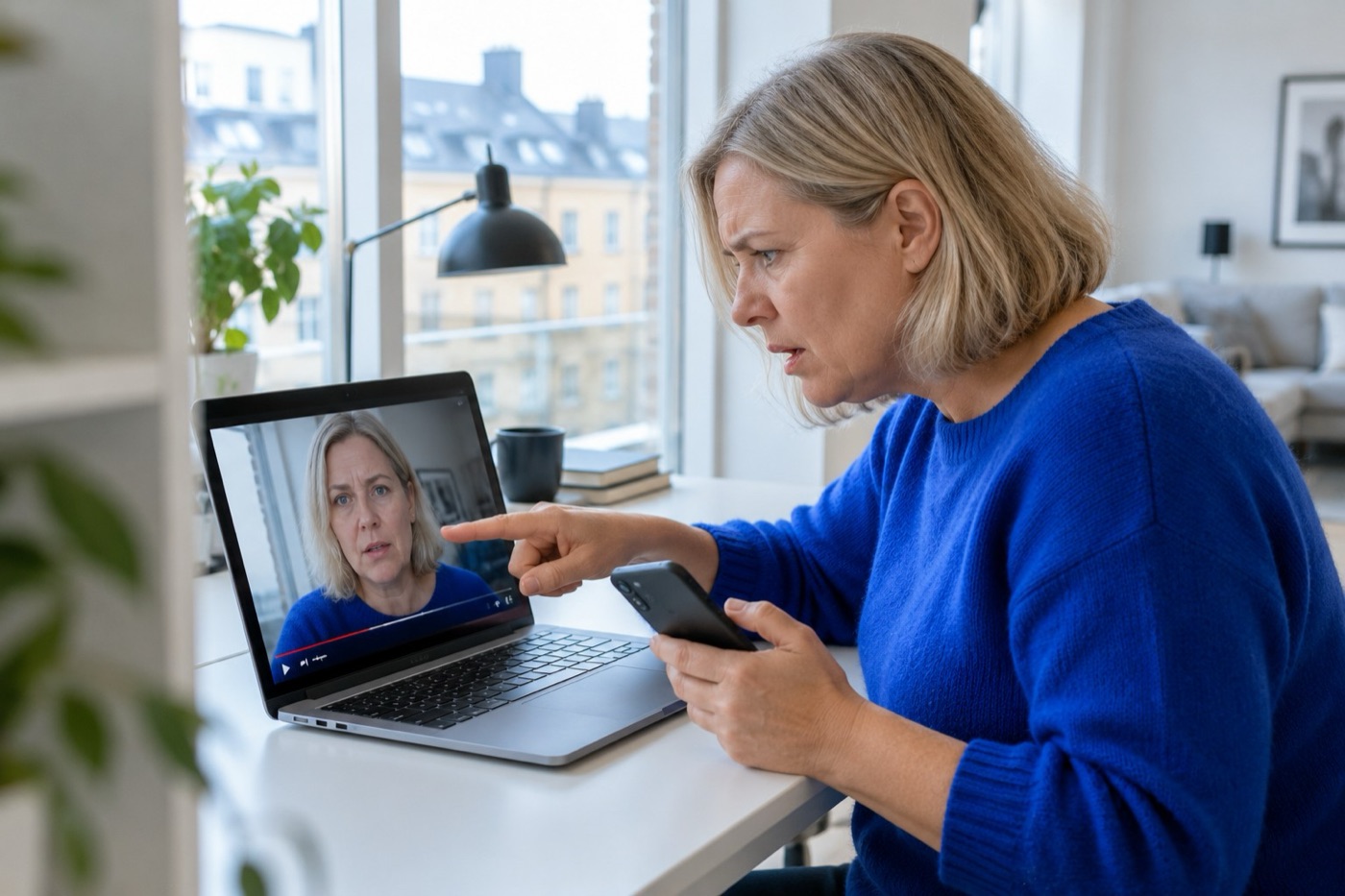
Imagine opening your phone and watching a video of yourself saying something terrible. You know you never said it, and the video was never recorded. Someone has used artificial intelligence to make up a fake version of your face and your voice. What could you do about it?
This kind of video is called a deepfake. AI can now create realistic pictures, sound recordings and moving images in a few minutes. Some are made for jokes or films, but others are used to embarrass, deceive or hurt people. The real problem is that ordinary viewers cannot always tell the difference between a fake and a genuine recording.
In October 2026, Denmark announced plans for a law to protect people against certain AI copies of their appearance and voice. The proposal would make it easier to challenge the unauthorised sharing of realistic digital imitations, in other words copies that were shared without permission. It was a proposed law, not something that had already solved the problem.
Supporters say people should be able to control how others use their faces. A fake video can damage somebody's reputation, get them into trouble at work or make friends and family believe something untrue. Ordinary people may be affected too, not only celebrities and politicians, and most of them have no lawyers to fall back on. Once a fake video has spread, it is also very hard to take it down again.
However, the issue is complicated. Films, jokes and political cartoons have always copied famous people, and that is part of free speech. It is important to protect artistic freedom and public discussion while stopping harmful fakes. Laws also have to work when a video is made in one country and shared in another, which is not easy to arrange.
The internet made it easy to copy photographs. AI now makes it possible to invent actions and speech as well, so a picture is no longer proof that something happened. Denmark's proposal asks a simple but very difficult question: if somebody can create a convincing digital version of you, who should decide what that version is allowed to do?
Intermediate version
Your face used to be difficult to copy convincingly. A skilled actor, make-up artist or video editor might imitate you, but the result was rarely good enough to pass off as the real thing. Artificial intelligence has changed that. It is now possible to produce realistic footage or audio of a person saying things they never said, which raises concerns about reputation, consent and personal identity.
In October 2026, Denmark announced plans to bring in legislation addressing the unauthorised sharing of AI-generated copies of people's appearance and voices. The proposed rules would strengthen an individual's ability to challenge convincing digital impersonations. At the time of the announcement, the legislation was still a proposal rather than an established legal solution, and the detail had yet to be worked out.
Deepfakes can be used for entertainment, but the technology also creates serious risks. A fabricated video may spread false statements, humiliate a private individual or chip away at public trust in genuine evidence. Once an image has been shared widely, taking down every copy becomes extremely difficult, and the original clip tends to outlive any correction.
Supporters of the Danish approach argue that control over your own face ought to be a basic right rather than a privilege reserved for the famous. A convincing fake can cost an ordinary person a job, a friendship or simply their peace of mind. Very few private individuals have the time, money or contacts to chase every copy across the internet.
There are challenges in deciding where protection should begin and end. A realistic fake designed to deceive is different from an obvious cartoon or a clearly labelled comedy sketch. Journalists, artists and campaigners may have perfectly legitimate reasons to criticise public figures through parody. Laws must be precise enough to protect personal dignity without blocking ordinary expression, and drawing that line is a well-known sticking point in every country that has tried.
Enforcement presents another difficulty. Images can be generated cheaply and shared across national borders within minutes, while some platforms respond to complaints far more quickly than others. Even working out who was responsible for a harmful fake can be impossible, which makes it hard to crack down on the people doing the most damage. A law that nobody can enforce may still shift behaviour, but it will not reassure the person whose face has been borrowed.
Denmark's proposal reflects a wider change in how people think about privacy. The concern is no longer only who may photograph you, but who may invent a convincing version of you and send it out into the world. In an age of increasingly powerful AI tools, control over personal identity may end up mattering as much as control over personal information.
Advanced version
A video appears to show you saying something you never said. The face looks right. The voice sounds familiar. But no camera recorded it: someone made it with AI. Denmark's proposal to give people more control over copies of their face and voice starts with that unsettling possibility.
Denmark responded in October 2026 by announcing proposed legislation aimed at limiting the unauthorised distribution of realistic AI-generated reproductions of individuals' faces and voices. Its significance lies in treating a person's digital likeness as something deserving specific protection, rather than as an incidental by-product of being photographed or recorded in public. Whether the eventual text can match that ambition is another matter. The proposal should not, however, be described as a law already in force.
The potential harms extend well beyond embarrassing online jokes. Fabricated recordings can be used to impersonate people, circulate humiliating material, damage professional reputations or manipulate public debate at a decisive moment. Even once the falsehood has been exposed, the original impression often survives in screenshots, forwarded messages and private groups, where no correction ever reaches it. Damage of that kind is cumulative rather than dramatic, and it is correspondingly hard to measure or compensate.
Advocates of the Danish approach present control over one's likeness as a right rather than a privilege of the well-resourced. The argument carries particular force for private individuals, who seldom command the legal advice, publicity or platform contacts that allow a public figure to mount a rapid correction. For them, a single persuasive clip can reach a workplace or a family group long before anyone can intervene.
A workable legal framework must nevertheless distinguish harmful impersonation from legitimate expression. Satire, journalism, artistic adaptation and clearly identifiable fictional performances may all involve portraying real individuals without their direct participation. An excessively broad restriction risks becoming a convenient tool for suppressing criticism, particularly when powerful public figures are the ones complaining. Few legislative tasks are more delicate than drawing that line and making it hold.
Practical enforcement is equally challenging. Online content crosses borders almost instantly, while the technical systems designed to flag up manipulated media remain imperfect and are easily outpaced. Taking a video down from one platform achieves little if copies continue circulating elsewhere. Legal remedies may therefore need to be combined with better platform policies and a more sceptical public understanding of what digital evidence can and cannot prove.
The Danish initiative illustrates a genuine shift in the meaning of privacy. It is no longer merely a question of keeping existing personal information secret. It is also about preventing others from manufacturing a persuasive identity on somebody's behalf and setting it loose. As synthetic media becomes commonplace, societies will have to decide how much control individuals ought to retain over their own digital doubles, and who should bear the cost when that control fails. The answer will shape not only privacy law but the everyday business of believing what we see.
After you read
4True, false or not given5 statements
Choose T (true), F (false) or NG (the article does not say).
- Denmark has proposed a law about AI copies of people's faces and voices.
The text says: "In October 2026, Denmark announced plans for a law to protect people against certain AI copies of their appearance and voice."
- Some deepfakes are made for fun or for films.
The text says: "Some are made for jokes or films, but others are used to embarrass, deceive or hurt people."
- Other countries have copied the Danish proposal.
Not stated. The text does not say whether other countries have copied the proposal.
- The Danish law had already solved the problem.
The text says the opposite: "It was a proposed law, not something that had already solved the problem."
- Only famous people can be harmed by fake videos.
The text says: "Ordinary people may be affected too, not only celebrities and politicians"
5Vocabulary5 gaps
Complete the sentences with words from the box. Two words are not needed.
appearancefreedompermissionproofproposalreputationtrouble
- You need a person's before you share a video of them.
- A false story can destroy the that a person has built over many years.
- A photo is no longer that something really happened.
- The government will discuss the next month before it decides.
- Her changed so much with the new hairstyle that friends did not recognise her.
6Verb forms5 gaps
Write the correct form of the verb in brackets.
- Imagine a video of yourself saying something terrible. (WATCH)
- Last week, a man a fake video of his boss. (MAKE)
- In October 2026, Denmark plans for a new law. (ANNOUNCE)
- It was a proposed law, not something that had already the problem. (SOLVE)
- Laws also have to work when a video in one country and shared in another. (MAKE)
7Language focusprepositions
Complete the sentences with words from the box. Two words are not needed. Some words always take the same small word after them. Learn the pair together, for example reaction to, afraid of.
betweenbyforofontowith
- There is a big difference a joke and a harmful fake.
- Many teenagers are afraid fake videos of themselves.
- People cannot always rely their eyes to spot a fake.
- Denmark announced plans a new law.
- Viewers should pay attention where a video came from.
4True, false or not given5 statements
Choose T (true), F (false) or NG (the article does not say).
- When it was announced, Denmark's plan was not yet a finished law.
The text says: "At the time of the announcement, the legislation was still a proposal rather than an established legal solution, and the detail had yet to be worked out."
- All platforms respond to complaints at the same speed.
The text says the opposite: "Images can be generated cheaply and shared across national borders within minutes, while some platforms respond to complaints far more quickly than others."
- Denmark has already prosecuted someone under the new rules.
Not stated. The text does not mention any prosecution under the rules.
- Parody of public figures can have a reasonable purpose.
The text says: "Journalists, artists and campaigners may have perfectly legitimate reasons to criticise public figures through parody."
- The writer thinks a law that is hard to enforce is completely useless.
The text says: "A law that nobody can enforce may still shift behaviour"
5Vocabulary6 gaps
Complete the sentences with words from the box. Two words are not needed.
ambiguousexaggeratefabricatedfootagehumiliatepreciseprivilegereassure
- Police studied the security to see who entered the building.
- The newspaper apologised for printing quotations, because the minister had never said any of those words.
- The clip was only meant to him, to make him feel ashamed in front of everyone.
- In some countries, a good education is still a enjoyed only by the wealthy.
- The instructions must be enough that nobody can misunderstand them.
- The doctor tried to the nervous patient by explaining that the test was routine.
6Verb forms5 gaps
Write the correct form of the verb in brackets.
- By the time the platform removed the clip, thousands of people it. (SHARE)
- Realistic fakes cheaply and shared across borders every day. (CREATE)
- If the original clip had not spread so quickly, fewer people the lie. (BELIEVE)
- Experts for several years that deepfakes could damage public trust. (WARN)
- Denmark its plans in October 2026. (ANNOUNCE)
7Language focusprepositions
Complete the sentences with words from the box. Two words are not needed. Many adjectives and verbs need a fixed preposition. Learn them as a chunk: responsible for, depend on, cope with.
byforfromofontowith
- Her reaction the fake clip was surprisingly calm.
- Platforms should be held responsible the content they host.
- In an age cheap AI tools, anyone can copy a voice.
- How harmful a fake is will depend largely who sees it.
- Many small platforms cannot cope the number of complaints.
4True, false or not given5 statements
Choose T (true), F (false) or NG (the article does not say).
- Public figures are better placed than private individuals to correct a fake quickly.
Private individuals seldom have the contacts "that allow a public figure to mount a rapid correction."
- The Danish proposal would send people who create deepfakes to prison.
The text does not say what penalties the proposal would include.
- A correction usually reaches everyone who saw the original fake.
The impression survives in places "where no correction ever reaches it."
- The writer believes legal measures alone will be enough to deal with enforcement.
Legal remedies "may therefore need to be combined with better platform policies" and a more sceptical public.
- A fake can go on doing harm after it has been shown to be false.
"Even once the falsehood has been exposed, the original impression often survives."
5Vocabulary6 gaps
Complete the sentences with words from the box. Two words are not needed.
compensatecumulativedecisiveexhaustiveincidentalinterveneoutpacedrelinquish
- No single insult was serious, but the effect of hundreds of them eventually wore her down.
- Regulators complained that the rules had been by the speed of technological change.
- Teachers are reluctant to in a quarrel unless someone is in danger.
- The extra publicity was merely ; the project's real purpose lay elsewhere.
- No payment can fully a family for the loss of a home.
- The goal in the final minute proved , because it settled the match.
6Word forms5 gaps
Use the word in brackets to make a word that fits the gap.
- Even specialists struggled to confirm the of the recording. (AUTHENTIC)
- Critics warn that vague wording could lead to enforcement, with only unpopular speakers punished. (SELECT)
- As synthetic media improves, fakes may become from genuine recordings. (DISTINGUISH)
- A fine of that size seemed to the harm the clip had actually caused. (PROPORTION)
- A healthy about viral videos is now part of being an informed citizen. (SCEPTIC)
7Language focusprepositions
Complete the sentences with words from the box. Two words are not needed. At this level the preposition is often part of a formal chunk. Learn the whole phrase: tantamount to, fraught with, contingent on.
atforinofontowith
- A ban that is too broad could be tantamount censorship.
- Any attempt to regulate satire is fraught difficulty.
- Whether the law succeeds is contingent how well platforms cooperate.
- A platform could be held liable the harm caused by clips it failed to remove.
- Anyone acting breach of the order may be fined.
Speak
8Talk about it3 questions
Discuss in pairs or small groups. Give reasons for your answers.
- Who should have to remove a fake: the person posting it or the platform?
- Would a clear AI label make every fake video acceptable?
- What would help ordinary people challenge a fake about them?
8Talk about it3 questions
Discuss in pairs or small groups. Give reasons for your answers.
- Who should have to remove a fake: the person posting it or the platform?
- Would a clear AI label make every fake video acceptable?
- What would help ordinary people challenge a fake about them?
8Talk about it3 questions
Discuss in pairs or small groups. Give reasons for your answers.
- Who should have to remove a fake: the person posting it or the platform?
- Would a clear AI label make every fake video acceptable?
- What would help ordinary people challenge a fake about them?
9Role-play: a fake video of me
Work in pairs. Read your card, then have the conversation. Swap roles and do it again.
Student A · the person in the video
A friend made a joke video of you using AI. Your voice and face look real and people have started sharing it. Ask the website manager to remove it today. Explain why it matters to you.
Student B · the website manager
You run a video website. The video may be a joke, and you don't want to limit free speech. Ask at least two questions. You can remove it, keep it, or add a clear label.
Useful phrases
- I'd like you to remove this video today.
- I never said that, and I didn't agree to it.
- It's a joke, so is it really harmful?
- Who made it, and did you give permission?
- We could add a label saying it's AI.
- I'm afraid I can't promise that, but I'll look into it.
Afterwards, tell the class: was the video removed, and was that a fair decision?
Your words
Highlights0 saved
Highlights0 saved
Highlights0 saved
Was this lesson useful? Support johnplusnews on Ko-fi
Continue reading
Language
Did Writing Really Make Languages More Complicated?
A large study of about 100,000 sentences in 30 languages found no universal pattern showing that writing makes sentences more complex. It does not say that writing never changes a language.
Technology
Can You Be Emotionally Close to Someone Who Is Not Human?
A survey of 463 adults in the United States found that people in relationships with AI chatbots can feel as emotionally close as other couples, but the link between closeness and loneliness looked different.
Relationships
Would You Sign a Contract Before Getting Married?
More young Americans are signing prenuptial agreements before their weddings. Is planning for a divorce unromantic, or is it honest and sensible?