News lesson1 September 2026
The Glasses That Can Watch You Back
Wearable cameras are helping people with disabilities and worrying everyone else. Australia is weighing up where the limits should be.
Before you read
1Warm up3 questions
Talk about these questions with a partner.
- Would you notice if someone nearby was wearing a camera?
- Would smart glasses make a conversation more comfortable or less?
- Where would you most want people to put recording devices away?
2Key words8 words
These words are in the article. Choose the letter of the meaning for each one.
- microphones
- ordinary
- blind
- deaf
- wearer
- ban
- debate
- freedom
- Athe person who has something on their body
- Bnot able to hear, or not able to hear well
- Cnormal, not special or different
- Dnot able to see
- Ethe power to do what you want
- Fa serious talk where people give different opinions
- Gequipment that picks up sound so it can be heard or recorded
- Han official rule that says you must not do something
1Warm up3 questions
Talk about these questions with a partner.
- Would you notice if someone nearby was wearing a camera?
- Would smart glasses make a conversation more comfortable or less?
- Where would you most want people to put recording devices away?
2Key words8 words
These words are in the article. Choose the letter of the meaning for each one.
- spectacles
- captions
- appliances
- discreetly
- investigation
- consulting
- exception
- regulation
- Aofficial rules that control how something is done
- Ba careful search to find out the facts about something
- Csomething that is not included in a rule
- Dwords on a screen that show what people are saying
- Emachines in the home, such as a washing machine or oven
- Fin a quiet way so that other people do not notice
- Gglasses that you wear to see better
- Hasking people for their opinions before you decide
1Warm up3 questions
Talk about these questions with a partner.
- Would you notice if someone nearby was wearing a camera?
- Would smart glasses make a conversation more comfortable or less?
- Where would you most want people to put recording devices away?
2Key words8 words
These words are in the article. Choose the letter of the meaning for each one.
- voyeurism
- invoked
- legitimate
- credible
- enforcement
- assistive
- miniaturised
- accessibility
- Afair, reasonable and allowed by the rules
- Bused as a reason or an excuse for something
- Cmaking sure that people obey a law
- Ddesigned to help people who find daily tasks difficult
- Emade much smaller than before
- Fbelievable and likely to work
- Ghow easy something is for people with disabilities to use
- Hthe habit of secretly watching people for pleasure
Read
3Read the article
The paragraphs are numbered. Look out for the key words from task 2.
Core version
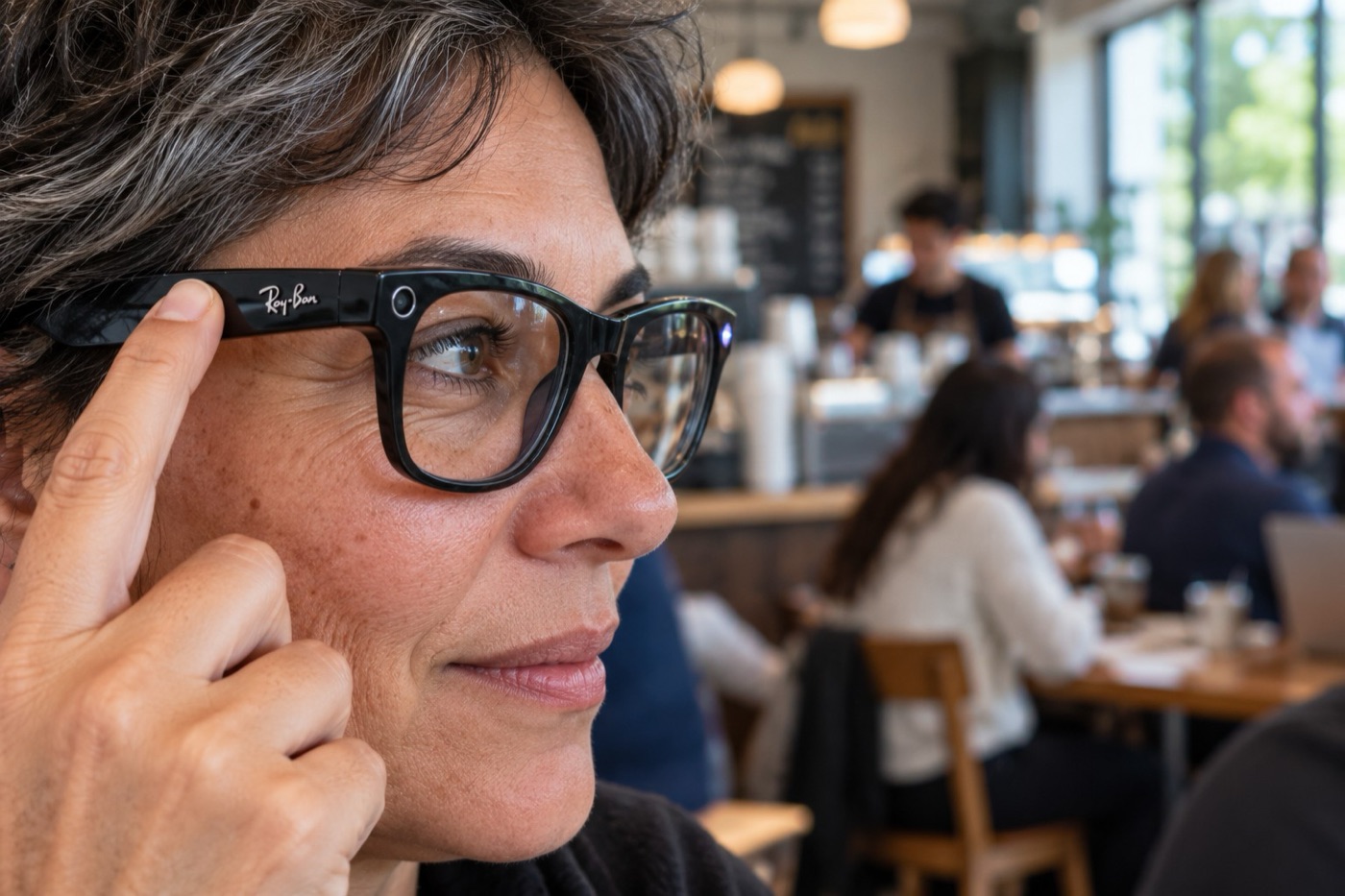
Imagine putting on glasses that can read a menu aloud, tell you what is in front of you or turn someone's speech into words on a small screen. These glasses already exist. Smart glasses contain technology such as cameras, microphones and artificial intelligence. They look like ordinary glasses, but some can record videos or give information without the wearer taking out a phone.
For people with disabilities, the technology can be extremely useful. Chris Edwards, an Australian man who is blind, uses smart glasses to read recipes, check household equipment and find his way around with his guide dog. Matt Henderson, who has been deaf since birth, uses glasses that show written words during meetings. Both say the devices help them live more independently.
But other people are worried. Some smart glasses can record video without everyone nearby noticing. Someone might be filmed at school, at work or in a changing room without knowing about it. Cheap devices may also have security problems, leaving recordings or personal information open to hackers. That means private moments could end up in the wrong hands, and once a video is online, it is very hard to take it back. These concerns have led to calls for stronger rules in Australia.
In 2026, the Australian Greens proposed a temporary ban on importing certain camera-equipped smart glasses. The proposal included exceptions for devices used to help people with disabilities. The national government said it was not planning its own import ban, although it was looking at changes to privacy law. The proposal was part of a political debate, not a ban that had already come into force.
People on both sides have important concerns. Everyone should be able to know when they are being recorded, but a person who needs smart glasses to read or communicate should not lose access to them. Better security, clearer recording lights and rules against secret filming could help. The difficult question is how to stop harmful uses of technology without taking away the freedom it gives other people.
Intermediate version
A pair of smart glasses can look almost identical to ordinary spectacles. Inside the frames, however, there may be cameras, microphones and software capable of describing objects, translating speech or recording video. For some users, the technology is a convenient way to capture everyday moments without taking out a phone. For others, it has become an important tool for living independently. That difference is at the centre of a growing privacy debate in Australia.
Chris Edwards, who is blind, uses smart glasses to read recipes, identify settings on household appliances and follow directions while walking with his guide dog. Because he can receive information without holding a phone, his hands remain free. Matt Henderson, an Australian town planner who has been deaf since birth, uses live captions during conversations and meetings. Both describe the technology as giving them confidence and reducing their dependence on other people.
Yet the same features that make smart glasses practical can also make them intrusive. Some models allow users to record people discreetly, sometimes in situations where filming would clearly be inappropriate. An investigation into inexpensive devices has also raised concerns about whether security protections are strong enough to prevent unauthorised access to recordings and data. As the glasses become smaller and more common, it may be increasingly difficult to tell when a camera is operating.
In 2026, Australian Greens politicians proposed a 12-month ban on imports of certain camera-enabled wearable devices while stronger privacy protections were considered. The proposal included an exception for genuine disability aids. However, the federal government said it had no plans to introduce its own import ban and was consulting on wider changes to privacy law. The distinction matters: the proposal attracted headlines, but it was not an existing nationwide ban.
Disability advocates worry that describing the devices mainly as tools for secret filming could create suspicion towards people who rely on them. A stranger may not be able to tell whether the glasses are reading a sign aloud for someone who is blind or recording the people nearby. That uncertainty could lead to uncomfortable confrontations and put people off using helpful technology in public.
Neither side has an easy solution. Clear recording indicators, stronger security standards and meaningful penalties for misuse could protect privacy without removing accessibility benefits. But even good rules may struggle to keep up with rapidly changing devices. The debate illustrates a familiar problem with new technology: a feature that provides independence for one person can threaten the privacy of another. Effective regulation has to take both experiences seriously.
Advanced version
To a stranger on a train, a pair of smart glasses may look like ordinary spectacles, with no way of telling whether a camera is recording. To a user who is blind, the same glasses can read a recipe aloud or describe a room. Proposals to restrict imports have turned that difference into a political argument. People who rely on the glasses warn that a privacy measure could also take away useful help.
Chris Edwards, who is blind and works with Vision Australia, uses AI-enabled glasses to obtain information that sighted people often take for granted. The devices can read recipes, describe household controls and provide directions while he walks with his guide dog. Matt Henderson, who has been deaf since birth, uses glasses that display live captions, allowing him to participate more confidently in professional meetings. For both men, hands-free access to information reduces reliance on other people and makes routine activities less demanding.
Yet the accessibility benefits coexist with a genuine security problem. Miniaturised cameras can blur the distinction between looking at someone and recording them. In sensitive environments, including schools, workplaces and changing rooms, the prospect of covert footage throws up obvious concerns about consent. Cheap devices may also lack adequate safeguards against unauthorised access. As wearable technology becomes less conspicuous, the social signals that normally indicate recording become increasingly unreliable. Norms built around the visible act of raising a phone offer little guidance once a camera sits permanently at eye level, leaving bystanders to take a stranger's word for it.
The Australian Greens proposed legislation in 2026 calling for a temporary prohibition on imports of camera-enabled wearable devices, with exemptions for genuine disability aids and additional privacy safeguards. The federal government, however, said it was not planning an import ban and was pursuing broader privacy reforms. The measure was therefore a political proposal, not an existing national prohibition. Its significance lay partly in giving rise to a public discussion about whether current laws can keep pace with recording technology that is becoming both cheaper and harder to recognise.
Disability organisations have been alarmed by rhetoric portraying the glasses primarily as instruments of voyeurism. A device that helps someone navigate a supermarket or understand a conversation should not become a source of suspicion or stigma. Equally, accessibility cannot be invoked as a blanket justification for unrestricted recording. Any sensible approach must distinguish between legitimate assistive functions and the misuse of cameras or personal data, while acknowledging that the boundary may not always be obvious to bystanders.
The most credible regulatory options include clearer recording indicators, minimum security standards, restrictions on covert filming and accessible complaints procedures. None is foolproof, and enforcement becomes progressively harder as devices shrink, multiply and evolve beyond the categories the law was written for. But the choice need not be between banning useful technology and abandoning privacy altogether. Smart glasses reveal the difficulty of governing tools whose value depends on context. A camera can undermine one person's autonomy while helping another regain it. Lawmakers who ignore either side risk solving one problem by creating another.
After you read
4True, false or not given5 statements
Choose T (true), F (false) or NG (the article does not say).
- Smart glasses are more expensive in Australia than elsewhere.
Not stated. The text never compares smart-glasses prices in Australia with prices elsewhere.
- Chris Edwards uses smart glasses to read recipes and find his way around.
The text says he uses them "to read recipes, check household equipment and find his way around with his guide dog."
- The Greens' proposal included exceptions for disability devices.
The text says: "The proposal included exceptions for devices used to help people with disabilities."
- Australia has already banned imports of camera-equipped smart glasses.
The text says the proposal was "not a ban that had already come into force."
- Matt Henderson uses glasses that show written words during meetings.
The text says he uses glasses "that show written words during meetings."
5Vocabulary5 gaps
Complete the sentences with words from the box. Two words are not needed.
exceptionsfootagehackersindependentlypermanentsecuritytemporary
- My grandmother is old, but she still lives in her own flat.
- Criminal sometimes break into online accounts and steal private photos.
- The road will be closed for a period of two weeks while workers repair it.
- The rule applies to everyone, but there are a few for young children.
- Good online means using a strong password and updating your phone.
6Verb forms5 gaps
Write the correct form of the verb in brackets.
- She her glasses on the train yesterday. (LEAVE)
- Someone might at school or at work without knowing about it. (FILM)
- Matt Henderson deaf since birth. (BE)
- In 2026, the Australian Greens a temporary ban on certain glasses. (PROPOSE)
- Chris Edwards, who is blind, smart glasses to read recipes. (USE)
7Language focuslinking words
Complete the sentences with words from the box. Two words are not needed. Linking words join ideas. Use because for a reason, so for a result, however for a difference and also to add an idea.
alsoalthoughbecausehoweverifsounless
- Many users bought smart glasses they wanted information without holding a phone.
- A cheap device may have weak security, hackers could see the recordings.
- Smart glasses are useful. , some people feel unsafe near them.
- The glasses can read signs aloud. They can translate speech.
- People will feel safer the glasses show a clear light when they record.
4True, false or not given5 statements
Choose T (true), F (false) or NG (the article does not say).
- Several Australian schools have already banned smart glasses.
Not stated. The text does not mention any Australian school banning smart glasses.
- Matt Henderson is an Australian town planner who uses live captions.
The text says he is "an Australian town planner who has been deaf since birth" and uses "live captions during conversations and meetings."
- The federal government planned to introduce its own import ban.
The text says it "had no plans to introduce its own import ban."
- The Greens proposed a 12-month ban on certain imports.
The text says they proposed "a 12-month ban on imports of certain camera-enabled wearable devices."
- The proposal would have banned glasses used as disability aids.
The text says the proposal "included an exception for genuine disability aids."
5Vocabulary6 gaps
Complete the sentences with words from the box. Two words are not needed.
confrontationsidenticalindicatorsloopholepenaltiessuspicionuncertaintyvisible
- The two phones look from the outside, but only one has a hidden camera.
- Flashing on the frame would show when a camera is on.
- Without meaningful , companies have little reason to follow the rules.
- Customers who film in shops are often treated with by the staff.
- Misunderstandings in crowded places can quickly lead to angry .
- Economic makes many companies delay big decisions.
6Verb forms5 gaps
Write the correct form of the verb in brackets.
- By then, he the glasses for a year. (USE)
- Smart glasses in many shops now. (SELL)
- If the glasses had a bright light, people the camera. (NOTICE)
- The new rules in parliament at the moment. (DISCUSS)
- While he home, the glasses gave him directions. (WALK)
7Language focuslinking words
Complete the sentences with words from the box. Two words are not needed. Contrast and condition. Whereas compares two facts, unless means except if, and otherwise means if not.
consequentlydespiteneverthelessotherwiseprovidedunlesswhereas
- Some users value the glasses for convenience, others depend on them to live independently.
- the benefits, many people feel uncomfortable being filmed.
- Glasses for disabled users should not be banned they are used to film people secretly.
- The penalties were small; , few firms took the rules seriously.
- Cameras should show a clear light; , nobody can tell when they are recording.
4True, false or not given5 statements
Choose T (true), F (false) or NG (the article does not say).
- The writer implies that habits built around phones no longer protect privacy once cameras sit in glasses.
The text says norms built around raising a phone "offer little guidance once a camera sits permanently at eye level."
- The Greens' proposal would have restricted imports of glasses sold as disability aids.
The text says it came "with exemptions for genuine disability aids."
- Vision Australia asked the federal government to reject the import ban.
The text says only that Chris Edwards works with Vision Australia; it reports no request from the organisation.
- The writer believes the only choices are banning smart glasses or ignoring privacy.
The text says "the choice need not be between banning useful technology and abandoning privacy altogether."
- The government's privacy plans were wider in scope than the Greens' proposal.
The Greens proposed an import ban, while the government was "pursuing broader privacy reforms."
5Vocabulary6 gaps
Complete the sentences with words from the box. Two words are not needed.
bystanderscovertexemptionsloopholeprohibitionrhetoricsafeguardsstigma
- A operation depends on nobody knowing that it exists.
- Politicians often resort to alarmist when they want support for tougher laws.
- Many people avoid seeking help because of the lingering that makes them ashamed of needing it.
- Several filmed the argument on their phones instead of intervening.
- Without adequate , personal data can easily be misused.
- The council introduced a complete on smoking in the city's parks.
6Word forms5 gaps
Use the word in brackets to make a word that fits the gap.
- Critics pointed to the in the wording of the law. (AMBIGUOUS)
- Campaigners accused the firm of in protecting customer data. (NEGLIGENT)
- The new rule is likely to prove for small businesses. (PROBLEM)
- Campaigners demanded greater about how the footage was stored. (TRANSPARENT)
- Her to wear the glasses in public surprised her colleagues. (RELUCTANT)
7Language focuslinking words
Complete the sentences with words from the box. Two words are not needed. Formal linkers. Albeit means although and introduces a short contrast; thereby shows a result; lest means in case.
albeithencelestnonethelessnotwithstandingtherebywhereby
- the benefits to disabled users, many campaigners want tighter controls.
- The glasses are discreet, not completely invisible.
- The device records continuously, raising concerns about consent.
- Cameras are shrinking fast; , current laws may soon prove inadequate.
- Wearers should say clearly when they are recording, bystanders feel deceived.
Speak
8Talk about it3 questions
Discuss in pairs or small groups. Give reasons for your answers.
- Should a visible recording light be enough to make filming strangers acceptable?
- What rule would let useful smart glasses coexist with privacy?
- Would your answer change if the glasses helped someone see or hear?
9Role-play: glasses in the cafe
Work in pairs. Read your card, then have the conversation. Swap roles and do it again.
Student A · the cafe manager
A customer is wearing smart glasses with a camera. Two other customers have complained. Politely ask what the glasses do. Decide if the customer can keep them on, and say why.
Student B · the customer
You wear smart glasses to read the menu and signs because your eyesight is poor. You aren't recording anyone. Explain this calmly and suggest a way to make people feel comfortable.
Useful phrases
- Excuse me, could I ask about your glasses?
- I'm not recording anyone, I promise.
- Some customers aren't comfortable with cameras.
- I'd be happy to show you how they work.
- Could we find a compromise?
- That's fair, I'll make sure the light is visible.
Afterwards, tell the class: did the manager and the customer agree, and was the solution fair to everyone?
Your words
Highlights0 saved
Highlights0 saved
Highlights0 saved
Was this lesson useful? Support johnplusnews on Ko-fi
Continue reading
Language
Did Writing Really Make Languages More Complicated?
A large study of about 100,000 sentences in 30 languages found no universal pattern showing that writing makes sentences more complex. It does not say that writing never changes a language.
Technology
Can You Be Emotionally Close to Someone Who Is Not Human?
A survey of 463 adults in the United States found that people in relationships with AI chatbots can feel as emotionally close as other couples, but the link between closeness and loneliness looked different.
Relationships
Would You Sign a Contract Before Getting Married?
More young Americans are signing prenuptial agreements before their weddings. Is planning for a divorce unromantic, or is it honest and sensible?