News lesson19 August 2025
What a Bag of Discarded Plastic Is Worth
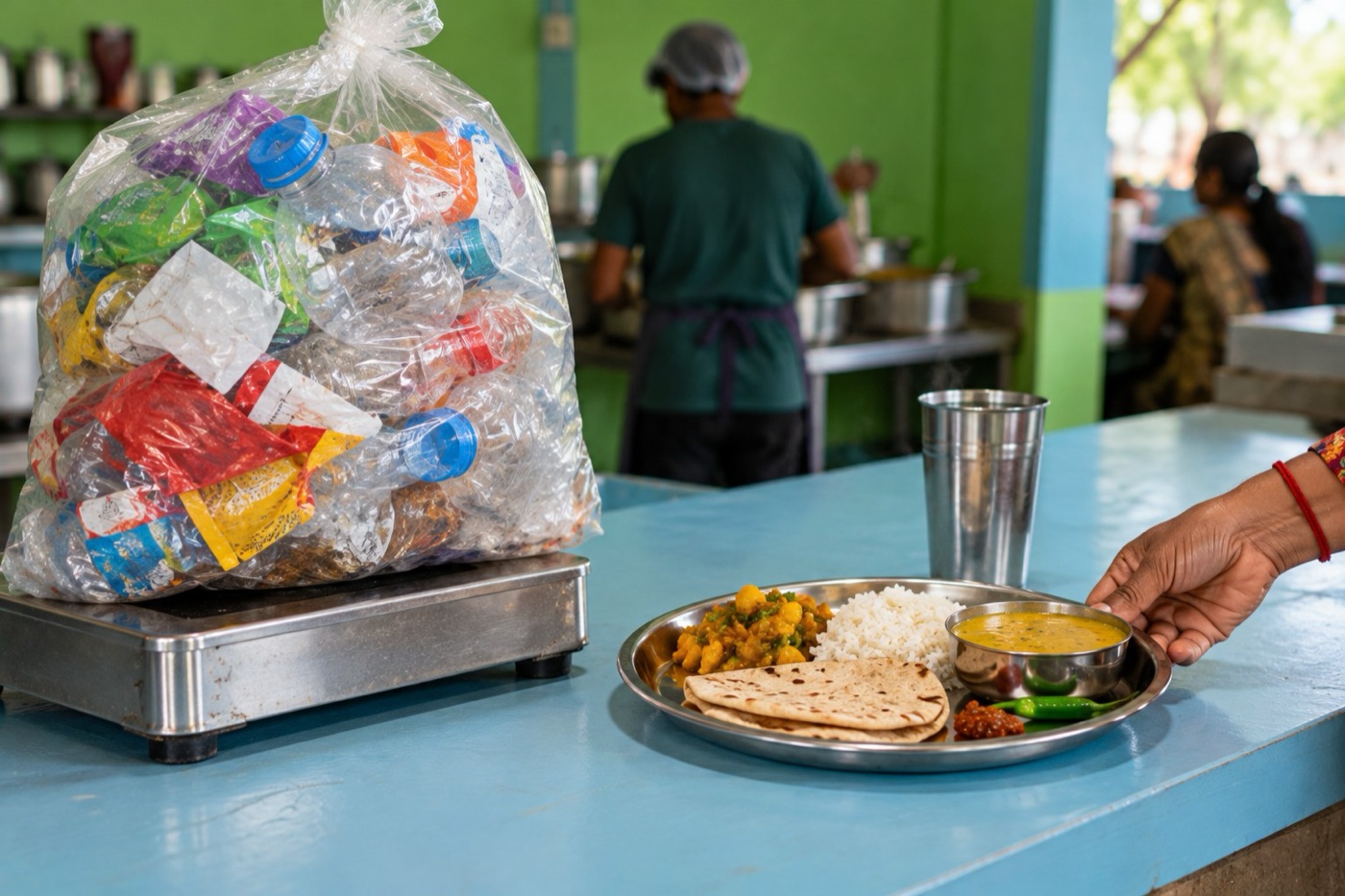
Ambikapur's Garbage Café pays informal collectors in food rather than small change. It cannot absorb a city's plastic, but it does make their work visible.
Before you read
1Warm up3 questions
Talk about these questions with a partner.
- What would persuade you to pick up litter you did not drop?
- Can a free meal be a good reason to help a neighbourhood?
- Would a small reward change a habit you already cared about?
2Key words8 words
These words are in the article. Choose the letter of the meaning for each one.
- convenient
- earn
- collectors
- recycle
- solve
- encourage
- factories
- damage
- Ause something again to make a new thing
- Bhurt something so that it is not good any more
- Cfind the answer to a problem
- Dbig buildings where things are made
- Egive someone a reason to do something
- Fget money for work you do
- Geasy and quick to use
- Hpeople whose job is to pick things up
1Warm up3 questions
Talk about these questions with a partner.
- What would persuade you to pick up litter you did not drop?
- Can a free meal be a good reason to help a neighbourhood?
- Would a small reward change a habit you already cared about?
2Key words8 words
These words are in the article. Choose the letter of the meaning for each one.
- informal
- discarded
- grasp
- precisely
- waterways
- organised
- visible
- limits
- Athrown away because it is not wanted
- Bunderstand something fully
- Cexactly
- Deasy to see or notice
- Enot official or part of a regular system
- Frivers and canals that boats can use
- Gpoints where something cannot go any further
- Harranged in a clear and planned way
1Warm up3 questions
Talk about these questions with a partner.
- What would persuade you to pick up litter you did not drop?
- Can a free meal be a good reason to help a neighbourhood?
- Would a small reward change a habit you already cared about?
2Key words8 words
These words are in the article. Choose the letter of the meaning for each one.
- established
- symbolic
- accumulates
- retrieve
- persists
- structural
- insecurity
- absorb
- Acontinues to exist, often for longer than expected
- Ba worrying lack of safety or certainty
- Cgradually collects in one place
- Dconnected with the basic way a society is organised
- Eset up and started
- Ftake in and deal with something large
- Gget something back from where it is
- Hrepresenting an idea rather than being practical
Read
3Read the article
The paragraphs are numbered. Look out for the key words from task 2.
Core version
Imagine walking into a café, ordering a hot lunch and paying with a bag of plastic waste. In the Indian city of Ambikapur, the idea is real. The Garbage Café gives people food in exchange for plastic waste, including used bottles, bags and food packaging that most of us would throw away without thinking.
The café opened in 2019 with support from the local authorities. Customers can bring one kilogram of plastic waste and receive a full meal in return. That might include rice, vegetables, bread and other dishes. The plastic is then collected and sent into the city's waste system, instead of being left on the streets or blown into a river.
For some people, picking up plastic is more than a way to help the environment. It is a way to earn enough to eat. Waste collectors may spend hours looking for material they can sell, and the money they get for it is often very small. A hot meal in exchange for a bag of plastic makes those hours worth much more, and the food arrives the same day.
The café also draws attention to a growing problem. Single-use plastic is cheap and convenient, but it stays in the environment for a very long time. Plastic bags and wrappers block drains, damage natural places and slowly break down into tiny pieces that nobody can clear away again.
Of course, one small café cannot solve India's plastic problem on its own. The city produces far more waste than the café could ever collect. People also need good rubbish collection, proper ways to recycle, and good reasons to use less plastic in the first place. Shops and factories play a part too, because they decide how much packaging ends up in the bin.
Still, the idea changes the way we think about rubbish. Plastic that looks worthless to one person may be worth a hot meal to somebody else. The café shows that a simple local project can help people and encourage a cleaner city at the same time.
Intermediate version
Most cafés expect their customers to pay by cash or card. In Ambikapur, a city in central India, one café accepts a far less attractive form of payment: plastic waste. Customers can hand over discarded packaging and, in return, receive a cooked meal. The project ties together two challenges that are usually discussed separately, hunger and pollution, and it does so in a way anyone can grasp in a sentence.
The Garbage Café was set up in 2019 with the involvement of local authorities. Its most memorable offer is a full meal in exchange for a kilogram of plastic. The food provides immediate value to people who collect recyclable material, while the plastic enters an organised waste-management system rather than ending up in streets or waterways.
The arrangement is particularly meaningful for informal waste collectors. They may earn very little from selling material to dealers, even after spending hours sorting through rubbish in difficult conditions. Being able to exchange what they gather for something as essential as lunch changes the practical value of their work. The exchange happens on the same day rather than at the end of a long month.
Ambikapur has also developed broader waste-sorting and recycling initiatives, so the café was never intended to be the city's entire environmental strategy. It is a visible way of involving the public and encouraging people to see plastic as material that has to be collected and managed, rather than simply thrown away and forgotten. A scheme that people can see working on their own high street is also far easier to talk about than a recycling target.
Single-use plastic is cheap and convenient, which is precisely why it turns up everywhere. It can block drains, spoil open land and break down into fragments that are too small to pick up, so anything that is not collected tends to stay in the environment for decades.
There are limits. A café cannot process all the plastic produced by a city, and collecting more waste is not the same as cutting down on waste in the first place. Critics could also question whether handing out meals in return for rubbish addresses the deeper causes of poverty, or merely makes them slightly easier to live with.
Nevertheless, the concept works because it is easy to understand. Instead of asking people to worry about a distant environmental crisis, it offers a direct exchange with an immediate benefit. A kilogram of plastic becomes a plate of food. An abstract argument about waste turns into a practical question about what a community actually values.
Advanced version
At the Garbage Café in Ambikapur, India, a bag of discarded plastic can pay for a hot meal. The exchange gives waste an immediate value to the person who collects it. It also connects two everyday problems a city might otherwise handle separately: rubbish on the streets and people needing food.
Established in 2019 with municipal involvement, the café offers a meal in exchange for approximately one kilogram of plastic waste, and the collected material is then fed into the city's waste-management network. For informal collectors, who may receive very little money for the plastic they recover, this exchange can turn hours of unpleasant and physically demanding work into a more dependable form of immediate support. A meal, unlike a fluctuating scrap price, is a known quantity.
The project's appeal lies partly in its symbolic simplicity. Rubbish is ordinarily treated as something valueless, to be cleared away and put out of sight as quickly as possible. Here, discarded packaging becomes a form of purchasing power. The exchange also makes visible the labour performed by people whose contribution to urban cleanliness is routinely overlooked, and whose work is seldom counted as work at all. Recognition of that kind costs nothing, yet it is in remarkably short supply.
Ambikapur's wider approach includes sorting, collecting and recycling waste, so the café is best understood as one modest element within a larger system rather than a strategy in its own right. It cannot absorb the vast quantities of plastic that consumers produce, and its popularity is certainly no proof that incentives alone can undo the environmental damage caused by disposable packaging. Schemes of this kind work best when they sit on top of functioning collection services, not in place of them.
Part of what makes the problem so stubborn is the material itself. Single-use plastic is cheap, light and convenient, and those same properties make it extremely difficult to contain once discarded: it blocks drains, accumulates on open ground and fragments into pieces too small to retrieve. Waste that goes uncollected does not quietly disappear. It persists, dispersed and largely unrecoverable.
There are social questions as well, and they are not easily brushed aside. Providing food through waste collection is inventive, but it does nothing to remove the insecurity that makes some residents dependent on such exchanges in the first place. A policy can be compassionate and still leave the structural causes of poverty entirely untouched. Nor should an eye-catching recycling initiative distract attention from the more difficult task of reducing unnecessary plastic production.
Even with those qualifications, the café offers a valuable example of local problem-solving. Measured by tonnage it collects a drop in the ocean, yet its real achievement may lie elsewhere: in the relationships it exposes between waste, work and basic needs. Sometimes an effective public idea begins not with new technology but by changing the perceived value of something everybody else is ready to throw away. Once a discarded bottle is understood as lunch, it becomes very hard to walk past.
After you read
4True, false or not given5 statements
Choose T (true), F (false) or NG (the article does not say).
- The café opened with help from the local authorities.
The text says it opened in 2019 "with support from the local authorities".
- Customers need to bring two kilograms of plastic for a meal.
The text says one kilogram of plastic gets a full meal.
- Customers can choose their meal from a long menu.
The text lists some food but does not say customers can choose.
- The writer says one small café cannot solve India's plastic problem.
The text says "one small café cannot solve India's plastic problem on its own".
- Waste collectors usually earn a lot of money from selling plastic.
The text says the money they get is "often very small".
5Vocabulary5 gaps
Complete the sentences with words from the box. Two words are not needed.
attentionauthoritiesdrainsenvironmentkilogrammealpackaging
- Everything in this shop comes in plastic .
- The local asked shops to give out fewer plastic bags.
- Using too much plastic is bad for the .
- Rubbish can block the , so water cannot leave the street.
- The new poster got a lot of on social media.
6Verb forms5 gaps
Write the correct form of the verb in brackets.
- The café in 2019. (OPEN)
- Customers plastic bags to the café. (BRING)
- In return, they a hot meal. (GET)
- In the past, collectors hours looking for things to sell. (SPEND)
- Yesterday I a plastic bottle in the park. (FIND)
7Language focusphrasal verbs
Complete the sentences with words from the box. Two words are not needed. A phrasal verb is a verb plus a small word. The small word changes the meaning, so learn the two words together.
awaydownforinoutroundup
- Most of us throw plastic without thinking.
- Volunteers pick litter from the beach every Sunday.
- The café ran of rice by two o'clock.
- Waste collectors spend hours looking plastic they can sell.
- Shops should cut on plastic packaging.
4True, false or not given5 statements
Choose T (true), F (false) or NG (the article does not say).
- A collector who hands over plastic at the café is rewarded on the same day.
The text says the exchange happens "on the same day rather than at the end of a long month".
- The café is the city's main way of dealing with waste.
The text says the café "was never intended to be the city's entire environmental strategy".
- Most of the café's customers are informal collectors.
The text does not say who the customers are.
- Some people might say the café makes poverty easier to live with without fixing it.
Critics are said to wonder if it "merely makes them slightly easier to live with".
- Plastic that nobody collects disappears within a few years.
The text says uncollected plastic stays "for decades".
5Vocabulary6 gaps
Complete the sentences with words from the box. Two words are not needed.
arrangementCriticsdealersfragmentsinitiativesinvolvementtargettonnage
- The council welcomed the of local volunteers in the clean-up.
- Under the new , shops collect used bags and customers get a small discount.
- Several recycling have started in towns across the region.
- A bottle left in the sun can split into tiny that are almost impossible to collect.
- argue that free meals do not tackle the causes of poverty.
- The city set a recycling of fifty per cent.
6Verb forms5 gaps
Write the correct form of the verb in brackets.
- The community garden by volunteers in 2020. (BUILD)
- By the time the collector arrived, the kitchen . (CLOSE)
- Bottles that on the beach can take decades to break down. (LEAVE)
- If every shop plastic as payment, the streets would be much cleaner. (ACCEPT)
- By the end of the week, the volunteers over two hundred kilograms of plastic. (COLLECT)
7Language focusphrasal verbs
Complete the sentences with words from the box. Two words are not needed. Some phrasal verbs have two small words, like put up with. Learn the whole chunk, not just the first part.
downintooffoutroundupwith
- The charity plans to set a second café next year.
- We could cut on waste by banning thin plastic bags.
- Many collectors have to put up very low prices.
- The council hopes the scheme will help people find how much waste they produce.
- The council will look ways to cut plastic use.
4True, false or not given5 statements
Choose T (true), F (false) or NG (the article does not say).
- A meal at the café has a more predictable value to a collector than the money from selling scrap.
The text contrasts "a fluctuating scrap price" with a meal, "a known quantity".
- The writer sees the amount of plastic removed as the café's main achievement.
The writer calls the tonnage "a drop in the ocean" and looks for its real achievement elsewhere.
- Other Indian cities have copied the café's approach.
The text never mentions other cities or imitations.
- The writer thinks schemes like this work best alongside regular waste collection.
They "work best when they sit on top of functioning collection services, not in place of them".
- The text claims a compassionate policy will necessarily tackle the causes of poverty.
It says a policy "can be compassionate and still leave the structural causes of poverty entirely untouched".
5Vocabulary6 gaps
Complete the sentences with words from the box. Two words are not needed.
dependabledispersedfluctuatinginventivemunicipaloverlookedperceivedunrecoverable
- Because scrap prices keep from week to week, small dealers find it hard to plan ahead.
- The needs of the poorest residents were repeatedly in the budget.
- A income, even a small one, helps a household plan its spending.
- After the storm the debris was across several kilometres of open ground.
- The charity's biggest challenge is changing the value of rubbish in people's minds.
- The designers made an use of old tyres, turning them into playground equipment.
6Word forms5 gaps
Use the word in brackets to make a word that fits the gap.
- The scheme's long-term depends on continued funding. (SUSTAIN)
- Critics point to the of relying on charity to feed a city. (ADEQUATE)
- Public of their labour is long overdue. (RECOGNISE)
- Without proper collection services, such schemes are largely . (EFFECT)
- Some residents resent being on handouts. (DEPEND)
7Language focusphrasal verbs
Complete the sentences with words from the box. Two words are not needed. Many C1 phrasal verbs are formal or figurative. Notice the idea behind the particle: out means gradually removing, down means taking firm action.
awaydownoffoutoverroundup
- The council plans to phase single-use plastic bags over three years.
- Campaigners urged the government to clamp on illegal dumping.
- Many dealers shy from paying collectors a fair price.
- Supporters hold the café as a model for other cities.
- Critics fear the scheme merely tides families until the next crisis.
Speak
8Talk about it3 questions
Discuss in pairs or small groups. Give reasons for your answers.
- What would make a rubbish-for-food scheme feel welcoming rather than embarrassing?
- Should people need a reward to look after shared spaces?
- Which everyday problem could your neighbourhood tackle with a simple exchange?
9Role-play: one kilogram, or nothing?
Work in pairs. Read your card, then have the conversation. Swap roles and do it again.
Student A · the café manager
The rule is one kilogram of plastic for one meal. A collector arrives with a bit less. Ask what is in the bag and why it is light. You can say no, or find a fair solution.
Student B · the waste collector
You've worked all day and your bag is a little under one kilogram. You haven't eaten. Explain your day and ask for a meal. Offer something in return.
Useful phrases
- I've been collecting since early this morning.
- It's only a bit under a kilogram.
- I'm sorry, but the rule is the same for everyone.
- Could you make an exception just this once?
- I'd be happy to give you a smaller meal.
- That's fair, I'll bring more tomorrow.
Afterwards, tell the class: was the manager's decision fair, and would you have decided the same?
Your words
Highlights0 saved
Highlights0 saved
Highlights0 saved
Was this lesson useful? Support johnplusnews on Ko-fi
Continue reading
Language
Did Writing Really Make Languages More Complicated?
A large study of about 100,000 sentences in 30 languages found no universal pattern showing that writing makes sentences more complex. It does not say that writing never changes a language.
Relationships
Would You Sign a Contract Before Getting Married?
More young Americans are signing prenuptial agreements before their weddings. Is planning for a divorce unromantic, or is it honest and sensible?
Work
They Still Have Their Jobs. They Are Leaving Anyway
Nobody made these workers redundant. AI changed what their work felt like, and they walked out on careers they had spent a decade building.