News lesson6 October 2026
Sharing a Neighbourhood with Giant Rodents
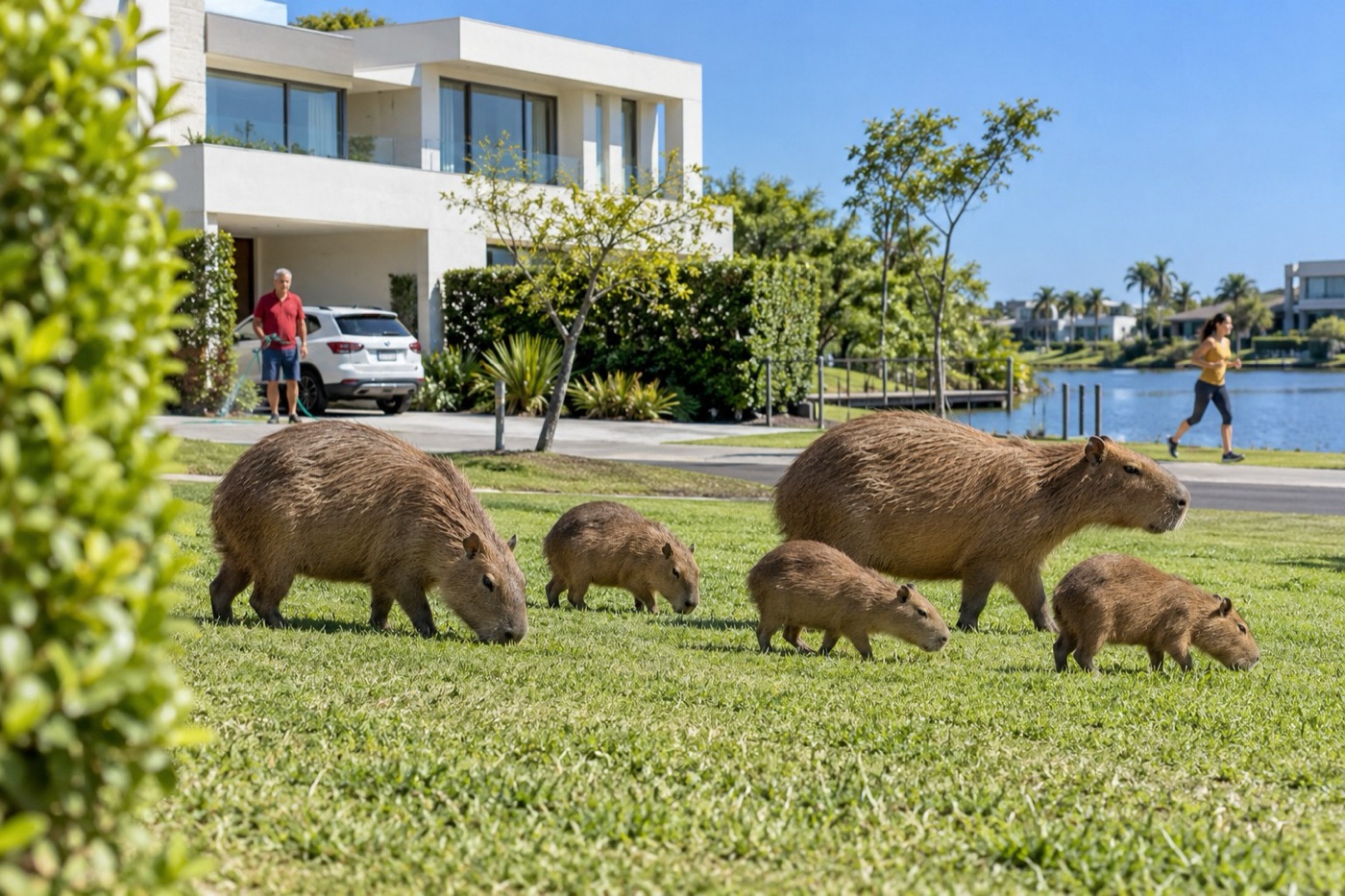
Residents report damaged gardens, road risks and awkward encounters with pets. Campaigners reply that the capybaras came from nowhere else: the neighbourhood expanded around them.
Before you read
1Warm up3 questions
Talk about these questions with a partner.
- How would you react to a capybara outside your front door?
- What wildlife do people welcome near their homes?
- When do people start calling an animal a problem?
2Key words8 words
These words are in the article. Choose the letter of the meaning for each one.
- rodents
- wetland
- artificial
- campaigners
- investigation
- complaints
- routes
- lawns
- Apeople who work together to change something
- Bmade by people, not found in nature
- Csmall animals with big front teeth, like mice and rats
- Dareas of short grass in a garden
- Eland that is very wet, with a lot of water
- Fwords that say you are not happy about something
- Gan official check to find out what happened
- Hways to go from one place to another
1Warm up3 questions
Talk about these questions with a partner.
- How would you react to a capybara outside your front door?
- What wildlife do people welcome near their homes?
- When do people start calling an animal a problem?
2Key words8 words
These words are in the article. Choose the letter of the meaning for each one.
- coexistence
- wander
- inhabit
- habitat
- ecosystem
- relocation
- corridors
- dispute
- Astrips of land that connect two larger areas
- Ba serious argument between people or groups
- Cmoving something or someone to a new place
- Dwalk slowly around with no clear aim
- Eall the living things in an area and how they depend on each other
- Fliving in the same place without fighting
- Gthe natural home of an animal or plant
- Hlive in a place
1Warm up3 questions
Talk about these questions with a partner.
- How would you react to a capybara outside your front door?
- What wildlife do people welcome near their homes?
- When do people start calling an animal a problem?
2Key words8 words
These words are in the article. Choose the letter of the meaning for each one.
- landscaped
- semi-aquatic
- vegetation
- remedy
- legitimate
- hardening
- comprehensively
- coexistence
- Acompletely and in great detail
- Bthe state of living or existing together peacefully
- Ca way of fixing a problem
- Dmaking something firmer or less willing to change
- Espending part of its life in water and part on land
- Fplants in general, especially those growing in one place
- Gfair and reasonable, with a good reason behind it
- Hdesigned and planted to look attractive, as a garden or park is
Read
3Read the article
The paragraphs are numbered. Look out for the key words from task 2.
Core version
Imagine looking out of your kitchen window and seeing an enormous brown animal eating the grass beside your swimming pool. For some people living in Nordelta, an expensive neighbourhood near Buenos Aires in Argentina, that is an ordinary morning rather than a surprise.
The animals are capybaras, called carpinchos in Argentina. They are the world's largest living rodents and are related to guinea pigs, although they are far bigger. They love water and usually live in groups near rivers, lakes and wetlands. Nordelta was built on wetland, where capybaras already lived. In Nordelta, they can be seen walking across lawns, crossing roads and resting beside the artificial lakes that were built for the residents.
For some residents, the animals are a wonderful part of local life and visitors love taking photographs of them. Other people are much less happy. They worry about their pets, damaged gardens and animals suddenly turning up in front of cars at night. In September 2026, a resident was filmed firing a gun at capybaras near his home. The incident led to complaints and an investigation.
Animal campaigners say the bigger problem is not the capybaras themselves. As people moved in and built more homes, the animals lost a great deal of their natural space.
Finding a solution is difficult. Moving capybaras somewhere else is not always simple, and residents also need to feel safe in their own gardens. Campaigners have suggested protecting the natural areas that are left and creating routes where animals can move around without crossing busy streets. None of this is quick, and it costs money that somebody has to agree to spend.
The story has become famous partly because capybaras look calm and friendly in photographs. But the argument behind it is serious: when people build a new community in an animal's home, who has the right to stay? That question matters far beyond Argentina, because towns and cities everywhere are still growing into places where animals already live.
Intermediate version
In most wealthy neighbourhoods, homeowners complain about parking, noisy neighbours or the cost of maintenance. In Nordelta, a large residential development outside Buenos Aires, the most unusual dispute concerns capybaras: giant, semi-aquatic rodents that wander across carefully maintained lawns as if they own the place.
Capybaras, known locally as carpinchos, are native to South America and naturally inhabit wetlands. Nordelta, however, was built in an area where those wetlands once spread out for miles. Its artificial lakes and green spaces still attract the animals. The result is an uncomfortable coexistence between wildlife and residents who had not expected to share their gardens with anything larger than a cat.
It helps to know what a capybara actually is. They are the largest living rodents in the world, relatives of the guinea pig on a far greater scale, and they live in groups wherever there is water. A family of them grazing on a lawn is therefore perfectly normal wetland behaviour, simply carried out in an unexpected setting.
Some people are delighted to see the capybaras, while others report damage to gardens, risks on the roads and awkward encounters with domestic pets. The tension flared up in September 2026, when a resident was filmed shooting towards capybaras near his property. The incident prompted formal complaints and revived a long-running argument about how the neighbourhood should manage its animal population. Residents who had quietly put up with the situation for years suddenly found themselves taking sides in public.
Environmental campaigners argue that talk of an animal "invasion" turns the real history of the area upside down. The capybaras did not arrive from another continent. They survived while a human settlement expanded around them and gradually took over the ground they had always used, lake by lake and street by street. That does not make every resident's concern unreasonable, but it does change how responsibility might be understood.
Possible responses include protecting the remaining habitat, providing wildlife corridors and finding safer ways for people and animals to move around the same landscape. Relocation or population control may look straightforward on paper, but both raise ecological and ethical questions that are difficult to settle, and neither is cheap. Moving a group of animals, for instance, only works if there is somewhere suitable to move them to.
The capybara has become an internet favourite thanks to its relaxed expression and its surprising friendships with other species. Nordelta's dispute is a useful reminder that real wildlife is not a cute social-media character. It is a living part of an ecosystem, and sharing space with it turns out to be considerably more complicated than liking a photograph.
Advanced version
Capybaras graze on the landscaped lawns of Nordelta, a gated community outside Buenos Aires, as if the gardens had been planted for them. The residents enjoy artificial lakes and the promise of orderly, well-managed living. Yet the neighbourhood is also home to large numbers of carpinchos, the semi-aquatic rodents known internationally as capybaras, whose unhurried presence disrupts that carefully arranged environment.
The animals are not newcomers in any meaningful ecological sense. They are native to the wetlands on which the development expanded, and the waterways and vegetation created for human enjoyment have proved attractive habitat for the original inhabitants. What some residents describe as an invasion is better understood as the survival of wildlife within a landscape that has been comprehensively rebuilt around it.
It is worth recalling what the animal in question actually is. Capybaras are the largest living rodents on earth, group-dwelling relatives of the guinea pig that depend on water and graze on open vegetation. A family of them cropping a Nordelta lawn is not aberrant behaviour but entirely ordinary wetland behaviour, performed in an extraordinary setting.
The resulting tension is not entirely imaginary, and it would be unfair to pretend otherwise. People have raised concerns about road accidents, damage to property and unpredictable interactions with pets. The dispute nonetheless took a disturbing turn in September 2026, when footage emerged of a resident firing at capybaras. Complaints and an investigation followed, drawing renewed attention to the limits of private control over a shared ecosystem. A gated community may be able to regulate its hedges and its parking, but it cannot issue instructions to a wetland.
Campaigners advocate better habitat protection, ecological corridors and forms of coexistence that acknowledge how thoroughly the development has reshaped the wetland. Residents seeking practical safety measures have legitimate interests too, and dismissing them outright achieves nothing beyond hardening the argument. Relocation, often proposed as the obvious remedy, depends on there being somewhere suitable to move the animals to, which is precisely what the development has done away with. The challenge is to separate evidence-based management from the comfortable assumption that wildlife ought to disappear the moment it becomes inconvenient.
The argument also exposes a linguistic trap worth noticing. Terms such as "pest", "invasion" and "wildlife problem" quietly suggest that nature has intruded upon a settled human order. Often the building came after the animals. Roads and homes broke up their habitat, leaving them to find food and space in a landscape people had changed. Language of that sort does a good deal of work before the argument has formally begun, and whoever controls the vocabulary is halfway to controlling the policy that follows.
Nordelta's capybaras may look amusing in photographs, but they pose an uncomfortable question for cities everywhere. When property development manufactures a desirable address by transforming natural land, how much responsibility should fall to the people who benefit from it, and how much to the creatures that simply stayed where they were? The answer will matter wherever suburbs continue to expand into land that was never empty in the first place.
After you read
4True, false or not given5 statements
Choose T (true), F (false) or NG (the article does not say).
- Nordelta was built on land where capybaras already lived.
The text says: "Nordelta was built on wetland, where capybaras already lived."
- No living rodent is bigger than the capybara.
The text says capybaras are "the world's largest living rodents".
- The resident who fired the gun was arrested.
The text mentions complaints and an investigation, but does not say whether anyone was arrested.
- All residents of Nordelta enjoy having the animals nearby.
The text says: "Other people are much less happy."
- Capybaras usually live alone.
The text says they "usually live in groups near rivers, lakes and wetlands".
5Vocabulary5 gaps
Complete the sentences with words from the box. Two words are not needed.
damagedenormousnaturalordinaryserioustidywealthy
- The whale was so that it could hardly fit inside the small bay.
- Seeing a cat on the garden wall is an sight, so nobody looks twice.
- After the storm, the fence had to be repaired.
- Farmers worry that building on areas will harm the wildlife.
- The police said the crime was , so they began an immediate search.
6Verb forms5 gaps
Write the correct form of the verb in brackets.
- In Nordelta, they can be walking across lawns. (SEE)
- In September 2026, a resident firing a gun at capybaras. (FILM)
- The incident to complaints and an investigation. (LEAD)
- capybaras somewhere else is not always simple. (MOVE)
- Campaigners have protecting the natural areas that are left. (SUGGEST)
7Language focuscollocations
Complete the sentences with words from the box. Two words are not needed. A collocation is a pair of words that go together naturally. Learn them as a pair, like take a photograph.
busydealheavymakeprotectsafetake
- Visitors love to photographs of the capybaras.
- The animals lost a great of their natural space.
- Residents want to feel when they walk home at night.
- Drivers must be careful on a road with heavy traffic.
- Campaigners want to the places where animals live.
4True, false or not given5 statements
Choose T (true), F (false) or NG (the article does not say).
- The capybaras were living in the area before Nordelta was developed.
The text says they "survived while a human settlement expanded around them".
- Everyone in Nordelta reacted to the capybaras in the same way.
The text says some people are delighted, while others report damage and risks.
- Nordelta residents have voted on whether to move the capybaras.
The text mentions no vote.
- Moving the animals would be difficult even if residents agreed to it.
The text says moving a group "only works if there is somewhere suitable to move them to".
- The shooting incident was the first time residents argued about the capybaras.
The incident "revived a long-running argument", so the argument already existed.
5Vocabulary6 gaps
Complete the sentences with words from the box. Two words are not needed.
awkwardcarefullydomesticformalgraduallyrecentlystraightforwardsuddenly
- There was an silence when the neighbours realised they had been talking about each other.
- Dogs and cats are animals, while wolves and foxes are wild.
- The job looked difficult, but the instructions were so clear that it was .
- The head teacher wore a suit and tie for the ceremony.
- The town grew bigger over fifty years as more families moved in.
- She carried the sleeping baby so as not to wake her.
6Verb forms5 gaps
Write the correct form of the verb in brackets.
- Nordelta in an area where wetlands once spread out for miles. (BUILD)
- Before the incident, many residents the capybaras quietly for years. (TOLERATE)
- In September 2026, a resident shooting towards capybaras near his property. (FILM)
- Campaigners say the capybaras from another continent. (NOT ARRIVE)
- Any plan to move the animals by experts first. (APPROVE (MUST))
7Language focuscollocations
Complete the sentences with words from the box. Two words are not needed. Verbs and nouns often come in fixed pairs. Choose the verb that native speakers actually use with the noun, not one that only seems logical.
costpayprotectraisereachstrongtake
- Residents are being forced to sides in a public dispute.
- The proposal to move the animals could ethical questions.
- After years of talks, the two sides still hope to an agreement.
- Wildlife groups want to the remaining habitat.
- Many residents hold opinions about how the animals should be treated.
4True, false or not given5 statements
Choose T (true), F (false) or NG (the article does not say).
- The writer implies that the capybaras' behaviour on the lawns is typical of the species.
The text calls it "entirely ordinary wetland behaviour, performed in an extraordinary setting".
- The writer treats relocation as an easy solution.
Relocation "depends on there being somewhere suitable to move the animals to", which the development has done away with.
- The investigation into the shooting has concluded.
The text says an investigation followed but not how it ended.
- The writer considers the word "invasion" misleading in this case.
The text says what some call an invasion is "better understood as the survival of wildlife".
- Nordelta's artificial lakes make the area less attractive to capybaras.
The text says the waterways "have proved attractive habitat" for them.
5Vocabulary6 gaps
Complete the sentences with words from the box. Two words are not needed.
acknowledgeadvocateDismissingdisruptsintrudemanufacturesreshapedsustain
- The minister refused to that the original forecast had been wrong.
- Several economists phasing in the tax over a decade rather than overnight.
- A single signal failure routinely the whole rail timetable.
- A clever marketing team a sense of scarcity to drive up demand.
- the objections without reading them only angers those who made them.
- Decades of erosion have the coastline beyond recognition.
6Word forms5 gaps
Use the word in brackets to make a word that fits the gap.
- The of habitat has pushed many species towards extinction. (FRAGMENT)
- Critics called the decision and said it ignored the scientific evidence. (RESPONSIBLE)
- Their of the risks left them badly exposed when costs soared. (ESTIMATE)
- Conservationists welcomed the of a protected zone around the lake. (ESTABLISH)
- Her to compromise made the negotiations far harder. (WILLING)
7Language focuscollocations
Complete the sentences with words from the box. Two words are not needed. At C1, collocations are fixed: change one word and the phrase sounds wrong, such as strike a balance, not make a balance.
beardrewposeraisedstrikevestedweigh
- Rising sea levels a serious threat to coastal communities.
- Local people have concerns about the noise from the new airport.
- The speaker's remarks last week a good deal of criticism.
- Planners must a balance between growth and conservation.
- Developers with a interest in the land opposed the ban.
Speak
8Talk about it3 questions
Discuss in pairs or small groups. Give reasons for your answers.
- If homes are built in an animal's habitat, who should adapt?
- Would you accept a less tidy garden to leave more room for wildlife?
- What would make sharing a neighbourhood with wild animals workable?
8Talk about it3 questions
Discuss in pairs or small groups. Give reasons for your answers.
- If homes are built in an animal's habitat, who should adapt?
- Would you accept a less tidy garden to leave more room for wildlife?
- What would make sharing a neighbourhood with wild animals workable?
8Talk about it3 questions
Discuss in pairs or small groups. Give reasons for your answers.
- If homes are built in an animal's habitat, who should adapt?
- Would you accept a less tidy garden to leave more room for wildlife?
- What would make sharing a neighbourhood with wild animals workable?
9Role-play: a capybara on the lawn
Work in pairs. Read your card, then have the conversation. Swap roles and do it again.
Student A · the resident
Capybaras keep eating your garden and you're worried about your dog. Explain the problem and ask what the community will do. You can accept a plan, or ask for something different.
Student B · the wildlife campaigner
You think the animals were here first. Listen to the resident, then suggest ways to share the space. Try to find a plan you both accept.
Useful phrases
- I'm worried about my dog.
- They were here long before the houses.
- What do you suggest we do?
- I'd be happy to try that.
- That isn't fair to the animals.
- Can we meet halfway?
Afterwards, tell the class: what plan did you agree, and who gave up more?
Your words
Highlights0 saved
Highlights0 saved
Highlights0 saved
Was this lesson useful? Support johnplusnews on Ko-fi
Continue reading
Language
Did Writing Really Make Languages More Complicated?
A large study of about 100,000 sentences in 30 languages found no universal pattern showing that writing makes sentences more complex. It does not say that writing never changes a language.
Relationships
Would You Sign a Contract Before Getting Married?
More young Americans are signing prenuptial agreements before their weddings. Is planning for a divorce unromantic, or is it honest and sensible?
Work
They Still Have Their Jobs. They Are Leaving Anyway
Nobody made these workers redundant. AI changed what their work felt like, and they walked out on careers they had spent a decade building.