News lessonNovember 2026
The Couple Who Spent the Night Looking for a Stranger
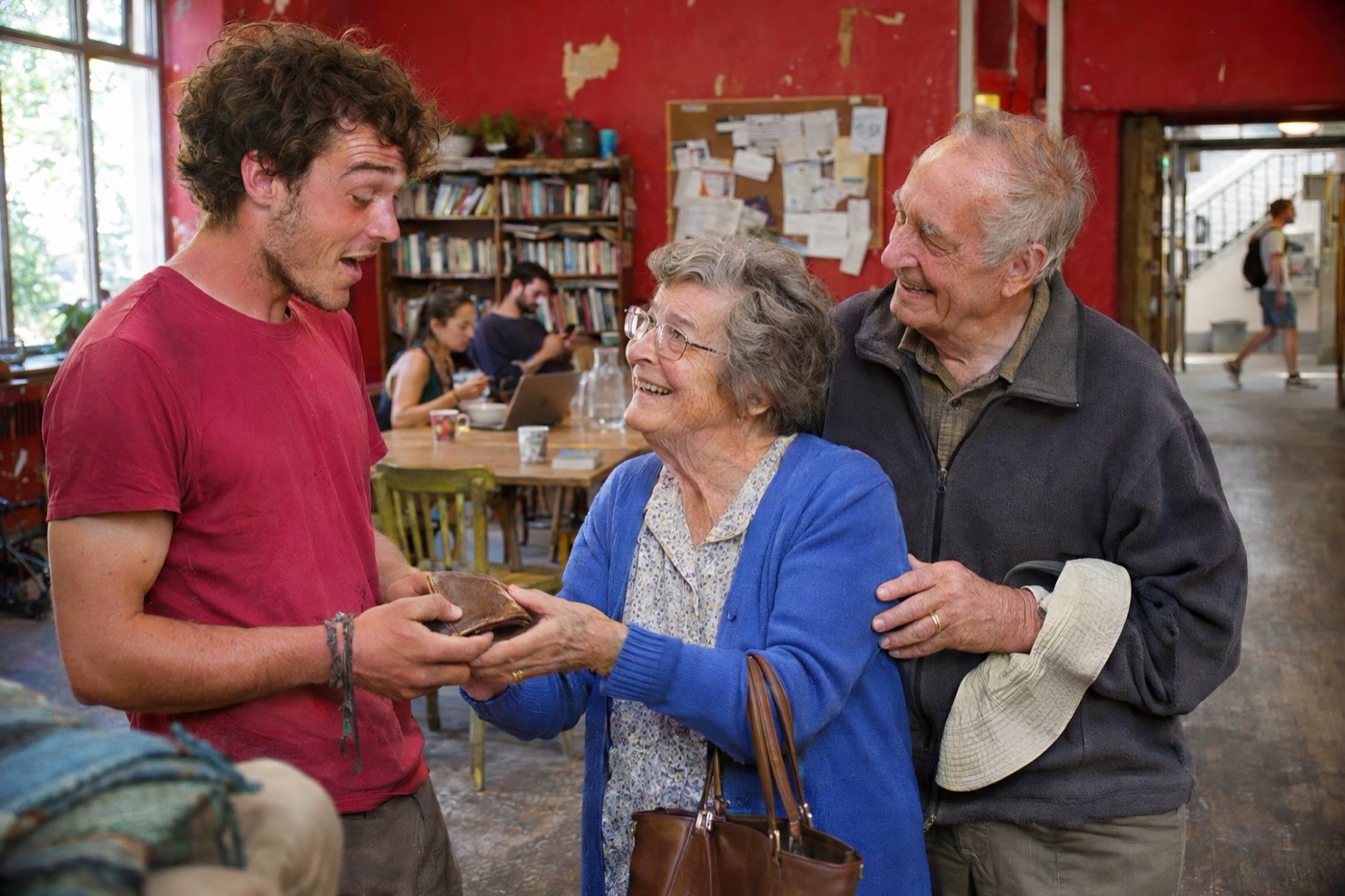
A backpacker lost a wallet holding a month's money in Darwin in 1989. Two strangers visited four hostels to give it back, then disappeared.
Before you read
1Warm up3 questions
Talk about these questions with a partner.
- Have you ever lost something important? What happened?
- Has a stranger ever helped you?
- Would you take the time to return a lost wallet?
2Key words8 words
These words are in the article. Choose the letter of the meaning for each one.
- wallet
- cash
- manager
- loudly
- properly
- chance
- asleep
- Athe person who runs a place
- Bin the right way
- Cmoney in notes and coins
- Dsleeping
- Ea small case for money and cards
- Fa small bag sewn into your clothes
- Gwith a lot of noise
- Ha time when you are able to do something
1Warm up3 questions
Talk about these questions with a partner.
- How would you try to return a wallet with no phone number in it?
- Do you think people are more or less honest than they were in 1989?
- What makes a small act of kindness stay in your memory?
2Key words8 words
These words are in the article. Choose the letter of the meaning for each one.
- unaware
- island-hop
- ruined
- elderly
- backpacker
- series
- knocking
- private
- Aold, said in a polite way
- Bthe sound of hitting a door
- Ca set of articles or programmes with the same idea
- Dtravel from one island to the next
- Ecompletely spoiled
- Fa traveller who carries a bag on their back
- Gnot knowing about something
- Hkept to yourself, not shared
1Warm up3 questions
Talk about these questions with a partner.
- Why are we so moved by help from people with nothing to gain?
- Can a debt of gratitude ever really be repaid?
- How much should we trust a memory recalled nearly forty years later?
2Key words8 words
These words are in the article. Choose the letter of the meaning for each one.
- punishing
- affection
- comprehension
- unaware
- compounding
- illustrate
- pretend
- lender
- Anot knowing about something
- Bextremely tiring or severe
- Ca feeling of warm liking
- Da person or bank that gives money and expects it back
- Ethe ability to understand
- Fgrowing bigger because it builds on itself
- Gto show clearly by giving an example
- Hto act as if something is true when it is not
Read
3Read the article
The paragraphs are numbered. Look out for the key words from task 2.
Core version
In 1989, Simon Kelsey was a young British man at the end of a year in Australia. He had finished university, flown out and spent ten months working long hours on building sites along the east coast. The work was hot and hard, but he loved it, and by the end he had saved enough money to travel slowly home.
It was his last night in Darwin, in the north of the country. He was out with a group of travelling friends, and the next morning they were all flying to Timor, hoping to move from island to island all the way to Singapore. In his pocket was a wallet with $1,000 in cash inside. In those days, people carried cash, and that money was enough to live on for a month.
At some point in the evening, the wallet fell out of his pocket. He did not notice. He went back to the hostel and went to bed.
At 1.30 in the morning, somebody knocked loudly on his door. Half asleep, he opened it. Outside stood the hostel manager and an elderly couple he had never seen before. The couple were holding his wallet.
They had found it and decided to return it. There was no phone number inside, only a student identity card with his name on it. So they had gone from one backpacker hostel to another, asking for him. His hostel was the fourth one they tried. Every single dollar was still inside the wallet.
Think about what that meant. It was the middle of the night. They were not young. They had no reason to believe they would ever find him, and nobody would have known if they had given up after the second hostel.
He was tired and had been drinking, so he thanked them and went back to bed. It was only the next morning, on the way to the airport, that he understood what they had done. Without them, he says, his whole trip would have been ruined. He never got the chance to thank them properly.
Instead, he made himself a promise. When somebody needs help and he can give it, he goes further than he has to. He does not ask for anything back. He just tells the person to pass it on to somebody else.
Intermediate version
Some acts of kindness are small enough to forget by the following week. Others stay with a person for nearly forty years. Simon Kelsey's story, told to the Guardian's Katie Cunningham as part of a reader series about the kindness of strangers, is firmly in the second category, and the details are what make it so.
In 1989, Kelsey had just finished university in the UK and gone travelling in Australia. He spent most of the year on the east coast, working long hours on building sites in the blistering sun, and by his own account he loved every minute of it. After ten months he had saved enough to begin making his way slowly home.
The plan began in Darwin. He and a group of travelling friends had one last night out before a flight to Timor, from where they intended to island-hop all the way to Singapore. Cash was king in those days, as he puts it, and the $1,000 in his wallet represented roughly a month on the road. Somewhere in the course of the evening, with the beers going down easily, the wallet fell out of his pocket. He noticed nothing, and went to bed still unaware.
At 1.30am there was loud knocking at his door. He stumbled out of bed and opened it to find the hostel manager standing beside an elderly couple he had never met. They were holding his wallet, and every dollar was still in it.
What they had done to get there is the part worth sitting with. The wallet contained no phone number, only a student ID card with his name. So the couple had worked their way around the backpacker places of Darwin, asking at each one, until they found the right hostel. It was the fourth they had tried, and by then it was the middle of the night.
Kelsey admits he did not rise to the occasion. Half asleep and the worse for the evening's drinks, he thanked them and went back to bed. Only the next morning did the scale of the effort become clear to him. Without the couple, he says, the trip he had worked ten months for would have been ruined.
He never learnt enough about them to thank them properly, and he has never stopped wishing he could. What he did instead was make a private pledge, to himself and in a sense to them, that he would always go the extra mile when he had the chance to help someone. When he does, he asks only that they pay it forward. He likes to think that the couple in Darwin have quietly helped a great many people they will never meet.
Advanced version
There is a particular arithmetic to a lost wallet. You calculate what was in it, what cannot be replaced, and how long it will take to recover. In Darwin in 1989, Simon Kelsey never had to do the sum, because the answer arrived at his door at half past one in the morning, carried by two people he had never met and would never see again.
The circumstances are ordinary enough. Kelsey had finished university in the UK and spent a year in Australia, most of it working long hours on east coast building sites in punishing heat, which he remembers with unmistakable affection. Ten months of that had bought him the means to travel slowly home. He was in Darwin for a final night out with the friends he would fly to Timor with the next morning, intending to island-hop to Singapore. Cash was king then, as he says, and the $1,000 in his wallet was about a month of freedom.
He lost it without noticing and went to bed unaware. The knocking woke him at 1.30am: the hostel manager, an elderly couple, and his wallet with every dollar inside.
The effort behind that moment is the thing the story turns on. There was no phone number to call. There was a student ID card with a name, which in a town full of backpacker hostels narrows nothing very much. So the couple went looking, hostel by hostel, in the middle of the night, and his was the fourth they tried. They could have left the wallet with a police station or a bar. They could, of course, have kept it. Instead they chose the most laborious route available and then, having completed it, went home.
Kelsey's own account is honest about his response, which is part of why it reads truthfully. Bleary and the worse for the evening, he thanked them and went back to sleep. Comprehension arrived with the morning, by which time they were gone and unthankable. Thirty-seven years later he still describes wishing he could have done it properly.
What he did instead is the quietly interesting part. Unable to repay the couple, he converted the debt into a standing policy: go further than strictly necessary when someone needs help, and ask the person to pay it forward rather than back. It is a sentimental idea that happens also to be a practical one, since a debt that cannot be settled with the lender can only be settled with everyone else.
A single recollection, published nearly four decades after the event, is not evidence about human nature, and nobody should pretend otherwise. It is one man's memory, offered to a newspaper series collecting such things. But it does illustrate something that is easy to lose sight of: the cost of the kindness fell entirely on the couple, and the benefit has been compounding ever since, in places they never heard about and to people they never met.
After you read
4True, false or not given5 statements
Choose T (true), F (false) or NG (the article does not say).
- Simon lost his wallet on his last night in Darwin.
The text says it was his last night in Darwin and the wallet fell out of his pocket in the evening.
- Some of the money was missing when the wallet came back.
The text says: "Every single dollar was still inside the wallet."
- The couple found Simon by asking at several hostels.
The text says his hostel was the fourth one they tried.
- The couple lived in Darwin.
Not stated. The text does not say where the couple were from.
- Simon thanked the couple properly the next morning.
The text says he never got the chance to thank them properly.
5Vocabulary5 gaps
Complete the sentences with words from the box. Two words are not needed.
believecoupleidentitynoticereasonruinedunderstood
- The rain our picnic, so we went home early.
- Did you the small mistake on the first page?
- Many children in ghosts until they are about ten.
- I the joke only after my friend explained it twice.
- At the airport, the officer asked to see my card.
6Verb forms5 gaps
Write the correct form of the verb in brackets.
- In 1989, Simon Kelsey a young British man at the end of a year in Australia. (BE)
- By the end of his year, he enough money to travel slowly home. (SAVE)
- Half asleep, he the door. (OPEN)
- They from one hostel to another before they found him. (GO)
- Today, when someone needs help, he further than he has to. (GO)
7Language focusphrasal verbs
Complete the sentences with words from the box. Two words are not needed. A phrasal verb is a verb plus a small word like up, on or out. The small word changes the meaning, so learn the two words together.
fellgivenknockedlookedpasstakenwent
- Yesterday my phone out of my pocket on the bus.
- We left the museum early and back to the hotel.
- Someone on the door at midnight, but nobody was home.
- He had almost up, but then he found the right address.
- Please read this and it on to your classmates.
4True, false or not given5 statements
Choose T (true), F (false) or NG (the article does not say).
- Kelsey was with friends on his last night out in Darwin.
The text says he and a group of travelling friends had one last night out.
- The couple found the right hostel on their first attempt.
The text says it was the fourth hostel they had tried.
- Kelsey reported the missing wallet to the police.
Not stated. The text says he noticed nothing and does not mention the police.
- The cash in the wallet would have lasted Kelsey about a month.
The text says the $1,000 "represented roughly a month on the road".
- Kelsey has been able to repay the couple directly.
The text says he never learnt enough about them to thank them and still wishes he could.
5Vocabulary6 gaps
Complete the sentences with words from the box. Two words are not needed.
admitscategorydeclineemphasisintendedoccasionrepresentedscale
- The missing money two weeks of his wages.
- Only after the flood did people see the true of the damage.
- She to stay for a week, but she ended up staying a month.
- Some films fit neatly into one , but others belong to several.
- My brother that he should have listened to the advice.
- The manager asked the team to rise to the during the busy week.
6Verb forms5 gaps
Write the correct form of the verb in brackets.
- By the time the couple reached his hostel, they three others. (VISIT)
- His wallet to him by two strangers. (RETURN)
- If he had known their names, he them. (THANK)
- The couple the wallet at the police station, but they did not. (LEAVE)
- While Kelsey , two strangers were going from hostel to hostel. (SLEEP)
7Language focusphrasal verbs
Complete the sentences with words from the box. Two words are not needed. Many phrasal verbs have a literal and a figurative meaning. Read the whole sentence, then ask what the verb and particle mean together.
alongawaybackdownonoutup
- The couple tracked the owner of the wallet by visiting every hostel in town.
- After the second hostel, many people would have given and gone home.
- It took him a moment to work who the strangers at the door were.
- He wanted to pay their kindness one day.
- Kelsey decided to carry the couple's habit of helping strangers.
4True, false or not given5 statements
Choose T (true), F (false) or NG (the article does not say).
- The writer implies that the couple could have chosen easier ways of returning the wallet.
The text says they could have left it with a police station or a bar but chose the "most laborious route".
- Kelsey grasped the full extent of the couple's effort as soon as he saw them.
The text says comprehension "arrived with the morning", after he had gone back to sleep.
- Kelsey has repeated this story in public talks.
Not stated. The text only mentions a newspaper series.
- The writer sees Kelsey's policy as both emotionally appealing and useful.
The text calls it "a sentimental idea that happens also to be a practical one".
- The writer believes the story shows that most people are generous.
The text says one recollection "is not evidence about human nature".
5Vocabulary6 gaps
Complete the sentences with words from the box. Two words are not needed.
bolsteredcircumstancesconvertedinclinationnarrowsrecollectionsettledstanding
- Given the of the case, the judge decided that a lighter sentence was justified.
- The disused warehouse was into a community centre.
- She struggled to give a clear of events that had happened thirty years earlier.
- A single photograph rarely down the list of suspects.
- Both parties finally the dispute out of court.
- The committee has a rule against accepting gifts from suppliers.
6Word forms5 gaps
Use the word in brackets to make a word that fits the gap.
- The judge praised the witness for her to speak openly under pressure. (WILLING)
- There was an note of relief in his voice when the wallet was returned. (MISTAKE)
- He never lost his to the strangers who had helped him. (GRATEFUL)
- Memory is notoriously after nearly forty years. (RELY)
- The couple's was all the more remarkable because nobody was watching. (GENEROUS)
7Language focusphrasal verbs
Complete the sentences with words from the box. Two words are not needed. Some phrasal verbs take an object after the particle (shrug off the guilt) and others do not (turn out well). Check the form and the particle before you choose.
backfellpassedshrugturnedwearwent
- Kelsey could not simply off the guilt of never having thanked them.
- The couple about their search methodically, hostel by hostel.
- The mix-up out well for Kelsey in the end.
- The generosity he received was on to strangers he later met.
- Anecdotes alone cannot up a broad claim about human nature.
Speak
8Talk about it3 questions
Discuss in pairs or small groups. Give reasons for your answers.
- Why do you think the couple did not simply leave the wallet with the police?
- What is the kindest thing a stranger has done for you?
- Is it better to thank someone, or to help somebody else instead?
8Talk about it3 questions
Discuss in pairs or small groups. Give reasons for your answers.
- Kelsey could not thank the couple. Does paying it forward make up for that?
- Why might we remember kindness from strangers more than kindness from friends?
- Would this story have ended differently with modern phones? How?
8Talk about it3 questions
Discuss in pairs or small groups. Give reasons for your answers.
- The couple chose the most laborious option available. What explains that?
- Is “pay it forward” a genuine moral principle or a comfortable one?
- One anecdote is not evidence. So what, if anything, does a story like this prove?
9Role-play: a wallet at one in the morning
Work in pairs. Read your card, then have the conversation. Swap roles and do it again.
Student A · the finder
You have found a wallet with cash and a student card. It is nearly midnight. You want to go and look for the owner tonight. Explain why it matters and ask your friend to come with you.
Student B · the friend
You are tired and want to go home. You think the wallet should go to the police in the morning. Give your reasons, ask questions, then agree on a plan.
Useful phrases
- I've just found a wallet on the pavement.
- I can't leave it until tomorrow.
- Wouldn't it be easier to take it to the police?
- What if we try the hostels first?
- I'm tired, but I'll come for one hour.
- Let's do it, and we'll feel better afterwards.
Afterwards, tell the class: what did you decide to do, and was it the right choice?
Your words
Highlights0 saved
Highlights0 saved
Highlights0 saved
Was this lesson useful? Support johnplusnews on Ko-fi
Continue reading
Language
Did Writing Really Make Languages More Complicated?
A large study of about 100,000 sentences in 30 languages found no universal pattern showing that writing makes sentences more complex. It does not say that writing never changes a language.
Relationships
Would You Sign a Contract Before Getting Married?
More young Americans are signing prenuptial agreements before their weddings. Is planning for a divorce unromantic, or is it honest and sensible?
Work
They Still Have Their Jobs. They Are Leaving Anyway
Nobody made these workers redundant. AI changed what their work felt like, and they walked out on careers they had spent a decade building.