News lesson4 October 2026
The Returned Jacket Nobody Wants
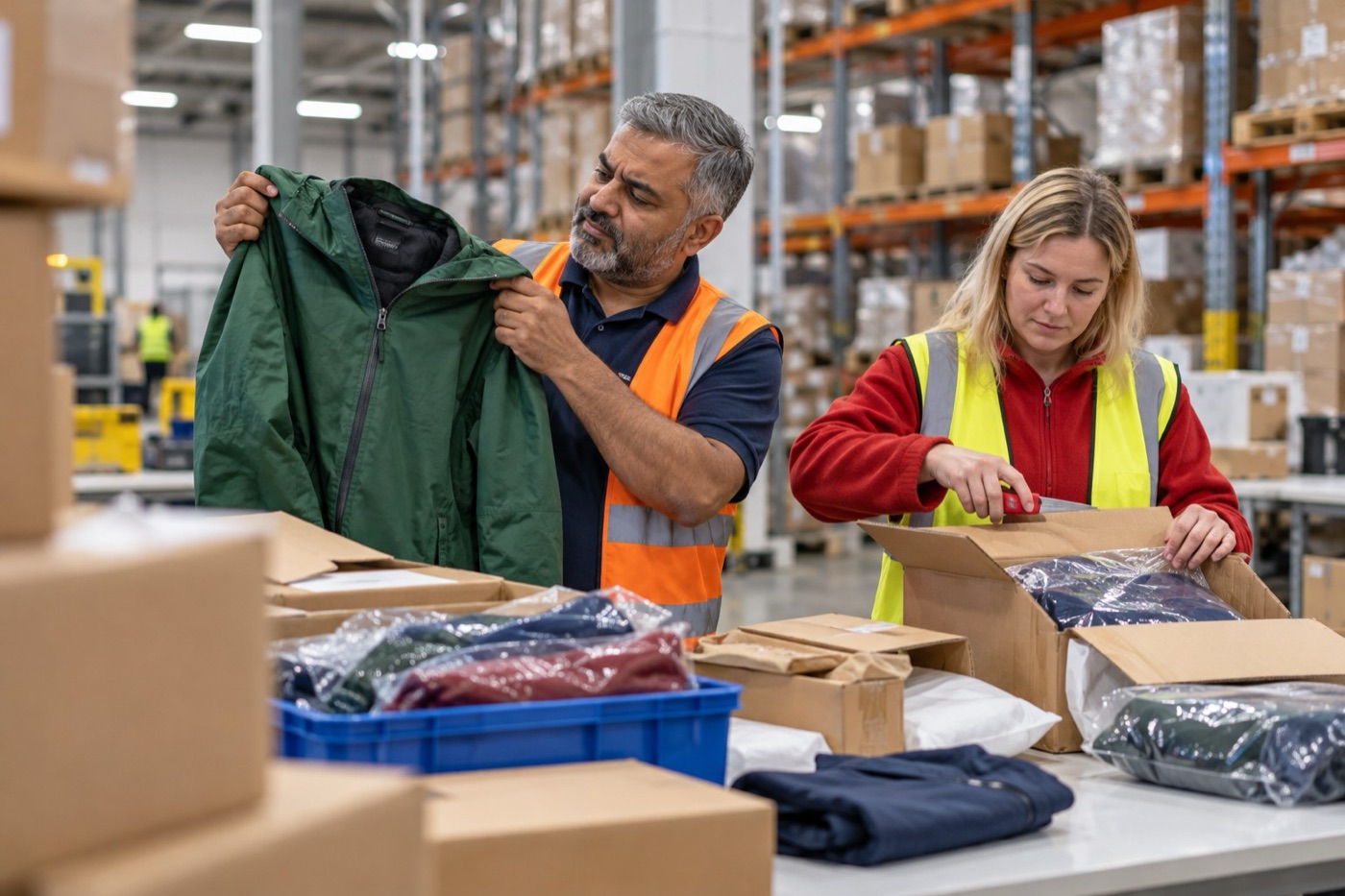
The label prints in seconds and the parcel leaves your life. Inside the retailer's warehouse, somebody still has to decide what that jacket is now worth.
Before you read
1Warm up3 questions
Talk about these questions with a partner.
- Would you order three sizes if returns were free?
- What makes you hesitate before buying clothes online?
- Would you pay a little more for a shop with a fitting room?
2Key words8 words
These words are in the article. Choose the letter of the meaning for each one.
- label
- parcel
- warehouse
- retailers
- refund
- fees
- pollution
- storage
- Amoney you must pay for a service
- Ba package that you send or receive by post
- Ckeeping things in a place until you need them
- Ddirty air, water or land caused by people
- Ea big building where goods are kept before they are sold
- Fpeople or companies that sell things to the public
- Gmoney that a shop gives back to you
- Ha piece of paper or card with information on it, stuck on a parcel
1Warm up3 questions
Talk about these questions with a partner.
- Would you order three sizes if returns were free?
- What makes you hesitate before buying clothes online?
- Would you pay a little more for a shop with a fitting room?
2Key words8 words
These words are in the article. Choose the letter of the meaning for each one.
- logistics
- stock
- destination
- impact
- cancellation
- postage
- accountant
- charges
- Aa person whose job is to manage and check money records
- Bthe money you pay to send something by post
- Cthe strong effect that something has
- Dthe act of stopping an order that you made
- Eamounts of money that you have to pay
- Fthe place where something is going
- Gthe goods that a shop has ready to sell
- Hthe work of moving and storing goods
1Warm up3 questions
Talk about these questions with a partner.
- Would you order three sizes if returns were free?
- What makes you hesitate before buying clothes online?
- Would you pay a little more for a shop with a fitting room?
2Key words8 words
These words are in the article. Choose the letter of the meaning for each one.
- merchandise
- disposal
- emissions
- tension
- loyalty
- obligations
- unofficial
- confrontational
- Anot formally recognised or planned
- Bthe habit of staying faithful to a shop or brand
- Cgases that are sent into the air
- Dthe act of getting rid of something
- Ea difficult situation where two needs pull against each other
- Fgoods that are bought and sold
- Gaggressive and likely to cause an argument
- Hthings that you must do by law or duty
Read
3Read the article
The paragraphs are numbered. Look out for the key words from task 2.
Core version
A jacket arrives at your door. It looked perfect online, but the sleeves are too long, so you put it back in the bag and print a free returns label. For you, the story is over. For the jacket, it has only just begun. A van collects it, a warehouse worker opens it and somebody must decide whether it can be sold again. "Free" describes what you pay at the post office, not what the return really costs.
Online returns are especially common with clothes because customers cannot try them on first. According to the US National Retail Federation, almost one in five online purchases was expected to be returned in 2025. Across online and physical shops, retailers expected goods worth nearly $850 billion to come back. That figure is the value of the products, not the cost of checking, storing and moving them.
When a parcel arrives back at a warehouse, workers may need to open it, inspect the product and decide whether it can be sold again. Transport and storage also cost money. Some items are damaged or out of season, so retailers struggle to sell them. Clothing returns can also produce extra packaging waste and pollution. If an item cannot be sold as new, the shop may have to lower its price or sell it on to another buyer.
To cut costs, some shops have introduced return fees or shorter deadlines. But customers dislike paying to send things back, especially when they cannot try clothes on before ordering them. Retailers must make a difficult choice: save money on returns or risk losing shoppers to another website. They also worry that extra charges might stop people shopping online altogether.
Customers also have legal rights. In the UK, people buying most goods online usually have 14 days after delivery to cancel their order, followed by another 14 days to send the goods back. Rules differ in other countries. They may have to pay return postage if the seller explained this clearly beforehand. A 2026 investigation by consumer organisation Which? found that several major retailers had not followed all the refund rules.
Better size guides, accurate photos and helpful reviews could prevent some unnecessary returns. Shoppers can help by checking sizes carefully instead of ordering several versions automatically. Free returns are convenient, but they are not truly free. The question is who should cover the cost without making online shopping unfair or too expensive.
Intermediate version
You try on three jackets, keep one and seal the other two in their original bags. A returns label appears in seconds, and the parcel disappears from your life. Inside the retailer's system, however, the unwanted jackets begin a difficult journey in the wrong direction. They must be collected, opened, inspected and given a new destination. Some return to stock. Others end up losing value with every mile.
This is no small side operation. The US National Retail Federation expected around 19% of online sales to be returned in 2025. It also expected goods worth nearly $850 billion to come back to American retailers across all types of shopping that year. That figure is the value of the goods, not the cost of processing them, but it shows the scale of the problem. For a fashion business, a returned product is not simply a sale that vanished; it is a fresh logistics job with no guarantee of a second customer.
Each item may need collecting, transporting, checking, cleaning, repackaging and putting back into stock. If it is damaged or out of season, selling it again may be difficult. Some products are reduced in price, sold through other businesses or discarded. Research supported by the British Fashion Council has highlighted the environmental impact of clothing returns, including extra transport, wasted materials and garments that cannot be resold. A generous returns policy therefore has consequences for both company profits and the planet.
Retailers have started responding with return charges, shorter deadlines and stricter conditions. From a business perspective, making customers pay a small fee can help claw back some costs. But there is a risk: people who cannot try products on before buying them may decide the shop is no longer worth the trouble. In an October 2026 Guardian business column, an accountant argued that sensible companies should plan for the normal cost of returns instead of treating them as a surprise.
There is also a legal difference between returning something because you have changed your mind and returning a faulty product. In Britain, most online shoppers have a fourteen-day cancellation period after delivery, with another fourteen days to return the goods. They may have to cover the return postage for unwanted items when properly informed, while the retailer must normally refund the standard original delivery charge. A September investigation by Which? found that some well-known shops failed to meet their refund obligations, even when customers were entitled to their money back.
The more useful solution may begin before the customer clicks Buy. Accurate measurements, photographs showing clothes on different body types and more dependable product descriptions could prevent unnecessary orders. Customers, meanwhile, can avoid ordering a pile of items with little intention of keeping them. Easy returns remain an important part of online shopping, but pretending they cost nothing helps nobody understand the trade-offs involved.
Advanced version
The customer's living room has become an unofficial fitting room. Several sizes arrive, one survives the inspection and the rest are sent back at the click of a button. The transaction feels almost risk-free because the returns label is free. Yet the unwanted garment must now travel backwards through a system built to move products towards customers. The item may lose value while the shop keeps paying for transport, staff and storage.
The scale is formidable. The US National Retail Federation estimated that 19.3% of online sales would be returned in 2025 and projected nearly $850 billion in returned merchandise across retail. That headline figure is the value of the goods, not the cost of processing them, but it explains why the journey after a return has become a central commercial concern rather than an occasional inconvenience.
What happens next is a journey in reverse: collecting goods, checking their condition, deciding whether they can be resold and directing them towards warehouses, discount outlets or disposal. The industry calls this reverse logistics. These activities absorb labour, transport capacity and storage space. A garment that arrives too late for its season may be worth little even if it remains unworn. Research commissioned by the British Fashion Council has linked fashion returns to substantial emissions and waste, while academic analysis of European returned clothing suggests that a significant share never reaches another consumer.
There is no straightforward commercial answer. Charging for returns can recover costs and discourage excessive ordering, but it may also put off buyers who reasonably want to check whether an unfamiliar brand fits. Retailers face a classic tension between short-term savings and long-term loyalty. A Guardian business commentary published in October argued that companies should treat the cost of returns as a predictable operating expense, rather than alienating customers with unexpected charges. That approach is not necessarily cheaper, but it may make commercial sense if an easy service encourages repeat purchases.
Consumer protection complicates the picture further. Under UK distance-selling rules, customers normally have fourteen days after delivery to cancel most online purchases without giving a reason and a further fourteen days to send the goods back. Retailers must generally refund the original standard delivery charge, although consumers can be required to cover the cost of returning unwanted goods when properly informed. Faulty items involve different rights. A September 2026 investigation by Which? found that several major retailers had failed to provide refunds in accordance with the law, demonstrating that the economics of returns cannot simply override statutory obligations.
The most promising improvements may be less confrontational. Better sizing information, accurate product images and more reliable descriptions could reduce the number of purchases that disappoint in the first place. More efficient sorting and resale systems could also preserve the value of goods that do come back, rather than writing off stock that is perfectly wearable. Yet the central contradiction remains: online retailers have encouraged consumers to behave as though their living rooms were fitting rooms with unlimited delivery. Winding back that expectation without damaging trust will require more than adding a charge at checkout.
After you read
4True, false or not given5 statements
Choose T (true), F (false) or NG (the article does not say).
- The writer says a free return costs the shop nothing.
The text says "Free" describes only what you pay at the post office, not the real cost.
- Customers return a lot of clothes bought online because they cannot try them on first.
The text says returns are common with clothes because customers cannot try them on first.
- Most people who return a jacket order the same one in a different size.
The text does not say what customers order after a return.
- Shops worry that extra charges might stop some people shopping online.
The text says they "worry that extra charges might stop people shopping online altogether".
- The $850 billion figure shows how much it costs shops to process returns.
The text says the figure is the value of the products, not the cost of checking, storing and moving them.
5Vocabulary5 gaps
Complete the sentences with words from the box. Two words are not needed.
cancelconvenientdamageddeadlinesinspectreliablestruggle
- The zip was when the parcel arrived, so I sent the jacket back.
- A worker must each item carefully to see if it can be sold again.
- Some shops now have shorter for sending goods back.
- Many small shops to compete with the big online sellers.
- Online shopping is because you can order from your sofa.
6Verb forms5 gaps
Write the correct form of the verb in brackets.
- Last week I a jacket that was too small. (BUY)
- She the parcel back to the shop on Monday. (SEND)
- If a jacket too long, I send it back. (BE)
- Yesterday the worker the box and checked the shirt. (OPEN)
- The jacket by a van and taken to the warehouse. (COLLECT)
7Language focuscollocations
Complete the sentences with words from the box. Two words are not needed. Some words go together naturally. Learn the pair, not just one word.
cutholdmakepackagingprintrightsrun
- Retailers must a difficult choice between saving money and keeping shoppers.
- To costs, some shops now charge for returns.
- Customers have legal when they buy goods online.
- You can a returns label from the shop's website.
- Clothing returns can produce extra waste.
4True, false or not given5 statements
Choose T (true), F (false) or NG (the article does not say).
- The $850 billion figure is what American retailers spend on processing returns.
The text says the figure is the value of the goods, not the cost of processing them.
- A small return fee might help a shop recover some costs but could also lose it customers.
The text says a fee can help "claw back some costs" but people may decide the shop is not worth the trouble.
- The accountant quoted in the Guardian column works for a clothing retailer.
The text only calls him an accountant and does not say who employs him.
- A British shopper who cancels on the last allowed day still has two more weeks to return the goods.
There are fourteen days to cancel, "with another fourteen days to return the goods".
- The text says a returned product is just a lost sale and creates no extra work for the retailer.
It calls a return "not simply a sale that vanished" but "a fresh logistics job".
5Vocabulary6 gaps
Complete the sentences with words from the box. Two words are not needed.
dependablediscardedentitledobligationsreducedrefundedreluctantscale
- Stock that is too damaged to repair is often and sent to landfill.
- Shoppers are to compensation if the goods arrive in poor condition.
- Companies that break consumer law may fail to meet their legal .
- Reviews written by real customers are a more guide to sizing than a shop's own photographs.
- The sheer of the operation surprised even experienced managers.
- Last season's coats have been in price to clear the shelves.
6Verb forms5 gaps
Write the correct form of the verb in brackets.
- By the time the parcel reached the depot, the season . (END)
- Each returned jacket by a member of staff before it goes back on sale. (INSPECT)
- If shoppers the real cost, they might order fewer items. (KNOW)
- The faulty jacket back to the supplier last week. (SEND)
- The retailer its returns policy twice since January. (CHANGE)
7Language focuscollocations
Complete the sentences with words from the box. Two words are not needed. Many verbs go with only a few nouns. Ask which verb a native speaker would choose.
chargecoverfaceliftrefundstrikewaive
- Retailers must a balance between low prices and happy customers.
- Shoppers may have to the return postage themselves.
- Some sellers customers a small fee to make them think before ordering.
- Companies that break the rules may serious criticism.
- Many shops offer a full if the product is faulty.
4True, false or not given5 statements
Choose T (true), F (false) or NG (the article does not say).
- The $850 billion figure tells us how much retailers lose on returns.
The text calls it "the value of the goods, not the cost of processing them".
- The 19.3% return rate and the $850 billion projection both relate to the same year.
Both are given for 2025 in the same sentence.
- A customer who cancels on day fourteen after delivery can still post the goods back.
Customers have a "further fourteen days to send the goods back" after cancelling.
- The Which? investigation found that retailers withheld refunds deliberately.
It found refunds were not provided in accordance with the law, but gives no reason.
- The writer is confident that treating returns as a predictable expense would cost less.
The text says: "That approach is not necessarily cheaper".
5Vocabulary6 gaps
Complete the sentences with words from the box. Two words are not needed.
absorbalienatingdwindleexcessivelenientoverridepreserveprojected
- Aggressive pricing risks loyal customers who have supported the brand for years.
- Analysts that profits would double within three years, though the company has not confirmed this.
- A company's own policy cannot simply the duty to inform customers of their rights.
- The scheme aims to the value of clothing that is still perfectly wearable.
- The company can a small rise in postage, but not a doubling of its costs.
- Critics argue that unlimited returns encourage ordering.
6Word forms5 gaps
Use the word in brackets to make a word that fits the gap.
- Customers who treat returns as a free service show little for the retailer's costs. (CONSIDER)
- The retailer's to refund customers on time led to a flood of complaints. (FAIL)
- Too many unwanted purchases make the business model in the long term. (SUSTAIN)
- Several analysts have criticised the of the new returns policy. (CONSISTENT)
- Better sizing information could bring about a reduction in returns. (SUBSTANCE)
7Language focuscollocations
Complete the sentences with words from the box. Two words are not needed. Verb and noun pairs at this level are often fixed. A close synonym will not work.
bearcastimposeplayreapstemwage
- Small independent sellers often the brunt of rising returns.
- Charging a fee may help to the tide of speculative orders.
- Regulators can a heavy fine on any shop that ignores the rules.
- Unpredictable demand can havoc with a retailer's stock planning.
- Companies that the benefits of free returns must also accept the costs.
Speak
8Talk about it3 questions
Discuss in pairs or small groups. Give reasons for your answers.
- Who should cover the cost when an online size guide is wrong?
- Would a small return fee change how carefully you choose?
- What would make online shopping easier without sending so many parcels back?
8Talk about it3 questions
Discuss in pairs or small groups. Give reasons for your answers.
- Who should cover the cost when an online size guide is wrong?
- Would a small return fee change how carefully you choose?
- What would make online shopping easier without sending so many parcels back?
8Talk about it3 questions
Discuss in pairs or small groups. Give reasons for your answers.
- Who should cover the cost when an online size guide is wrong?
- Would a small return fee change how carefully you choose?
- What would make online shopping easier without sending so many parcels back?
9Role-play: should the shop charge for returns?
Work in pairs. Read your card, then have the conversation. Swap roles and do it again.
Student A · the shop owner
You run a small clothes shop online. Too many parcels come back and you're losing money. You want to charge a fee for returns. Explain why, and listen to your customer.
Student B · the regular customer
You often order two sizes and send one back. You don't want to pay a fee. Say why returns matter to you and suggest another way to cut the number of parcels.
Useful phrases
- I'm afraid we can't afford free returns any more.
- I'd rather pay a small fee than lose the service.
- That's fair, but I can't try anything on first.
- What if we improved the size guide?
- I'd be happy to keep ordering if the fee stays low.
- Could we find a compromise?
Afterwards, tell the class: did you agree on a fee, and was it fair?
Your words
Highlights0 saved
Highlights0 saved
Highlights0 saved
Was this lesson useful? Support johnplusnews on Ko-fi
Continue reading
Business
Can One Video Game Be Worth More Than a Hollywood Blockbuster?
Grand Theft Auto VI launched on 19 November 2026, and its publisher says shoppers spent about US$3.79 billion on the first day. The figure is a company estimate, and comparing a game with a film is harder than it sounds.
Travel
What Happens When One of the World's Quietest Places Gets Easier to Visit?
Greenland now has three new airports and more visitors than ever, but tourism is still a small part of its economy. Some residents worry about what a rush of visitors could do to a quiet place with a fragile environment.
Technology
What Is It Like to Live Next to a Data Centre?
Britain is building data centres to power artificial intelligence. In Newport and Cardiff, the people living beside them are asking who benefits.