News lesson5 September 2026
Filming the People Who Do Not Want to Be Found
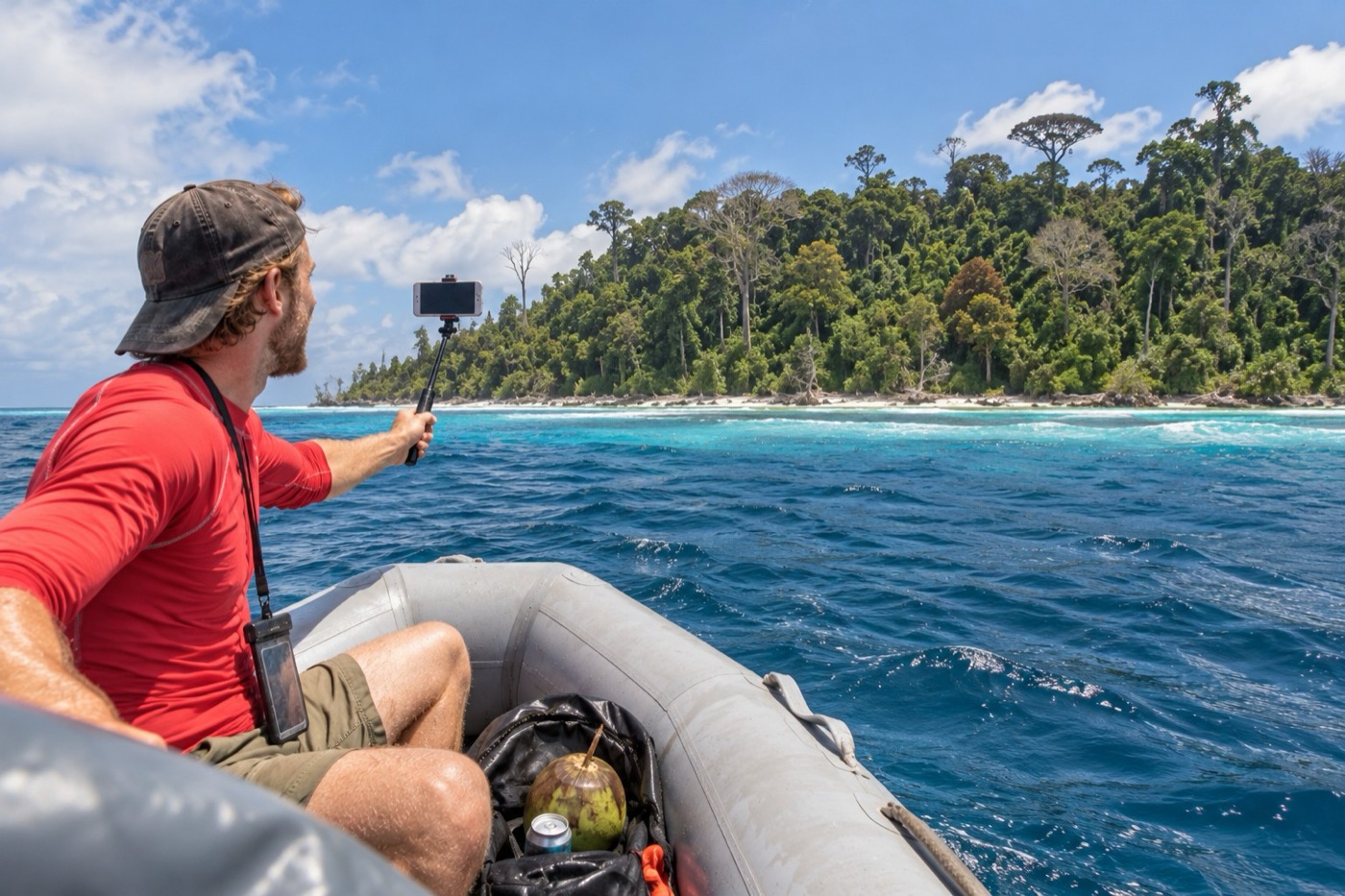
A traveller landed on a forbidden island with a camera and a can of Diet Coke. The risk he took was not only his own.
Before you read
1Warm up3 questions
Talk about these questions with a partner.
- Would you want strangers visiting your home because they had seen a video of it?
- Can a travel video show respect for a place?
- When does sharing a place online change it?
2Key words8 words
These words are in the article. Choose the letter of the meaning for each one.
- Indigenous
- community
- isolated
- uncontacted
- advertising
- creators
- respect
- outsiders
- Anot visited or spoken to by people from outside
- Bpeople who are not part of a group or place
- Cfar away from other people or places
- Dtreating someone with care because you think they matter
- Epeople who make videos to share online
- Fbelonging to the first people who lived in a place
- Ga group of people who live in the same place
- Htelling people about things they can buy
1Warm up3 questions
Talk about these questions with a partner.
- Would you want strangers visiting your home because they had seen a video of it?
- Can a travel video show respect for a place?
- When does sharing a place online change it?
2Key words8 words
These words are in the article. Choose the letter of the meaning for each one.
- archipelago
- inhabitants
- restricts
- encounter
- uncontacted
- consequences
- boundary
- revenue
- Athe people who live in a place
- Ba group of small islands
- Climits what people are allowed to do
- Dnot yet visited or spoken to by outsiders
- Ea meeting, especially one that you did not plan
- Fa line or limit that should not be crossed
- Gthe results of something, often bad ones
- Hmoney that a person or company earns
1Warm up3 questions
Talk about these questions with a partner.
- Would you want strangers visiting your home because they had seen a video of it?
- Can a travel video show respect for a place?
- When does sharing a place online change it?
2Key words8 words
These words are in the article. Choose the letter of the meaning for each one.
- archipelago
- unauthorised
- consistently
- scenery
- consent
- intrusion
- novelty
- agency
- Adone without official permission
- Bthe quality of being new and unusual
- Centering a place or situation where you are not wanted
- Din the same way every time
- Ea group of islands close together
- Fthe background of a place or story, seen but not really thought about
- Gpermission to do something, freely given
- Hthe ability to make your own choices and act on them
Read
3Read the article
The paragraphs are numbered. Look out for the key words from task 2.
Core version
In March 2025, an American traveller called Mykhailo Polyakov travelled by small boat towards North Sentinel Island in the Indian Ocean. He carried a camera and gifts, including a coconut and a can of Diet Coke. His plan was to visit and film a community that has very little contact with the outside world. The trip ended with his arrest by Indian police.
North Sentinel Island is home to the Sentinelese, an Indigenous community that has lived separately from most other people for generations. They do not welcome visitors, and Indian law keeps outsiders out. Outsiders are not allowed to travel there without permission. Polyakov reached the shore and tried to attract attention, but he did not come across any of the island's residents before leaving.
The main concern is not simply that someone broke a rule. Contact can be dangerous for isolated communities because they may have little protection against illnesses carried by visitors. Even an ordinary infection can have terrible results. There is also an important question of respect. The Sentinelese have made it clear that they do not want contact with strangers. They have the right to refuse visitors, and that choice should be respected.
Some social media creators want to make videos of places that other people cannot easily visit. Rare footage can pull in millions of views, new followers and advertising money. But an interesting video is not always a good reason to enter somebody else's home or community. Survival International, an organisation working for Indigenous rights, says that there are almost 200 uncontacted groups around the world, many living in remote forests. Uncontacted does not mean they know nothing about the outside world. Many have chosen to avoid contact.
Not every film about Indigenous people is harmful. Some communities choose to welcome visitors and work with filmmakers. In those cases, people can give permission and tell their own stories. North Sentinel Island is different because its inhabitants have refused contact. Technology makes it possible to travel further and film more than ever before, but it does not give people the right to go everywhere. Sometimes respecting others means accepting that they do not want to be seen.
Intermediate version
When American traveller Mykhailo Polyakov set off towards North Sentinel Island in March 2025, he took a small inflatable boat, a camera and several gifts, including a coconut and a can of Diet Coke. His aim was to reach one of the world's most isolated Indigenous communities and record his visit. He managed to land on the island, but did not meet any of its inhabitants. The trip ended with his arrest by Indian authorities.
The Sentinelese live on a small forested island in the Andaman archipelago and have repeatedly resisted contact with outsiders. Indian law restricts access to protect the community, whose members may be especially vulnerable to infectious diseases introduced by visitors. Polyakov attempted to attract attention before leaving, but the absence of any encounter does not make the visit harmless. It placed the island's inhabitants at risk without their agreement.
The incident forms part of a wider debate about the lengths some adventurers and content creators will go to for extraordinary footage. Remote locations offer an obvious attraction in an online world where familiar images are everywhere. A video that appears to show people living beyond modern civilisation may gain millions of views and attract followers or advertising revenue. But the search for something exclusive can make other people's privacy seem less important than a creator's ambition.
Survival International, an Indigenous rights organisation, estimates that 196 uncontacted groups exist worldwide. Many have chosen to keep away from outsiders after earlier experiences of violence, land loss or disease. Writing off such communities as unaware of the modern world can be misleading. In some cases, refusing contact is an informed decision about how to protect their people and way of life.
There is an important difference between filming a community that has agreed to welcome visitors and trying to reach one that has repeatedly rejected them. Some Indigenous groups work with documentary-makers, invite carefully managed tourism and use their own media to campaign for land rights. Such projects can give communities greater control over how their stories are told. Uninvited expeditions offer no similar choice, and visitors may underestimate the consequences of even a brief encounter.
Supporters of exploration sometimes argue that the public has an interest in learning about remote societies. Curiosity can certainly encourage understanding, but it does not automatically create a right to enter another community's territory. Polyakov's case highlights a difficult boundary in the age of social media. Cameras and boats can take people to places that once seemed unreachable. Respecting a community's wishes may require steering clear of the island and leaving the camera switched off.
Advanced version
The objects in Mykhailo Polyakov's boat were almost absurdly ordinary: a camera, a coconut and a can of Diet Coke. The destination was anything but. In March 2025, the American traveller headed for North Sentinel Island, home to an Indigenous community that has consistently rejected outside contact. He landed, attempted to draw attention and departed without encountering residents. Indian authorities subsequently arrested him. The episode raised a question the video could not answer: what right did an outsider have to arrive when the people living there had refused contact?
The Sentinelese inhabit a forested island in the Andaman archipelago, where legal restrictions are intended to prevent unauthorised visits. Those protections are not merely symbolic. Communities with little exposure to outside populations may be exceptionally vulnerable to infectious diseases, while past encounters with outsiders have demonstrated the potential for violence and exploitation. The fact that Polyakov apparently failed to meet anyone does not cancel out the risk created by his arrival; what matters is the contact that might have occurred, not merely the contact that did.
His expedition reflects a broader problem in the attention economy. The more elusive a place or community appears, the greater its potential value as online content. Creators increasingly zero in on the most isolated communities for exactly that reason. Images presented as unprecedented can draw in enormous audiences, converting novelty into advertising income and a public profile. In that calculation, Indigenous people risk becoming scenery in somebody else's account of adventure. What might be described as exploration from the visitor's perspective can look very different to those whose boundaries have been ignored.
Survival International estimates that 196 uncontacted groups remain worldwide, many in regions threatened by logging, mining or land encroachment. The label "uncontacted" should not be mistaken for ignorance or a lack of agency. Avoiding outsiders can be a deliberate response to historical experience, including disease, violence and dispossession. To present isolation as a mystery waiting to be solved is to deny communities the capacity to decide their own future, and to treat their refusal as an obstacle rather than an answer.
The distinction between consent and intrusion is essential. Indigenous groups that invite journalists or researchers can negotiate conditions, control access and decide how they are represented. Others choose to use digital media themselves to make political claims and document threats to their territory. Those partnerships differ fundamentally from an unsolicited approach to a population that has repeatedly rejected visitors. Public interest cannot be established merely by the fact that an image would attract attention.
The ethical challenge extends beyond one traveller. Satellite imagery, drones and affordable cameras have made remote places increasingly visible, tempting outsiders to equate technical access with moral permission. It is possible to learn about Indigenous rights, protect land and challenge environmental destruction without attempting direct contact with people who refuse it. The most responsible documentary decision may be one that produces no extraordinary footage at all. Curiosity is valuable, but only when it recognises that other people's right to be left alone is not ours to trade for a few million views.
After you read
4True, false or not given5 statements
Choose T (true), F (false) or NG (the article does not say).
- Survival International says there are almost 200 uncontacted groups.
The text says there are "almost 200 uncontacted groups around the world".
- Polyakov was later fined by an Indian court.
The text only says he was arrested; it does not mention a fine.
- He met and filmed several Sentinelese people.
The text says he "did not come across any of the island's residents".
- Polyakov was arrested by Indian police.
The text says: "The trip ended with his arrest by Indian police."
- The writer says that every film about Indigenous people is harmful.
The text says: "Not every film about Indigenous people is harmful."
5Vocabulary5 gaps
Complete the sentences with words from the box. Two words are not needed.
audiencefollowersfootageinfectionjourneypermissionprotection
- You must get written from the owner before you film inside a private building.
- A cold is a common that spreads easily between people.
- The police asked the journalist to delete the he had recorded.
- Warm clothes give good against the cold.
- Her new videos gained thousands of in a week.
6Verb forms5 gaps
Write the correct form of the verb in brackets.
- In March 2025, Mykhailo Polyakov by small boat towards the island. (TRAVEL)
- North Sentinel Island is home to a community that separately from most other people for generations. (LIVE)
- Outsiders are not to land on the island. (ALLOW)
- Yesterday I an article about remote communities and then told my sister. (READ)
- Some communities choose visitors and work with filmmakers. (WELCOME)
7Language focusprepositions
Complete the sentences with words from the box. Two words are not needed. Some verbs and adjectives always take one small word after them. Learn the pair together, for example 'different from'.
atbyfrominofonto
- Many creators travel boat to reach places that are hard to visit.
- The film was recorded the middle of the night.
- Many isolated communities live far big towns.
- Strangers can be dangerous a small community.
- Some visitors are not aware the risks they bring.
4True, false or not given5 statements
Choose T (true), F (false) or NG (the article does not say).
- The writer says that the lack of an encounter means no harm was done.
The text says "the absence of any encounter does not make the visit harmless".
- Polyakov posted footage of his trip online.
The text says he wanted to record his visit but not whether he posted it.
- Some uncontacted groups avoid outsiders because of things that happened to them in the past.
Many "have chosen to keep away from outsiders after earlier experiences of violence, land loss or disease".
- According to the text, Indigenous groups that work with filmmakers lose control of their stories.
Such projects "can give communities greater control over how their stories are told".
- The writer treats a visit by invitation differently from an uninvited expedition.
The text sees "an important difference" between a community that welcomes visitors and one that has rejected them.
5Vocabulary6 gaps
Complete the sentences with words from the box. Two words are not needed.
briefexclusiveextraordinarygradualgratefulharmlessinformedvulnerable
- Very old and very young patients are often more to the effects of extreme heat.
- The old dog looked frightening, but it was completely .
- The club is so that only invited guests can ever join.
- Her calm courage during the storm was truly .
- Having read the contract carefully, she gave her consent.
- He kept the call , as he was late for work.
6Verb forms5 gaps
Write the correct form of the verb in brackets.
- By the time the police arrived, the traveller the shore. (LEAVE)
- Visits to the island by Indian law for many years. (CONTROL)
- If the video had not gone viral, nobody of the trip. (HEAR)
- A tourist the sunset when his phone battery died. (FILM)
- Respecting a community's wishes means away from its land. (STAY)
7Language focusprepositions
Complete the sentences with words from the box. Two words are not needed. Verbs, adjectives and nouns often need one fixed preposition. Learn them as a pair, such as 'result in'.
atforfrominofonto
- Creators are responsible the effects of their videos.
- The views of the campaigners differ those of the adventurers.
- Even a short visit could result serious illness.
- Careless filming can put local people risk.
- Some creators insist filming whatever they like.
4True, false or not given5 statements
Choose T (true), F (false) or NG (the article does not say).
- The writer suggests that an unsuccessful landing could still have been harmful.
Failing to meet anyone "does not cancel out the risk created by his arrival".
- The writer thinks groups that avoid outsiders probably do so because they know nothing about the wider world.
Avoiding outsiders "can be a deliberate response to historical experience".
- Polyakov had arranged to sell his recordings.
The text says nothing about any plan to sell his footage.
- The writer distinguishes between groups that invite journalists and groups approached without an invitation.
The first kind of partnership "differ fundamentally from an unsolicited approach".
- The writer thinks easy technical access to remote places makes visiting them more acceptable.
The text calls it a temptation to "equate technical access with moral permission".
5Vocabulary6 gaps
Complete the sentences with words from the box. Two words are not needed.
convertingdocumentequateexceedinhabitnegotiatereflectingtempting
- It is a mistake to popularity with quality, since the most-watched programmes are not always the best.
- The two sides sat down to over pay, but neither would move.
- Only a few hundred people the remote valley, and most of them are farmers.
- Photographers have worked for decades to the effects of deforestation on rural families.
- Clever marketing is good at a passing curiosity into a long-term habit.
- The low price kept shoppers into buying things they did not need.
6Word forms5 gaps
Use the word in brackets to make a word that fits the gap.
- Wildlife officers described the sudden loss of habitat as an crisis. (PRECEDENT)
- The rare bird is notoriously , and few photographers have ever captured it. (ELUDE)
- Campaigners say the of cheap labour in the industry must stop. (EXPLOIT)
- Farmers complained about the steady of building on protected farmland. (ENCROACH)
- Entire families suffered when the government seized the land. (DISPOSSESS)
7Language focusprepositions
Complete the sentences with words from the box. Two words are not needed. Some formal adjectives and nouns take one fixed preposition. Learn the whole phrase, such as 'contingent on', not the adjective alone.
atforinofontowith
- Entering the territory of a community that has refused contact is tantamount ignoring its right to decide.
- Any approach to isolated groups is fraught danger for the people who live there.
- The success of such a project is contingent the community's genuine consent.
- The creators filmed the village in defiance the explicit wishes of its elders.
- Viewers who share such videos may become complicit the damage.
Speak
8Talk about it3 questions
Discuss in pairs or small groups. Give reasons for your answers.
- Who should decide whether a small community welcomes visitors?
- Does asking one person's permission make it fair to film everyone?
- What should a creator leave out even if it would get more views?
8Talk about it3 questions
Discuss in pairs or small groups. Give reasons for your answers.
- Who should decide whether a small community welcomes visitors?
- Does asking one person's permission make it fair to film everyone?
- What should a creator leave out even if it would get more views?
8Talk about it3 questions
Discuss in pairs or small groups. Give reasons for your answers.
- Who should decide whether a small community welcomes visitors?
- Does asking one person's permission make it fair to film everyone?
- What should a creator leave out even if it would get more views?
9Role-play: should we share this video?
Work in pairs. Read your card, then have the conversation. Swap roles and do it again.
Student A · the friend who found the video
You found a video online of a visit to a remote community that does not want visitors. You think it is interesting and want to share it. Explain why, and listen to your friend's worries.
Student B · the friend who is not sure
You think the video may not be respectful. Ask where it came from and who agreed to it. Say what you would prefer to share instead. Try to agree on a decision.
Useful phrases
- I'm not sure we should share this.
- I can see why it's interesting, but they didn't ask to be filmed.
- What if the community doesn't want to be seen?
- I'd rather check the source first.
- We could share an article about their rights instead.
- Let's agree to disagree.
Afterwards, tell the class: did you share the video, and what was your main reason?
Your words
Highlights0 saved
Highlights0 saved
Highlights0 saved
Was this lesson useful? Support johnplusnews on Ko-fi
Continue reading
Language
Did Writing Really Make Languages More Complicated?
A large study of about 100,000 sentences in 30 languages found no universal pattern showing that writing makes sentences more complex. It does not say that writing never changes a language.
Technology
Can You Be Emotionally Close to Someone Who Is Not Human?
A survey of 463 adults in the United States found that people in relationships with AI chatbots can feel as emotionally close as other couples, but the link between closeness and loneliness looked different.
Relationships
Would You Sign a Contract Before Getting Married?
More young Americans are signing prenuptial agreements before their weddings. Is planning for a divorce unromantic, or is it honest and sensible?