News lesson7 October 2026
A Library Card for the Great Outdoors
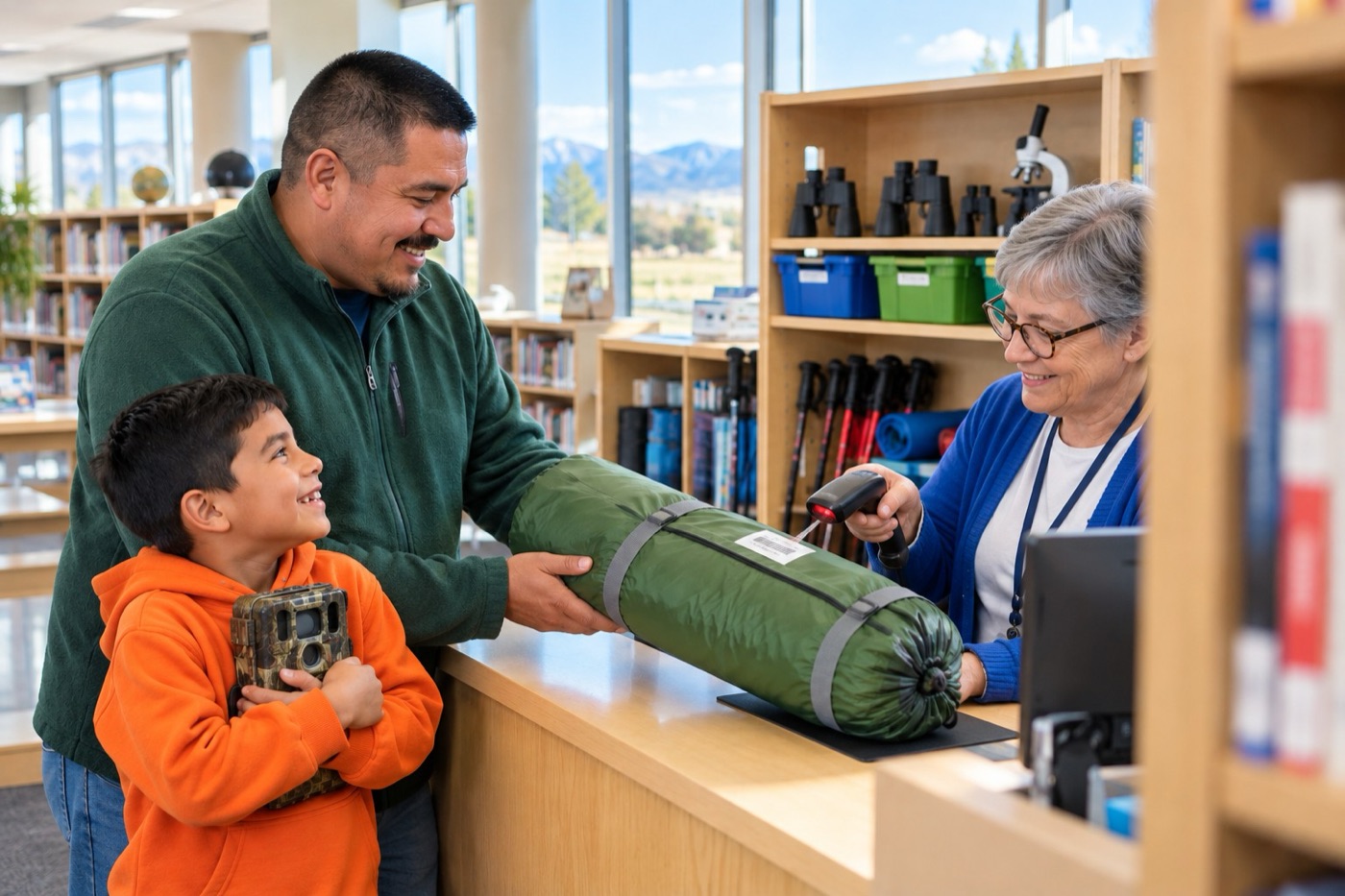
A tent, a wildlife camera, a telescope. A Colorado library has decided that outdoor equipment can be lent out like any other resource.
Before you read
1Warm up3 questions
Talk about these questions with a partner.
- What would you borrow if a library lent more than books?
- Would you try a new hobby if you could borrow all the equipment?
- Which thing do people buy and hardly ever use?
2Key words8 words
These words are in the article. Choose the letter of the meaning for each one.
- equipment
- borrow
- binoculars
- stargazing
- insects
- attract
- director
- confidence
- Athe feeling that you can do something well
- Bthe person who is in charge of a place
- Cvery small animals with six legs, like ants and bees
- Dlooking at the stars in the night sky
- Etwo small tubes that make faraway things look close
- Ftake something for a short time and then give it back
- Gmake someone or something come closer
- Hthe things you need to do an activity
1Warm up3 questions
Talk about these questions with a partner.
- What would you borrow if a library lent more than books?
- Would you try a new hobby if you could borrow all the equipment?
- Which thing do people buy and hardly ever use?
2Key words8 words
These words are in the article. Choose the letter of the meaning for each one.
- afford
- institution
- landscape
- pollinators
- expedition
- curiosity
- neighbourhood
- traditionally
- Ainsects that carry pollen from one flower to another
- Bhave enough money to pay for something
- Ca long, organised trip to a faraway place
- Da strong wish to learn about something
- Ea large, important organisation, like a library or a school
- Fthe area around where you live
- Gin the way things have been done for a long time
- Heverything you can see in an area of land
1Warm up3 questions
Talk about these questions with a partner.
- What would you borrow if a library lent more than books?
- Would you try a new hobby if you could borrow all the equipment?
- Which thing do people buy and hardly ever use?
2Key words8 words
These words are in the article. Choose the letter of the meaning for each one.
- conservation
- pollinators
- drought-resistant
- naturalist
- stakes
- psychological
- residents
- extension
- Aconnected with the mind and feelings
- Bthe people who live in a place
- Cable to live through long periods without rain
- Dinsects that carry pollen from one flower to another
- Ea person who studies plants and animals
- Fwhat you might gain or lose if something goes wrong
- Gthe protection of nature and wild places
- Hsomething added to make a thing bigger or longer
Read
3Read the article
The paragraphs are numbered. Look out for the key words from task 2.
Core version
Between the books at a new library in Colorado, you can find a tent, binoculars and a camera for watching wildlife. You do not need to buy them. A library card is enough. The Anythink Nature Library opened in August 2026. People can try camping, birdwatching or stargazing without buying all the equipment first.
The library is in Thornton, near Denver. It has thousands of books and around 850 sets of equipment that visitors can borrow and bring back. Some contain tools for watching birds or studying insects. Others help people go hiking, look at stars or try camping. The thinking behind this is straightforward: if you want to learn about nature, you should not have to buy everything before getting started.
The building itself is part of the experience. It stands beside open land and has gardens, paths and places for children to explore. There are rocks to climb, areas where children can play in mud and plants that attract birds and insects. The library also uses solar panels and an energy-efficient heating and cooling system. Staff organise activities to help visitors pick up new skills.
Families who visited soon after it opened described how useful the service was. One mother borrowed a camera that helped her young son photograph insects and flowers during a walk. Another family borrowed books about birds and planned to try a kit for looking at stars. Some visitors said that camping equipment would normally be too expensive to buy for a single weekend.
The library's director, Mark Fink, believes that people do not need to travel far into the mountains to enjoy nature. A local garden, a bird outside the window or a short walk can be interesting too. For children growing up in cities, having the chance to touch plants, climb rocks and explore outside may be especially valuable.
The nature library is still a public library, so people can read, study and borrow ordinary books. What makes it different is the idea that learning can happen outside as well as inside a building. A tent, a camera or a pair of binoculars might encourage somebody to try something new. Perhaps the library's most useful gift is not the equipment itself, but the confidence to go outdoors and discover what is there.
Intermediate version
A visitor walks into a Colorado library and leaves with a tent. Another borrows a wildlife camera; a family takes home equipment for looking at stars. At the Anythink Nature Library, which opened in Thornton in August 2026, these objects are not unusual extras. They express the institution's main idea: people should be able to experience nature before deciding whether they can afford the equipment.
The idea is particularly attractive to families who would like to try camping or birdwatching but cannot justify splashing out on expensive equipment. Alongside its large book collection, the library offers about 850 sets of nature-related equipment, including microscopes, gardening tools, hiking supplies and cameras. Visitors can borrow a kit, learn how to use it and decide whether the activity interests them before spending any money of their own.
The building stands on a 15-acre site next to a much larger area of open land. There are walking paths, gardens designed for different plants and animals, and places where children can climb on rocks or play in mud. The library also uses solar panels and geothermal heating and cooling. The building sits within the landscape it invites people to explore.
Early visitors have already described the benefits. One family borrowed an outdoor camera and a navigation device before taking their seven-year-old son on a hike. Another borrowed a gardening kit to set up a space that would attract bees and other pollinators. For people unfamiliar with camping or wildlife, access to the right equipment can make an unfamiliar activity feel far less intimidating.
There is a wider social argument behind the project. Outdoor activities can involve costs that are easy to overlook: transport, suitable clothing, specialist tools and time away from work. Those barriers mean that green spaces, even when they are technically open to everyone, may not feel equally accessible. The library's director, Mark Fink, argues that experiencing nature need not involve an ambitious expedition. Noticing birds in a local neighbourhood can be a meaningful starting point.
The project also asks us to think again about what a public library is for. Libraries have traditionally provided shared access to things individuals might not be able to afford, especially books and information. Lending outdoor equipment follows the same principle, only with a wider understanding of learning. A visitor might leave with a novel, a tent or a new interest in the natural world. The point is that curiosity should not depend on the size of someone's bank account.
Advanced version
On the shelves of a new Colorado library, you can borrow a tent, a wildlife camera or equipment for looking at the stars. Borrowing means someone can try camping, birdwatching or stargazing without buying anything first. The Anythink Nature Library, opened in Thornton in August 2026, extends the library's traditional promise beyond books and information.
Alongside a conventional collection of tens of thousands of items, the library provides approximately 850 nature-focused equipment kits. The building stands on a 15-acre site next to open land, with gardens, walking trails and spaces designed for practical exploration. Children can scramble over boulders or play in mud, while adults can learn about drought-resistant gardening, wildlife photography or stargazing. Solar panels and a geothermal heating and cooling system reinforce the environmental purpose of a public building that treats the outdoors as an extension of its reading rooms.
The strongest argument for the project emerges in the experiences of its visitors. One mother borrowed an outdoor camera and navigation equipment, allowing her young son to explore and photograph insects and flowers. Another family used gardening materials to plan a garden more welcoming to pollinators. Parents who felt intimidated by camping described how borrowing equipment lowered the financial and psychological stakes of trying something new. The library does not promise to turn every visitor into an accomplished naturalist. It offers a manageable first encounter with activities that might otherwise remain out of reach.
That distinction matters. Access to public green space is often discussed as though the presence of a park or trail were sufficient. In practice, enjoying the outdoors can require money, transport, time, appropriate clothing and a sense of belonging. Families working long hours, older people with limited mobility and city residents unfamiliar with rural environments may come up against very different obstacles. Anythink's director, Mark Fink, has emphasised that nature need not be synonymous with remote mountains or lengthy camping trips. It can begin with learning the names of birds visiting a garden.
There is an environmental argument, too, although it deserves a little caution. Direct experience of wildlife may encourage people to value conservation more deeply, and borrowing shared equipment can cut down on individual purchases. Yet the relationship between environmental knowledge and behaviour is not automatic. Owning fewer objects is useful only if the lending system is accessible, maintained and well used. The library's success will depend not merely on an impressive building and an inventive catalogue, but on whether residents continue to return and discover practical value in the service.
At a time when public libraries are frequently required to justify their existence, the Colorado experiment offers a more expansive definition of what they provide. Its central innovation is not the tent itself but the removal of a threshold. A person can try camping without buying equipment, learn to recognise local birds without first becoming an expert, or explore a garden without owning one. The institution remains recognisably a library: a place where resources are shared so that opportunities need not belong exclusively to those who can afford them.
After you read
4True, false or not given5 statements
Choose T (true), F (false) or NG (the article does not say).
- The Anythink Nature Library is just outside Denver.
The text says: "The library is in Thornton, near Denver."
- The library has solar panels.
The text says: "The library also uses solar panels and an energy-efficient heating and cooling system."
- Other American states plan to copy the idea.
Not stated. The text does not say whether other states plan to copy the idea.
- Visitors must pay to borrow the nature equipment.
The text says the opposite: "You do not need to buy them. A library card is enough."
- Mark Fink says people must travel far into the mountains to enjoy nature.
The text says the opposite: people "do not need to travel far into the mountains to enjoy nature."
5Vocabulary5 gaps
Complete the sentences with words from the box. Two words are not needed.
containdescribedencourageexploreorganisestraightforwardvaluable
- A good teacher will you to try new things.
- Old family photographs are very to the people who keep them.
- Several visitors the new library as friendly and bright.
- The box may a torch, a map and some food.
- The instructions were , so everyone put the tent up in minutes.
6Verb forms5 gaps
Write the correct form of the verb in brackets.
- The Anythink Nature Library in August 2026. (OPEN)
- Visitors the equipment back after a week. (BRING)
- The building beside open land and has gardens and paths. (STAND)
- For children up in cities, exploring outside may be valuable. (GROW)
- One mother borrowed a camera that her young son photograph insects and flowers. (HELP)
7Language focuslinking words
Complete the sentences with words from the box. Two words are not needed. Look at the idea before and after the gap. Does the second idea give a result, a condition, a contrast or extra emphasis?
becausebutespeciallyifsounlesswithout
- Camping equipment is expensive, many families borrow it instead.
- you want to learn about nature, you should not have to buy everything first.
- The tent was cheap to borrow, the walk to the campsite was long.
- Nature is good for everyone, for children who live in cities.
- You can try camping buying a tent.
4True, false or not given5 statements
Choose T (true), F (false) or NG (the article does not say).
- The library is built on land that has a much bigger open area beside it.
The text says: "The building stands on a 15-acre site next to a much larger area of open land."
- The equipment is funded by a local outdoor retailer.
Not stated. The text does not say who paid for the equipment.
- The library no longer lends ordinary books.
The text says the opposite: "Alongside its large book collection, the library offers about 850 sets of nature-related equipment, including microscopes, gardening tools, hiking supplies and cameras."
- Mark Fink argues that people must go on an ambitious expedition to experience nature.
The text says he argues that experiencing nature "need not involve an ambitious expedition."
- Families can find out whether they enjoy an activity without spending their own money.
Visitors can borrow a kit and "decide whether the activity interests them before spending any money of their own."
5Vocabulary6 gaps
Complete the sentences with words from the box. Two words are not needed.
affordablebarriersintimidatingjustifyoverlookprinciplereluctantunfamiliar
- Speaking in front of two hundred people can feel for a first-time presenter.
- Many households cannot paying a high price for equipment they will use only once.
- High prices and long journeys are that keep some families away from the countryside.
- It is easy to small details when you are in a hurry.
- Visitors who are with camping often need advice.
- The scheme works on the same as a book library: shared resources for everyone.
6Verb forms5 gaps
Write the correct form of the verb in brackets.
- By the time Mia reached the campsite, the rain . (STOP)
- The gardens at the library for different plants and animals. (DESIGN)
- Visitors a kit and try it before spending any money. (BORROW)
- The Anythink Nature Library in Thornton in August 2026. (OPEN)
- Early visitors the benefits already. (DESCRIBE)
7Language focuslinking words
Complete the sentences with words from the box. Two words are not needed. Decide the relationship first: contrast, condition or result. Then check whether a clause or a noun follows the gap, and whether the word can start a new sentence.
althoughdespitehowevermeanwhileotherwisethereforeunless
- the library is new, it already attracts many families.
- the high cost of tents, many families still want to go camping.
- A hobby will not become a habit people can try it cheaply first.
- The equipment is free to borrow. , visitors must return it on time.
- A lending scheme removes the cost; , more people can try new hobbies.
4True, false or not given5 statements
Choose T (true), F (false) or NG (the article does not say).
- The writer implies that having a park nearby does not guarantee everyone can enjoy the outdoors.
Access is often discussed "as though the presence of a park or trail were sufficient. In practice," enjoying the outdoors can require money, transport and time.
- The writer is certain that lending equipment will reduce what individuals buy.
The text says borrowing "can cut down on individual purchases" but owning fewer objects is useful "only if" the system is accessible, maintained and well used.
- Local residents have criticised the library's opening hours.
Not stated. The text never mentions opening hours or any criticism.
- The library's long-term success partly depends on people coming back to use it.
Success depends on "whether residents continue to return and discover practical value in the service."
- The writer regards the tent itself as the library's greatest innovation.
The text says the central innovation "is not the tent itself but the removal of a threshold."
5Vocabulary6 gaps
Complete the sentences with words from the box. Two words are not needed.
accomplishedexpansiveintimidatedreinforcereluctantscramblesynonymousthreshold
- The new policy was meant to the message that public services belong to everyone.
- Luxury is not always with comfort.
- Removing the application fee lowered the for first-time applicants.
- Many first-time hikers feel by the sheer amount of gear on offer.
- Hikers had to up the loose slope on hands and knees.
- The museum took an view of its role, hosting concerts, classes and markets.
6Word forms5 gaps
Use the word in brackets to make a word that fits the gap.
- The long-term of the scheme depends on community support. (SUSTAIN)
- Knowledge of wildlife can seem to people who are struggling to pay the rent. (RELEVANT)
- Public spaces are only valuable if their is real, not just formal. (ACCESS)
- A lending scheme succeeds only if borrowers return items . (RELY)
- Careful of the equipment keeps the scheme affordable. (MAINTAIN)
7Language focuslinking words
Complete the sentences with words from the box. Two words are not needed. At this level, check the logic first. Some words take a noun phrase, some a clause, and some start a new sentence. Is the link concessive, conditional or contrastive?
albeitlestnonethelessnotwithstandingprovidedtherebywhereas
- the occasional damaged item, lending schemes of this kind tend to run smoothly.
- The first month was a modest success, one that surprised the sceptics.
- Wealthier households can simply buy a tent, others must weigh every purchase.
- A lending scheme can widen access, it is properly maintained and well publicised.
- The scheme cannot guarantee a lasting love of nature. , it removes a real obstacle.
Speak
8Talk about it3 questions
Discuss in pairs or small groups. Give reasons for your answers.
- What should every neighbourhood be able to borrow?
- Would you lend something you loved to a stranger through a library?
- What would turn a library into a place you wanted to spend time?
8Talk about it3 questions
Discuss in pairs or small groups. Give reasons for your answers.
- What should every neighbourhood be able to borrow?
- Would you lend something you loved to a stranger through a library?
- What would turn a library into a place you wanted to spend time?
8Talk about it3 questions
Discuss in pairs or small groups. Give reasons for your answers.
- What should every neighbourhood be able to borrow?
- Would you lend something you loved to a stranger through a library?
- What would turn a library into a place you wanted to spend time?
9Role-play: borrow it or buy it?
Work in pairs. Read your card, then have the conversation. Swap roles and do it again.
Student A · the friend who wants to buy
You want to go camping next weekend. You plan to buy a tent. Explain why owning one feels better, and ask your friend about any problems with borrowing.
Student B · the friend who suggests borrowing
You know a library where you can borrow a tent. Persuade your friend to try borrowing first. Answer their worries and say what you'd do together.
Useful phrases
- I was thinking of buying a tent.
- Why don't we borrow one first?
- What if it's already taken?
- That's a fair point, but it's cheaper.
- I'd rather try it before I spend money.
- Okay, let's give it a go.
Afterwards, tell the class: did your friend decide to borrow or to buy, and why?
Your words
Highlights0 saved
Highlights0 saved
Highlights0 saved
Was this lesson useful? Support johnplusnews on Ko-fi
Continue reading
Language
Did Writing Really Make Languages More Complicated?
A large study of about 100,000 sentences in 30 languages found no universal pattern showing that writing makes sentences more complex. It does not say that writing never changes a language.
Relationships
Would You Sign a Contract Before Getting Married?
More young Americans are signing prenuptial agreements before their weddings. Is planning for a divorce unromantic, or is it honest and sensible?
Work
They Still Have Their Jobs. They Are Leaving Anyway
Nobody made these workers redundant. AI changed what their work felt like, and they walked out on careers they had spent a decade building.