News lessonOctober 2026
The Restaurants Asking Families to Put Their Phones Away
Fifteen Sardinian restaurants are trying a new approach to family meals: fewer screens, more games and, they hope, more conversation.
Before you read
1Warm up3 questions
Talk about these questions with a partner.
- What makes a meal with other people enjoyable?
- Is it rude to look at your phone while you are eating with someone?
- Would you like a phone-free dinner, or would it annoy you?
2Key words8 words
These words are in the article. Choose the letter of the meaning for each one.
- ombudsman
- leaflet
- reunion
- official
- lively
- association
- limits
- connect
- Aa person whose job is to make sure people are treated fairly
- Ba group of people with the same job or aim
- Cfull of energy and noise
- Da person with an important job in an organisation
- Ea small piece of paper with information on it
- Fa time when people meet again after being apart
- Gto feel close to someone
- Hthe most that is allowed
1Warm up3 questions
Talk about these questions with a partner.
- Has a phone ever interrupted a meal you were enjoying?
- Should a restaurant be allowed to set rules about how guests behave?
- What is the difference between a comfortable silence and an awkward one?
2Key words8 words
These words are in the article. Choose the letter of the meaning for each one.
- ombudsman
- federation
- paediatricians
- initiative
- campaign
- excessive
- voluntary
- leaflet
- Aa small printed paper with information
- Bdone by choice, not because you must
- Ca group of organisations that work together
- Da series of actions to achieve something
- Emore than is normal or needed
- Fa new plan to solve a problem
- Gdoctors who look after children
- Han official who protects people's rights
1Warm up3 questions
Talk about these questions with a partner.
- Do shared meals still do the social work they used to do?
- Where should responsibility for children's screen use sit?
- Can an institution create a good conversation, or only make room for one?
2Key words8 words
These words are in the article. Choose the letter of the meaning for each one.
- ombudsman
- magistrate
- juvenile
- federation
- paediatricians
- initiative
- excessive
- absorbed
- Aan official who protects the public's rights and looks into complaints
- Ban organisation made up of smaller groups
- Cdoctors who specialise in children's health
- Dconnected with young people
- Egreater than is reasonable
- Fcompletely focused on something
- Ga judge who deals with less serious cases
- Ha new plan aimed at solving a problem
Read
3Read the article
The paragraphs are numbered. Look out for the key words from task 2.
Core version
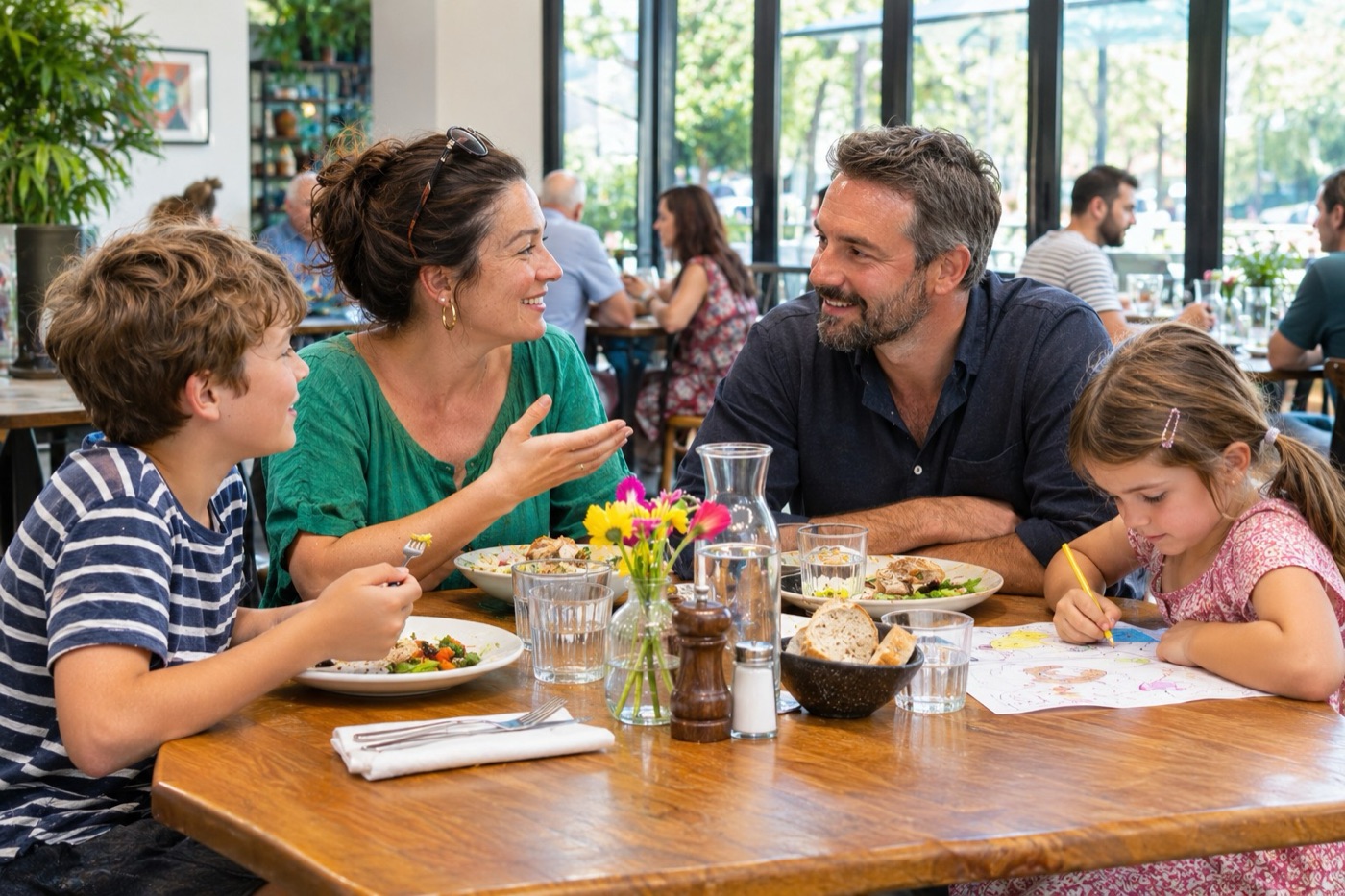
You are at a restaurant with your family. The food has not arrived yet, and everyone is looking at a phone. Nobody is arguing, but nobody is talking either. Does that sound peaceful, or a little sad? A group of restaurants in Sardinia, an Italian island, wants families to try something different.
Fifteen restaurants have agreed to take part in a one-month trial called “At the table without screens”. Families eating at those restaurants will be asked to put their devices away. The idea is to give parents and children more time to talk during their meal. The restaurants chose to join the scheme, so it is not a rule for every restaurant on the island.
After families hand in their devices, staff will offer them a “reunion kit”. It contains games and drawings designed to help children and parents spend time together. The games have time limits, so they fit around a restaurant meal. Families can also use the time to share stories about their day.
The kit also holds a short leaflet for parents. It explains the risks of too much time online and gives advice about social media at home.
Anna Cau, Sardinia's children's ombudsman, is leading the project. An ombudsman is an official whose job is to protect people's rights. She wants public places to help families connect, rather than leaving parents to deal with screens alone. A local restaurant association is supporting the trial too. Its island president said that lively chatter is often replaced by silence, and that children are sometimes handed a device to keep them quiet.
Of course, a phone can be useful at a restaurant. A parent might be waiting for an important message, and a game can help a tired child wait for food. People may also disagree about whether a restaurant should make rules for a family's meal. A quiet table does not always mean an unhappy one.
Still, the idea raises an interesting question. If the screens disappeared for an hour, what would happen next? Some families might enjoy the break. Others might discover that starting a conversation takes a little more effort than picking up a phone. Either way, the trial invites them to find out.
Intermediate version
Look around a restaurant while people are waiting for their food and you may notice a familiar scene: a family sitting together, each person absorbed in a separate screen. It can be a moment of welcome peace, particularly for tired parents. But a group of restaurants in Sardinia is asking whether those quiet minutes could be used differently.
Fifteen establishments on the Italian island have volunteered for a one-month pilot called “At the table without screens”. During the trial, parents and children dining at participating restaurants will be asked to put their devices away. The aim is not simply to remove phones, but to make room for the kind of conversation that can disappear when everybody is scrolling.
Families will be offered a “reunion kit” containing games and drawings. Designed with the Italian federation of paediatricians, the activities are intended to help children and parents interact, perhaps by sharing stories about their day. The kit also includes a leaflet about the risks of too much screen time and tips for managing social media at home.
The initiative is being led by Anna Cau, Sardinia's children's ombudsman and a former juvenile magistrate, with support from a local catering and tourism association. Cau argues that the burden should not fall entirely on parents, and that public settings ought to support them. The association's island president, Emanuele Frongia, said the fifteen restaurants had readily agreed to take part. He has noticed lively chatter giving way to stretches of silence as diners look at their devices, and said children are often handed one to keep them quiet.
Cau, who worked on the scheme with the Sardinian wing of the catering association Fipe-Confcommercio, describes it as a small step in a wider campaign to reduce excessive screen use among children. The games, she said, are deliberately given time limits so that they fit the length of a lunch or dinner.
It is easy to understand the appeal of the idea. A meal out can bring people together without anyone having to cook or wash up. Removing the usual distractions might make it easier to notice what someone else has to say. A game could also help families who find that the question “How was your day?” gets the same answer every evening.
Yet phones are not used only to escape conversation. They can help parents manage long waits, keep in touch with someone at home or deal with an unexpected problem. Some diners may feel that putting a screen away should be a personal choice rather than part of the restaurant's rules. Others may welcome having that decision made for them.
For now, the scheme is a limited experiment, not a ban across Sardinia, and the organisers plan to expand it only on a voluntary basis. The question for diners is simple: if everyone put their phone away, would dinner feel more enjoyable, or just a little longer?
Advanced version
There is a particular kind of silence that can settle over a restaurant table before the food arrives. Nobody is upset. Nobody has necessarily run out of things to say. They are simply elsewhere: checking a message, watching a video or giving a child a screen to make the wait easier. In Sardinia, fifteen restaurants have volunteered to see what happens when that familiar option is removed.
The one-month pilot, called “At the table without screens”, asks parents and children eating at participating establishments to put their devices away. In exchange, families receive a “reunion kit” of games and drawings, designed with the Italian federation of paediatricians to encourage conversation. The activities have time limits so they can sit comfortably within a lunch or dinner, rather than turning the whole meal into an organised event.
Anna Cau, the island's children's ombudsman and a former juvenile magistrate, is leading the initiative with support from a local hospitality association. Her argument is that this should not be treated as a task for parents alone: the broader environment can help create the conditions for children to interact with others. Emanuele Frongia, who represents the association in Sardinia, says restaurants increasingly see lively chatter replaced by diners absorbed in their devices.
It is an appealing idea, partly because it addresses a problem many people recognise without requiring an elaborate solution. A shared meal can be one of the few times a family stops moving in different directions. A game might ease the awkwardness of beginning a conversation, especially if asking about school or work tends to produce a one-word answer. The restaurant provides both the opportunity and a reason to take it.
It is also part of something larger. Cau frames the pilot as one step in a campaign against excessive screen use among children, and Frongia says the plan is to extend it to other restaurants, voluntarily, if the month goes well.
The case for phones is less romantic, but it is practical. A parent may be expecting an important call. A child may struggle with a long, noisy wait. A family might be talking to someone who cannot join them in person. And a silence at the table is not automatically a failure: people can enjoy each other's company without filling every minute with words.
The trial also raises a question about choice. Restaurants already set rules about reservations, menus and behaviour, so a screen-free table is not an entirely new kind of condition. Even so, some customers may welcome a reason to put their phones away while others resent being told how to spend time with their own families. That the restaurants volunteered does not mean every diner will feel the same way.
The scheme was announced before the pilot began, so nothing is yet known about whether it improves anything. Its value lies in the experiment itself. For an hour, a device that usually solves boredom is out of reach. What replaces it, whether a game, an argument, a conversation or comfortable silence, will depend on the people at the table.
After you read
4True, false or not given5 statements
Choose T (true), F (false) or NG (the article does not say).
- Fifteen restaurants have agreed to take part in the trial.
The text says: “Fifteen restaurants have agreed to take part in a one-month trial”.
- Every restaurant on the island must follow the rule.
The text says the opposite: “The restaurants chose to join the scheme, so it is not a rule for every restaurant on the island.”
- The reunion kit contains games and drawings.
The text says: “It contains games and drawings designed to help children and parents spend time together.”
- Most families in Sardinia like the idea.
Not stated. The text describes the trial but never says what most families think of it.
- Parents can read about the risks of too much time online in the kit.
The text says the kit holds a leaflet that “explains the risks of too much time online”.
5Vocabulary5 gaps
Complete the sentences with words from the box. Two words are not needed.
advicedisagreeeffortpeacefulrightsriskssilence
- The leaflet explains the of too much time online.
- My doctor gave me some good about sleeping better.
- After a busy week, a quiet evening at home feels calm and .
- Climbing the hill took a lot of , and we were tired at the top.
- My brother and I often about which film to watch.
6Verb forms5 gaps
Write the correct form of the verb in brackets.
- You at a restaurant with your family. (BE)
- Fifteen restaurants to take part in a one-month trial called “At the table without screens”. (AGREE)
- Families at those restaurants a reunion kit by the staff. (OFFER)
- The restaurants to join the scheme, so it is not a rule for every restaurant on the island. (CHOOSE)
- Anna Cau, Sardinia's children's ombudsman, the project. (LEAD)
7Language focusphrasal verbs
Complete the sentences with words from the box. Two words are not needed. A phrasal verb is a verb plus a small word, like put away. The small word changes the meaning, so learn them together.
acrossawayinoutthroughupwith
- Please put your phone in your bag and enjoy the meal.
- At the door, parents hand their devices and get a reunion kit.
- Some children are given a tablet to help them deal a long wait.
- It is a trial, so the restaurants will find whether families enjoy it.
- It is easy to pick a phone when a conversation feels difficult.
4True, false or not given5 statements
Choose T (true), F (false) or NG (the article does not say).
- The reunion kit includes information for parents as well as activities for children.
The kit has games and drawings, and also “a leaflet about the risks of too much screen time”.
- Cau believes parents should deal with children's screen use alone.
The text says she “argues that the burden should not fall entirely on parents”.
- The local association forced the restaurants to join the pilot.
The restaurants “volunteered”, and the association's president said they “had readily agreed”.
- Families will have to pay extra for the reunion kit.
The text never mentions the price of the kit.
- The scheme covers only some of the restaurants in Sardinia.
Only fifteen restaurants take part, and the scheme is “not a ban across Sardinia”.
5Vocabulary6 gaps
Complete the sentences with words from the box. Two words are not needed.
absorbedappealburdenexpandinteractpersuadereluctantunexpected
- The children were so in their drawings that they did not hear the waiter.
- Looking after a baby alone can be a heavy for one parent.
- Many people understand the of a quiet meal with no screens.
- Games can help shy children more easily at the table.
- The waiter brought an problem to the manager: the oven had stopped working.
- If the trial goes well, the restaurants hope to it to other towns.
6Verb forms5 gaps
Write the correct form of the verb in brackets.
- Fifteen establishments for a one-month pilot. (VOLUNTEER)
- The project by Anna Cau. (LEAD)
- By the time the trial began, all fifteen restaurants to take part. (AGREE)
- Families a reunion kit containing games and drawings. (OFFER)
- Some diners feel that the decision a personal choice. (BE (SHOULD))
7Language focusphrasal verbs
Complete the sentences with words from the box. Two words are not needed. Many phrasal verbs have a particle that adds a clear idea: away means removed, together means joined, on and with link the verb to an object.
awaybelowbeyondontogetherupwith
- Guests were asked to put their phones in a basket by the door.
- It took months, and the group is still working improving the games.
- Parents often have to deal tired children during a long wait.
- Shared games can bring family members for a laugh.
- After a meal at home, someone has to cook and then wash .
4True, false or not given5 statements
Choose T (true), F (false) or NG (the article does not say).
- The scheme could reach more restaurants only if the first month goes well, and only by choice.
Frongia plans “to extend it to other restaurants, voluntarily, if the month goes well”.
- The writer sees a screen-free table as unlike anything restaurants normally ask of customers.
Restaurants “already set rules about reservations, menus and behaviour”, so it is “not an entirely new kind of condition”.
- The writer suggests the pilot is worthwhile whatever its results turn out to be.
Nothing is yet known about whether it improves anything, yet “its value lies in the experiment itself”.
- The games in the reunion kit were tested on children before the pilot began.
The text says they were designed with paediatricians but never mentions testing.
- Cau holds that parents alone should be responsible for children's screen use.
She argues it “should not be treated as a task for parents alone”.
5Vocabulary6 gaps
Complete the sentences with words from the box. Two words are not needed.
easeelaborateelsewhereextendframesresentunderminewithdraw
- The ceremony was far more than the couple had wanted, with three orchestras and a fireworks display.
- A few well-chosen questions can the tension between people meeting for the first time.
- He began to his sister for being praised at every family gathering.
- The council hopes to the scheme to a further twenty schools if the results are encouraging.
- Her body was in the meeting, but her mind was clearly .
- A good teacher every mistake as a chance to learn.
6Word forms5 gaps
Use the word in brackets to make a word that fits the gap.
- The of the trial will be hard to measure, since nobody collected data beforehand. (EFFECTIVE)
- Some diners may find any rule , however well meant. (INTRUDE)
- The organisers' is to make families talk, not to punish anyone. (INTEND)
- The pilot is not , because restaurants chose to take part. (COMPEL)
- Few would deny the of a family sitting down together. (SIGNIFICANT)
7Language focusphrasal verbs
Complete the sentences with words from the box. Two words are not needed. In a phrasal verb the particle often carries the meaning, and some are fixed with a preposition: run out of, settle over, lie in.
apartawayinintoonoutthrough
- Even close friends can run of things to say, and the silence need not be awkward.
- The idea may not catch with teenagers, who are used to eating with a screen.
- The value of the pilot will lie what families learn about themselves.
- Guests were asked to put their phones without being made to feel watched.
- A trial that goes well may turn a permanent fixture.
Speak
8Talk about it3 questions
Discuss in pairs or small groups. Give reasons for your answers.
- Would you choose a restaurant with a phone-free rule? Why or why not?
- When is using a phone during a meal understandable, and when is it annoying?
- What helps people have a good conversation when they eat together?
8Talk about it3 questions
Discuss in pairs or small groups. Give reasons for your answers.
- Is a trial like this a helpful nudge, or does it go too far?
- Parents are often blamed for their children's screen time. How fair is that?
- What would actually get your family talking at the table?
8Talk about it3 questions
Discuss in pairs or small groups. Give reasons for your answers.
- The organisers cannot measure what a phone-free hour achieves. Does that matter?
- Would you rather a public space encouraged better behaviour, or left you alone?
- If this pilot spread, which other places should try it, and which should not?
9Role-play: a phone-free table
Work in pairs. Read your card, then have the conversation. Swap roles and do it again.
Student A · the restaurant manager
Your restaurant has joined the phone-free trial. A family has just sat down. Explain the rule and the reunion kit. Answer the parent's worries and decide if there can be any exceptions.
Student B · the parent
You are eating out with two children and you are expecting an important message. You don't like being told what to do. Ask questions, explain your problem and try to agree a solution.
Useful phrases
- Could I just explain how it works?
- I'm expecting an important message.
- It's only for one meal, and we've got games for the children.
- I'd rather decide that for myself.
- What if there's an emergency?
- Let's agree on a compromise.
Afterwards, tell the class: did you reach an agreement, and was the rule fair?
Your words
Highlights0 saved
Highlights0 saved
Highlights0 saved
Was this lesson useful? Support johnplusnews on Ko-fi
Continue reading
Language
Did Writing Really Make Languages More Complicated?
A large study of about 100,000 sentences in 30 languages found no universal pattern showing that writing makes sentences more complex. It does not say that writing never changes a language.
Technology
Can You Be Emotionally Close to Someone Who Is Not Human?
A survey of 463 adults in the United States found that people in relationships with AI chatbots can feel as emotionally close as other couples, but the link between closeness and loneliness looked different.
Relationships
Would You Sign a Contract Before Getting Married?
More young Americans are signing prenuptial agreements before their weddings. Is planning for a divorce unromantic, or is it honest and sensible?