News lesson1 March 2026
The Small Lights You Stopped Noticing Years Ago
The 27% figure is an association rather than proof, and most of the studies carried some risk of bias. Timing matters as much as darkness.
Before you read
1Warm up3 questions
Talk about these questions with a partner.
- What makes a bedroom feel restful?
- Would you choose complete darkness or a little light at night?
- Which bedtime habit would be easiest for you to change?
2Key words8 words
These words are in the article. Choose the letter of the meaning for each one.
- rhythm
- artificial
- exposed
- combined
- nightlight
- brightness
- environment
- blinds
- Athe place and things around you
- Ba pattern that repeats again and again, like a body clock
- Ccovers that you pull down over a window
- Din a place where something can reach you or affect you
- Emade by people, not natural
- Fhow strong and shining a light is
- Ga small light that stays on in the night
- Hput together into one group
1Warm up3 questions
Talk about these questions with a partner.
- What makes a bedroom feel restful?
- Would you choose complete darkness or a little light at night?
- Which bedtime habit would be easiest for you to change?
2Key words8 words
These words are in the article. Choose the letter of the meaning for each one.
- association
- prevalence
- disturbance
- exposure
- illumination
- realistic
- bias
- manageable
- Asomething that interrupts or upsets sleep or rest
- Bhow common something is in a group of people
- Ca link between two things, where one may not cause the other
- Dlight that makes a place bright
- Esensible and possible in real life
- Fan unfair leaning towards one result
- Gthe state of being in contact with something, such as light
- Hsmall enough to deal with without much trouble
1Warm up3 questions
Talk about these questions with a partner.
- What makes a bedroom feel restful?
- Would you choose complete darkness or a little light at night?
- Which bedtime habit would be easiest for you to change?
2Key words8 words
These words are in the article. Choose the letter of the meaning for each one.
- circadian
- epidemiological
- observational
- prevalence
- relative
- disturbance
- mobility
- alter
- Abased on watching what happens, not on running an experiment
- Bhow common something is in a group
- Csomething that interrupts or upsets sleep or rest
- Dto change something a little
- Eto do with studying how health problems spread and what causes them in groups of people
- Fjudged by comparing with something else
- Gfollowing a natural cycle of about 24 hours
- Hthe ability to move around easily
Read
3Read the article
The paragraphs are numbered. Look out for the key words from task 2.
Core version
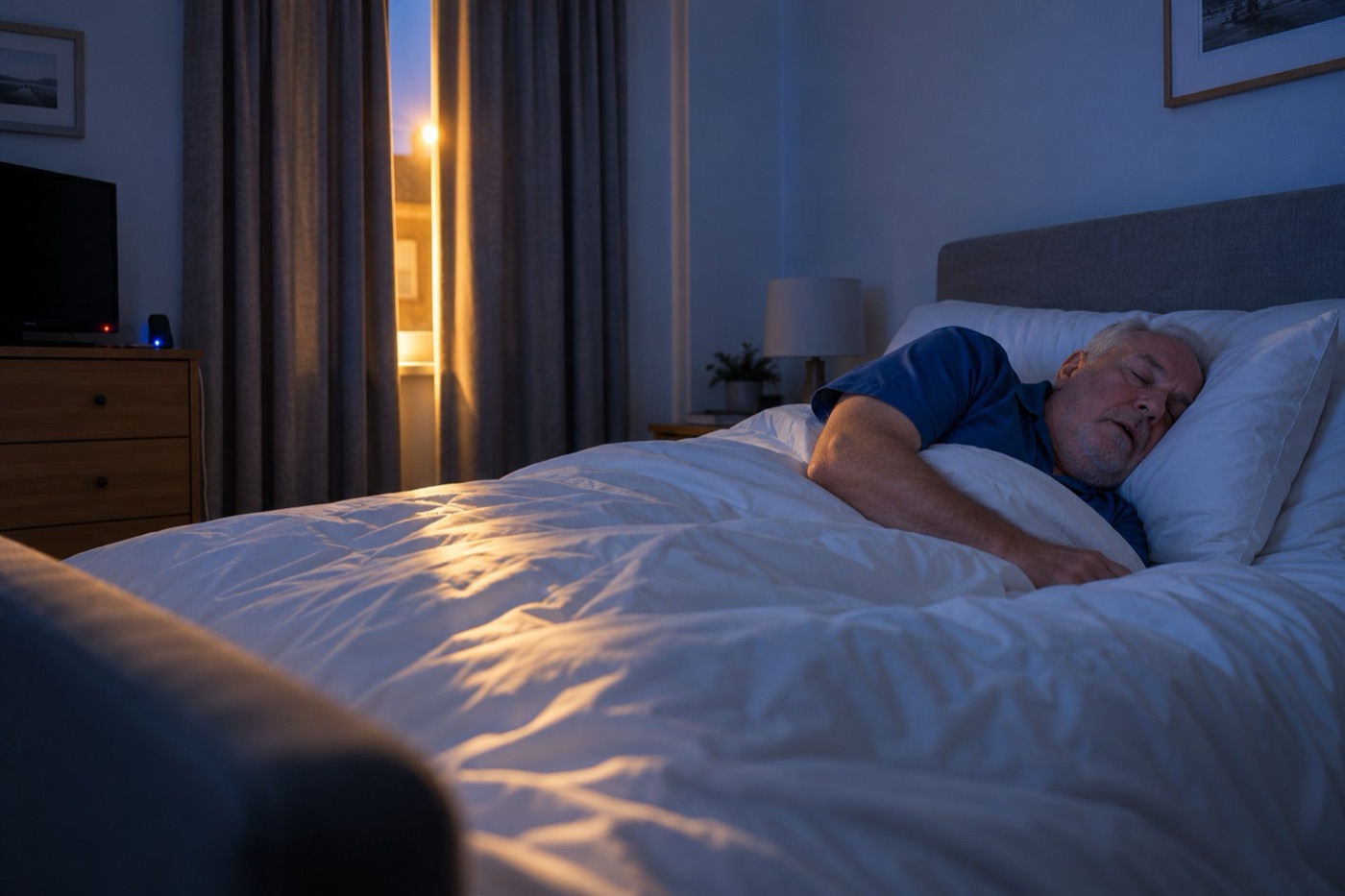
Look around your bedroom when you turn off the light. Is it completely dark? You may notice light from the street, a phone charger or a television. These small lights are common, but researchers are interested in how they affect our sleep.
Our bodies follow a daily rhythm. Light helps tell us when to be awake, and darkness helps prepare us for sleep. Bright light at the wrong time may make this rhythm less clear. The problem is not only what we do before bed. Light can also enter a room while we are sleeping.
In 2026, researchers published a review of 15 studies involving more than 765,000 participants. In the combined results, sleep problems were 27% more common in the group exposed to the most artificial light at night than in the group with low or no exposure. As an example only, if 10 in 100 people in the low-light group had sleep problems, 27% more would be about 13 in 100. This was a link, not proof that the light caused the problems.
There are other reasons people sleep badly, including noise, stress, illness and irregular working hours. Some of the studies also had problems measuring exactly how much light people experienced. That makes it difficult to know how large the effect is for any one bedroom.
Still, a dark room can be a sensible place to start. Thick curtains or blinds may block streetlights. Turning off unnecessary lamps and moving bright devices away from the bed are simple changes. Not everyone can control lighting outside their home.
During the day, daylight helps us stay awake and understand what time it is. In the evening, many people enjoy softer light, especially when they are getting ready for bed. A room that is comfortable in the afternoon may not be the best room for sleeping at night. Some people need a small nightlight for safety, particularly when they get up to use the bathroom.
That is an important reason not to tell everybody to switch off every light. The aim is to avoid unnecessary brightness while keeping the home safe. It can also help to have regular sleeping and waking times. Light is only one part of a much bigger picture of healthy sleep.
The research does not mean one small light will ruin your night. But it suggests that the environment around us deserves attention. We often think about how many hours we sleep. Perhaps we should also think about what our bedrooms are like during those hours.
Intermediate version
When you put out your bedroom light, darkness does not always follow. Streetlamps shine through curtains, a television flashes in the corner and electronic devices display tiny coloured lights. These details are easy to ignore, but researchers increasingly suspect that nighttime lighting can affect sleep quality.
Human sleep is influenced by the body's internal clock, which responds partly to patterns of light and darkness. Artificial light late in the evening may interfere with signals associated with preparing for sleep. Researchers also want to understand the effects of exposure during the night itself.
A systematic review published in Environmental Research in March 2026 combined evidence from 15 studies involving more than 765,000 people. Participants with the greatest exposure to artificial light at night had a 27% higher prevalence of sleep disturbance than those with little or no exposure. The result was an association, and most included studies had some risk of bias.
That distinction matters. People living in brightly lit areas may also experience traffic noise, stressful conditions or other factors linked to poorer sleep. Measuring the light somebody receives is difficult, particularly when researchers rely on outdoor estimates rather than measurements inside bedrooms. Not everybody can simply install perfect blinds. People renting a room or working night shifts may have little control over their sleeping environment, so practical solutions need to be realistic.
Nevertheless, there are practical reasons to pay attention to lighting. Curtains that block streetlights, reduced screen brightness before bed and shutting down unnecessary devices may create a more comfortable sleep environment. People working nights or living in busy cities may have fewer options.
The timing of light exposure is just as important as its presence. Brightness during the morning and daytime helps the body distinguish waking hours from the night. Excessive illumination close to bedtime may send less helpful signals. A practical approach is therefore not to make homes dark all day, but to provide appropriate lighting at different times. Safety also matters.
An older person moving around the house at night may reasonably prefer a low-level light to walking through a completely dark room. Researchers and public-health advisers must balance such needs instead of turning darkness into an absolute rule. Alongside lighting, consistent routines, manageable noise and any underlying medical conditions influence sleep quality. Good advice recognises the whole environment.
No single change guarantees good sleep, and persistent difficulties can require professional advice. But the study offers a useful reminder: sleep is influenced by our surroundings as well as our routines. Sometimes improving a bedroom begins with noticing the small sources of light we stopped seeing years ago.
Advanced version
A bedroom can appear dark while remaining surprisingly illuminated. Light leaks around blinds, a phone charges beside the bed and the glow of nearby buildings reaches through the curtains. Because these sources are so familiar, we tend to tune them out. Yet growing research suggests that artificial light at night deserves a place in discussions about sleep health.
A charger's glow is one example of small light in a bedroom. The review did not test chargers or any single source. It looked at overall exposure to artificial light at night, which the studies measured in different ways and often estimated rather than recorded at the sleeper's eyes.
Our circadian system responds to the daily pattern of light and darkness. Exposure at biologically inappropriate times may alter signals involved in preparing for sleep. A systematic review and meta-analysis published in Environmental Research in March 2026 examined epidemiological research on nighttime illumination and sleep disturbance.
Across 15 studies involving more than 765,000 participants, the authors found that higher exposure was associated with poorer sleep. In the studies suitable for pooled analysis, those with the greatest exposure had a 27% higher prevalence of sleep disturbance compared with groups receiving little or no artificial light at night. The figure describes relative association, not an individual's probability of having insomnia. Observational research cannot isolate every influence. People exposed to more nighttime light may also differ in working hours, neighbourhood conditions or existing health problems, all of which complicate interpretation.
The limitations are substantial. Most studies had a high risk of bias, and estimates of nighttime illumination are not always accurate representations of what reaches a sleeper's eyes. Residents of brightly lit neighbourhoods may also face additional environmental pressures, including noise and irregular working conditions. Observational evidence cannot easily disentangle these factors.
Even so, the findings support reasonable measures to reduce unnecessary exposure: properly fitted blinds, dimmer evening lighting and removing bright electronic displays from the bedside. These adjustments may be easier than changing a demanding work schedule, although cost and housing conditions still influence what people can do. The sensible conclusion is modest rather than alarmist: reduce unnecessary light where possible, without turning another aspect of sleep into a source of relentless anxiety.
A simplistic reading of the evidence could lead to the conclusion that less artificial light is always better. In reality, the biological effects of illumination depend on timing, intensity, duration and individual circumstances. Daytime light exposure helps maintain a clear daily rhythm, while adequate nighttime visibility can prevent accidents. Residents with mobility difficulties may need carefully positioned low-level lighting even when darkness would otherwise be preferable.
This creates a design challenge rather than a demand to eliminate every light source. Buildings and streets can potentially be illuminated where necessary while reducing unnecessary glare or light spilling into bedrooms. The review's findings therefore have implications for architects and city authorities as well as individuals deciding whether to buy blackout curtains.
There is also a wider policy question. Public lighting supports safety and access, so plunging streets into darkness is not a practical solution. Better-designed lighting could balance those benefits with reduced disturbance to residents. A good night's sleep may depend partly on decisions made far beyond the bedroom walls.
After you read
4True, false or not given5 statements
Choose T (true), F (false) or NG (the article does not say).
- Thick curtains may block streetlights.
The text says: "Thick curtains or blinds may block streetlights."
- The study proved that light causes sleep problems.
The text says the opposite: "This was a link, not proof that the light caused the problems."
- Most bedrooms in cities are too bright at night.
The text does not say how bright bedrooms in cities are.
- The review involved more than 765,000 participants.
The text says: "a review of 15 studies involving more than 765,000 participants."
- The writer says everybody should switch off every light.
The text says: "That is an important reason not to tell everybody to switch off every light."
5Vocabulary5 gaps
Complete the sentences with words from the box. Two words are not needed.
blockestimateignoreirregularparticipantsproofsensible
- Nurses who work hours often find it hard to sleep well.
- The researchers asked thousands of how well they slept.
- Wearing earplugs is a way to cope with a noisy street.
- A tall building can the sun from a small garden.
- A strong link between two things is not that one causes the other.
6Verb forms5 gaps
Write the correct form of the verb in brackets.
- Light tell us when to be awake. (HELP)
- In 2026, researchers a review of 15 studies. (PUBLISH)
- These small lights common, but they may affect our sleep. (BE)
- This was an association, not proof that light every problem. (CAUSE)
- Light can enter a room while we . (SLEEP)
7Language focuscollocations
Complete the sentences with words from the box. Two words are not needed. A collocation is a pair of words that go together naturally. Learn the whole pair, such as pay attention, not just one word.
brightdofallkeepmakepaytake
- Try to a short walk before bed.
- Neighbours who play loud music a lot of noise at night.
- The light from the street shone into the room.
- Most of us don't attention to the small lights in our bedroom.
- It's easy to asleep on the sofa when you're tired.
4True, false or not given5 statements
Choose T (true), F (false) or NG (the article does not say).
- Measuring the light somebody receives is difficult.
The text says: "Measuring the light somebody receives is difficult".
- The review appeared in Environmental Research in March 2026.
The text says the review was "published in Environmental Research in March 2026".
- Blackout blinds are recommended by sleep doctors.
The text does not say what sleep doctors recommend.
- The review established that light alone causes poor sleep.
The text says the result "was an association, and most included studies had some risk of bias".
- The writer thinks homes should be kept dark all day.
The text says the approach is "not to make homes dark all day".
5Vocabulary6 gaps
Complete the sentences with words from the box. Two words are not needed.
balanceconsistentdistinctionevidenceexcessivefactorsinstallinterfere
- Loud music from next door can with your ability to fall asleep.
- Many people fail to see the between feeling tired and being ill.
- We plan to thicker blinds in the spare room next month.
- Parents often have to their children's needs against their own.
- A bedtime routine is easier to keep than one that changes every night.
- Stress and diet are two that can affect how well you sleep.
6Verb forms5 gaps
Write the correct form of the verb in brackets.
- By the time the review appeared, its authors evidence from 15 studies. (COMBINE)
- So far, light at night to poorer sleep in several studies. (LINK)
- At this time tomorrow, I behind my new blackout blinds. (SLEEP)
- The review in Environmental Research in March 2026. (PUBLISH)
- If the streetlamp into my room, I would sleep better. (NOT SHINE)
7Language focuscollocations
Complete the sentences with words from the box. Two words are not needed. Verb and noun pairs often feel fixed in English. Learn the pair as one chunk, because a near-synonym can sound wrong.
awarenessconclusiondeepheavyissueshedstrong
- traffic outside the window keeps many residents awake at night.
- The campaign hopes to raise of how streetlights affect sleep.
- More data is needed before scientists can draw a firm .
- A new study may help to light on why some people sleep badly.
- Doctors often a warning about screens before bed.
4True, false or not given5 statements
Choose T (true), F (false) or NG (the article does not say).
- Several cities have reduced their street lighting as a result.
The text does not say that any city has changed its street lighting.
- The 27% figure means that 27% of people exposed to the most light developed insomnia.
The text says the figure is a relative association, "not an individual's probability of having insomnia".
- The writer implies that improving street lighting is a better policy than switching it off.
Public lighting supports safety, so darkness is "not a practical solution", while better design "could balance those benefits".
- Fitting blinds is presented as easier than changing a demanding work schedule.
The text says these adjustments "may be easier than changing a demanding work schedule".
- The text says residents with mobility difficulties should avoid low-level lighting.
The text says they "may need carefully positioned low-level lighting".
5Vocabulary6 gaps
Complete the sentences with words from the box. Two words are not needed.
complicatecorrelationglarehypothesisinterpretationmodestpooledrelentless
- Night after night, the flicker of the lamp outside left her exhausted.
- Hidden factors tend to any attempt to say what a single streetlamp does.
- Drivers complained that the new white lamps produced an uncomfortable in wet weather.
- The authors make only a claim: that cutting needless light is sensible, not that it cures insomnia.
- Because each trial was small, the researchers the results to see the overall pattern.
- Without information about diet and income, any of the data must stay cautious.
6Word forms5 gaps
Use the word in brackets to make a word that fits the gap.
- The limitations of the review are . (SUBSTANCE)
- Exposure at biologically times may alter sleep signals. (APPROPRIATE)
- Observational research cannot easily these factors. (TANGLE)
- A reading could suggest that less light is always better. (SIMPLE)
- Estimates of nighttime are not always accurate. (ILLUMINATE)
7Language focuscollocations
Complete the sentences with words from the box. Two words are not needed. At this level, partners often carry a formal tone: strike a balance, cast doubt on. Choose the partner that sounds natural, not just one that fits the meaning.
balancecastgrowinginflictposetentativewield
- Bright advertising screens near homes could a threat to residents' sleep.
- A body of research now links nighttime light with poorer sleep.
- At this stage, the authors can offer only conclusions.
- Councils must strike a between public safety and residents' sleep.
- A high risk of bias may doubt on even the most impressive headline figure.
Speak
8Talk about it3 questions
Discuss in pairs or small groups. Give reasons for your answers.
- How could a city make nights darker without making streets feel unsafe?
- Would you change your bedroom because of one study?
- What makes health advice easy enough to fit real life?
8Talk about it3 questions
Discuss in pairs or small groups. Give reasons for your answers.
- How could a city make nights darker without making streets feel unsafe?
- Would you change your bedroom because of one study?
- What makes health advice easy enough to fit real life?
8Talk about it3 questions
Discuss in pairs or small groups. Give reasons for your answers.
- How could a city make nights darker without making streets feel unsafe?
- Would you change your bedroom because of one study?
- What makes health advice easy enough to fit real life?
9Role-play: lights on or lights off?
Work in pairs. Read your card, then have the conversation. Swap roles and do it again.
Student A · the light sleeper
You share a flat. Your flatmate leaves a bright lamp on all night and you can't sleep. Ask for a change. Listen to the reason before you decide what to agree.
Student B · the flatmate
You like a small light on because you get up in the night and want to feel safe. Explain why total darkness worries you and suggest a fair compromise.
Useful phrases
- I've been having trouble sleeping lately.
- Would you mind turning the lamp off at night?
- I'd feel safer with a small light on.
- How about a dim nightlight instead?
- That's a fair point, but I'm still tired.
- Let's try it for a week and see.
Afterwards, tell the class what you agreed and whether it's a fair deal.
Your words
Highlights0 saved
Highlights0 saved
Highlights0 saved
Was this lesson useful? Support johnplusnews on Ko-fi
Continue reading
Language
Did Writing Really Make Languages More Complicated?
A large study of about 100,000 sentences in 30 languages found no universal pattern showing that writing makes sentences more complex. It does not say that writing never changes a language.
Psychology
The Way You Think About Being Alone Changes How It Feels
Researchers read 144 newspaper articles about solitude and found them overwhelmingly gloomy. They also found that what you believe about time alone predicts how lonely it makes you.
History
Were People Getting High 2,800 Years Ago?
Cannabis seeds and chemical traces in preserved hair from a Siberian tomb suggest that some Scythians were exposed to its intoxicating compounds about 2,800 years ago. The evidence is strong, but it leaves many questions open.