What Was Inside a Pompeii Wardrobe?
Archaeologists opened a wooden cupboard in Pompeii and found make-up tools, coins and a child's necklace. What can small everyday objects tell us about people who lived 2,000 years ago?
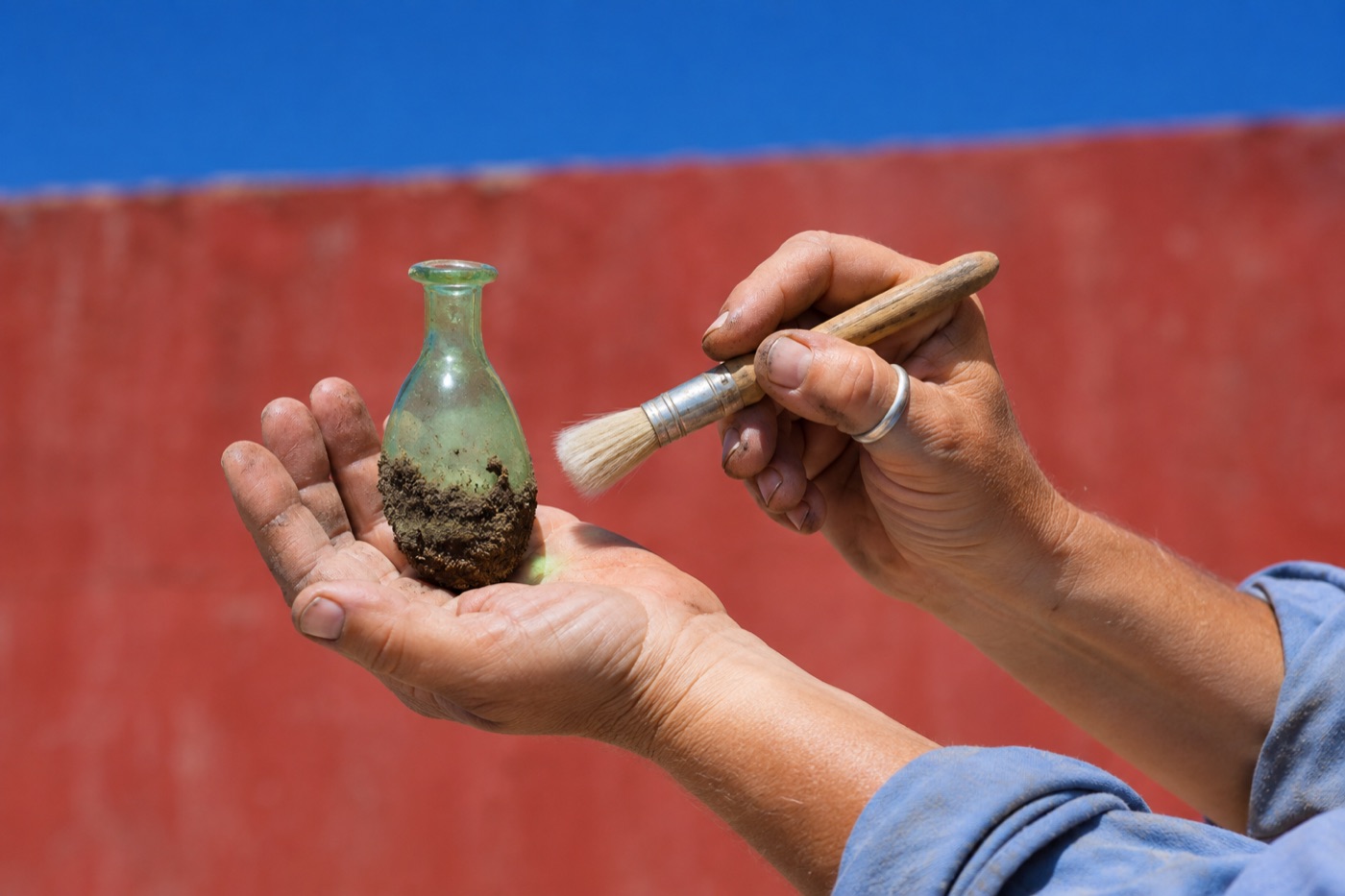
Warm up3 questions
- What everyday objects could tell archaeologists about your life?
- What do you know about the volcano that buried Pompeii?
- Why might a necklace mean more than just decoration?
Sentence help (optional): I'd choose ... because ... · For me, ... · I think ... because ...
Warm up3 questions
- What everyday objects could tell archaeologists about your life?
- What do you know about the volcano that buried Pompeii?
- Why might a necklace mean more than just decoration?
Warm up3 questions
- What everyday objects could tell archaeologists about your life?
- What do you know about the volcano that buried Pompeii?
- Why might a necklace mean more than just decoration?
Core version
Imagine opening a cupboard that nobody has touched for almost 2,000 years. Inside, you find a small perfume bottle, jewellery, coins and things people used in everyday life. Archaeologists have made a discovery like this in Pompeii, an ancient Roman town. The objects tell a story about ordinary people, not just famous emperors or rich rulers.
Pompeii was covered in volcanic material when Mount Vesuvius erupted in AD 79. Many buildings and objects stayed hidden for centuries. In October 2026, archaeologists announced the discovery of objects from a wooden cupboard in a house on Via dell'Abbondanza, one of the busiest streets in Pompeii. The house has been linked to a man called Cornelius Maximus because of old inscriptions, but we cannot be sure who lived there.
The finds included tweezers for make-up, a small glass bottle for perfume or oil, a lamp and an incense burner for burning pleasant smells. There were also 38 bronze coins and some lead weights, possibly used for buying and selling goods. One of the most touching items was a child's necklace made from many small charms. Some looked like hands, feet, grapes and figures of gods.
Why would a child wear a necklace like that? Archaeologists think it may have been a lucky charm, worn for protection. It might also have made a sound as the child moved, helping adults know where the child was. We cannot know exactly who wore it or what happened on the day of the eruption. But these little objects help us imagine real families living, working and looking after children long ago.
The discovery also reminds us that history is not just about battles and important dates. People in ancient Rome worried about their appearance, cared for their families and needed money to buy things. They used tools and objects that sometimes seem surprisingly familiar. A perfume bottle or necklace can tell us about daily life in a way that a statue of an emperor cannot.
Of course, archaeologists must be careful when they work out what objects meant. Finding a necklace in a cupboard does not prove who owned it. Still, the collection gives us a rare look into a home whose owners may have left in a hurry. If people found your cupboard two thousand years from now, what would your belongings tell them about the way we live today?
Intermediate version
Imagine discovering a wardrobe that has been closed for almost two thousand years. Inside are jewellery, a small perfume bottle, coins and everyday objects that once belonged to people living in a busy Roman town. This is not the plot of a historical mystery novel. Archaeologists working at Pompeii in southern Italy have uncovered a wooden cupboard and the remarkable collection of possessions that it contained, offering a glimpse into the private lives of people who lived there before disaster struck.
Pompeii was buried by volcanic material during the eruption of Mount Vesuvius in AD 79. The layers that destroyed the city also preserved traces of buildings and objects for future generations to investigate. In reports published on 29 and 30 October 2026, researchers described finds from a cupboard in a house on Via dell'Abbondanza, one of the busiest streets in Pompeii. The house was previously associated with Cornelius Maximus because of inscriptions that are no longer visible, so the identity of the people who lived there remains uncertain.
The discoveries were surprisingly personal. There were tools for preparing make-up, a small glass container for perfume or ointment, a lamp and an incense burner. The cupboard also held 38 bronze coins and lead weights that may have been connected with trade. Among the most fascinating items was a necklace made from at least 24 miniature charms, including representations of hands, feet, grapes and gods. Archaeologists believe it was probably worn by a child.
The necklace may have been more than a decoration. Some researchers suggest that objects of this kind were worn as protective charms. Their movement might also have produced a gentle noise, allowing adults to keep track of a young child nearby. We should not assume that every interpretation is certain, but the possibility makes the discovery feel remarkably close to modern life. Parents have always looked for ways to protect their children and make them feel safe.
History lessons often concentrate on battles, emperors and major political events, yet ordinary objects can tell a different story. The cupboard suggests a household where people cared about appearance, handled money, perhaps traded goods and kept meaningful possessions close at hand. A bottle of perfume or a child's necklace can make an ancient city feel less distant than a grand monument. Such discoveries remind us that daily routines connect people across centuries.
At the same time, archaeologists must resist filling every gap with imagination. They cannot necessarily identify the exact owner of each object or reconstruct the final moments of the household. Evidence offers clues rather than a complete biography. Nevertheless, this small collection raises a question that every reader can understand: if someone opened your wardrobe two thousand years from now, which of your possessions would tell the most interesting story about you?
Advanced version
What would a stranger make of your bedroom if they opened it two thousand years from now? A favourite necklace, an almost empty perfume bottle and a handful of coins might seem unremarkable today, but such objects could offer precious clues about your identity, habits and relationships. That is what makes a newly reported discovery at Pompeii so compelling. Archaeologists have examined the remains of a household cupboard containing personal possessions that bring the everyday lives of ancient Romans into surprisingly sharp focus.
Pompeii was buried during the eruption of Mount Vesuvius in AD 79, an event that devastated the town while preserving extraordinary traces of its buildings and domestic life. Reports issued on 29 and 30 October 2026 described objects recovered from a wooden cupboard in a house on Via dell'Abbondanza, once one of the busiest streets in the city. The house had previously been associated with a figure named Cornelius Maximus because of inscriptions that are no longer visible. Its facade was first excavated in 1912, but experts are only now exploring some of its rooms as part of a wider restoration project.
The contents were more varied than the phrase ancient treasure might suggest. Archaeologists identified tweezers and other tools used for make-up, a small glass vessel for perfume or ointment, an incense burner and a bronze lamp. They also recovered 38 bronze coins and lead weights that may indicate commercial activity within the household. Particularly striking was a necklace made from at least 24 miniature charms, including depictions of hands, feet, grapes and divine figures. Its small scale and protective symbols suggest that it may once have been worn by a child.
These items are valuable not simply because they are old, but because they illuminate the details of ordinary existence. Cosmetics point towards personal presentation, coins and weights towards economic activity, and a child's necklace towards beliefs about safety and care. Some scholars suggest that the necklace's small components could have made a sound as its wearer moved, allowing adults to keep track of a child. Such interpretations remain tentative, but they offer a vivid reminder that ancient people had emotional and practical concerns that would be familiar to families today.
Archaeological discoveries can also challenge the way history is presented. Textbooks often privilege powerful rulers, dramatic conflicts and impressive public buildings, leaving little room for the people who cooked, worked, traded and raised children. Domestic objects provide a more intimate perspective, although they must be interpreted cautiously. We cannot simply assume that a particular item belonged to a woman because modern readers associate it with feminine activities, or that every object in a house was used by its apparent owner.
The Pompeii cupboard is therefore both a window into the past and a lesson in uncertainty. Physical evidence can tell us a great deal, but it does not reveal every thought, relationship or event associated with an object. We are left with fragments of individual lives rather than a finished story, and perhaps that is what makes them so powerful. Ancient history becomes less remote when a small personal possession invites us to recognise ourselves in someone who lived almost two millennia ago. Which everyday object from your own home would best represent your life to a future archaeologist?
Study this story
Save the words you want to keep, talk about the story, then practise the language.
Highlights0 saved
Highlights0 saved
Highlights0 saved
Talk about it3 questions
- Which object from the cupboard surprises you most?
- What can ordinary objects show us that big monuments cannot?
- What would someone learn about your generation from your bedroom?
Sentence help (optional): I think ... because ... · One reason is ... · For me, ...
You can talk about people in general instead of yourself, and you can pass on any question.
Talk about it3 questions
- Which object from the cupboard surprises you most?
- What can ordinary objects show us that big monuments cannot?
- What would someone learn about your generation from your bedroom?
You can talk about people in general instead of yourself, and you can pass on any question.
Try it
Work in pairs. Each of you secretly invents a cupboard with five made-up objects in it. Describe the objects to your partner one at a time, and your partner guesses what kind of person owned them. Then say which guesses were certain and which were only possible. All the objects are invented, so nobody has to share anything real.
Exercises4 exercises
1. Complete the sentences
Drag a word into each gap, or tap a word and then tap a gap. Tap a filled gap to put the word back. Two words are not needed.
- Pompeii was covered in volcanic material when Mount erupted in AD 79.
- There were also 38 bronze .
- One of the most touching items was a child's .
- The objects tell a story about ordinary people, not just famous .
- The necklace might have made a as the child moved.
2. Match the meaning
Choose the meaning of each word or phrase as it is used in the article.
- archaeologists
- eruption
- charm
- protection
Write the letter of the meaning next to each word.
- A scientists who study the past by digging up old objects
- B a small object believed to bring luck
- C the moment when a volcano throws out hot rock and ash
- D keeping someone safe from harm
3. Put the verb in the right form
Write the correct form of the verb in brackets.
- Pompeii covered in volcanic material. (be)
- Many buildings and objects hidden for centuries. (stay)
- The finds tweezers for make-up and a small glass bottle. (include)
- Archaeologists a discovery like this in Pompeii. (make)
- People in ancient Rome about their appearance. (worry)
4. True, false or not given
Choose Not given if the article does not say, even when you think the statement is probably true.
- Mount Vesuvius erupted in AD 79.
The text says: "Pompeii was covered in volcanic material when Mount Vesuvius erupted in AD 79."
- The cupboard held 20 bronze coins.
The text says: "There were also 38 bronze coins"
- The child who wore the necklace escaped the eruption.
The text does not say what happened to the child who wore the necklace.
- Archaeologists think the necklace may have been a lucky charm.
The text says: "Archaeologists think it may have been a lucky charm, worn for protection."
- Finding the necklace proves who owned it.
The text says: "Finding a necklace in a cupboard does not prove who owned it."
Your score
Do all four, then add them up.
Answer key
- Complete the sentences1 Vesuvius · 2 coins · 3 necklace · 4 emperors · 5 sound
- Match the meaning1 archaeologists = A · 2 eruption = C · 3 charm = B · 4 protection = D
- Put the verb in the right form1 was · 2 stayed · 3 included · 4 have made · 5 worried
- True, false or not given1 True · 2 False · 3 Not given · 4 True · 5 False
1. Complete the sentences
Drag a word into each gap, or tap a word and then tap a gap. Tap a filled gap to put the word back. Two words are not needed.
- Archaeologists at Pompeii in southern uncovered a wooden cupboard.
- The layers that destroyed the city also traces of buildings and objects.
- The cupboard held 38 bronze coins and lead that may have been connected with trade.
- The necklace was made from at least 24 miniature .
- History lessons often concentrate on battles, emperors and major events.
- Archaeologists must resist filling every with imagination.
2. Match the meaning
Choose the meaning of each word or phrase as it is used in the article.
- glimpse
- remarkable
- inscriptions
- distant
Write the letter of the meaning next to each word.
- A a short look at something
- B very unusual and worth noticing
- C far away in time or space
- D words carved or written on a surface
3. Put the verb in the right form
Write the correct form of the verb in brackets.
- Pompeii buried by volcanic material in AD 79. (be)
- Researchers finds from a cupboard in a house. (describe)
- The cupboard also 38 bronze coins. (hold)
- Archaeologists the necklace was probably worn by a child. (believe)
- Parents have always for ways to protect their children. (look)
4. True, false or not given
Choose Not given if the article does not say, even when you think the statement is probably true.
- Pompeii is in southern Italy.
The text says: "Archaeologists working at Pompeii in southern Italy"
- The exact owner of the house is known for certain.
The text says: "so the identity of the people who lived there remains uncertain"
- The necklace is now in a museum in Naples.
The text does not say where the necklace is kept now.
- The cupboard contained 38 bronze coins.
The text says: "The cupboard also held 38 bronze coins"
- Archaeologists are completely sure the necklace belonged to a child.
The text says: "Archaeologists believe it was probably worn by a child."
Your score
Do all four, then add them up.
Answer key
- Complete the sentences1 Italy · 2 preserved · 3 weights · 4 charms · 5 political · 6 gap
- Match the meaning1 glimpse = A · 2 remarkable = B · 3 inscriptions = D · 4 distant = C
- Put the verb in the right form1 was · 2 described · 3 held · 4 believe · 5 looked
- True, false or not given1 True · 2 False · 3 Not given · 4 True · 5 False
1. Complete the sentences
Drag a word into each gap, or tap a word and then tap a gap. Tap a filled gap to put the word back. Two words are not needed.
- Pompeii was buried in AD 79, an event that the town.
- The facade of the house was first in 1912.
- Lead weights may indicate activity within the household.
- Cosmetics point towards personal .
- Such interpretations remain .
- We are left with of individual lives rather than a finished story.
2. Match the meaning
Choose the meaning of each word or phrase as it is used in the article.
- illuminate
- tentative
- domestic
- remote
Write the letter of the meaning next to each word.
- A to make something clearer
- B not certain or final
- C connected with the home
- D far away or distant
3. Make the right word
Use the word in brackets to make a word that fits the gap.
- Archaeologists examined the of a household cupboard. (REMAIN)
- The objects offer a vivid that ancient people had practical concerns. (REMIND)
- The items illuminate the details of ordinary . (EXIST)
- Domestic objects provide a more perspective. (INTIMACY)
- The cupboard is a window into the past and a lesson in . (CERTAIN)
4. True, false or not given
Choose Not given if the article does not say, even when you think the statement is probably true.
- The facade of the house was first excavated in 1912.
The text says: "Its facade was first excavated in 1912"
- The inscriptions naming Cornelius Maximus are still clearly visible.
The text says: "because of inscriptions that are no longer visible"
- The necklace was made of gold.
The text does not say what material the necklace was made of.
- The scholars' interpretations of the necklace are tentative.
The text says: "Such interpretations remain tentative"
- We can know every thought of the people who owned the objects.
The text says: "it does not reveal every thought, relationship or event associated with an object"
Your score
Do all four, then add them up.
Answer key
- Complete the sentences1 devastated · 2 excavated · 3 commercial · 4 presentation · 5 tentative · 6 fragments
- Match the meaning1 illuminate = A · 2 tentative = B · 3 domestic = C · 4 remote = D
- Make the right word1 remains · 2 reminder · 3 existence · 4 intimate · 5 uncertainty
- True, false or not given1 True · 2 False · 3 Not given · 4 True · 5 False
Continue reading
Music & style
Why a Great Song Doesn't Need Your Language
Songs in 16 languages reached a streaming service's global top 50 in 2025. What makes a song travel, and what gets lost on the way?
Games & online life
Who Makes the Rules in a Group Chat?
A UNICEF guide for teenagers in Argentina came with a glossary of more than 100 expressions that young people use online. Chat messages can mean different things in different groups.
Music & style
Would You Wear a Rival Team's Shirt?
A writer argues that fashion has discovered the football shirt. So what are you saying when you wear one, and who decides what it means?



Read this article online: johnplusnews.com/articles/what-was-inside-a-pompeii-wardrobe/