Would You Wear a Rival Team's Shirt?
A writer argues that fashion has discovered the football shirt. So what are you saying when you wear one, and who decides what it means?
Warm up3 questions
- Would you wear a rival team's shirt if you loved its design?
- Can you enjoy football shirts without following football?
- Which matters more in an outfit: its look or its meaning?
Sentence help (optional): I'd choose ... because ... · For me, ... · I think ... because ...
Warm up3 questions
- Would you wear a rival team's shirt if you loved its design?
- Can you enjoy football shirts without following football?
- Which matters more in an outfit: its look or its meaning?
Warm up3 questions
- Would you wear a rival team's shirt if you loved its design?
- Can you enjoy football shirts without following football?
- Which matters more in an outfit: its look or its meaning?
Core version
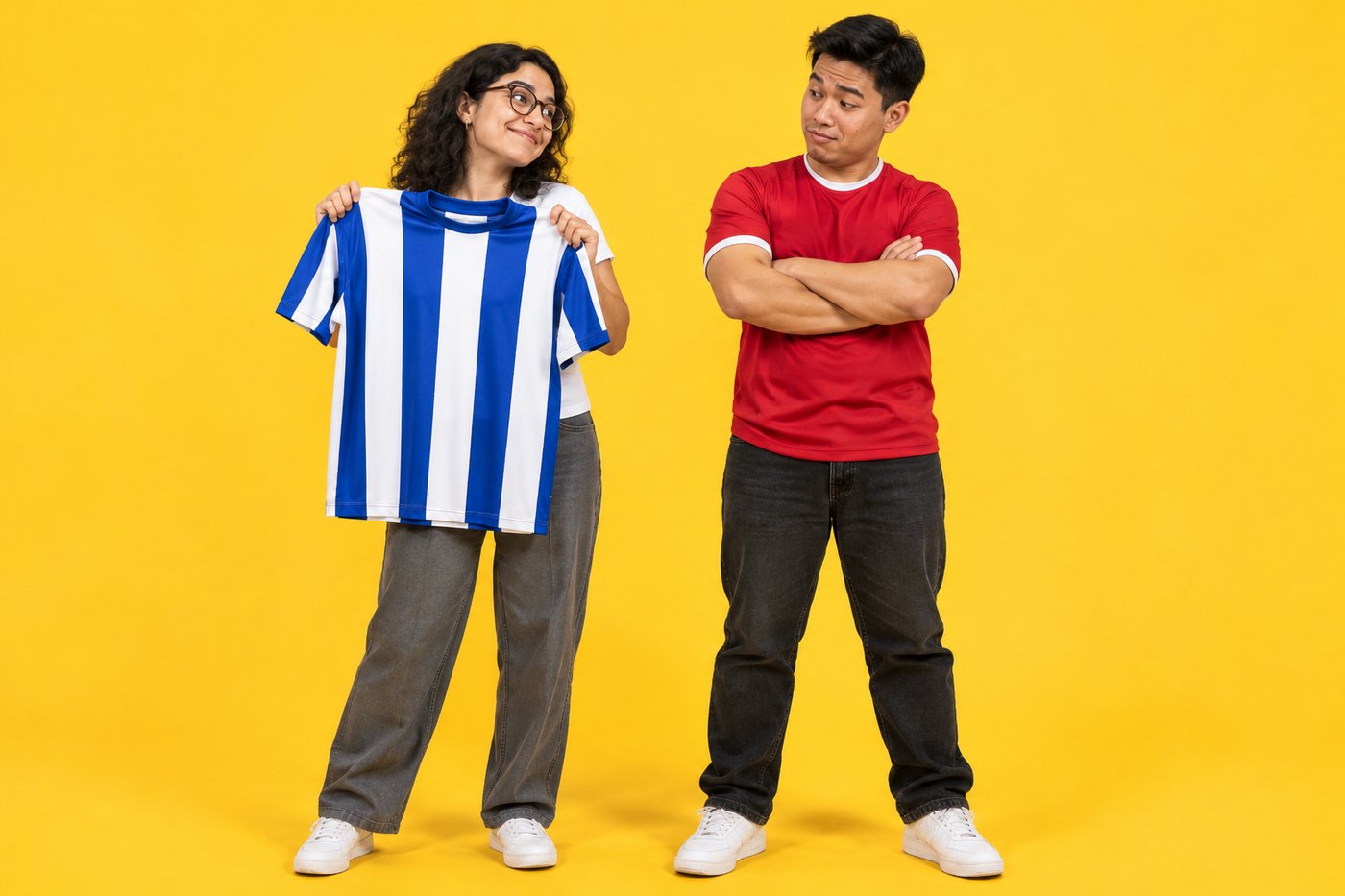
Imagine you see a football shirt in a shop window. The colour is perfect, the badge looks great and the material looks really soft. There is only one problem. It belongs to the biggest rival of your friend's team. If someone gave it to you, would you wear it?
A football shirt can be two things at once. For a fan, it shows which team you support. For other people, it can simply be a nice piece of clothing. In August 2026, the writer Katriona Flynn wrote an article for RTÉ, an Irish broadcaster, about this. She says people now wear football shirts to festivals and on nights out, and people of all ages wear them, not only at matches.
Flynn says that a shirt comes with a kind of "biography". It has a history: old players, old sponsors and special seasons. Fashion brands can't invent that. So some brands try to copy the feeling of a club, with its history, its community and its loyal fans.
That is why wearing a shirt does not always mean you support the club. One person wears it because they love the team. Another person wears it because they like the colours. A third person wears it because it belonged to someone in their family, and it tells part of a story.
Not everyone agrees about the rules. Some fans say you should only wear the shirt of the team you support. Others say that a good shirt is a good shirt. There isn't one official answer. And a joke from a friend can feel serious when a rivalry matters to them.
Remember that this is one writer's opinion. She gives many examples, but she doesn't have sales numbers to prove that everyone is wearing football shirts. And you don't have to love football to have an opinion. Maybe you only like the design, the colour or the badge.
So what would you do if a shirt looks great but belongs to the wrong team? Would you wear it, swap it or leave it? And what would you say to your friends?
Intermediate version
Imagine you are given a shirt that looks fantastic: bold colours, a clean badge, a design people stop to look at. Then you notice whose team it is. It belongs to the rival of the club your best friend has supported since they were small. You like the shirt. Do you also have to like the team?
In August 2026, the writer Katriona Flynn wrote an article for RTÉ Brainstorm, a website run by an Irish broadcaster. She argues that fashion has finally noticed the football shirt, which had been working as fashion all along. She points to festivals, nights out and people of every age wearing shirts far from any stadium, and to fashion magazines describing the shirt as a going-out top.
Her main idea is that a shirt arrives with a "biography": heritage, sponsors and eras that fashion brands find hard to manufacture. Brands, she says, try to borrow the same feelings: history, authenticity, community and loyalty.
She also asks questions without answering them firmly. When Arsenal released a pale yellow third kit, it arrived at the same time as the "butter yellow" colour trend in luxury fashion, so was the club following fashion? She notes that Burberry's "A Good Sport" campaign for autumn 2026 used touchlines, burger vans and Sunday League football, with a mix of models and players. Is that a tribute to football culture or a way to sell clothes? You can decide for yourself.
These examples show two different motives. One is identity ("this is my team"). The other is design ("I like how this looks"). Flynn notes that a shirt is both a mass-produced product and a personal object, so it can be worn without loyalty to the club. Some fans find that disrespectful. Others think shirts belong to anyone who enjoys them.
It's worth remembering the limits. This is an opinion article, and the evidence is mostly examples and brand stories. There are no sales figures showing that every teenager now wears football shirts, and the butter yellow data she mentions counts searches for a colour, not for shirts.
So back to the shop window. If you wore the shirt, what would you want it to say about you? And would you wear it to your friend's house?
Advanced version
The shirt is excellent. The fabric is good, the colours are bold and the design makes people look twice. The problem is that it belongs to the team your friends cannot stand. Wearing it will be read as a statement whether you mean one or not, and that, more than the cotton, is the real cost of the shirt.
In an article for RTÉ Brainstorm, updated in August 2026, the writer Katriona Flynn argues that 2026 is the year fashion noticed the football shirt, an object that had been functioning as fashion all along. Her evidence is largely observational: shirts at festivals and on nights out, worn across age groups, in a year with a World Cup, and in a summer when fashion magazines called the shirt a going-out top.
Her central idea is that a shirt comes with a "biography" of heritage, sponsors and eras that fashion struggles to manufacture. A club's shirt can signal a city, a country, a period or a personal history, and it tells other people something about who we are. Brands, she suggests, are trying to acquire what clubs have accumulated over decades: heritage, authenticity, community and loyalty.
The examples are suggestive rather than conclusive. Arsenal's pale yellow third kit arrived while "butter yellow" was fashionable in luxury, and Flynn asks whether the club is following fashion without answering firmly. Burberry's "A Good Sport" campaign for autumn 2026 borrows football's visual world, from touchlines and spectators to burger vans and Sunday League, and casts models alongside players. Gabriela Hearst's off-pitch uniforms for Uruguay use local merino wool.
It is important to be clear about the limits of this evidence. The article is the author's opinion, and the evidence is mostly anecdotal or comes from brands. The statistic about "butter yellow" concerns searches for a colour in 2024 and 2025, not for football shirts, and the link between luxury fashion and football kits is partly interpretation. Flynn herself concedes that fashion did not make the shirt interesting; it mostly caught up with something already there.
That leaves the question your friends will actually ask. Who decides whether someone is a "real" fan? A supporter who has stood in the rain for decades may feel that a shirt worn for its colour is a costume. Someone who has never been to a match may feel that the shirt is simply theirs. Because the shirt is both a mass-produced product and a personal object, both reactions are understandable, and neither group controls what the shirt means.
So would you wear it? One person sees a great design. Another sees a rival team. The same shirt can start two very different conversations.
Study this story
Save the words you want to keep, talk about the story, then practise the language.
Highlights0 saved
Highlights0 saved
Highlights0 saved
Talk about it3 questions
- Who gets to decide what someone else's shirt means?
- Would you rather wear something everyone recognised or something nobody else had?
- What could change a shirt from sportswear into a fashion item?
Sentence help (optional): I think ... because ... · One reason is ... · For me, ...
You can talk about people in general instead of yourself, and you can pass on any question.
Talk about it3 questions
- Who gets to decide what someone else's shirt means?
- Would you rather wear something everyone recognised or something nobody else had?
- What could change a shirt from sportswear into a fashion item?
You can talk about people in general instead of yourself, and you can pass on any question.
Try it
Design a paper kit for an imaginary local team. Give it a colour, a symbol and one feature with a story behind it. Then explain the design to someone who dislikes sport. You don't need to buy anything or use a real club's name.
Exercises4 exercises
1. Complete the sentences
Drag a word into each gap, or tap a word and then tap a gap. Tap a filled gap to put the word back. Two words are not needed.
- For a fan, a shirt shows which team you .
- The on a shirt shows the team's symbol.
- A shirt has a history: old players, old and special seasons.
- Some brands try to copy a club's history, community and fans.
- Remember that this is one writer's .
2. Match the meaning
Choose the meaning of each word or phrase as it is used in the article.
- rival
- biography
- sponsors
- loyal
Write the letter of the meaning next to each word.
- A the story of someone's life
- B a person or team that you compete against
- C staying faithful to someone or something
- D companies that pay a team and appear on its shirts
3. Put the verb in the right form
Write the correct form of the verb in brackets.
- The colour perfect. (be)
- In August 2026, a writer an article for RTÉ. (write)
- People now football shirts to festivals. (wear)
- A shirt with a kind of biography. (come)
- A third person wears it because it to someone in their family. (belong)
4. True, false or not given
Choose Not given if the article does not say, even when you think the statement is probably true.
- The article was written for an Irish broadcaster.
The text says: "the writer Katriona Flynn wrote an article for RTÉ, an Irish broadcaster"
- Katriona Flynn says people only wear football shirts at matches.
The text says the opposite: "She says people now wear football shirts to festivals and on nights out, and people of all ages wear them, not only at matches."
- The writer has sales numbers that prove everyone is wearing football shirts.
The text says the opposite: "she doesn't have sales numbers to prove that everyone is wearing football shirts"
- Fashion brands find it hard to invent a shirt's history.
The text says: "Fashion brands can't invent that."
- Most teenagers prefer the shirt of their own team.
Not stated. This version does not give this information.
Your score
Do all four, then add them up.
Answer key
- Complete the sentences1 support · 2 badge · 3 sponsors · 4 loyal · 5 opinion
- Match the meaning1 rival = B · 2 biography = A · 3 sponsors = D · 4 loyal = C
- Put the verb in the right form1 is · 2 wrote · 3 wear · 4 comes · 5 belonged
- True, false or not given1 True · 2 False · 3 False · 4 True · 5 Not given
1. Complete the sentences
Drag a word into each gap, or tap a word and then tap a gap. Tap a filled gap to put the word back. Two words are not needed.
- A shirt arrives with a "biography" of , sponsors and eras.
- Brands try to borrow history, , community and loyalty.
- A shirt is both a product and a personal object.
- Some fans find it when people wear a shirt without caring about the club.
- The evidence is mostly examples and brand .
2. Match the meaning
Choose the meaning of each word or phrase as it is used in the article.
- manufacture
- disrespectful
- authenticity
- motives
Write the letter of the meaning next to each word.
- A showing a lack of respect
- B being real and not fake
- C reasons for doing something
- D to make things in large amounts in a factory
3. Put the verb in the right form
Write the correct form of the verb in brackets.
- In August 2026, Katriona Flynn that fashion has noticed the football shirt. (argue)
- She to people of every age wearing shirts far from any stadium. (point)
- Others think shirts to anyone who enjoys them. (belong)
- When Arsenal a pale yellow third kit, it arrived at the same time as a colour trend. (release)
- She points to people of every age shirts far from any stadium. (wear)
4. True, false or not given
Choose Not given if the article does not say, even when you think the statement is probably true.
- The article appeared on a site run by an Irish broadcaster.
The text says: "an article for RTÉ Brainstorm, a website run by an Irish broadcaster"
- Flynn gives a firm answer to each question she asks.
The text says the opposite: "She also asks questions without answering them firmly."
- Flynn says a shirt is both a product made in large numbers and a personal object.
The text says: "a shirt is both a mass-produced product and a personal object"
- The article proves that every teenager now wears football shirts.
The text says the opposite: "There are no sales figures showing that every teenager now wears football shirts"
- Burberry paid football clubs to use their shirts in its campaign.
Not stated. This version does not give this information.
Your score
Do all four, then add them up.
Answer key
- Complete the sentences1 heritage · 2 authenticity · 3 mass-produced · 4 disrespectful · 5 stories
- Match the meaning1 manufacture = D · 2 disrespectful = A · 3 authenticity = B · 4 motives = C
- Put the verb in the right form1 argued · 2 points · 3 belong · 4 released · 5 wearing
- True, false or not given1 True · 2 False · 3 True · 4 False · 5 Not given
1. Complete the sentences
Drag a word into each gap, or tap a word and then tap a gap. Tap a filled gap to put the word back. Two words are not needed.
- Her evidence is largely : shirts at festivals and on nights out.
- Brands are trying to acquire what clubs have over decades.
- The examples are suggestive rather than .
- Flynn herself that fashion did not make the shirt interesting.
- A shirt worn only for its colour may feel like a to a long-time supporter.
2. Match the meaning
Choose the meaning of each word or phrase as it is used in the article.
- anecdotal
- suggestive
- interpretation
- statement
Write the letter of the meaning next to each word.
- A an explanation of what something means
- B something that shows what you think or who you are
- C based on personal stories, not hard evidence
- D hinting at something without proving it
3. Make the right word
Use the word in brackets to make a word that fits the gap.
- Brands want , which they cannot manufacture. (AUTHENTIC)
- to a club grows over many years. (LOYAL)
- A shirt can be a object as well as a product. (PERSON)
- Pale yellow was in luxury fashion at the time. (FASHION)
- Both reactions are . (UNDERSTAND)
4. True, false or not given
Choose Not given if the article does not say, even when you think the statement is probably true.
- The article was updated in August 2026.
The text says: "an article for RTÉ Brainstorm, updated in August 2026"
- Flynn says fashion is what made the football shirt interesting.
The text says the opposite: "Flynn herself concedes that fashion did not make the shirt interesting"
- Flynn asks whether Arsenal is following fashion, but does not answer firmly.
The text says: "Flynn asks whether the club is following fashion without answering firmly"
- The butter yellow statistic counts searches for football shirts.
The text says the opposite: "concerns searches for a colour in 2024 and 2025, not for football shirts"
- Burberry's campaign sold more clothes than football shirts did.
Not stated. This version does not give this information.
- A shirt can be mass-produced and personal at the same time.
The text says: "the shirt is both a mass-produced product and a personal object"
Your score
Do all four, then add them up.
Answer key
- Complete the sentences1 observational · 2 accumulated · 3 conclusive · 4 concedes · 5 costume
- Match the meaning1 anecdotal = C · 2 suggestive = D · 3 interpretation = A · 4 statement = B
- Make the right word1 authenticity · 2 loyalty · 3 personal · 4 fashionable · 5 understandable
- True, false or not given1 True · 2 False · 3 True · 4 False · 5 Not given · 6 True
Continue reading
Music & style
Why a Great Song Doesn't Need Your Language
Songs in 16 languages reached a streaming service's global top 50 in 2025. What makes a song travel, and what gets lost on the way?
Music & style
What Makes a Bad Photo a Good Memory?
Some people are going back to older digital cameras. What can a blurry photo give you that a perfect one can't?
Places & people
Who Decides Where Teenagers Can Hang Out?
A pilot project in Barcelona asks teenagers how public spaces should work. Who should decide, and what would you change near you?
Read this article online: johnplusnews.com/articles/would-you-wear-a-rival-teams-shirt/