News lessonJune to July 2026
Could a Day at the Beach Become a Luxury?
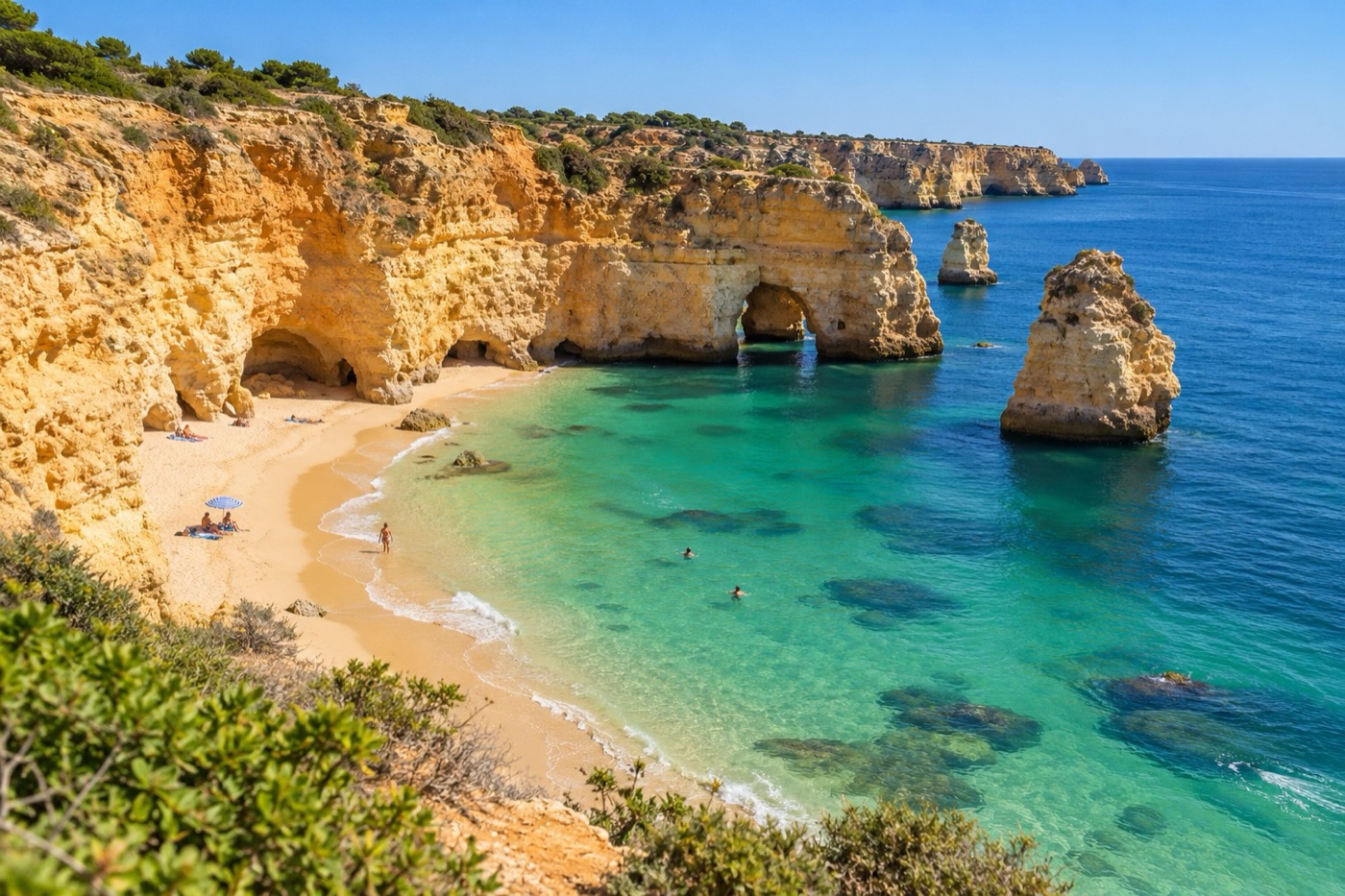
Protests in Portugal's Arrábida region in 2026 opposed development plans affecting several beaches. They were about who decides how a shared landscape is run.
Before you read
1Warm up3 questions
Talk about these questions with a partner.
- What should a day at the beach cost?
- Would you pay for a cleaner beach with better facilities?
- Can a small fee still stop people doing something?
2Key words8 words
These words are in the article. Choose the letter of the meaning for each one.
- residents
- development
- access
- privilege
- investment
- proof
- dispute
- wealthier
- Aa way to get to a place or use it
- Bpeople who live in a place
- Cmoney that a company puts into something to make more money later
- Dnew buildings or a big plan to build on land
- Ea strong disagreement
- Fa special thing that only some people are allowed to have
- Gfacts that show something is true
- Hhaving more money than others
1Warm up3 questions
Talk about these questions with a partner.
- What should a day at the beach cost?
- Would you pay for a cleaner beach with better facilities?
- Can a small fee still stop people doing something?
2Key words8 words
These words are in the article. Choose the letter of the meaning for each one.
- assumption
- concessions
- conservation
- proposal
- restrictions
- affordable
- sensitive
- trivial
- Asmall and not important
- Brules that limit what people can do
- Cprotecting nature and wild places
- Drights to run a business in a public place, such as a beach cafe
- Ea plan that someone suggests
- Feasily harmed or damaged
- Gcheap enough for ordinary people to pay
- Hsomething you believe is true without checking
1Warm up3 questions
Talk about these questions with a partner.
- What should a day at the beach cost?
- Would you pay for a cleaner beach with better facilities?
- Can a small fee still stop people doing something?
2Key words8 words
These words are in the article. Choose the letter of the meaning for each one.
- concessions
- infrastructure
- ecologically
- mechanism
- governance
- anticipated
- discouraging
- distributed
- Ashared out among a group or area
- Bexpected before it happens
- Cmaking people less willing to do something
- Da method or process that makes something happen
- Ethe way a place or organisation is managed and controlled
- Fpermission to run a business in a public place
- Gthe basic systems an area needs, such as roads and drains
- Hin a way that relates to living things and their surroundings
Read
3Read the article
The paragraphs are numbered. Look out for the key words from task 2.
Core version
On a hot summer day, a beach seems like a simple place. People swim, sit in the sun or walk beside the water. But what happens if a company controls the easiest way to reach the sand? In Portugal, that question turned into a public argument in 2026.
Residents and campaigners protested against plans connected with several beaches in Arrábida, a beautiful coastal area south of Lisbon. They were afraid that private development could make access more difficult for local families. The area is known for clear water, green hills and beaches that attract large numbers of visitors every summer. In July and August, the roads and car parks near the sea fill up quickly, so even a short trip needs planning.
The protesters argued that the coastline should stay something everyone can enjoy. For many residents, the beach is not just a tourist attraction. It is a place they grew up visiting as children, and they want their own children to be able to use it too, without paying for the privilege.
Supporters of private investment may see things differently. Businesses can provide parking, cleaning, restaurants and other useful services, and tourism creates jobs for people who live nearby. But those services usually come at a price, and people worry when an ordinary afternoon at the beach starts to feel like an expensive holiday package. Cleaning, parking and safety all cost money, and somebody has to pay for them in the end. A small fee may seem fair once, but a family that visits fifty times a summer would pay it fifty times.
There is an important difference between owning a beach and running services near it. The public debate was about access and the possible effects of a proposed development. It was not proof that every beach in the area had already become private property, and rules differ from beach to beach.
The dispute asks a question that matters in many countries. A coastline may be valuable because it is beautiful, but that is exactly why companies want to make money from it. Can local people, visitors and businesses all benefit without turning a shared natural place into somewhere only wealthier families feel comfortable? The answer may be different in every country, but the question keeps coming back.
Intermediate version
For most people, the right to visit the seaside feels obvious. Beaches may require maintenance, cleaning and transport links, but the sea itself seems like a shared resource rather than a product. In Portugal, protests around the Arrábida coast during the summer of 2026 revealed how complicated that assumption becomes once private development and mass tourism enter the picture.
Campaigners opposed plans affecting access to several beaches in the protected coastal area south of Lisbon. Residents feared that greater commercial control could make it harder for ordinary families to visit places they had enjoyed for generations. The protest was as much about local identity as it was about holidaymakers and parking spaces, and that is why it struck such a nerve so quickly.
Developers and businesses can make a reasonable case for investment. Coastal destinations need roads, facilities, cleaning and sometimes measures to protect sensitive habitats from heavy visitor numbers. Well-managed tourism can provide employment and income for nearby communities throughout the year. However, improvements can also bring in charges or restrictions that quietly change who is able to enjoy an area.
The argument requires careful wording. Opposition to a proposal is not the same as proof that an entire coastline has already been privatised. Public access, commercial concessions and outright private ownership raise quite different legal questions. What protesters feared was a future in which decisions about an important natural space increasingly reflected commercial priorities rather than local ones.
Protected status complicates things further. Rules that limit building or cut the number of cars allowed near the sea can be genuinely necessary for conservation, yet the same rules may be felt as a way of keeping ordinary visitors away. Who a restriction protects, and who it inconveniences, depends a great deal on who draws it up. Conservation rules, development plans and charges are different decisions, and each should be judged on its own.
A related concern is that tourism can price out the people who live closest to a destination. Visitors may be happy to pay for a premium experience during a fortnight's holiday, while residents need ordinary, affordable access all year round. A charge that looks trivial once can look very different fifty times a summer, and it is the local family, not the holidaymaker, who pays it most often. Seasonal work adds another layer, since many of the jobs tourism creates last only a few months.
The Arrábida dispute is therefore not simply a choice between protecting beaches and welcoming business. It raises a more practical question: who gets to decide how a shared landscape is managed, and how can the benefits of tourism be spread around without shutting out the communities that live there? Neither question is settled by pointing at the revenue figures.
Advanced version
Who can reach the sand on a popular beach? The answer depends on access roads, conservation rules, commercial concessions and private development. In Portugal's Arrábida region, opposition to development plans affecting several beaches made those tensions unusually visible during 2026.
Protesters argued that stronger private control could undermine residents' ability to enjoy a landscape they regarded as part of their community's identity. Arrábida's clear waters and striking coastal scenery draw visitors from well beyond the region, creating economic opportunities while placing considerable pressure on infrastructure and on sensitive natural areas that were never designed for crowds. The pressure is concentrated into a few months, which makes it harder to manage and easier to underestimate in the planning stage.
Those in favour of greater investment may reasonably emphasise improved facilities, better visitor management and employment. Yet the benefits of commercial development tend to be distributed unevenly. A fee can seem small to someone visiting once. A local family going back throughout the summer may see a very different cost.
Protected status complicates the picture rather than resolving it. Measures that limit construction or cap vehicle numbers may be ecologically indispensable, yet identical restrictions can function, or at least be experienced, as a mechanism for discouraging ordinary visitors. A great deal depends on who drafts the rules, who is consulted beforehand and whether the resulting inconvenience falls on day-trippers or on paying guests.
Precision matters in describing the dispute. Commercially managed facilities, restricted access routes and outright private ownership are not interchangeable concepts, however easily they are conflated in a headline. Nor should fears about a proposed project be reported as though the anticipated restrictions had already taken effect. The underlying conflict concerns how decisions over public access are made, and whose interests carry the greatest weight when they are.
There is a broader question of environmental justice here. Attractive landscapes often become commercially valuable precisely because earlier generations preserved or shared them rather than cashing in. If access comes to depend on spending power, a community ends up losing something that is difficult to measure in economic terms: the ability to enjoy a natural place without first having to purchase an experience. Such losses rarely appear in any assessment, partly because nobody has worked out how to price them, and partly because they are felt gradually rather than all at once.
Portugal's coastal controversy demonstrates that tourism policy is not only a matter of visitor numbers and revenue. It is also about governance, belonging and the meaning of public space, and about which of those things a council is willing to defend when money is on the table. A successful coastal economy ought to be judged not simply by the income it generates, but by whether the people who live beside it retain a genuine place within it. On that measure, the protests themselves may be the most useful evidence available.
After you read
4True, false or not given5 statements
Choose T (true), F (false) or NG (the article does not say).
- The roads near the sea are quiet in July and August.
The text says: "the roads and car parks near the sea fill up quickly"
- The development plans were cancelled after the protests.
Not stated. The text does not say what happened to the plans after the protests.
- Tourism can create jobs for people who live nearby.
The text says: "tourism creates jobs for people who live nearby."
- A family that visits fifty times a summer would pay a small fee fifty times.
The text says: "a family that visits fifty times a summer would pay it fifty times."
- The text says every beach in the area had already become private property.
The text says the debate "was not proof that every beach in the area had already become private property".
5Vocabulary5 gaps
Complete the sentences with words from the box. Two words are not needed.
attractcampaignerscrowdedfeenearbyprotectvaluable
- Several gave out leaflets and asked people to sign a petition.
- Beautiful beaches thousands of tourists every summer.
- The car park charges a small of three euros for the whole day.
- Beach land is very , so a house with a sea view can cost millions.
- Many people who live walk to the beach after work.
6Verb forms5 gaps
Write the correct form of the verb in brackets.
- The families swimming there every Sunday when the children were small. (GO)
- Last summer, the council a public meeting about the plan. (HOLD)
- A woman the crowd that she had swum there all her life. (TELL)
- A shopkeeper that fewer customers came after the car park became more expensive. (SAY)
- Volunteers the beach clean before the protest. (KEEP)
7Language focusprepositions
Complete the sentences with words from the box. Two words are not needed. Many verbs and nouns need one fixed small word after them. Learn the pair together, not just the first word.
aboutagainstbetweenforoftowith
- Residents protested the plans for the new car park.
- The area is known its clear water and green hills.
- Many families worry the cost of a day at the beach.
- There is a big difference owning a beach and running services near it.
- They want their children to have easy access the sand.
4True, false or not given5 statements
Choose T (true), F (false) or NG (the article does not say).
- The writer accepts that restrictions in a protected area can be necessary.
The text says such rules "can be genuinely necessary for conservation".
- A local family who visits often is affected by a small charge more than a one-off holidaymaker.
The text says it is "the local family, not the holidaymaker, who pays it most often".
- Most residents of the Arrábida area work in tourism.
Not stated. The text does not say how many residents work in tourism.
- The protesters believed the whole coastline had already been privatised.
The text says what they feared was "a future" of commercial control, and that opposition is "not the same as proof" of privatisation.
- Conservation rules, development plans and charges should all be judged together as one decision.
The text says the opposite: "each should be judged on its own."
5Vocabulary6 gaps
Complete the sentences with words from the box. Two words are not needed.
congestionemploymenthabitatslegislationmaintenancepremiumprivatisedrevenue
- The council spends a large part of its budget on the of paths and toilets at popular beaches.
- Many young people left the town to look for elsewhere.
- Fences keep walkers away from the of rare birds.
- Some visitors are happy to pay a for a quiet, clean beach with a lifeguard.
- The beach cafe's from ice cream doubled in July.
- Critics warned that the whole shoreline could be within ten years.
6Verb forms5 gaps
Write the correct form of the verb in brackets.
- By the time the protest began, most residents about the plans. (HEAR)
- Beach cleaning by a private company last summer. (DO)
- If the fee rises again, local families visiting. (STOP)
- Many residents wish the council them earlier. (CONSULT)
- While the protesters along the road, a cafe owner was handing out water. (MARCH)
7Language focusprepositions
Complete the sentences with words from the box. Two words are not needed. Adjectives, verbs and nouns often take a fixed preposition. After the preposition, use a noun or an -ing form.
atforfrominontowith
- Whether the scheme works depends how the money is spent.
- Campaigners were not opposed tourism itself.
- Barriers protect the dunes damage by large crowds.
- Residents are interested keeping the beach affordable.
- The council was criticised failing to consult residents.
4True, false or not given5 statements
Choose T (true), F (false) or NG (the article does not say).
- The writer suggests an identical restriction can be experienced as either protection or exclusion.
The text says restrictions may be "ecologically indispensable" yet can function "as a mechanism for discouraging ordinary visitors".
- The text claims that earlier generations made money from the landscapes they preserved.
The text says they "preserved or shared them rather than cashing in".
- Residents were consulted before the plans were drawn up.
Not stated. The text asks "who is consulted beforehand" but does not say whether anyone was.
- The writer regards the protests as weak evidence about whether a coastal economy serves local people.
The text says: "the protests themselves may be the most useful evidence available."
- A fixed fee is likely to be felt more heavily by regular local visitors than by one-off visitors.
The text says a fee seems small to someone visiting once, but a local family going back all summer "may see a very different cost".
5Vocabulary6 gaps
Complete the sentences with words from the box. Two words are not needed.
conflateddispensableindispensableinterchangeableredundantretainunderestimateundermine
- Secret deals between the council and developers did much to residents' trust in the process.
- Critics claimed the report had public access with private ownership.
- For a fragile dune system, strict limits on footfall may be , not merely desirable.
- The two terms are not : each has a precise legal meaning.
- Even after the redevelopment, longstanding residents hope to their right to cross the dunes freely.
- Planners tend to how quickly a quiet cove can become overcrowded.
6Word forms5 gaps
Use the word in brackets to make a word that fits the gap.
- The planners' failure to consult residents showed a lack of . (ACCOUNT)
- Heavy footfall is causing erosion of the dunes. (REVERSE)
- Commercial of public space often goes unnoticed until access is restricted. (EXPLOIT)
- A properly survey of residents would settle the question. (REPRESENT)
- The council's to consult anyone beforehand angered residents. (RELUCTANT)
7Language focusprepositions
Complete the sentences with words from the box. Two words are not needed. At this level the preposition is part of a fixed chunk, usually adjective plus preposition. Learn the whole chunk and its usual object.
atbyforinontowith
- Charging locals to reach their own shoreline would be tantamount a tax on belonging.
- Any plan to limit cars is fraught political risk.
- The scheme's approval was contingent a satisfactory environmental review.
- Critics say the profits were made the expense of ordinary visitors.
- The plan sits stark contrast to the council's earlier promises.
Speak
8Talk about it3 questions
Discuss in pairs or small groups. Give reasons for your answers.
- What should everyone be able to enjoy at a beach without paying?
- Would a local discount solve the problem of repeated entry fees?
- Who should help pay to look after a popular stretch of coast?
8Talk about it3 questions
Discuss in pairs or small groups. Give reasons for your answers.
- What should everyone be able to enjoy at a beach without paying?
- Would a local discount solve the problem of repeated entry fees?
- Who should help pay to look after a popular stretch of coast?
8Talk about it3 questions
Discuss in pairs or small groups. Give reasons for your answers.
- What should everyone be able to enjoy at a beach without paying?
- Would a local discount solve the problem of repeated entry fees?
- Who should help pay to look after a popular stretch of coast?
9Role-play: a fee for the beach car park
Work in pairs. Read your card, then have the conversation. Swap roles and do it again.
Student A · the council officer
Your council wants to charge a fee at the beach car park. The money will pay for cleaning and safety. Explain why, listen to the resident, and decide if you can offer anything.
Student B · the local resident
You take your family to the beach about fifty times every summer. You think a fee is unfair for local people. Say why, and suggest a better idea.
Useful phrases
- I understand your point, but we've got to pay for the cleaning.
- That's a lot of money for a family like ours.
- What if local people got a discount?
- I'm afraid we can't make an exception for everyone.
- Who'd decide how the money's spent?
- Let's try to find something that's fair for everybody.
Afterwards, tell the class: did you agree on a fee, and who was happiest with the result?
Your words
Highlights0 saved
Highlights0 saved
Highlights0 saved
Was this lesson useful? Support johnplusnews on Ko-fi
Continue reading
Language
Did Writing Really Make Languages More Complicated?
A large study of about 100,000 sentences in 30 languages found no universal pattern showing that writing makes sentences more complex. It does not say that writing never changes a language.
Relationships
Would You Sign a Contract Before Getting Married?
More young Americans are signing prenuptial agreements before their weddings. Is planning for a divorce unromantic, or is it honest and sensible?
Work
They Still Have Their Jobs. They Are Leaving Anyway
Nobody made these workers redundant. AI changed what their work felt like, and they walked out on careers they had spent a decade building.