News lesson13 October 2026
The Teenagers Who Walked Out of School
Secondary-school students across France are blocking their own gates. They say the buildings, the class sizes and the staffing have been ignored for years.
Before you read
1Warm up3 questions
Talk about these questions with a partner.
- What one change would improve a school you know?
- Can missing a lesson ever teach someone something useful?
- What makes adults take young people's opinions seriously?
2Key words8 words
These words are in the article. Choose the letter of the meaning for each one.
- demonstrations
- staff
- entrances
- clashes
- budgets
- wealthier
- replacement
- challenge
- Aevents where many people walk or gather in public to show what they think
- Bhaving more money
- Ca person who does a job instead of someone else
- Dplans for how much money you will spend
- Efights or angry arguments between groups
- Fdoors or gates where you go in
- Gthe people who work in a place
- Hsomething difficult that you must try to do
1Warm up3 questions
Talk about these questions with a partner.
- What one change would improve a school you know?
- Can missing a lesson ever teach someone something useful?
- What makes adults take young people's opinions seriously?
2Key words8 words
These words are in the article. Choose the letter of the meaning for each one.
- unions
- authorities
- underinvestment
- publicity
- inequality
- prolonged
- contradiction
- facilities
- Aattention from newspapers, television and the internet
- Bgroups of workers who join together to protect their rights
- Cbuildings and equipment that are used for a purpose
- Dthe people or offices that have official power
- Ean unfair difference between groups of people
- Fcontinuing for a long time
- Gnot spending enough money over a long time
- Ha situation where two ideas cannot both be true
1Warm up3 questions
Talk about these questions with a partner.
- What one change would improve a school you know?
- Can missing a lesson ever teach someone something useful?
- What makes adults take young people's opinions seriously?
2Key words8 words
These words are in the article. Choose the letter of the meaning for each one.
- infrastructure
- stopgap
- expenditure
- paradox
- confrontations
- embody
- constraint
- underinvestment
- Ato be a clear example of an idea
- Bthe basic buildings and systems that a place needs
- Cangry, sometimes violent meetings between opposing groups
- Dthe money that a government or group spends
- Ea short-term solution used until a better one comes
- Fsomething that limits what you can do
- Ga situation that seems to contradict itself
- Ha failure to spend enough money over a long period
Read
3Read the article
The paragraphs are numbered. Look out for the key words from task 2.
Core version
When students refuse to go to school, it is usually because they want a day off. But in France, thousands of teenagers have been missing lessons for a very different reason. They are protesting because they say their schools need more teachers, better buildings and more money. In September and October 2026, the protests spread to several parts of the country.
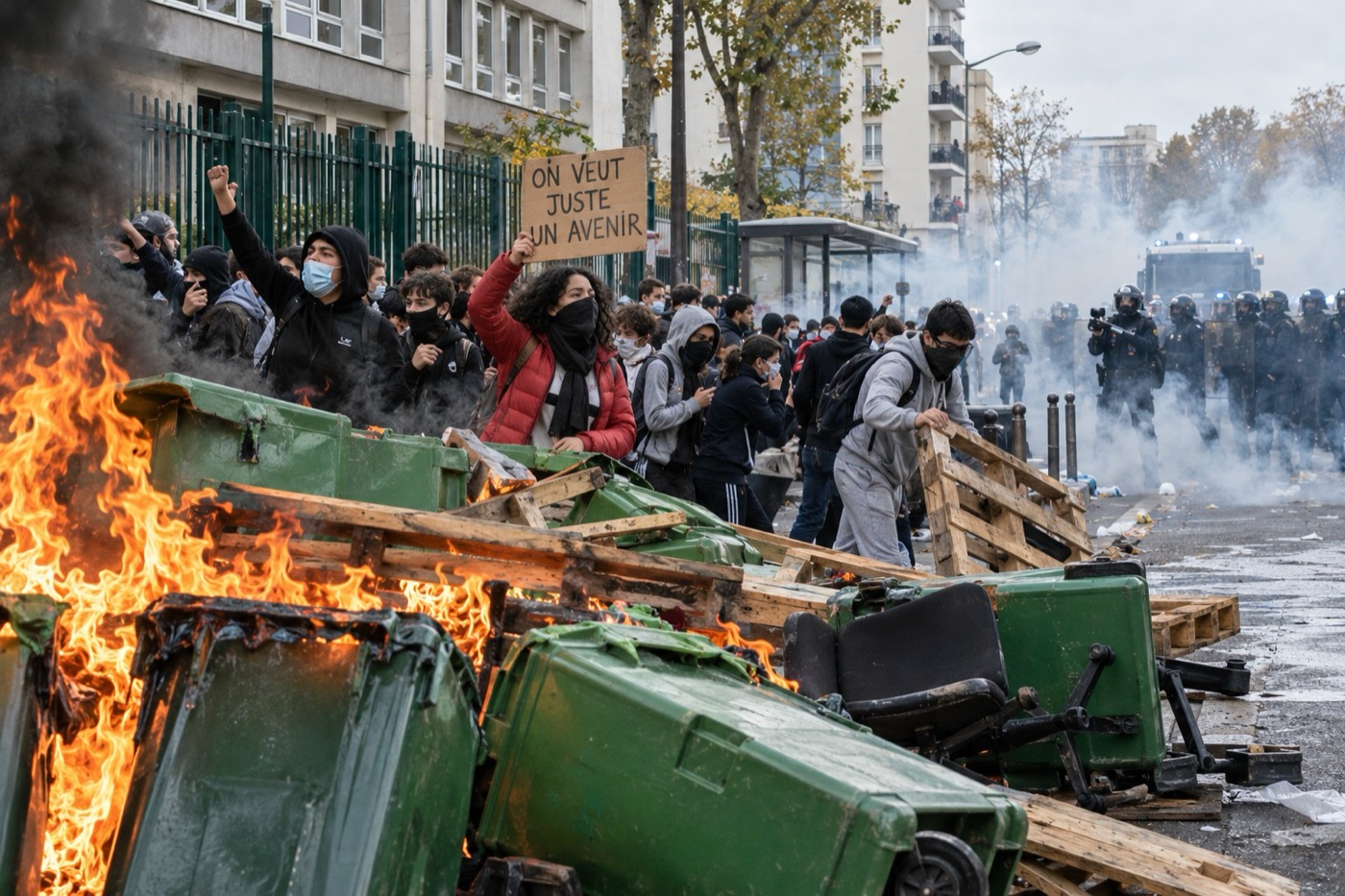
At some schools, students say lessons are cancelled because there are not enough staff. They also complain about crowded classrooms and buildings that need repairs. At a school in Saint-Denis, near Paris, students described poor conditions and demanded action. They blocked entrances and joined in demonstrations. Soon, other young people were organising their own protests. Students in other towns said they were putting up with the same problems.
On 13 October, large demonstrations took place across France. More than 160,000 people joined them, according to government figures, although the organisers gave a higher number. The Swedish climate campaigner Greta Thunberg visited students in Saint-Denis to show her support. The protests attracted attention far beyond France. Students argued that their education was being affected and that adults in power had not listened to them.
The French government said it would send in thousands of extra replacement teachers to schools that needed them. But many protesters believed this was not enough. They wanted a longer-term plan to improve classrooms, school buildings and teaching. Some parents and teachers supported the students, while others worried that staying away from lessons would make learning even harder. There were also clashes with police during some demonstrations, creating new arguments about how protests should be controlled.
There is no easy answer. Improving public schools costs money, and governments must decide how to spend limited budgets. But students in poorer areas may already have fewer opportunities than children in wealthier places. For the teenagers taking part, the protests are about more than missing a lesson. They want schools that give everyone a fair chance. Many of them say they are not asking for luxury, only for lessons that actually take place. Their biggest challenge is turning attention in the streets into real changes in the classroom.
Intermediate version
Since late September 2026, thousands of secondary-school students in France have walked out of lessons, blocked school gates and marched through city centres. Their complaint, as they put it, is straightforward: their schools are struggling, and the government is not doing enough to fix them.
Students describe overcrowded classrooms, buildings in poor condition and lessons cancelled because no teacher is available. The campaign gained attention in Saint-Denis, near Paris, where pupils at Lycée Paul Éluard protested against serious problems at their school. What began as anger over local conditions quickly grew into a wider movement. Young people in other cities recognised similar problems in their own schools and began to organise.
On 13 October, demonstrations brought more than 160,000 people onto French streets, according to official estimates. Organisers put the figure much higher. Greta Thunberg, who became internationally known through school strikes for climate action, visited students in Saint-Denis to support their demands. Her presence gave the campaign further publicity, although its main concerns remained practical: reliable lessons, decent buildings and enough teachers to cover the timetable.
The government promised to provide 3,000 additional replacement teachers in the worst-affected areas. Student groups and teaching unions welcomed attention to the problem but argued that temporary measures would not solve years of underinvestment. France also faces pressure to control public spending, making large improvements difficult to fund. A classroom may need repairs urgently, but money spent on schools cannot be spent elsewhere without changes to the budget. Unions argue that the shortage of teachers has been building up for years and will not be cleared up by short-term contracts.
The protests have not been entirely peaceful. Some marches led to clashes with police, injuries and arrests, prompting concerns about the treatment of young demonstrators. Authorities said they needed to respond to disorder, while students and campaigners accused police of using too much force. Meanwhile, some parents questioned whether missing weeks of school could damage the very education the protesters were trying to improve.
That contradiction is central to the debate. Continuing to attend poorly equipped schools may seem pointless to frustrated teenagers, yet prolonged disruption could leave them further behind. The movement also raises the question of educational inequality. If children in richer areas have more reliable lessons and better facilities, how equal are their opportunities? Whatever happens next, these students have spelled out what they expect: to have a say in decisions that shape their future.
Advanced version
The gates are blocked and the placards are handwritten. Many of the people demanding change are pupils who would normally be in class. Since late September, secondary-school students across France have protested about run-down buildings, staff shortages and what they say is too little money for public education.
At Lycée Paul Éluard in Saint-Denis, north of Paris, complaints about inadequate facilities became a focus for wider frustration. Students described disrupted timetables and an environment that fell short of the standards promised by the education system. Their grievances resonated well beyond the school gates. By 13 October, nationwide demonstrations had drawn more than 160,000 participants according to official figures, with organisers estimating substantially larger crowds. Greta Thunberg's visit to Saint-Denis brought international attention, though the campaign had already developed its own momentum.
The demonstrations expose a difficult tension in France's understanding of public education. Schools are supposed to embody republican equality, offering children opportunities that do not depend on their parents' income or postcode. Yet pupils argue that shortages and deteriorating infrastructure are not distributed evenly. When one school repeatedly cancels lessons and another is adequately staffed, the promise of equal opportunity becomes increasingly hard to defend. Pupils in Saint-Denis have been quick to point out that this gap is not an abstraction but their daily timetable.
The government's response has included a pledge to roll out 3,000 additional replacement teachers. That may alleviate immediate disruption, but campaigners insist that stopgap staffing arrangements cannot make up for sustained underinvestment.
Ministers face another political constraint: pressure to contain public expenditure and debt. Better recruitment, maintenance and classroom support require money, while competing priorities make additional spending contentious. The protests have laid bare the effects of years of underinvestment, so the dispute is as much about national choices as it is about local school conditions. Ministers who concede the principle while holding back the money are unlikely to satisfy anyone for long.
Policing has become a further source of controversy. Most demonstrations have been peaceful, but confrontations have produced injuries and arrests, and campaigners have accused officers of excessive force. Authorities point to incidents of violence and the need to maintain public order. These competing accounts underline the difficulty of policing a movement involving teenagers, many of whom are encountering organised political activism for the first time. The debate has widened from educational standards to the limits of protest and the state's responsibility towards young citizens. Those are questions that will not be settled by clearing a street.
There is an uncomfortable paradox at the heart of the strikes. By refusing to attend lessons, students risk losing more of the teaching they say they are being denied. Supporters respond that accepting the status quo carries its own long-term cost. Whether the movement secures lasting changes remains uncertain. What is already evident is a generation of pupils unwilling to be treated as passive recipients of government policy. In demanding better schools, they are also insisting on a voice in the institutions that shape their lives.
After you read
4True, false or not given5 statements
Choose T (true), F (false) or NG (the article does not say).
- Every parent and teacher supported the student protests.
The text says the opposite: "Some parents and teachers supported the students, while others worried that staying away from lessons would make learning even harder."
- The government agreed to send in more replacement teachers.
The text says: "The French government said it would send in thousands of extra replacement teachers to schools that needed them."
- According to the government, over 160,000 people took part on 13 October.
The text says: "More than 160,000 people joined them, according to government figures, although the organisers gave a higher number."
- The protests have already led to new school buildings.
Not stated. The text does not say whether any new school buildings have been built.
- Students say they want expensive new equipment for their schools.
The text says: "Many of them say they are not asking for luxury, only for lessons that actually take place."
5Vocabulary5 gaps
Complete the sentences with words from the box. Two words are not needed.
classroomscomplaineddemandedluxuryopportunitiesorganisersrepairs
- The of the march said far more people came than the police counted.
- The school roof was leaking, so the head teacher asked for money for urgent .
- After the accident, local families a safer road outside the school.
- A warm classroom with a working heater should not be seen as a .
- Children from poorer families often have fewer to succeed.
6Verb forms5 gaps
Write the correct form of the verb in brackets.
- Thousands of teenagers lessons for a very different reason. (MISS)
- At some schools, lessons because there are not enough staff. (CANCEL)
- On 13 October, large demonstrations place across France. (TAKE)
- The government said it send extra teachers to schools. (WILL)
- More than 160,000 people the demonstrations, according to government figures. (JOIN)
7Language focuscollocations
Complete the sentences with words from the box. Two words are not needed. Some words go together naturally. Learn the pair, not just the word, for example hold a meeting.
chanceheavyholdlimitedmakepayshow
- Hundreds of students gathered to a protest outside the town hall.
- The school needs to attention to its leaking roof.
- Many parents decided to their support for the students at the school gate.
- Schools have to work with budgets.
- Every child should get a fair to learn.
4True, false or not given5 statements
Choose T (true), F (false) or NG (the article does not say).
- All the marches passed off peacefully.
The text says the opposite: "Some marches led to clashes with police, injuries and arrests, prompting concerns about the treatment of young demonstrators."
- The government offered several thousand extra replacement teachers.
The text says: "The government promised to provide 3,000 additional replacement teachers in the worst-affected areas."
- The education minister met the student organisers.
Not stated. The text does not say whether the education minister met the student organisers.
- Teaching unions think short-term contracts will not end the teacher shortage.
The text says the shortage "will not be cleared up by short-term contracts".
- Police and campaigners agree that officers used too much force.
The text says students and campaigners accused police of too much force, while authorities said they had to respond to disorder.
5Vocabulary6 gaps
Complete the sentences with words from the box. Two words are not needed.
accusedconcernsdisorderequippedfrustratedpointlessreliableurgently
- The shop owner the delivery driver of breaking the window.
- After three hours of waiting, it seemed to stay any longer.
- The roof is leaking, so it needs to be fixed .
- Many teenagers feel when nobody listens to them.
- Residents raised about the noise from the new road.
- A science lab that is badly cannot teach practical lessons.
6Verb forms5 gaps
Write the correct form of the verb in brackets.
- By Friday, the head teacher all the afternoon lessons. (CANCEL)
- The government promised that 3,000 replacement teachers to the worst-affected areas. (SEND)
- If lessons keep being cancelled, students further behind. (FALL)
- Unions say the shortage for years. (BUILD UP)
- Several demonstrators during the march last week. (ARREST)
7Language focuscollocations
Complete the sentences with words from the box. Two words are not needed. Many verbs go with particular nouns. Check the noun near the gap and ask which verb sounds natural with it.
agreementcarrydogainholdputtake
- Teachers' unions plan to pressure on the government to hire more staff.
- The campaign began to attention after the first march.
- The ministry has promised to out a full review of school buildings.
- The two sides failed to reach an on how to spend the extra money.
- Politicians are expected to the demands of the protesters seriously.
4True, false or not given5 statements
Choose T (true), F (false) or NG (the article does not say).
- The writer suggests the campaign had gathered pace before Greta Thunberg arrived.
The text says the campaign "had already developed its own momentum".
- The writer thinks the promise of extra replacement teachers will fully solve the problem.
The text says it "may alleviate immediate disruption" but cannot make up for sustained underinvestment.
- Most of the injuries at the demonstrations were suffered by police officers.
The text mentions injuries and arrests but does not say who was hurt.
- Campaigners and authorities disagree about the cause of the violence at some demonstrations.
Campaigners accuse officers of excessive force, while authorities point to incidents of violence.
- Ministers who accept the students' case in principle but withhold funds are likely to end the dispute.
The text says such ministers "are unlikely to satisfy anyone for long".
5Vocabulary6 gaps
Complete the sentences with words from the box. Two words are not needed.
concedecontentiousdeterioratingexcessivemomentumpledgerecipientsresonated
- The singer's honest lyrics with fans who had faced similar struggles.
- After the second win, the campaign gathered such that opponents struggled to keep up.
- Under pressure from voters, the minister was finally forced to that the policy had failed.
- Plans to cut the library's funding proved highly among local residents.
- The condition of the bridge led engineers to close it to lorries.
- The judge ruled that the officers had used force against the unarmed crowd.
6Word forms5 gaps
Use the word in brackets to make a word that fits the gap.
- Campaigners described the fines as to the offence. (PROPORTION)
- The of the new rules has been uneven across the country. (ENFORCE)
- There is growing among staff with the new timetable. (SATISFY)
- Economists warned that the current level of spending was . (SUSTAIN)
- The of the official figures has been questioned. (RELY)
7Language focuscollocations
Complete the sentences with words from the box. Two words are not needed. Look for fixed or semi-fixed expressions. If you change one word, the whole phrase may sound wrong.
bargaindeafholdlaidlipraiseshift
- The inquiry has bare how little was spent on maintenance.
- Ministers have been accused of paying service to equality while cutting budgets.
- Local leaders drove a hard before agreeing to the deal.
- The minister's remarks fell on ears among angry teachers.
- Ministers are keen to the blame onto local councils.
Speak
8Talk about it3 questions
Discuss in pairs or small groups. Give reasons for your answers.
- What would make a student protest worth supporting?
- Should students help decide how a school spends its money?
- What could a school do to show it had really listened?
8Talk about it3 questions
Discuss in pairs or small groups. Give reasons for your answers.
- What would make a student protest worth supporting?
- Should students help decide how a school spends its money?
- What could a school do to show it had really listened?
8Talk about it3 questions
Discuss in pairs or small groups. Give reasons for your answers.
- What would make a student protest worth supporting?
- Should students help decide how a school spends its money?
- What could a school do to show it had really listened?
9Role-play: the school march
Work in pairs. Read your card, then have the conversation. Swap roles and do it again.
Student A · the parent
Your teenage son or daughter wants to miss school on Friday to join a march about school buildings. You understand the problem, but you're worried. Ask at least two questions before you decide.
Student B · the teenager
You want to join a student march on Friday. Explain why it matters, answer your parent's worries and suggest a plan that makes it safe.
Useful phrases
- I'd like to join the march on Friday.
- I'm worried you'll fall behind.
- It's not just about me, it's about everyone.
- What if things get out of hand?
- Could we agree on a compromise?
- I'll catch up on the lesson at the weekend.
Afterwards, tell the class: did the parent agree, and what condition did they set?
Your words
Highlights0 saved
Highlights0 saved
Highlights0 saved
Was this lesson useful? Support johnplusnews on Ko-fi
Continue reading
Education
Learning to Read at 46: A Second Chance at Life
For most people, reading is something they learn as children. But one British man spent decades unable to read a book, a menu or even a food label. Then, at the age of 46, everything began to change.
Society
A Home for Life? The Housing Crisis Shaking Spain
The eviction and death of an 87-year-old woman in Madrid have sparked protests across Spain, raising serious questions about the country's growing housing crisis.
Travel
Why Are Canadians Turning Their Backs on American Holidays?
Canadians have long been frequent visitors to the United States. But political tensions are changing some people's travel plans, and American tourist businesses are noticing.