News lesson6 October 2026
How Butter Became a Destination
Fifty varieties, a crowded shop and social media doing the rest. The ingredient most of us hide in the fridge is having a moment.
Before you read
1Warm up3 questions
Talk about these questions with a partner.
- Which ordinary food would you queue to try?
- Can good packaging make a familiar product feel special?
- Would you travel across town for something you saw online?
2Key words8 words
These words are in the article. Choose the letter of the meaning for each one.
- struggle
- varieties
- compare
- alternatives
- trend
- luxury
- tourists
- waste
- Adifferent kinds of the same thing
- Bsomething very nice that you do not really need
- Cpeople who visit a place for a holiday
- Dother things you can choose instead
- Esomething that many people start to like at the same time
- Fto find something hard to do
- Gthings you throw away because you do not use them
- Hlook at two things to see how they are the same or different
1Warm up3 questions
Talk about these questions with a partner.
- Which ordinary food would you queue to try?
- Can good packaging make a familiar product feel special?
- Would you travel across town for something you saw online?
2Key words8 words
These words are in the article. Choose the letter of the meaning for each one.
- nervous
- devoted
- queue
- enthusiasts
- texture
- striking
- tension
- craftsmanship
- Aa little afraid or worried about something
- Bvery surprising or easy to notice
- Chow something feels, for example smooth or rough
- Da line of people waiting for something
- Ea feeling of conflict between two ideas or sides
- Fpeople who are very interested in something
- Gmade for one purpose only, or giving all your time to it
- Hgreat skill in making things by hand
1Warm up3 questions
Talk about these questions with a partner.
- Which ordinary food would you queue to try?
- Can good packaging make a familiar product feel special?
- Would you travel across town for something you saw online?
2Key words8 words
These words are in the article. Choose the letter of the meaning for each one.
- eccentric
- celebrated
- versatility
- peculiar
- extravagant
- edible
- contradictions
- marketable
- Asafe and good to eat
- Bfamous and admired by many people
- Ccosting or using much more than is needed
- Dfacts or ideas that do not fit together
- Ethe ability to be used in many different ways
- Fstrange in a way that is unusual or a little funny
- Gstrange or unusual, often in an unexpected way
- Heasy to sell because people want it
Read
3Read the article
The paragraphs are numbered. Look out for the key words from task 2.
Core version
On a hot summer day in Paris, Erwan Leo opened a new shop. The strange thing was that it sold almost nothing but butter. With temperatures close to 41°C, he worried that the fridges might struggle and customers might stay away. Instead, people began turning up. Some even had to wait outside. Butter, a food most of us keep quietly in the fridge, had become something worth travelling for.
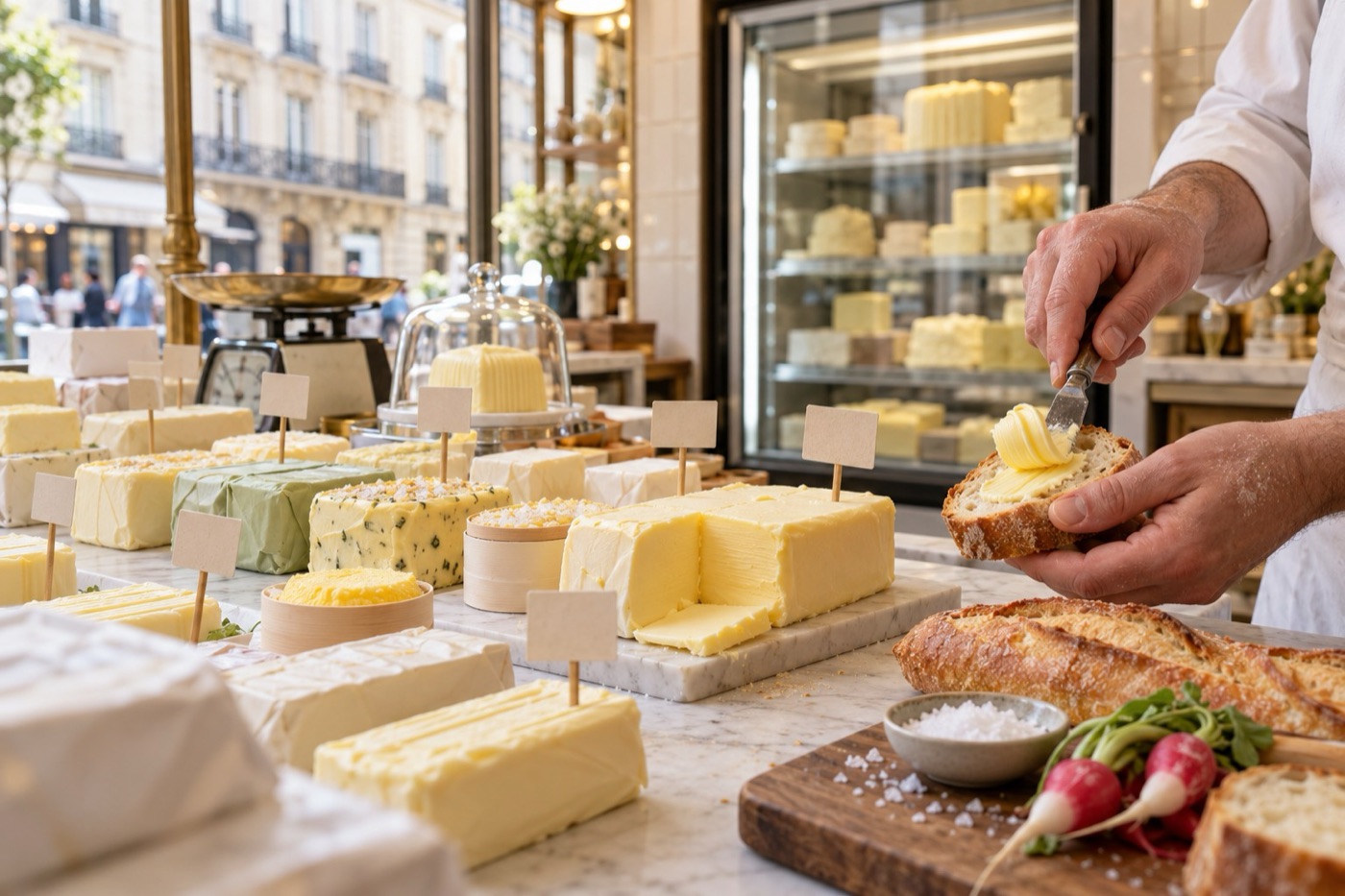
The shop, called Le Butter, opened in 2026. It sells around fifty different types, including special salted varieties. The colourful displays look beautiful in photographs, and social media has helped spread the word. Nearby, another famous food shop offers an even bigger choice. Tourists come looking for something unusual to take home, while cooks compare flavours like other people compare expensive wines.
Butter was not always treated with this much love. For years, many people tried to cut down on it because it contains a lot of saturated fat. Margarine and vegetable oils became popular alternatives. Now butter is appearing again in fashionable restaurants and online cooking videos. Chefs whip it until it is soft, add herbs or serve it with warm bread before the main meal.
Why are people so excited about something ordinary? Part of the answer is taste. Good butter can be creamy, rich and slightly salty, with different flavours depending on how it is made. It can turn a simple piece of toast into a delicious breakfast. And buying a special packet of butter costs much less than booking an expensive holiday or buying a designer handbag.
There is also something comforting about familiar food. People often enjoy small treats when life feels stressful or uncertain. Fresh bread and butter can feel like a luxury. But some chefs are worried about the trend. Huge displays made for photographs may lead to food waste. Not everybody thinks a mountain of butter looks appetising.
The new excitement does not mean butter has become a health food. It still contains plenty of saturated fat, so how much we eat matters. Nutrition advice has not disappeared just because an ingredient is fashionable. Perhaps the sensible approach is to enjoy good butter sometimes, without going overboard. Next time you spread it on toast, you might look at it differently. What used to be a basic kitchen item has become the star of the show.
Intermediate version
When Erwan Leo opened a shop devoted to butter in Paris during the summer of 2026, he had reasons to be nervous. The temperature was approaching 41°C, hardly ideal weather for selling a product that needs careful refrigeration. He was also unsure whether enough customers would turn up. Yet within months, Le Butter had attracted such interest that people sometimes had to queue outside. The humble ingredient normally hidden in our fridges had become a destination in its own right.
Inside the shop, customers can choose from around fifty varieties, including carefully produced salted butters. Some travellers buy several packets to take home, while food enthusiasts discuss flavour and texture with the seriousness usually reserved for cheese or wine. Elsewhere in Paris, a prestigious food department offers an even larger selection. According to a Guardian report in October 2026, butter is appearing at fashionable events, on restaurant tables and across social media in increasingly elaborate forms.
The change is striking because butter spent decades struggling with an unfashionable reputation. One generation remembers being told to replace it; younger food lovers may now discover it through stylish restaurant menus and recommendations on their phones. Health advice about saturated fat encouraged many households to cut back and switch to alternative spreads. Now chefs are whipping butter with herbs, shaping it into decorative pieces and treating bread and butter as a highlight rather than an afterthought. For some customers, the attraction is straightforward: a high-quality version of an everyday product can taste genuinely different.
There may also be an economic explanation, although this is interpretation rather than something the report proves. When larger luxuries feel out of reach, people sometimes look for smaller pleasures they can still afford. A special packet of butter might cost several euros, considerably more than a supermarket version but far less than a fine restaurant meal. Paired with fresh bread, it turns an ordinary evening into a small occasion. Social media then amplifies that pleasure, particularly when the packaging and presentation look irresistible on camera.
Not everybody welcomes the obsession. Some chefs question whether extravagant butter displays are more about getting attention than enjoying food. A beautifully prepared plate can be impressive, but huge sculpted arrangements may end up being thrown away. There is also a tension between describing butter as a natural, comforting ingredient and pretending that the nutritional concerns have vanished. Butter still contains saturated fat, and fashionable does not automatically mean healthy.
Perhaps the trend says more about how we treat food than about butter itself. We have a habit of rediscovering familiar ingredients, giving them stylish packaging and turning them into objects of desire. Sometimes that encourages people to appreciate quality and craftsmanship; sometimes it simply creates another expensive craze. When the excitement dies down, the best test may be surprisingly ordinary: does the butter make a piece of bread taste wonderful? If it does, perhaps that is enough.
Advanced version
In the summer of 2026, opening a shop dedicated to butter in Paris looked like an eccentric commercial gamble. The city was enduring temperatures approaching 41°C, and proprietor Erwan Leo was understandably anxious about his refrigerators, let alone the size of his potential customer base. Yet his shop, Le Butter, quickly drew enough attention to warrant managing queues outside. A substance that had spent decades as a mundane kitchen essential was being transformed into a desirable souvenir, an object of culinary expertise and, increasingly, a social media spectacle.
The Paris boutique stocks roughly fifty varieties, while a celebrated food hall elsewhere in the city offers an even more extensive selection. Customers compare the subtle flavours of salted, cultured and regionally produced butters much as enthusiasts might discuss wine. Reporting for the Guardian in October 2026, Morwenna Ferrier described tourists stocking up, restaurants presenting elaborate butter dishes and fashionable events using the ingredient as decoration. Butter has moved beyond the bread basket and into a strange new role as a statement about taste.
Its rehabilitation is remarkable given the ingredient's recent history. For years, conversations about saturated fat gave butter an unhealthy reputation, and many consumers moved towards margarine or vegetable oils. The current enthusiasm does not erase those concerns, but it does highlight the difference between nutritional guidance and food culture. Chefs have long valued butter for its richness and versatility. What's new is the extent to which a once-unremarkable ingredient is being singled out for admiration, photographed and sold as an experience in itself.
Part of the appeal lies in what might be called affordable indulgence. During periods of financial pressure, a costly holiday or designer purchase may be out of the question, whereas a beautifully wrapped packet of butter remains attainable. Add crusty bread and a quiet evening, and an everyday meal can feel unexpectedly luxurious. Social media helps such small pleasures catch on, particularly when producers package them with the visual care ordinarily associated with jewellery or cosmetics. The result is a peculiar mixture of genuine gastronomic curiosity and highly marketable nostalgia.
Still, the butter boom carries contradictions. Restaurants that pride themselves on sustainability may struggle to justify extravagant edible centrepieces that risk ending up in the bin. Social media encourages ever more theatrical displays, even when the ingredient's real virtues are best appreciated in modest quantities. And although butter's reputation may have softened, it remains rich in saturated fat. The claim that something is traditional, artisanal or beautifully presented should not be mistaken for scientific evidence that unlimited consumption is harmless.
Perhaps the more revealing question is why we continually turn familiar foods into cultural events. A good ingredient deserves recognition, and skilled producers can offer real differences in flavour and quality. But trends also encourage us to confuse scarcity, packaging and online popularity with lasting value. When the queues shorten, butter will still have its simplest appeal: melting into warm bread.
After you read
4True, false or not given5 statements
Choose T (true), F (false) or NG (the article does not say).
- The Paris shop sells roughly fifty kinds of butter.
The text says: "It sells around fifty different types, including special salted varieties."
- It was very hot in Paris when the shop opened.
The text says: "With temperatures close to 41°C, he worried that the fridges might struggle and customers might stay away."
- The text says that butter is now a health food.
The text says the opposite: "The new excitement does not mean butter has become a health food."
- The shop plans to open branches in other countries.
Not stated. The text does not say whether the shop will open more branches.
- Butter has always been loved as much as it is today.
The text says: "Butter was not always treated with this much love."
5Vocabulary5 gaps
Complete the sentences with words from the box. Two words are not needed.
colourfulcomfortingfamiliarordinarysensibleuncertainunusual
- It is to carry water when you walk in hot weather.
- A hot bowl of soup can be very on a cold, rainy evening.
- A shop that sells only butter is , because most shops sell many things.
- The song was to me because I had heard it many times.
- It was just an Tuesday, so nothing special happened.
6Verb forms5 gaps
Write the correct form of the verb in brackets.
- On a hot summer day in Paris, Erwan Leo a new shop. (OPEN)
- Butter was not always with this much love. (TREAT)
- Perhaps the sensible approach is good butter sometimes. (ENJOY)
- Tourists come for something unusual to take home. (LOOK)
- Nutrition advice has not just because an ingredient is fashionable. (DISAPPEAR)
7Language focuslinking words
Complete the sentences with words from the box. Two words are not needed. Linking words join ideas. Ask yourself: is the second idea a result, a reason, a contrast or something at the same time?
althoughbecausehoweverinsteadsounlesswhile
- I wanted a hot drink, I made some tea.
- of cheese, we bought butter.
- The shop closed early the heat was too strong.
- The butter is expensive. , many people still buy it.
- Please wait outside I find us a table.
4True, false or not given5 statements
Choose T (true), F (false) or NG (the article does not say).
- A newspaper report in October 2026 described the butter trend.
The text says: "According to a Guardian report in October 2026, butter is appearing at fashionable events, on restaurant tables and across social media in increasingly elaborate forms."
- Butter's nutritional concerns have gone away.
The text says the opposite: "There is also a tension between describing butter as a natural, comforting ingredient and pretending that the nutritional concerns have vanished."
- Butter sales in France rose by a fifth in 2026.
Not stated. The text gives no figures for butter sales.
- Some chefs think the butter displays are mainly about getting attention.
The text says: "Some chefs question whether extravagant butter displays are more about getting attention than enjoying food."
- The report proves that people buy luxury butter because money is tight.
The text calls this "interpretation rather than something the report proves".
5Vocabulary6 gaps
Complete the sentences with words from the box. Two words are not needed.
amplifiescrazeelaborateextravaganthumbleovercrowdedprestigiousreluctant
- She wanted to study at a university with a famous name.
- The cake was covered in decorations that took hours to make.
- Online sharing often a small problem until everyone is talking about it.
- Spending a fortune on one dinner seems when money is tight.
- Last summer's for brightly coloured trainers was over within a year.
- Although he became famous, he stayed and still lived in his small village.
6Verb forms5 gaps
Write the correct form of the verb in brackets.
- By the time the doors opened, a long queue outside. (FORM)
- Butter in a cool place. (KEEP)
- She a thick layer of butter on the bread when the phone rang. (SPREAD)
- Our local bakery very popular since it started selling cheese. (BECOME)
- The bread and butter at the restaurant last night. (SERVE)
7Language focuslinking words
Complete the sentences with words from the box. Two words are not needed. Check what comes next. Words like despite need a noun, words like whereas need a full clause, and some join two sentences.
despitemeanwhileneverthelessotherwiseprovidedunlesswhereas
- the rain, hundreds of people queued for the new bakery.
- You should book a table; , you may have to wait for hours.
- My sister loves strong cheese, I prefer mild varieties.
- The recipe was simple. , the result tasted wonderful.
- Stores usually will not refund food it arrives damaged.
4True, false or not given5 statements
Choose T (true), F (false) or NG (the article does not say).
- The writer suggests that butter's return owes more to food culture than to any change in nutritional guidance.
The text says the enthusiasm "does not erase those concerns" but highlights "the difference between nutritional guidance and food culture".
- Most of the customers at Le Butter are tourists.
Not stated. The text mentions tourists stocking up but gives no breakdown of customers.
- The writer treats packaging as irrelevant to the appeal of small luxuries.
The text says social media helps small pleasures catch on "when producers package them with the visual care" of jewellery or cosmetics.
- Butter's unhealthy reputation in recent decades came from nutritional concerns, not from chefs disliking it.
The text says saturated fat gave butter an unhealthy reputation, while "Chefs have long valued butter".
- Butter sales in Paris have doubled since the shop opened.
Not stated. The text gives no sales figures.
5Vocabulary6 gaps
Complete the sentences with words from the box. Two words are not needed.
affluenceattainableconnoisseurgastronomicnostalgiaproprietorrehabilitationwarrant
- The evidence is too thin to a full investigation.
- The of the family restaurant refused to sell it, whatever the offer.
- After years of disgrace, the architect's began when a major museum put his work on display.
- A house in the city centre is no longer for most young people on average wages.
- The film trades on for a simpler past.
- The region is a magnet for tourism, with food trails and tasting menus.
6Word forms5 gaps
Use the word in brackets to make a word that fits the gap.
- The company's to adapt cost it dearly. (WILLING)
- Critics questioned the of building yet another stadium. (SUSTAIN)
- Her approach to money meant she saved little and spent on a whim. (IMPULSE)
- The that the firm had hidden its losses was firmly denied. (ALLEGE)
- The of fresh herbs in winter forces chefs to plan ahead. (SCARCE)
7Language focuslinking words
Complete the sentences with words from the box. Two words are not needed. At this level, notice register and grammar. Notwithstanding takes a noun, albeit takes an adjective or phrase, and hence follows a semicolon.
albeithencenamelynonethelessnotwithstandingtherebywhereas
- the high prices, the shop was packed every weekend.
- The recipe was tasty, rather rich.
- Critics call the dish overpriced, its fans insist it is worth every penny.
- The festival was meant to be small; , it drew crowds in the thousands.
- Demand far exceeded supply; , prices climbed sharply.
Speak
8Talk about it3 questions
Discuss in pairs or small groups. Give reasons for your answers.
- When is a food trend worth the fuss?
- Would a special version of an everyday food feel like a treat or a waste?
- What familiar food from your area deserves more attention?
8Talk about it3 questions
Discuss in pairs or small groups. Give reasons for your answers.
- When is a food trend worth the fuss?
- Would a special version of an everyday food feel like a treat or a waste?
- What familiar food from your area deserves more attention?
8Talk about it3 questions
Discuss in pairs or small groups. Give reasons for your answers.
- When is a food trend worth the fuss?
- Would a special version of an everyday food feel like a treat or a waste?
- What familiar food from your area deserves more attention?
9Role-play: a trip to the butter shop
Work in pairs. Read your card, then have the conversation. Swap roles and do it again.
Student A · the food fan
You've seen a shop that sells fifty kinds of butter. You want to spend Saturday morning there. Persuade your friend to come. Say why it's worth a trip.
Student B · the sensible friend
You think queuing for butter is silly. You'd rather save money and cook at home. Ask questions, then agree on a plan you both like.
Useful phrases
- Have you seen this shop?
- I'd love to go on Saturday.
- Is it really worth queuing for?
- I'd rather save my money, to be honest.
- We could go early, so there won't be a queue.
- Let's meet in the middle: shop first, then lunch at home.
Afterwards, tell the class: where did you decide to go, and who gave way?
Your words
Highlights0 saved
Highlights0 saved
Highlights0 saved
Was this lesson useful? Support johnplusnews on Ko-fi
Continue reading
Work
Could a Better Job Be About Time, Not Money?
A global survey of 40,500 workers found that work-life balance has overtaken salary as the main reason people would consider leaving a job. What does that tell us about how people want to live?
Food
The Chef Who Lost His Job Over Pineapple
An Italian chef in Australia was sacked for refusing to add pineapple. A food historian says the rule he was defending is younger than he thinks.
Lifestyle
Can You Learn a Better Life from an Italian Grandmother?
Two friends in their late eighties bake bread in a small Italian town. The internet has decided they are the answer to something.