News lesson19 July 2025
Not Fewer Mosquitoes, but Different Ones
Spraying treats a neighbourhood and then wears off. Brazil is trying to change the local insect population itself, and asking residents to trust a much slower answer.
Before you read
1Warm up3 questions
Talk about these questions with a partner.
- What would you think if someone said they were releasing more mosquitoes near your home?
- What makes you trust a surprising scientific idea?
- Who would you want to explain a new local health project?
2Key words8 words
These words are in the article. Choose the letter of the meaning for each one.
- dengue
- bacterium
- chemicals
- residents
- breed
- standing water
- scale
- programme
- Aa very small living thing that you cannot see
- Bpeople who live in a particular place
- Chave babies, or make young animals
- Dthe size of something
- Ea plan of work with a clear aim
- Fsubstances made in a factory or laboratory, such as poison
- Gwater that stays in one place and does not move
- Ha disease from mosquito bites that gives people a high fever
1Warm up3 questions
Talk about these questions with a partner.
- What would you think if someone said they were releasing more mosquitoes near your home?
- What makes you trust a surprising scientific idea?
- Who would you want to explain a new local health project?
2Key words8 words
These words are in the article. Choose the letter of the meaning for each one.
- outbreak
- residential
- insecticide
- generations
- reproduce
- monitoring
- deliberately
- subtle
- Aeach new group of young born after the one before
- Ba chemical that kills insects
- Csmall and clever, not obvious
- Dhave young and so make more of the same kind
- Ea sudden increase in the number of people with a disease
- Fon purpose, not by accident
- Gto do with places where people live, not work
- Hwatching something carefully over time to see changes
1Warm up3 questions
Talk about these questions with a partner.
- What would you think if someone said they were releasing more mosquitoes near your home?
- What makes you trust a surprising scientific idea?
- Who would you want to explain a new local health project?
2Key words8 words
These words are in the article. Choose the letter of the meaning for each one.
- inaugurated
- conveyed
- successive
- consent
- vectors
- coexist
- sanitation
- mechanism
- Acoming one after another
- Bcommunicated an idea or message to someone
- Clive or exist together at the same time
- Dthe way that something works
- Ecreatures that carry a disease from one living thing to another
- Fpermission, or agreement to something
- Gofficially opened, often with a ceremony
- Hthe systems that keep places clean, such as drains and waste removal
Read
3Read the article
The paragraphs are numbered. Look out for the key words from task 2.
Core version
Imagine hearing that your city plans to release thousands of mosquitoes into the streets. Most people would probably be worried. Mosquitoes can spread dengue fever, a disease that can make people very ill. Yet in Brazil, releasing certain mosquitoes is part of an unusual plan to protect the public.
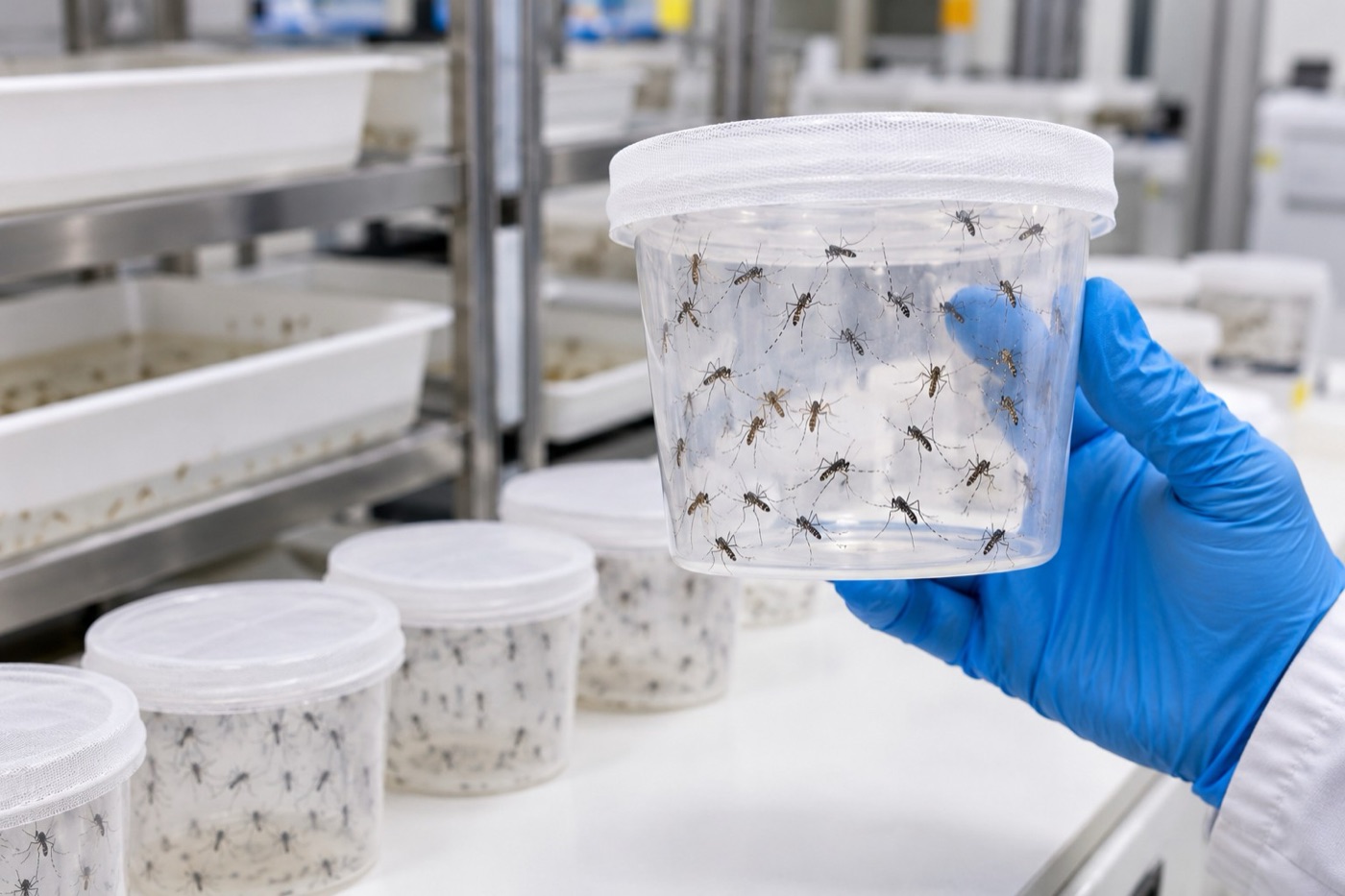
Scientists have found that a bacterium called Wolbachia, found naturally in many insects, makes it much harder for a mosquito to pass some viruses on to humans. In July 2025, a large mosquito factory opened in Curitiba, in southern Brazil, to produce mosquitoes that carry it. Its purpose is not to create more dangerous insects.
Scientists raise the insects in carefully controlled conditions. When mosquitoes carrying Wolbachia are released, they breed with the local mosquitoes. Over time, more and more of the mosquitoes in the area carry the bacterium. The aim is to bring down the number of people who catch dengue, Zika and chikungunya.
This idea sounds surprising because people usually fight mosquitoes by killing them. Spraying chemicals and removing standing water can help, but the insects keep coming back. The Wolbachia method tries to change the mosquitoes themselves rather than simply reduce their numbers for a few weeks. It works more slowly, but the effect is designed to last.
There is an important detail: these mosquitoes can still bite. They are not harmless, and no single method can stop every case of dengue. People still need to get rid of standing water around their homes and protect themselves from bites. The new programme works together with those older methods, not instead of them.
Public health workers also have to explain the plan to local residents. It is natural to feel nervous when a government sets up a factory for insects and then releases them near your house. Clear information matters here as much as good science does.
Brazil has already used the method in other cities, and the new factory is designed to produce mosquitoes on a much larger scale. Sometimes the best answer to a problem is not to fight nature harder. In the long run, it may be to understand nature well enough to work with it.
Intermediate version
Releasing mosquitoes into residential neighbourhoods sounds like the last thing a health department should do during a dengue outbreak. Yet Brazil is doing precisely that. In July 2025, officials opened a major production centre in Curitiba dedicated to breeding mosquitoes that can help interrupt the spread of infectious diseases.
The key is Wolbachia, a bacterium found naturally in many insects. When it is present in the Aedes aegypti mosquito, it reduces the insect's ability to transmit several viruses, including dengue, Zika and chikungunya. The aim is not to create a different species, but to build up a local mosquito population in which Wolbachia is common.
At the production facility, eggs are raised under controlled conditions before the mosquitoes are distributed through public-health programmes. Once released, they reproduce with wild mosquitoes and pass Wolbachia to later generations. Unlike spraying an area with insecticide, which has to be repeated, the method is designed to have an effect that continues on its own.
That distinction explains why the approach appeals to health authorities. Insecticide campaigns can be rolled out quickly, but they treat a neighbourhood rather than change it, and the mosquitoes return as soon as the spraying stops. A population in which Wolbachia has taken hold does not need to be re-treated in the same way, although it does need monitoring.
Researchers and authorities have tested the approach in Brazilian communities for years. Results from some locations have been encouraging, although the level of protection depends on local conditions and on how successfully the new mosquito population becomes established. The facility in Curitiba was built to expand a programme that already existed rather than to start one from nothing.
Reach is not the same as results: how many mosquitoes are released is a different question from how many people avoid infection. Measuring success is not straightforward either. A fall in dengue cases can have more than one cause, so authorities have to track how far Wolbachia has spread among local mosquitoes as well as how infection rates change over several seasons. Encouraging figures from one city do not guarantee the same outcome somewhere with different conditions.
Winning over the public is a separate challenge. Residents may reasonably ask why their government is deliberately adding insects that still bite. Clear explanations are essential: Wolbachia mosquitoes are not incapable of biting, and the strategy complements rather than replaces measures such as emptying water containers and protecting homes. Nobody involved is presenting it as a quick fix.
What makes the story remarkable is the reversal of an everyday assumption. People associate fewer mosquitoes with better health, but the more important question here is which mosquitoes are present. Brazil's experiment shows how understanding a disease carrier can lead, in the long term, to a far more subtle form of disease control.
Advanced version
For generations, public-health campaigns have conveyed a simple message: reduce mosquito populations and you reduce mosquito-borne disease. Brazil's expanding Wolbachia programme challenges that intuition. Rather than attempting to exterminate every disease-carrying insect, researchers are deliberately introducing mosquitoes whose biology makes them less effective at transmitting viruses.
A large-scale production facility inaugurated in Curitiba in July 2025 represents a significant expansion of that strategy. It breeds Aedes aegypti mosquitoes carrying Wolbachia, a naturally occurring bacterium that can interfere with the transmission of dengue, Zika and chikungunya. Released insects reproduce with wild populations, allowing the bacterium to spread across successive generations.
The innovation lies in population replacement rather than straightforward population reduction. Conventional measures such as insecticides may bring immediate benefits but generally require repeated application. The Wolbachia approach seeks a more durable change in a population's capacity to transmit infection. It is biological control, not a claim that the insects themselves have become entirely benign.
Scaling that idea up is a considerable undertaking. Breeding the mosquitoes requires careful control of temperature, food and quality. Enough of them must then be released in the right places for Wolbachia to spread through the local population. A facility of this size is an admission that the method only works as a sustained operation, not as a one-off intervention.
Field results in Brazil and elsewhere have offered promising evidence, though outcomes vary. Local ecology, release strategies and the extent to which Wolbachia becomes established all influence effectiveness. Even successful programmes must coexist with surveillance, treatment, sanitation and the removal of breeding sites. No responsible scientist would present a single intervention as a silver bullet. Nor is the comparison with insecticide entirely one-sided, since spraying at least offers visible, immediate reassurance, whereas population replacement asks the public to wait for a benefit it cannot see.
There is also a question of consent to which there is no tidy answer. An individual may decline a medical treatment, but nobody can opt out of the mosquitoes in their own street. Interventions that operate on an environment rather than a patient therefore rest on collective agreement, which is harder to secure and easier to lose than the individual kind.
Public confidence may prove almost as important as laboratory performance. People understandably associate mosquito releases with increased danger, and officials must explain both the mechanism and its limitations without overstating the evidence. That requires transparency about monitoring, genuine community consultation and candour about the continued possibility of bites.
It is worth noting how unusual such candour is in public health communication. Campaigns normally promise protection; this one asks residents to accept more of something they dislike in exchange for a benefit that is statistical, gradual and largely invisible. Trust, once lost over a programme of that kind, would be exceptionally difficult to rebuild.
The larger lesson is that the relationship between humans and disease vectors is more complicated than a battle against insects. By altering a mosquito's ability to transmit infection rather than trying to wipe the species out, Brazil is testing whether an apparently counter-intuitive intervention can deliver a practical public-health benefit at scale.
After you read
4True, false or not given5 statements
Choose T (true), F (false) or NG (the article does not say).
- The factory in Curitiba opened in July 2025.
The text says: "In July 2025, a large mosquito factory opened in Curitiba, in southern Brazil."
- The programme works alongside older methods such as removing water.
The text says: "The new programme works together with those older methods, not instead of them."
- Mosquitoes carrying Wolbachia cannot bite.
The text says the opposite: "There is an important detail: these mosquitoes can still bite."
- The factory produces a million mosquitoes a week.
Not stated. The text does not say how many mosquitoes the factory produces.
- The Wolbachia method works faster than spraying.
The text says: "It works more slowly, but the effect is designed to last."
5Vocabulary5 gaps
Complete the sentences with words from the box. Two words are not needed.
avoidexplainignorenervousprotectspreadunusual
- Mosquito bites can serious diseases from person to person.
- Some residents feel about living near a mosquito factory.
- Long sleeves and nets help to you from bites.
- The mayor must the plan clearly so that people understand it.
- Most cities do not breed insects, so this is a very plan.
6Verb forms5 gaps
Write the correct form of the verb in brackets.
- In July 2025, a large mosquito factory in Curitiba. (OPEN)
- The bacterium naturally in many insects. (FIND)
- In the past, many cities chemicals to kill mosquitoes. (SPRAY)
- When the mosquitoes , they breed with the local ones. (RELEASE)
- Brazil this method in other cities, so it is not completely new. (USE)
7Language focuscollocations
Complete the sentences with words from the box. Two words are not needed. A collocation is a pair of words that naturally go together. Learn the pair as one piece, for example catch a disease.
catchheavymakepaypublicstandingtake
- People usually dengue after being bitten by an infected mosquito.
- Empty any water around your home, because mosquitoes breed there.
- health workers visit homes to answer questions.
- Mosquitoes multiply quickly after rain.
- Residents can part in meetings about the plan.
4True, false or not given5 statements
Choose T (true), F (false) or NG (the article does not say).
- Wolbachia occurs naturally in many insects.
The text says: "The key is Wolbachia, a bacterium found naturally in many insects."
- The Curitiba facility started the programme from nothing.
The text says the opposite: "The facility in Curitiba was built to expand a programme that already existed rather than to start one from nothing."
- Dengue cases in Curitiba have halved since the factory opened.
Not stated. The text gives no figures for dengue cases in Curitiba.
- Falling dengue figures may have more than one explanation.
The text says: "A fall in dengue cases can have more than one cause"
- The programme aims to create a new species of mosquito.
The text says: "The aim is not to create a different species."
5Vocabulary6 gaps
Complete the sentences with words from the box. Two words are not needed.
a quick fixbuild upcome up withinterruptrolled outtaken holdthe last thingwear off
- Releasing mosquitoes sounds like a health department should do.
- The aim is to a population in which Wolbachia is common.
- Hand washing can the spread of some infections.
- Insecticide campaigns can be quickly.
- A population in which Wolbachia has needs less re-treatment.
- The method is slow, so nobody is presenting it as .
6Verb forms5 gaps
Write the correct form of the verb in brackets.
- By the time the factory opened, the method in several Brazilian communities. (TEST)
- Spraying stopped in the street last month, and the mosquitoes since. (RETURN)
- Right now, nobody the method as a miracle cure. (DESCRIBE)
- If the programme had started a year earlier, more people protected last season. (BE)
- The facility to expand a programme that already existed. (BUILD)
7Language focuscollocations
Complete the sentences with words from the box. Two words are not needed. Verbs are picky about their nouns. You raise awareness, face criticism and measure results, but you do not do them the other way round.
facehaveheavylongmeasurepayraise
- Spraying can an immediate effect, but it wears off.
- Posters and meetings help to awareness of how the programme works.
- Officials who release insects may criticism at first.
- It takes years to the results accurately.
- In the term, the effect is designed to last.
4True, false or not given5 statements
Choose T (true), F (false) or NG (the article does not say).
- The writer implies that insecticide has one advantage over the Wolbachia approach.
The text says spraying "at least offers visible, immediate reassurance".
- The writer suggests that the Wolbachia approach removes the need for other disease-control measures.
The text says even successful programmes "must coexist with surveillance, treatment, sanitation" and the removal of breeding sites.
- Residents were consulted before the Curitiba facility was built.
The text says consultation is needed but does not say whether it happened.
- According to the writer, consent works differently for a medical treatment than for a mosquito release.
An individual may decline treatment, but nobody can opt out of the mosquitoes in their own street.
- The writer treats the size of the Curitiba plant as a sign that a single release would be enough.
The text says a facility of this size admits the method only works "as a sustained operation, not as a one-off intervention".
5Vocabulary6 gaps
Complete the sentences with words from the box. Two words are not needed.
benignconsiderableconveycounter-intuitivedeclinedurableexterminatesurveillance
- Most lumps are , but a doctor should still examine every one.
- Rather than the species, the researchers want people to learn to live alongside it.
- Patients are entitled to a treatment they do not want.
- A solution still works years after it was installed, unlike a stopgap.
- Hospitals rely on to detect new cases of a disease before it spreads.
- Economists often find that the correct policy is , which is why voters resist it.
6Word forms5 gaps
Use the word in brackets to make a word that fits the gap.
- The of the intervention depends on how widely Wolbachia spreads. (EFFECTIVE)
- Officials were criticised for their to explain the risks. (WILLING)
- The trial produced results, so scientists asked for further research. (CONCLUDE)
- Presenting the figures without context would be . (MISLEAD)
- The agency promised greater to the communities it affects. (ACCOUNT)
7Language focuscollocations
Complete the sentences with words from the box. Two words are not needed. Some collocations are almost fixed chunks. You strike a balance, shed light on something and hold a vested interest. Learn the whole chunk.
bearerodemetposeshedstrikevested
- The agency must a balance between reassuring residents and admitting the risks.
- Careless messaging could public trust for good.
- The announcement was with scepticism.
- A pilot study can light on whether a method works in a particular climate.
- Companies with a interest in the outcome should declare it.
Speak
8Talk about it3 questions
Discuss in pairs or small groups. Give reasons for your answers.
- What would residents need to know before welcoming these mosquitoes?
- Would a successful trial elsewhere persuade you to support a local project?
- How could scientists earn trust before asking people to accept a change?
9Role-play: a meeting about the mosquito release
Work in pairs. Read your card, then have the conversation. Swap roles and do it again.
Student A · the health officer
Mosquitoes carrying Wolbachia will soon be released in a neighbourhood. Explain the plan to a resident. Answer at least two questions honestly, including the fact that the mosquitoes can still bite.
Student B · the resident
You live in the neighbourhood and you're worried about more mosquitoes near your home. Ask questions and say what would make you feel safer. Decide at the end if you support the plan.
Useful phrases
- I'm worried about the mosquitoes near my house.
- I'd like to understand how it works.
- Let me explain what we're doing.
- They can still bite, but they don't pass on dengue as easily.
- What if the plan doesn't work?
- I'm still not convinced, but I'll come to the meeting.
Afterwards, tell the class: did the resident support the plan, and what changed their mind?
Your words
Highlights0 saved
Highlights0 saved
Highlights0 saved
Was this lesson useful? Support johnplusnews on Ko-fi
Continue reading
Language
Did Writing Really Make Languages More Complicated?
A large study of about 100,000 sentences in 30 languages found no universal pattern showing that writing makes sentences more complex. It does not say that writing never changes a language.
Psychology
The Way You Think About Being Alone Changes How It Feels
Researchers read 144 newspaper articles about solitude and found them overwhelmingly gloomy. They also found that what you believe about time alone predicts how lonely it makes you.
History
Were People Getting High 2,800 Years Ago?
Cannabis seeds and chemical traces in preserved hair from a Siberian tomb suggest that some Scythians were exposed to its intoxicating compounds about 2,800 years ago. The evidence is strong, but it leaves many questions open.