News lessonOctober 2026
Why Young People Are Turning Up to Ceilidhs
An old Scottish and Irish dance is filling pubs with people in their twenties. Ticket sales are up, and nobody has to arrive with friends.
Before you read
1Warm up3 questions
Talk about these questions with a partner.
- Do you know any traditional dances from your country?
- Is it easy or difficult to meet new people where you live?
- Would you go to a dance evening alone?
2Key words8 words
These words are in the article. Choose the letter of the meaning for each one.
- traditional
- steps
- spokesperson
- polished
- communal
- silly
- screens
- partner
- Asomething that people have done for a very long time
- Bfunny in a way that is not serious
- Cthe flat parts of phones and computers that you look at
- Dshared by everyone in a group
- Ethe small movements of your feet in a dance
- Fvery neat and perfect, with no mistakes
- Ga person who speaks for a company or group
- Hthe person you dance or do something with
1Warm up3 questions
Talk about these questions with a partner.
- Why might young people want more offline events?
- What makes an evening out feel welcoming to someone who arrives alone?
- Are traditional activities becoming fashionable again where you live?
2Key words8 words
These words are in the article. Choose the letter of the meaning for each one.
- renaissance
- communal
- polished
- ego
- dignity
- accordion
- statistics
- judgment
- Aa time when something becomes popular again
- Ba musical instrument that you squeeze and play with keys
- Cyour feeling of how important you are
- Dnumbers that show facts about something
- Ean opinion that something or someone is good or bad
- Fshared by everyone in a group
- Gthe feeling that people respect you
- Hvery neat and professional, with no rough edges
1Warm up3 questions
Talk about these questions with a partner.
- What does a social occasion have to provide that an app cannot?
- Why do old forms sometimes return with a new audience?
- Is loneliness best addressed individually or by changing what is on offer?
2Key words8 words
These words are in the article. Choose the letter of the meaning for each one.
- generational
- renaissance
- communal
- polished
- virtues
- caller
- acoustic
- ego
- Aa person who tells dancers which steps to do next
- Bconnected with one age group of people
- Cshared by everyone in a group
- Dvery neat and professional, with no rough edges
- Ea time when something becomes popular again
- Fyour feeling of how important you are
- Gplayed on instruments that do not use electric power
- Hgood qualities that make something worth admiring
Read
3Read the article
The paragraphs are numbered. Look out for the key words from task 2.
Core version
A ceilidh is a traditional dance from Scotland and Ireland. The word comes from Gaelic and means something like a visit or a gathering, and it is said “KAY-lee”. A band plays, someone explains the steps, and everybody dances in lines and circles. You do not need a partner. You do not need to be good.
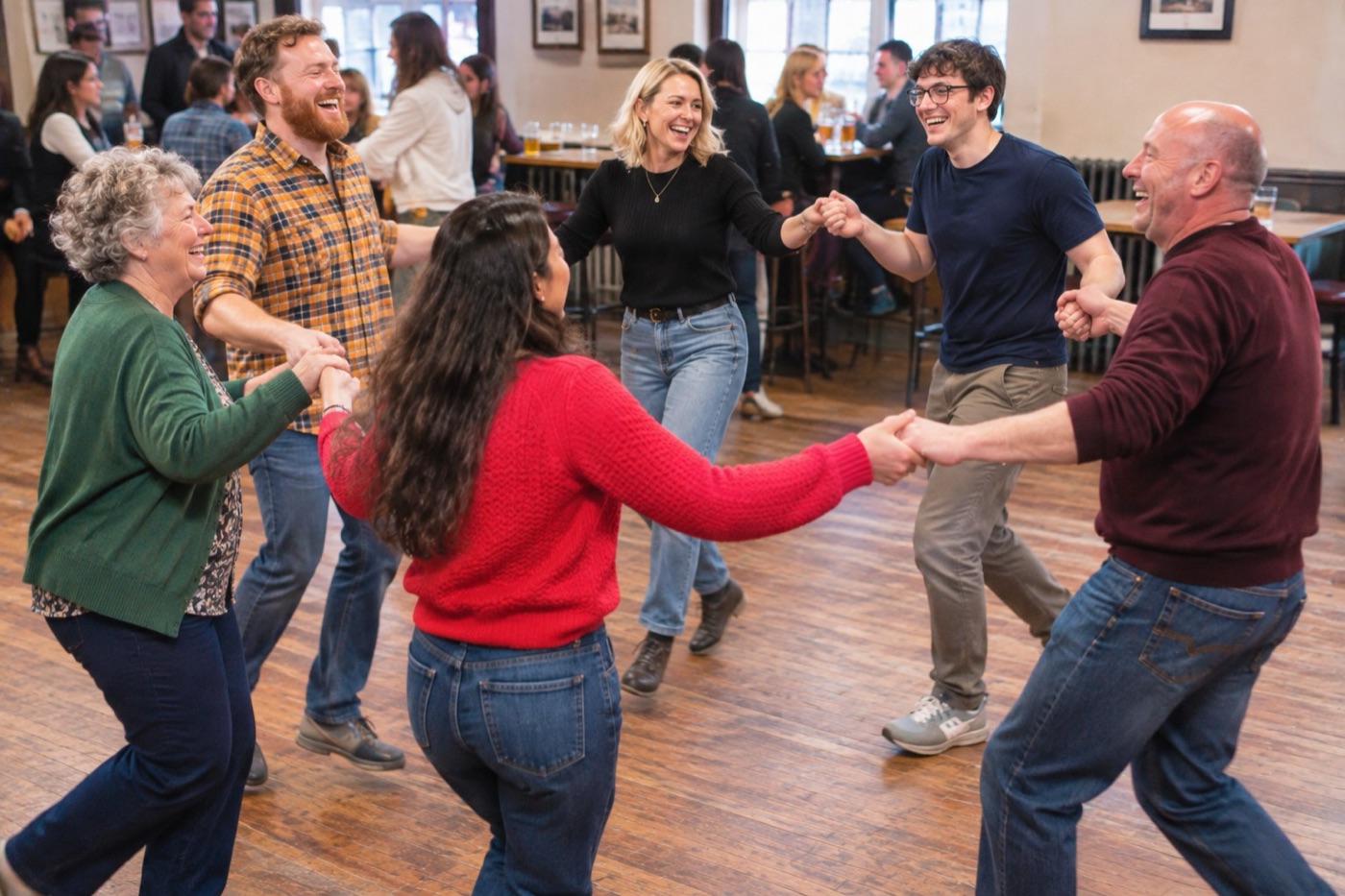
Last Friday, a ceilidh filled the Ivy House pub in Nunhead, in south-east London. The pub is better known for rock and indie music, but that night the dancefloor belonged to a folk band and a crowd of all ages. Many of the dancers were young, and many of them had never been to a ceilidh before.
The numbers suggest this is not only happening in one pub. According to the ticket platform Eventbrite, ticket sales for ceilidh events in the UK grew by 16% from 2024 to 2025. Across the world, they grew by 15%. A spokesperson for the platform said young people are looking for events that are “communal and a lot less polished”.
The dancers gave simple reasons. “We spend a lot of time looking at screens,” said Matt, who liked the chance to spend an evening offline. George, 35, was at his first proper ceilidh. “I just like how silly it can be,” he said. “It just makes you feel alive.” His partner Louise, 32, liked that nobody was judging how well anyone danced. Jamie, 19, has been to many and says they are becoming popular with his friends.
Part of the appeal seems to be that you cannot look cool while doing it. You get hot, you get the steps wrong and you laugh at the same moments as everyone else. Ed McCabe, who founded the London Ceilidh Club, said the scene has boomed since Covid. In his words, people simply want to be in a room together.
It is not perfect for everyone. The music is loud, the room is crowded and some people would rather not hold hands with a stranger. But for a first-timer who arrives alone, that may be the point. Within one dance, you have already met six people.
Intermediate version
The Ivy House in Nunhead, south-east London, is a pub with a loud musical history. Ian Dury and Elvis Costello played there in the 1970s, and contemporary indie bands still pull in crowds. Last Friday, though, the thing filling the dancefloor was not a gig. It was a ceilidh: a traditional Scottish and Irish dance, pronounced “KAY-lee”, from a Gaelic word meaning a visit or a gathering.
Reporters and organisers have started calling it a ceilidh renaissance, and there are figures behind the phrase. The ticketing platform Eventbrite says sales for ceilidh events in the UK rose 16% between 2024 and 2025, with 15% growth worldwide. Page Dudley, a spokesperson for the platform, said young people were seeking events that felt “communal and a lot less polished”. A touring show, Ceilidh the Musical, opened at Shoreditch town hall in east London last week.
What draws people is easier to hear from the dancers than from the statistics. “We spend a lot of time looking at screens,” said Matt, who treated the evening as a refreshing way to be offline. George, 35, at his first proper ceilidh, said he liked how silly it could be: “It just makes you feel alive.” His partner Louise, 32, valued the absence of judgment. “When you strip away the ego, everyone just becomes their childlike selves,” she said. Jamie, 19, has been to plenty, and says the surprise is how often he now meets schoolfriends at them.
The format does a lot of the work. A caller explains each dance, the steps are simple enough to copy and complicated enough to go wrong, and partners change constantly, so nobody is left standing at the side. Ed McCabe, founder of the London Ceilidh Club, says the scene has boomed since Covid, and that ceilidhs have low barriers to entry. His point is partly about dignity: you cannot look cool while doing it, which removes a great deal of pressure.
The musicians make a related point about who feels welcome. Richard Jones, who plays accordion in the South East London Folk Orchestra, notes that the dances are not organised around men and women. His bandmate Neil McLean put it more plainly: “We don't really do men and women, we do ones and twos.” Jones adds that people know they can come without a group, and that the room becomes its own community very quickly.
That may explain why an anti-loneliness charity was involved. Link Age Southwark raised money from ticket sales at the Ivy House, and Anna Spree, who works there, said the ceilidh revival had allowed the charity to reach new people. An evening out that happens to introduce you to thirty strangers is an unusual kind of fundraiser.
Advanced version
A ceilidh is not an obvious candidate for a youth trend. The music is acoustic, the dances are centuries old, the instructions are shouted by someone with a microphone, and at no point does anybody look good. Yet last Friday the Ivy House in Nunhead, a south London pub with a history of raucous gigs, was full of people in their twenties and thirties learning to strip the willow.
The commentary around this tends to reach immediately for a diagnosis: a lonely generation, exhausted by dating apps, seeking something analogue. There is evidence that something is happening. Eventbrite reports that UK ticket sales for ceilidh events grew 16% between 2024 and 2025, and 15% globally, and a spokesperson describes demand for occasions that are communal and less polished. A touring musical has arrived to meet the moment.
The explanation worth taking seriously, though, is structural rather than generational. A ceilidh is unusually well designed for strangers. A caller teaches each dance in advance, which means nobody is expected to arrive competent. Partners rotate by the logic of the figures, so joining alone carries no social cost and standing at the edge is not really an option. The steps are, as one charity worker put it, accessible enough that anyone can join in but complex enough to be fun, which is a precise description of a good game.
The dancers' own accounts point the same way. George, 35, said he liked how silly it was and that it made him feel alive. Louise, 32, valued that nobody was assessing anyone's ability: strip away the ego, she said, and people become their childlike selves. Ed McCabe of the London Ceilidh Club argues that the inability to look cool is a feature, since you are sweaty and smiling and therefore unguarded. Musicians in the band note that the dances assign roles as ones and twos rather than men and women, which quietly removes a set of assumptions nobody has to discuss.
Put together, these are not nostalgic virtues. They are the things most social occasions are bad at. A party requires you to already know someone. A dating app requires you to perform a version of yourself and then meet the consequences alone. A ceilidh gives you a structure, a task, a reason to touch hands with a stranger and an excuse to laugh when it goes wrong, and it ends at a fixed time.
Some caution is warranted before declaring a movement. Growth figures from one ticketing platform describe a market, not a culture, and a crowded pub in Nunhead is one evening in one city. Scottish and Irish communities have been holding ceilidhs continuously for well over a century, so the renaissance belongs to the people discovering them, not to the form.
Still, the appeal is not mysterious. A local anti-loneliness charity took the ticket money and said the revival had helped it reach new people. Whatever else is going on, a room where nobody can look cool turns out to be an efficient way to meet somebody.
After you read
4True, false or not given5 statements
Choose T (true), F (false) or NG (the article does not say).
- You need a partner to join a ceilidh.
The text says the opposite: “You do not need a partner.”
- The Ivy House is usually known for rock and indie music.
The text says: “The pub is better known for rock and indie music, but that night the dancefloor belonged to a folk band and a crowd of all ages.”
- Jamie is 19 and has been to many ceilidhs.
The text says: “Jamie, 19, has been to many and says they are becoming popular with his friends.”
- Ceilidh tickets have become more expensive.
Not stated. The text gives sales figures but says nothing about prices.
- The Ivy House is in the north of London.
The text says the pub is in Nunhead, in south-east London.
5Vocabulary5 gaps
Complete the sentences with words from the box. Two words are not needed.
aliveappealboomedcrowdjudgingpopularstranger
- Part of the of old dances is that nobody has to be perfect.
- Cafes in the town centre have since the new university opened.
- Football is very in many countries, and millions of people watch it.
- Some people stay at home because they think others will be them.
- Her mother told her never to go home with a .
6Verb forms5 gaps
Write the correct form of the verb in brackets.
- At a ceilidh, a band and everybody dances. (PLAY)
- Many of the dancers to a ceilidh before. (NEVER BE)
- Across the world, ticket sales by 15%. (GROW)
- Ed McCabe, who the London Ceilidh Club, said the scene has boomed since Covid. (FOUND)
- Within one dance, you six people. (ALREADY MEET)
7Language focuscollocations
Complete the sentences with words from the box. Two words are not needed. A collocation is a pair of words that sound right together, like heavy rain. Learn the verb and the noun as one piece.
dogetmakepayspendtaketell
- It is easy to new friends at a ceilidh, because you change partners often.
- Anyone can part in the dances, even if they are beginners.
- Many young people hours every day on their phones.
- Beginners often lost in the middle of a dance, but someone always helps.
- The dancers their best, but nobody cares about mistakes.
4True, false or not given5 statements
Choose T (true), F (false) or NG (the article does not say).
- Eventbrite recorded faster growth in the UK than worldwide.
The text says: “The ticketing platform Eventbrite says sales for ceilidh events in the UK rose 16% between 2024 and 2025, with 15% growth worldwide.”
- Dancers keep the same partner for the whole evening.
The text says the opposite: “partners change constantly, so nobody is left standing at the side”.
- A charity raised money from the ticket sales at the Ivy House.
The text says: “Link Age Southwark raised money from ticket sales at the Ivy House, and Anna Spree, who works there, said the ceilidh revival had allowed the charity to reach new people.”
- Most of the people at the Ivy House were under 30.
Not stated. The text quotes several young dancers but gives no figures about the ages of the crowd.
- Ceilidh the Musical opened in Nunhead.
The text says it opened at Shoreditch town hall in east London.
5Vocabulary6 gaps
Complete the sentences with words from the box. Two words are not needed.
absenceattendedcontemporaryinvolvedplentyrefreshingseekingwelcoming
- The museum shows medieval paintings alongside art made in the last few years.
- Many graduates are work in cities where rents are lower.
- After a week of emails, a walk by the river felt .
- In the of a clear leader, the committee could not decide.
- Don't rush, we have of time before the train leaves.
- Several local schools were in organising the event.
6Verb forms5 gaps
Write the correct form of the verb in brackets.
- Eventbrite says that sales by 16% between 2024 and 2025. (RISE)
- At a ceilidh, nobody standing at the side of the room. (LEAVE)
- Until that Friday, most of the group a ceilidh. (NEVER TRY)
- The scene since Covid, according to one organiser. (BOOM)
- Folk dances like this for generations. (ENJOY)
7Language focuscollocations
Complete the sentences with words from the box. Two words are not needed. Collocations are word pairs that sound natural together. Ask which verb usually goes with the noun, then test each word in the box.
breakbuildgoliftpourraisereach
- The charity wants to money for people who live alone.
- Because the steps are simple, very little can wrong, and mistakes are funny.
- The festival hopes to new audiences, including people who rarely go out.
- Shy people can the ice by starting with a simple dance.
- The evening gave students a chance to a sense of community.
4True, false or not given5 statements
Choose T (true), F (false) or NG (the article does not say).
- The writer thinks dating apps ask people to present a version of themselves.
The text says an app "requires you to perform a version of yourself".
- The writer treats the Nunhead evening as proof of a national movement.
The text calls it "one evening in one city" and warns against declaring a movement.
- Most dancers interviewed said they had come to the pub to get away from dating apps.
The dancers quoted talk about silliness and ego, but none mentions dating apps.
- The writer thinks a ceilidh asks less prior social knowledge of strangers than a party does.
The text says "A party requires you to already know someone", while a ceilidh gives you a structure.
- The writer believes the ceilidh itself has changed to attract younger people.
The text says the renaissance belongs to "the people discovering them, not to the form".
5Vocabulary6 gaps
Complete the sentences with words from the box. Two words are not needed.
accessibleassigndormantnostalgicobsoleterotatestructuralwarranted
- Given the scale of the losses, an investigation is fully .
- Older viewers felt when the theme tune from their childhood returned.
- Because the flaw is , built into the system itself, replacing managers will not fix it.
- Museums have worked to make their collections more to visitors with disabilities.
- Staff between the two offices every month, so nobody stays in one place.
- The teacher decided to each pupil a different task.
6Word forms5 gaps
Use the word in brackets to make a word that fits the gap.
- The commentary jumped to a quick of a lonely generation. (DIAGNOSE)
- Careful readers will challenge the behind such claims. (ASSUME)
- The tradition has survived in Scottish and Irish communities. (CONTINUE)
- Some critics see the to look cool as the main strength of the dance. (ABLE)
- The two explanations are not exclusive, so both may be partly true. (MUTUAL)
7Language focuscollocations
Complete the sentences with words from the box. Two words are not needed. At this level, collocations are often verb plus abstract noun. Ask which verb the noun expects, and do not trust a direct translation.
allaybardrawfosterposerunstrike
- Sales figures from one platform are too narrow a base from which to sweeping conclusions.
- Critics argue that treating ceilidhs as a cure for loneliness may a threat to the tradition itself.
- Organisers must a balance between welcoming beginners and keeping the dances lively.
- A good caller can a sense of belonging in a room of strangers.
- A clear structure can the fears of anxious newcomers.
Speak
8Talk about it3 questions
Discuss in pairs or small groups. Give reasons for your answers.
- What is good about activities where everybody is a beginner?
- Which is easier for meeting people: a party, a class or a dance? Why?
- What stops people from trying something new in public?
8Talk about it3 questions
Discuss in pairs or small groups. Give reasons for your answers.
- Ed McCabe says you cannot look cool at a ceilidh. Why might that help?
- Can an organised activity really solve loneliness, or only interrupt it?
- What event would you design for people who find socialising hard?
8Talk about it3 questions
Discuss in pairs or small groups. Give reasons for your answers.
- How much should we read into growth figures from a single ticketing platform?
- The article credits the design of the dance rather than the generation. Which explanation convinces you?
- What would be lost if a tradition became mainly a cure for loneliness?
9Role-play: a Friday night out
Work in pairs. Read your card, then have the conversation. Swap roles and do it again.
Student A · the friend who wants to go
You went to a ceilidh last week and loved it. Invite your friend for Friday. Explain what it is like, answer their worries and try to agree a plan.
Student B · the friend who is not sure
You are tired and think dancing in front of strangers sounds embarrassing. Ask questions, say what worries you, and decide if you can agree a plan you both like.
Useful phrases
- Why don't you come to a ceilidh with me?
- I'm not very good at dancing.
- Don't worry, you don't need a partner.
- That's not really my kind of evening.
- How about we try it for an hour? If you're not enjoying it, we'll leave.
- Let's meet at seven, then.
Afterwards, tell the class: are you going to the ceilidh, and what changed your mind?
Your words
Highlights0 saved
Highlights0 saved
Highlights0 saved
Was this lesson useful? Support johnplusnews on Ko-fi
Continue reading
Language
Did Writing Really Make Languages More Complicated?
A large study of about 100,000 sentences in 30 languages found no universal pattern showing that writing makes sentences more complex. It does not say that writing never changes a language.
Relationships
Would You Sign a Contract Before Getting Married?
More young Americans are signing prenuptial agreements before their weddings. Is planning for a divorce unromantic, or is it honest and sensible?
Work
They Still Have Their Jobs. They Are Leaving Anyway
Nobody made these workers redundant. AI changed what their work felt like, and they walked out on careers they had spent a decade building.