News lesson30 September 2026
What Should a Child's First Phone Leave Out?
Freckle has no browser, no app store and a camera that identifies birds and plants. It also lets parents see where their child is.
Before you read
1Warm up3 questions
Talk about these questions with a partner.
- What is a phone useful for besides social media?
- Would you choose a phone that could call and play music but had no feed?
- Who should help decide a child's first phone rules?
2Key words8 words
These words are in the article. Choose the letter of the meaning for each one.
- browser
- device
- independence
- explore
- scrolling
- alerts
- attractive
- insects
- Anice to look at or interesting to you
- Bmessages that tell you something has happened
- Ca small machine, such as a phone
- Dmoving down a screen to see more
- Every small animals with six legs, like ants
- Fbeing able to do things without help from others
- Ga program you use to look at pages on the internet
- Hto go to new places and find out about them
1Warm up3 questions
Talk about these questions with a partner.
- What is a phone useful for besides social media?
- Would you choose a phone that could call and play music but had no feed?
- Who should help decide a child's first phone rules?
2Key words8 words
These words are in the article. Choose the letter of the meaning for each one.
- approved
- unfair
- gradually
- privacy
- notifications
- unlikely
- adventure
- settle
- Anot probably going to happen
- Bto end an argument by finding an answer
- Cthe right to keep your life and information to yourself
- Dslowly, a little at a time
- Ean exciting or unusual experience
- Fnot treating people in an equal or reasonable way
- Gofficially accepted as allowed
- Hshort messages from an app on your phone
1Warm up3 questions
Talk about these questions with a partner.
- What is a phone useful for besides social media?
- Would you choose a phone that could call and play music but had no feed?
- Who should help decide a child's first phone rules?
2Key words8 words
These words are in the article. Choose the letter of the meaning for each one.
- anxiety
- compact
- distinctive
- designated
- exposure
- burden
- boundaries
- reproducing
- Athe state of being in contact with something, often harmful
- Bsmall and neatly designed
- Ca worried, nervous feeling
- Dchosen for a particular purpose
- Elimits that show what is allowed
- Fmaking an exact copy of something
- Gclearly different from others
- Hsomething heavy or hard that you must carry or deal with
Read
3Read the article
The paragraphs are numbered. Look out for the key words from task 2.
Core version
A child asks for a phone. Their parents want to stay in touch, but they worry about social media, strange websites and too much time staring at a screen. It is a familiar problem in many families. An American company has come up with an answer: a colourful phone that lets children call home but does not give them the whole internet.
The device is called Freckle. It is designed mainly for children aged seven to thirteen and was announced in 2026. Unlike a normal smartphone, it does not have social media apps, an app store, YouTube or a web browser. Children can call and send messages to contacts approved by their parents. The aim is to give them some independence without opening the door to everything online.
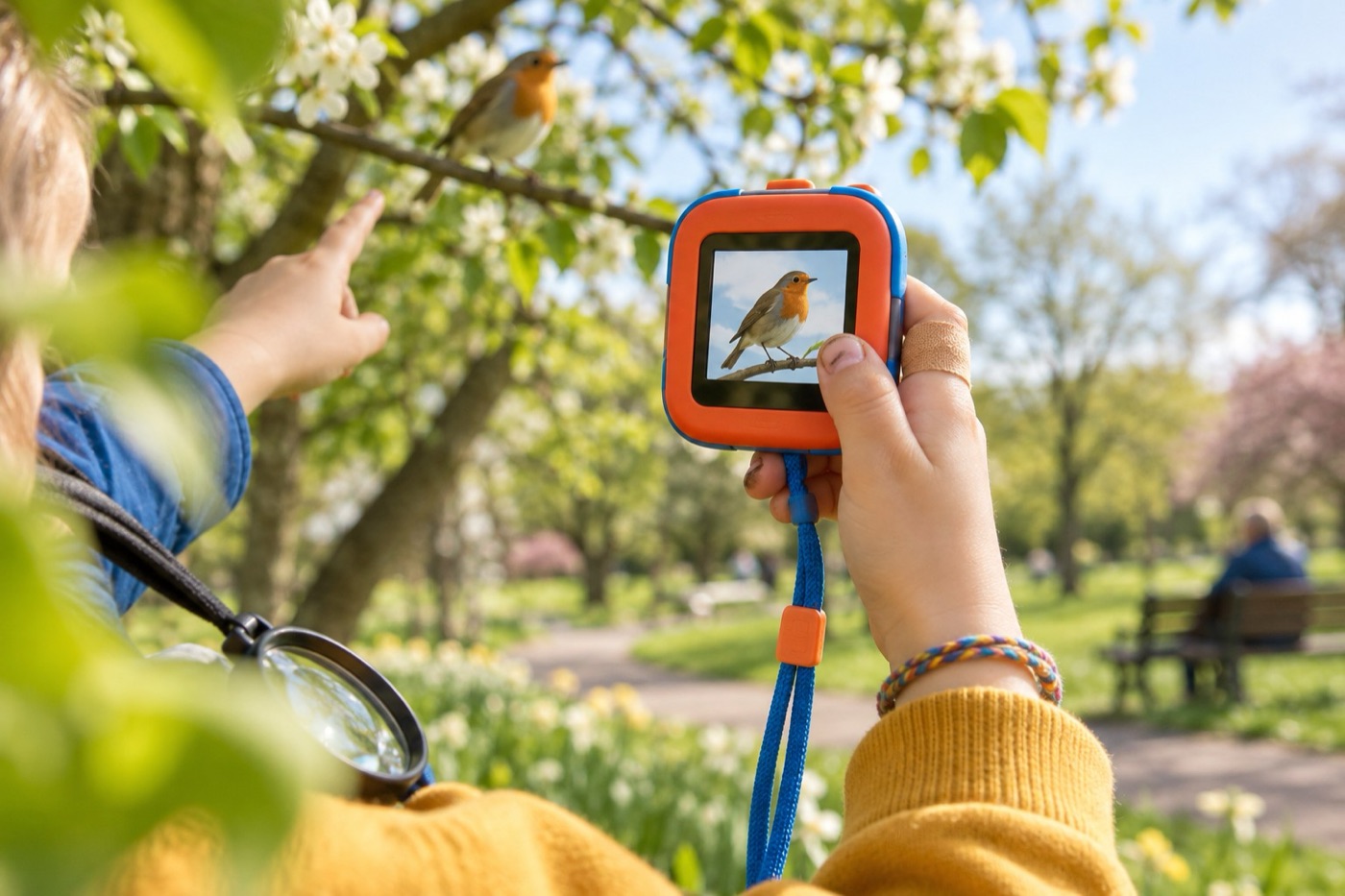
Freckle also tries to make the outside world more interesting. Its small, square design includes a camera that can help children recognise plants, birds and insects. Children can collect discoveries in a digital book. The company says it hopes children will go out, explore and learn, rather than spend hours scrolling through videos, but this has not yet been tested. Parents can use an app to manage which features their child can access.
The phone is expected to cost $199, with a mobile plan of around $25 a month. Its first deliveries were planned for December 2026, so the promised benefits had not yet been tested by large numbers of families when it was announced. Parents also have the option to check where their child is and set alerts for certain areas. Some may find this reassuring; others may worry about too much tracking.
The idea sounds attractive, but there are questions. Will children enjoy a phone that cannot play the same games or use the same apps as their friends? Could they feel left out? And if adults choose everything their children can see, when will young people learn to make safe decisions online by themselves? Keeping children away from danger is important, but learning how to deal with technology matters too.
For many parents, the real choice is between safety and freedom. They want children to call for help, meet friends and become more independent. They also want to avoid endless screen time. Freckle offers one possible middle ground, not a perfect answer for every family. Perhaps the most useful part is the conversation it starts: what should a child's first phone actually be for?
Intermediate version
The request sounds simple: 'Can I have a phone?' For a parent, it is really a decision. A normal smartphone lets a child contact home, but it also opens the door to much more. In 2026, an American company introduced a possible compromise: a phone designed to connect children to their families without pulling them into the wider internet.
The Freckle phone is aimed primarily at children aged seven to thirteen. It has no general web browser, app store, social media or YouTube. Children can call and message contacts that their parents have approved, while adults manage features through a separate app. The device runs the company's own ClayOS software and uses colourful hardware with a small, square screen. According to its creators, the goal is to give children greater freedom while protecting them from online environments they may not yet be ready to navigate.
Rather than relying entirely on entertainment, Freckle encourages children to explore the world around them. Its discovery camera is designed to identify birds, plants and insects, adding the results to a digital collection. A walk in the park could therefore turn into a small adventure. Parents can also check a child's location and receive alerts linked to selected areas. Those tools could offer reassurance when children begin going out without an adult, although they also raise questions about privacy and constant supervision.
The company announced a price of $199, with a wireless plan costing around $25 a month, and expected its first deliveries in December 2026. At the time of the announcement, the phone was still a new product rather than a proven solution. Promotional claims about making children more adventurous or reducing screen time should therefore be treated cautiously. Families will need to see how the device works in everyday life and whether its restrictions remain useful as children grow older.
There is another difficulty: children do not use technology in isolation. A child whose friends communicate through popular apps may feel left out when their own phone cannot access them. On the other hand, many parents believe it is unfair to expect a ten-year-old to manage the pressures of social media alone. Removing some options may make family rules easier to follow, at least for a few years. The challenge is finding a balance between protection and learning responsibility.
Freckle is unlikely to settle the debate about childhood and smartphones. Some families will prefer a basic phone, while others will introduce internet access gradually and discuss the risks openly. The important question is not whether children should use technology at all, but what we want technology to help them do. If a device makes it easier to keep in touch, go outside and build independence, perhaps it is serving a more useful purpose than a screen filled with endless notifications.
Advanced version
Few parenting decisions seem to generate quite as much anxiety as the first smartphone. Adults want children to be able to call home, arrange to meet friends and develop independence. At the same time, handing over a conventional device can mean opening the door to social media, addictive video feeds and online spaces that even adults struggle to navigate responsibly. In 2026, US start-up Freckle announced a phone for children without social media. The idea was to keep useful tools while leaving out the feed. Whether families would find it helpful remained to be seen.
Freckle's compact device is aimed primarily at seven- to thirteen-year-olds. Running on the company's ClayOS operating system, it excludes a general web browser, app store, social media platforms and YouTube. Calling and messaging are limited to parent-approved contacts, while a separate application allows adults to introduce new capabilities over time. The colourful hardware and small square touchscreen are intended to appeal to children without simply reproducing the design and functions of an adult smartphone. The company is trying to occupy the middle ground between a basic communication device and a fully connected digital world.
Its most distinctive feature may be a discovery camera designed to identify plants, birds and insects, allowing children to build a digital collection of what they find outdoors. In theory, technology becomes a reason to head out into the world rather than withdraw from it. Location tracking and alerts linked to designated areas could also give parents greater confidence as children begin travelling independently. Yet those same features raise a delicate question: how much freedom does a child really gain if every movement can be monitored?
Announced at $199 with a wireless plan of approximately $25 a month, the phone was expected to begin shipping in December 2026. At the time of its launch publicity, therefore, promises about its effects on childhood behaviour remained largely untested. A thoughtfully designed product might encourage healthier habits, but it cannot by itself prove that children will spend more time outdoors or become more resilient. Family expectations, friendship groups, local safety and the child's own interests will all influence what happens once the device is taken out of the box.
There is also the problem of social belonging. Children increasingly organise friendships through group chats, games and shared online spaces. A device that shuts out those channels could protect a child from harmful content while simultaneously making them feel excluded. Conversely, expecting very young users to manage persuasive platforms without guidance places a heavy burden on developing judgement. Parents are caught between two legitimate goals: reducing exposure to risks and teaching children to recognise those risks for themselves.
Freckle's most valuable contribution may be less the hardware than the question it forces families to confront. Why do we assume that a phone must provide access to everything, immediately and without stages? A carefully limited device may suit some children, while others will need a different approach. No single product can remove the difficult work of setting boundaries, having conversations and gradually handing over responsibility. But an alternative to the all-purpose smartphone makes it easier to imagine technology serving childhood, rather than childhood being organised around technology.
After you read
4True, false or not given5 statements
Choose T (true), F (false) or NG (the article does not say).
- With the camera, children can identify plants, birds and insects.
The text says the camera can help children recognise plants, birds and insects.
- The phone is already on sale in Europe.
The text does not say where the phone is on sale.
- Children can message anybody they like on the Freckle phone.
The text says children can only message contacts approved by their parents.
- The company has already proved that children go outside more with this phone.
The text says the company's hope "has not yet been tested".
- Parents can set alerts for certain areas.
The text says parents can "set alerts for certain areas".
5Vocabulary5 gaps
Complete the sentences with words from the box. Two words are not needed.
announcedapproveddiscoveredfamiliarrecognisetemptingtracking
- The company the phone at a news event in 2026.
- Children can only message contacts that their parents have .
- It is a problem, because lots of families worry about the same thing.
- The camera helps children birds and flowers by name.
- Some parents like the idea, but others worry about too much .
6Verb forms5 gaps
Write the correct form of the verb in brackets.
- The device Freckle. (CALL)
- A child for a phone, but the parents worry about social media. (ASK)
- The phone to cost $199. (EXPECT)
- Parents can use an app which features their child can access. (MANAGE)
- The first deliveries for December 2026. (PLAN)
7Language focuscollocations
Complete the sentences with words from the box. Two words are not needed. Some words go together as a pair. If you know one word, think about which word usually comes next to it.
attentionnumberplanscreentaketelltouch
- Parents want to stay in with their children during the day.
- Children can photos of birds and plants with the camera.
- Too much time is a worry for many families.
- Parents should pay to what children do online.
- The phone has a mobile of around $25 a month.
4True, false or not given5 statements
Choose T (true), F (false) or NG (the article does not say).
- The device had been tested by large numbers of families before launch.
The text says it was "still a new product rather than a proven solution".
- Teachers have welcomed the phone in schools.
The text never mentions teachers or schools.
- Parents manage the phone's features through a separate app.
The text says "adults manage features through a separate app".
- The location tools could help parents but also cause worries about constant watching.
The text says they "could offer reassurance" but "raise questions about privacy and constant supervision".
- The writer says claims about the phone should be believed at once.
The text says such claims "should therefore be treated cautiously".
5Vocabulary6 gaps
Complete the sentences with words from the box. Two words are not needed.
cautiouslyexposureincentivepromotionalprovenreassurancerestrictionssupervision
- A regular call home gave the worried parents some while their son was away.
- The method sounds clever, but it has not been to work with large groups.
- Claims made by companies should be treated until independent tests are published.
- Strict on screen time can make the rules easier to follow.
- Under eights are not allowed to swim without adult .
- A video made the product look better than it really was.
6Verb forms5 gaps
Write the correct form of the verb in brackets.
- By the time the family bought the phone, their daughter for one many times. (ASK)
- The rules for the phone by the whole family last weekend. (AGREE)
- If the phone cheaper, more families would buy one. (BE)
- The shop said that the new phones in December. (ARRIVE)
- By next summer, the family the phone for a year. (USE)
7Language focuscollocations
Complete the sentences with words from the box. Two words are not needed. Collocations are words that naturally go together. Check the verb and noun partnership, not only the meaning.
balancecarryholdmakeprotectraiseset
- The new features serious questions about privacy.
- The challenge is finding the right between protection and learning.
- Parents often clear boundaries about screen time.
- Every family must a decision about when to buy a first phone.
- Parents want to their children from online dangers.
4True, false or not given5 statements
Choose T (true), F (false) or NG (the article does not say).
- The text suggests that a device built for safety can create a different problem for a child.
It says shutting out group chats "could protect a child from harmful content while simultaneously making them feel excluded".
- The same features that give parents confidence also let them follow a child's movements.
Location tracking gives confidence, but the text asks about freedom if "every movement can be monitored".
- Families already using the phone have shown that children spend more time outdoors.
The text says its effects on behaviour "remained largely untested" at launch.
- Rival companies have announced similar devices for children.
The text does not mention any other company's product.
- The writer suggests the phone's limits will suit every child.
The text says it "may suit some children, while others will need a different approach".
5Vocabulary6 gaps
Complete the sentences with words from the box. Two words are not needed.
confrontconventionalephemerallegitimatemonitorpersuasivesimultaneouslywithdraw
- Critics argued that the approach to schooling no longer prepared pupils for creative work.
- After the criticism, several members chose to from the committee rather than defend its decision.
- Advertising aimed at children is often so that adults struggle to resist it themselves.
- No single member of staff can supervise two classrooms on opposite sides of the building.
- Both sides had concerns, so the mediator refused to call either position unreasonable.
- The documentary forces viewers to uncomfortable questions about their own habits.
6Word forms5 gaps
Use the word in brackets to make a word that fits the gap.
- Experts warn of the of children to online manipulation. (VULNERABLE)
- The charity has called for greater about how companies use children's data. (TRANSPARENT)
- It would be to expect a child to resist a platform built by hundreds of engineers. (REALISTIC)
- Many parents find round-the-clock tracking and prefer to build trust instead. (INTRUDE)
- Her to put the phone away at dinner surprised her parents. (WILLING)
7Language focuscollocations
Complete the sentences with words from the box. Two words are not needed. A collocation is a pair that fluent speakers reach for by habit. Ask which verb normally sits with the noun, not which verb simply makes sense.
beardrawexertsetstriketreadvoiced
- Regulators are under mounting pressure to a balance between innovation and child safety.
- Peer pressure can a powerful influence over what children choose to wear and watch.
- Several headteachers have publicly concerns about children's sleep.
- The ruling could a precedent that other courts feel obliged to follow.
- Platforms should some responsibility for the content they recommend to children.
Speak
8Talk about it3 questions
Discuss in pairs or small groups. Give reasons for your answers.
- What would make a limited phone feel like freedom rather than punishment?
- Should phone rules depend more on age or on how someone uses it?
- What would a phone designed around what children actually need look like?
9Role-play: a first phone for a ten-year-old
Work in pairs. Read your card, then have the conversation. Swap roles and do it again.
Student A · a parent
Your daughter is ten and wants a phone. You want a simple one with calls and a camera but no social media. Explain your reasons and ask what your friend thinks.
Student B · a friend
Your son has a full smartphone. You think a limited phone may make a child feel left out. Say what worries you, but listen to your friend's reasons.
Useful phrases
- I'd rather she didn't have social media yet.
- I'm worried she'll feel left out.
- That's a fair point, but safety matters more to me.
- What do her friends use?
- Couldn't we try it for a few months?
- I'd be happy to review the rules when she's older.
Afterwards, tell the class: did the two friends agree, and what was the compromise?
Your words
Highlights0 saved
Highlights0 saved
Highlights0 saved
Was this lesson useful? Support johnplusnews on Ko-fi
Continue reading
Language
Did Writing Really Make Languages More Complicated?
A large study of about 100,000 sentences in 30 languages found no universal pattern showing that writing makes sentences more complex. It does not say that writing never changes a language.
Technology
Can You Be Emotionally Close to Someone Who Is Not Human?
A survey of 463 adults in the United States found that people in relationships with AI chatbots can feel as emotionally close as other couples, but the link between closeness and loneliness looked different.
Relationships
Would You Sign a Contract Before Getting Married?
More young Americans are signing prenuptial agreements before their weddings. Is planning for a divorce unromantic, or is it honest and sensible?