News lessonOctober 2026
Old Craft Skills, New Designs in Ukraine
Break the chain between an older craftsperson and a younger one and the technique goes too. Paying customers, awkwardly, may be what keeps it going.
Before you read
1Warm up3 questions
Talk about these questions with a partner.
- Can clothes tell a story without using words?
- What makes you notice a new designer?
- Would knowing who made an outfit change how you saw it?
2Key words8 words
These words are in the article. Choose the letter of the meaning for each one.
- pattern
- craftspeople
- embroidery
- weaving
- workshop
- invasion
- luxury
- ceramics
- Awhen an army enters another country to take control
- Bsomething very nice and expensive that you do not really need
- Cplates, cups and pots made from baked clay
- Da room or building where people make things
- Emaking cloth by crossing threads over and under each other
- Fpictures or patterns sewn onto cloth with thread
- Ga design of lines, shapes or colours that repeats
- Hpeople who make beautiful things with their hands
1Warm up3 questions
Talk about these questions with a partner.
- Can clothes tell a story without using words?
- What makes you notice a new designer?
- Would knowing who made an outfit change how you saw it?
2Key words8 words
These words are in the article. Choose the letter of the meaning for each one.
- artisans
- heritage
- displacement
- preservation
- reinterpretation
- luxury
- generation
- identity
- Asomething expensive and special that people do not really need
- Ball the people born at about the same time
- Cthe things that make a person or group who they are
- Da new way of showing or explaining something old
- Eskilled people who make things by hand
- Fbeing forced to leave your home
- Gthe history and traditions a country or group has had for a long time
- Hkeeping something safe so it is not lost or damaged
1Warm up3 questions
Talk about these questions with a partner.
- Can clothes tell a story without using words?
- What makes you notice a new designer?
- Would knowing who made an outfit change how you saw it?
2Key words8 words
These words are in the article. Choose the letter of the meaning for each one.
- motifs
- artefacts
- replica
- nostalgia
- commerce
- monuments
- conservation
- heritage
- Atraditions and history passed down from earlier times
- Ba warm, slightly sad longing for the past
- Cthe buying and selling of goods
- Dold objects made by people, often kept in museums
- Ecareful protection of old things so they last
- Fan exact copy of something
- Grepeated shapes or images used in a design
- Hlarge structures built to remember a person or event
Read
3Read the article
The paragraphs are numbered. Look out for the key words from task 2.
Core version
A plate can be much more than a plate. It can show a flower, an old pattern or a picture that people in a country have used for hundreds of years. In Ukraine, some designers are using everyday objects to help keep their culture alive.
One example is GUNIA Project, a design company based in Kyiv. It makes clothes, jewellery, candles, plates and other objects. Take one of its plates: the pattern may come from traditional Ukrainian art, but the plate is made for a modern home. The company does not simply copy old objects. It works with artists to create new pieces that fit modern homes and lives, so a very old idea can turn up in a very new form.
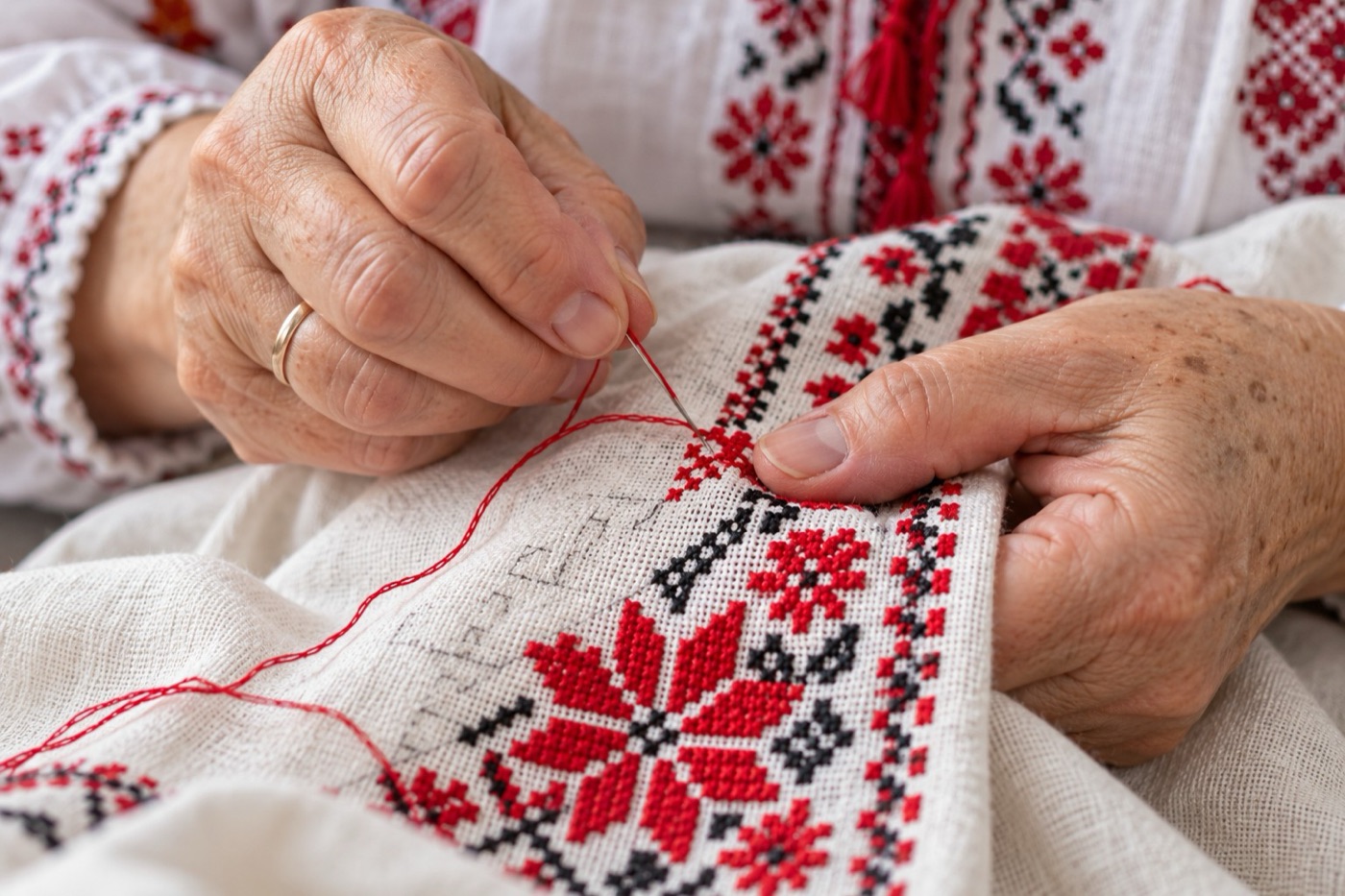
Some skills are very difficult to pick up. Glassblowing, weaving, embroidery and making ceramics can take years of practice, and they are usually handed down from older workers to younger ones. GUNIA says it works with more than 150 craftspeople across Ukraine. Buying handmade products can help these workers carry on using and teaching their skills.
Since Russia's full-scale invasion in 2022, protecting Ukrainian culture has become especially important. War can damage museums, destroy buildings and force families to leave their homes. It can also make it much harder for small workshops to find materials or customers. Artists may have to move to a safer part of the country, far from the workshop where they trained. If a workshop closes, the skills inside it may slowly die out.
Not everyone can afford expensive handmade products, and a fashion brand cannot protect a whole country's history on its own. Ukraine has many regions and many crafts, so one company cannot speak for all of them. Some people also ask who really benefits when old traditions are sold as luxury goods. But a successful design company can introduce younger buyers to traditions they might otherwise never notice. A pattern that once appeared on a traditional coat might now show up on a modern cushion or cup.
Culture is not only something we find in museums or history books. It can be part of what we wear, use and give as gifts. Sometimes the most ordinary objects help people remember who they are.
Intermediate version
How can a ceramic plate or a hand-embroidered shirt become part of a country's cultural survival? In Ukraine, designers are answering that question by turning traditional crafts into modern products. One of the best-known examples is GUNIA Project, a Kyiv-based company that works with artisans from across the country.
The brand creates clothing, jewellery, tableware and decorative objects inspired by historical designs. Rather than turning out exact copies of museum pieces, its designers look into folk traditions and adapt their patterns, materials and techniques for contemporary customers. A familiar symbol might crop up on an unusual candle, while traditional embroidery may become part of a modern garment. The aim seems to be recognition rather than reproduction: a buyer should sense where a design came from without mistaking the object for an antique.
The work depends on craftspeople whose knowledge cannot easily be replaced by machines. GUNIA says it collaborates with more than 150 artisans using techniques including ceramics, weaving and blown glass. Each handmade object represents not only a finished product, but also years spent learning a craft and handing it down from one generation to the next. Break that chain and the technique tends to go with it, however many photographs of it survive.
After Russia's full-scale invasion of Ukraine in 2022, the idea of cultural preservation took on greater urgency. Military attacks and displacement have placed historic sites and traditional livelihoods under pressure. A workshop may lose its materials, its customers or the people who ran it. For designers, continuing to produce objects rooted in Ukrainian culture can be both a business decision and a statement about national identity. Keeping the workshops going is, in itself, a way of insisting that the culture has a future as well as a past.
There are tensions in this approach. Handmade products may be too expensive for many people, and selling cultural traditions as luxury goods can raise awkward questions about who really benefits. Designers also have to weigh up the difference between respectful reinterpretation and treating a community's heritage as decoration. A pattern taken out of its original setting can end up as little more than a pretty shape.
Even so, the project challenges a familiar assumption about tradition. Preserving culture does not always mean keeping old objects untouched behind glass. It can also mean giving a skill new customers, new uses and a reason to survive. Tradition, on this view, is less a museum case than a working habit that has to be passed on.
Advanced version
A plate, a shirt or a candle can carry a very old idea. Kyiv-based GUNIA Project makes clothing, ceramics and household objects that reinterpret traditional Ukrainian crafts for modern buyers. It is a business, not a museum, and that sits oddly with conventional ideas of heritage, though it seems to work in practice.
The company's method begins with research into historical motifs and techniques, followed by collaborations with working craftspeople. According to GUNIA, its production network takes in more than 150 artisans across Ukraine and draws on disciplines ranging from embroidery and weaving to blown glass and fine ceramics. A traditional image, lifted out of its original setting, is given a new function without necessarily shedding its cultural associations. What results is neither replica nor invention, but something closer to translation.
Russia's full-scale invasion in 2022 has made such work particularly resonant. Heritage is lost not only when buildings or artefacts are destroyed, but when artisans are displaced, local markets collapse and specialist knowledge stops paying its way. A craft rarely dies out through a single dramatic event. It fades when the last person who can teach it has nobody left to teach and no reason to keep working. In those circumstances, commercial demand supplies something that reverence cannot: a livelihood attached to a disappearing skill.
The relationship between commerce and heritage remains uneasy, nonetheless. Luxury positioning may narrow the audience for objects presented as national culture, while reinterpretation risks turning complex traditions into attractive motifs stripped of context. Who speaks for a tradition, and who profits from it, are questions that cannot simply be brushed aside. Nor are they settled by good intentions: they have to be managed case by case, in decisions about pricing, credit and whose name appears on the label. Supporters counter that the alternative, allowing valuable techniques to drop out of ordinary use altogether, would represent a far greater loss.
What sets this kind of design apart from simple nostalgia is its refusal to treat tradition as something fixed. Techniques survive partly because they are adapted, and a practice incapable of change is a practice waiting to be catalogued. A new design can still keep an old skill in use. Someone buying a piece for their home may discover the history behind the way it was made.
Ukraine's experience points to a broader lesson. A culture is not only a collection of irreplaceable monuments; it is also a network of people who know how to make things, pass that knowledge on and invest familiar symbols with contemporary meaning. Protecting the monuments is comparatively straightforward. Keeping the network intact, particularly under wartime conditions, may call for as much creativity as conservation. It is an unglamorous form of preservation, and quite possibly a more durable one.
After you read
4True, false or not given5 statements
Choose T (true), F (false) or NG (the article does not say).
- GUNIA says it works with more than 150 craftspeople.
The text says: "GUNIA says it works with more than 150 craftspeople across Ukraine."
- The company makes exact copies of museum objects.
The text says the opposite: "The company does not simply copy old objects."
- The company exports most of its products to Europe.
Not stated. The text does not say where the company sells its products.
- GUNIA Project is based in Kyiv.
The text says: "One example is GUNIA Project, a design company based in Kyiv."
- Glassblowing is a skill that most people can learn quickly.
The text says glassblowing and weaving "can take years of practice".
5Vocabulary5 gaps
Complete the sentences with words from the box. Two words are not needed.
afforddamagedecorateintroducenoticeprotectrepair
- A strong storm can old buildings, and the repairs cost a lot.
- Many students cannot a new phone every year.
- A teacher can a new idea with a short story.
- Most people do not the small details on a plain cup.
- Wearing a hat will you from the sun.
6Verb forms5 gaps
Write the correct form of the verb in brackets.
- It clothes, jewellery, candles and plates. (MAKE)
- Yesterday, a young designer her first plate at the market. (SELL)
- Since 2022, protecting Ukrainian culture especially important. (BECOME)
- Artists may have to a safer part of the country. (MOVE)
- Buying handmade products can help workers carry on their skills. (USE)
7Language focuscollocations
Complete the sentences with words from the box. Two words are not needed. Some words go together naturally. Learn the pair, not just one word.
carrydoholdmakepayplaytake
- It can many years to learn glassblowing.
- Young buyers often attention to the pattern on a plate.
- Many small workshops a profit by selling cups and cushions.
- A brand can an important part in keeping a culture alive.
- Small workshops cannot business without customers.
4True, false or not given5 statements
Choose T (true), F (false) or NG (the article does not say).
- The article says handmade products are affordable for everyone.
The text says: "Handmade products may be too expensive for many people".
- The company has opened a shop outside Ukraine.
Not stated. The text does not say whether the company has a shop outside Ukraine.
- The writer says preserving culture can mean giving a skill new customers.
The text says: "It can also mean giving a skill new customers, new uses and a reason to survive."
- The writer suggests that photographs of a craft can keep the technique alive.
The text says that if the chain is broken the technique goes, "however many photographs of it survive".
- A buyer is expected to recognise where a design came from.
The text says a buyer "should sense where a design came from" without mistaking it for an antique.
5Vocabulary6 gaps
Complete the sentences with words from the box. Two words are not needed.
adaptassumptioncontemporarydecorationlivelihoodsreproductiontensionsurgency
- The flood warning gave the work a new , and volunteers arrived within the hour.
- It is a common that handmade goods are always better than factory ones.
- Small firms must quickly if their customers change what they want.
- The gallery shows art made by living artists in the last few years.
- There were between the owners and the staff over pay and working hours.
- When the factory closed, hundreds of families lost their .
6Verb forms5 gaps
Write the correct form of the verb in brackets.
- By the time the war began, the workshop three apprentices. (TRAIN)
- Patterns like this on clothes for centuries. (USE)
- Some artists to leave their studios after 2022. (FORCE)
- At the moment, the designers a new range of cups. (PLAN)
- If prices fell, more people handmade plates. (BUY)
7Language focuscollocations
Complete the sentences with words from the box. Two words are not needed. A collocation is a pair that sounds natural. Ask which verb or noun usually goes with the other.
attitudedecisionhabitmakepressureraisestatement
- The new price list could doubts about who really benefits.
- Many workshops are under to cut their prices.
- Opening a second studio was a risky business .
- After the attack, the museum released a short to the press.
- Small firms can a living from selling handmade goods.
4True, false or not given5 statements
Choose T (true), F (false) or NG (the article does not say).
- The Ukrainian government funds the company's work.
Not stated. The text does not say who pays for the company's work.
- The writer implies that buyers' spending can protect a craft more reliably than admiration for it.
The text says commercial demand "supplies something that reverence cannot: a livelihood".
- The writer believes good intentions are enough to settle disputes over credit and pricing.
The text says the questions are not "settled by good intentions" and must be managed case by case.
- The writer treats an unchanging practice as more vulnerable than an adapted one.
The text says "a practice incapable of change is a practice waiting to be catalogued".
- The writer considers protecting monuments harder than keeping the network of makers intact.
The text says protecting monuments is "comparatively straightforward" while the network may need "as much creativity as conservation".
5Vocabulary6 gaps
Complete the sentences with words from the box. Two words are not needed.
conventionaldurableephemeralintactornateresonantspecialistunglamorous
- The speech was deeply with an audience that had lived through similar losses.
- Fast fashion falls apart within a season, whereas a well-made linen coat is built to be .
- Despite the bombing, the old market hall remained largely , its roof and arches undamaged.
- Her designs break with thinking, which treats embroidery as a purely decorative art.
- Archive work is slow, repetitive and largely , yet it keeps the craft alive.
- Only a conservator could repair a fabric as old and fragile as this.
6Word forms5 gaps
Use the word in brackets to make a word that fits the gap.
- The of local workshops would be a serious loss. (DISAPPEAR)
- The advertising campaign was criticised as , since it ignored the makers. (MISLEAD)
- The of the technique took the apprentice nearly a decade. (MASTER)
- Buyers valued the of a handmade piece more than the name on the label. (AUTHENTIC)
- Such a project is without public funding. (SUSTAIN)
7Language focuscollocations
Complete the sentences with words from the box. Two words are not needed. These are fixed combinations. Ask which word a native speaker expects, then check the whole phrase makes sense.
crushingfraillovemountingpavedpaystrivial
- Large brands that borrow village motifs without credit have drawn criticism.
- Critics say the label merely lip service to the makers.
- The restoration, unpaid and unseen, was a labour of for the volunteers.
- The workshop's collapse was a blow to a village with no other employer.
- The fabric's revival has the way for a new generation of weavers.
Speak
8Talk about it3 questions
Discuss in pairs or small groups. Give reasons for your answers.
- What should a fashion story show beyond a dramatic photograph?
- How can designers refer to difficult events without turning them into a selling point?
- What would you want people abroad to notice about creativity where you live?
9Role-play: is a handmade plate worth the price?
Work in pairs. Read your card, then have the conversation. Swap roles and do it again.
Student A · the shop owner
You sell handmade plates with traditional patterns. Each plate costs 80 pounds. Explain why it costs so much and who makes it. You can lower the price a little, but only if the customer asks a good question.
Student B · the customer
You like a handmade plate with a traditional pattern, but it's very expensive. Ask who makes it and where the money goes. Decide if you will buy it, buy a cheaper one, or leave.
Useful phrases
- I'd love to buy it, but it's a bit expensive.
- Who actually makes these plates?
- That's what makes it special.
- Where does the money go?
- I can't lower the price much, but I'll add a free cup.
- We're not rich, so could we meet in the middle?
Afterwards, tell the class: did the customer buy the plate, and was the price fair?
Your words
Highlights0 saved
Highlights0 saved
Highlights0 saved
Was this lesson useful? Support johnplusnews on Ko-fi
Continue reading
Business
Can One Video Game Be Worth More Than a Hollywood Blockbuster?
Grand Theft Auto VI launched on 19 November 2026, and its publisher says shoppers spent about US$3.79 billion on the first day. The figure is a company estimate, and comparing a game with a film is harder than it sounds.
Food
The Chef Who Lost His Job Over Pineapple
An Italian chef in Australia was sacked for refusing to add pineapple. A food historian says the rule he was defending is younger than he thinks.
History
Were People Getting High 2,800 Years Ago?
Cannabis seeds and chemical traces in preserved hair from a Siberian tomb suggest that some Scythians were exposed to its intoxicating compounds about 2,800 years ago. The evidence is strong, but it leaves many questions open.