Can Rap Help Keep a Language Alive?
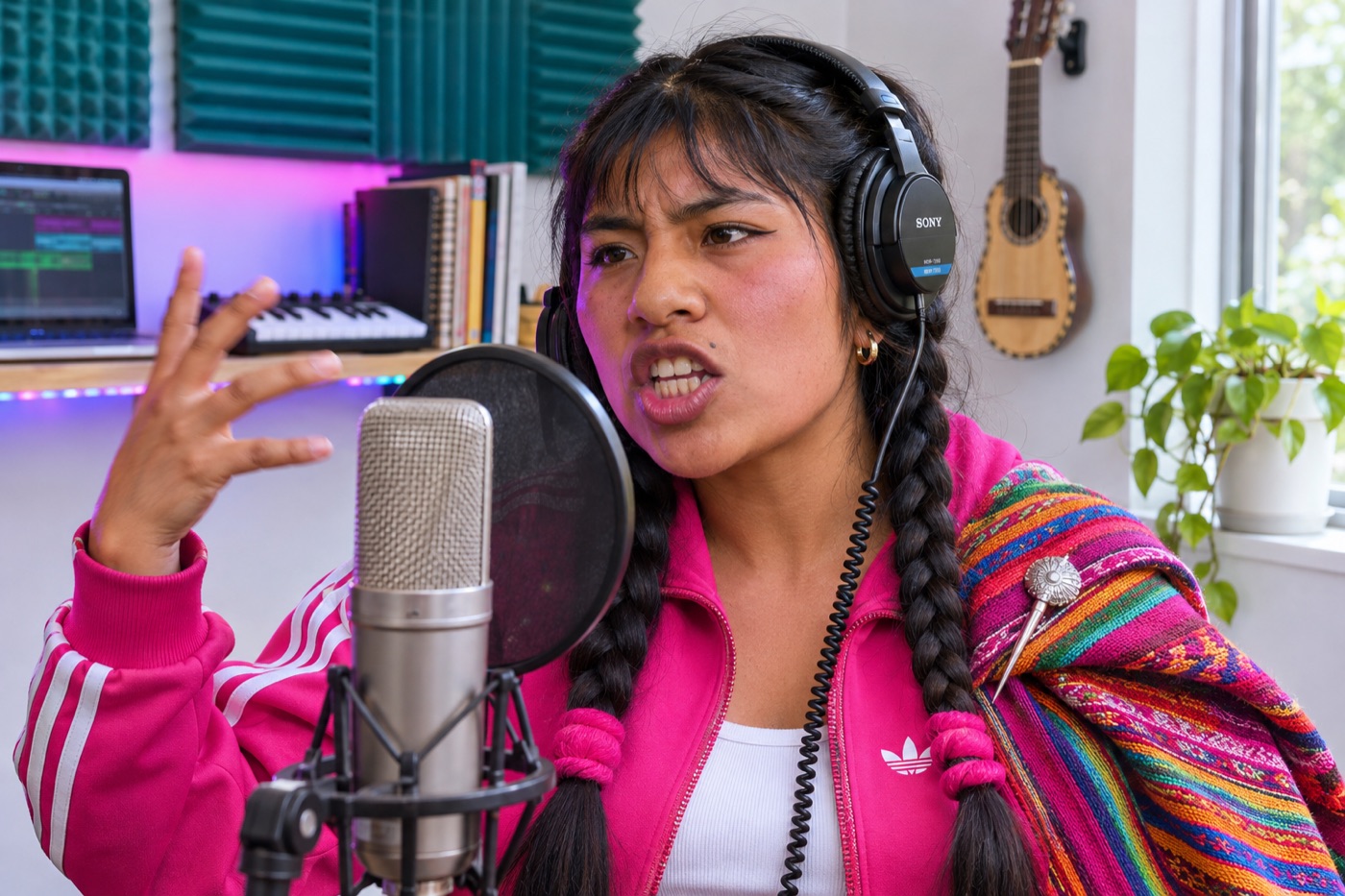
Peruvian rapper Renata Flores mixes hip-hop with Quechua, a language that has often been looked down on. Can a song really help a language survive?
Warm up3 questions
- Can music help you enjoy a language you do not understand?
- Why might a family stop teaching children their traditional language?
- What happens when modern music uses traditional instruments?
Sentence help (optional): I'd choose ... because ... · For me, ... · I think ... because ...
Warm up3 questions
- Can music help you enjoy a language you do not understand?
- Why might a family stop teaching children their traditional language?
- What happens when modern music uses traditional instruments?
Warm up3 questions
- Can music help you enjoy a language you do not understand?
- Why might a family stop teaching children their traditional language?
- What happens when modern music uses traditional instruments?
Core version
Rap often makes us think of English or Spanish songs. But a young Peruvian musician is helping people hear a very different language. Renata Flores mixes rap, hip-hop and other modern sounds with Quechua, an Indigenous language spoken in the Andes. Her songs are reaching new audiences and encouraging younger people to feel proud of a language that has sometimes been treated unfairly.
The Guardian wrote about Flores on 18 November 2026. Flores, who is 25, first became widely known when she was fourteen. She recorded a Quechua version of a Michael Jackson song, and her grandmothers helped her translate it. The video became a hit on YouTube and helped her begin a music career. Since then, she has continued to bring Quechua into modern popular music.
There is a personal reason behind her choice. According to the report, Flores learnt Quechua from her grandmothers because her parents had not taught it to her. They were worried that she might face discrimination. In Peru, people who speak Quechua have sometimes been treated with contempt. By singing in it, Flores helps show that the language belongs on modern stages as well as in family homes.
Her music combines traditional Andean instruments and sounds with styles such as trap and reggaeton. This mixture can surprise listeners who think old languages belong only in museums or history books. Younger musicians in the Ayacucho region are also exploring their own ways of using Quechua. They are not simply copying old songs. They are making something new while keeping an important part of their culture alive.
Music cannot solve every problem facing a language. For people to keep speaking Quechua, they also need chances to use it in schools, public services, media and everyday life. Children need to hear it and have chances to learn it. A popular song may encourage someone to take an interest, but it cannot replace years of learning or support for the people who speak the language.
Still, a song can reach people who would never open a language textbook. It can make a language sound exciting, emotional and full of life. Flores's story also asks a question about identity: do people have to choose between being modern and respecting tradition? Perhaps they can do both. If you could make a song in a language that few people around you understand, would you choose to sing in it anyway?
Intermediate version
Rap music is often associated with English, Spanish and the major global music industries. But in Peru, a young artist is using it to introduce audiences to Quechua, an Indigenous language spoken across parts of the Andes. Renata Flores combines contemporary hip-hop, trap and reggaeton with traditional Andean sounds, challenging the idea that Indigenous languages belong only to the past. Her growing popularity is part of a wider artistic movement that wants younger generations to feel proud of their cultural heritage.
In an article published on 18 November 2026, the Guardian described Flores, now 25, and a new generation of musicians working in Quechua. She first attracted attention at fourteen after recording a Quechua version of a Michael Jackson song, translating it with help from her grandmothers. The video became a viral hit on YouTube and opened the door to a music career. Rather than switching to a more commercially familiar language, Flores continued to develop her own sound around Quechua.
Her choice has a complicated family history. According to the report, Flores's parents did not teach her Quechua because of social stigma and the fear that she could face discrimination. In Peru, Indigenous languages have sometimes been associated with lower social status, and speakers have often been treated with contempt. Flores chose to learn from her grandmothers and bring the language to places where young people already spend time, such as YouTube.
That approach can change how people see a language. When a song mixes Andean instruments with modern beats, it shows that cultural traditions do not have to remain frozen in the past. Young musicians in the Ayacucho region are building on similar ideas, creating new music while celebrating local identity. Some listeners may not understand every word, but the sound, rhythm and performance can encourage curiosity. Music becomes a way of opening a conversation about who gets to decide which languages are valuable.
However, a popular artist cannot protect a language alone. Quechua needs support in education, public life and the media, as well as opportunities for children to hear and use it at home. An audience that enjoys a song is not necessarily going to learn the language. There is also a risk of celebrating traditional culture on stage while ignoring the prejudice that speakers face in everyday situations. Genuine respect requires more than buying a ticket or sharing a video.
Flores's career suggests that cultural preservation does not always mean keeping things exactly as they were. Traditions can survive by changing, mixing with other influences and reaching people in unfamiliar ways. Her music invites listeners to question whether a language sounds old-fashioned because of the language itself or because of the attitudes around it. Can a modern song help repair the damage caused by generations of people being told that their language was less important?
Advanced version
Can a musical genre associated with global youth culture help revive respect for a language that has endured generations of prejudice? In Peru, rapper Renata Flores is offering a compelling answer. By combining Quechua, an Indigenous language of the Andes, with hip-hop, trap, reggaeton and traditional instruments, she challenges the assumption that cultural heritage must remain rooted in the past. Her music is both contemporary entertainment and a public statement about the value of linguistic identity.
A Guardian feature published on 18 November 2026 explored Flores's career and a wider movement of Quechua-speaking artists. Now 25, Flores first gained widespread attention at the age of fourteen after recording a Quechua version of a Michael Jackson song, translated with help from her grandmothers. Rather than treating the viral success as a novelty, she built an artistic identity around the language. Her work has since helped bring Quechua into musical spaces where many younger listeners might not previously have encountered it.
The decision has particular significance because of her family's experience. According to the report, Flores's parents did not pass Quechua on to her because of social stigma and the fear that she would face discrimination. Indigenous languages have often been stigmatised, and speaking one can carry social consequences that outsiders may overlook. Flores's choice to learn from her grandmothers therefore represents more than a musical preference. It is an attempt to reclaim something that earlier generations sometimes felt obliged to hide in order to avoid prejudice.
Her work illustrates how preservation and innovation can reinforce each other. By blending Andean sounds with contemporary urban music, Flores refuses the idea that an Indigenous language must be confined to ceremonies, traditional folk performances or academic study. Other young musicians in Ayacucho are finding ways to express modern experiences through Quechua too. Their work can challenge stereotypes and make cultural continuity appealing to listeners who identify strongly with global popular music. A language remains alive when it is used to say new things, not only when it is remembered for saying old ones.
Still, music has limitations as a tool for linguistic survival. The success of a prominent performer does not guarantee that children can study in Quechua, access public services in it or use it without facing discrimination. A widely shared song may spark interest, but long-term change depends on families, schools, institutions and opportunities for everyday communication. Celebrating Indigenous culture in entertainment while failing to respect its speakers in ordinary life would be a shallow form of progress.
The story also complicates a familiar debate about cultural authenticity. Some might argue that traditional languages should be protected by keeping their original forms of expression intact. Flores's approach suggests the opposite: combining old and new can be a way of resisting disappearance rather than surrendering to global culture. Her music does not ask younger listeners to choose between modern identity and inherited language. It invites them to inhabit both. If preserving a language means keeping it alive, should communities be encouraged to change how it sounds and where it is heard?
Study this story
Save the words you want to keep, talk about the story, then practise the language.
Highlights0 saved
Highlights0 saved
Highlights0 saved
Talk about it3 questions
- Can a popular song really help protect a language?
- Should schools do more to teach Indigenous and regional languages?
- Is changing a tradition a way of protecting it, or changing it too much?
Sentence help (optional): I think ... because ... · One reason is ... · For me, ...
You can talk about people in general instead of yourself, and you can pass on any question.
Talk about it3 questions
- Can a popular song really help protect a language?
- Should schools do more to teach Indigenous and regional languages?
- Is changing a tradition a way of protecting it, or changing it too much?
You can talk about people in general instead of yourself, and you can pass on any question.
Try it
Work in pairs. Choose a traditional song, rhyme, dance or saying from anywhere in the world. It does not have to come from your own family. Talk about how you could bring it into a modern style, such as pop, rap or electronic music, without losing what makes it special. Then explain your idea to another pair in thirty seconds. Nothing needs to be recorded or shared online.
Exercises4 exercises
1. Complete the sentences
Drag a word into each gap, or tap a word and then tap a gap. Tap a filled gap to put the word back. Two words are not needed.
- Flores recorded a Quechua version of a Michael Jackson .
- Her helped her translate it.
- Her music combines traditional Andean with trap and reggaeton.
- Children need to hear Quechua and have chances to it.
- A song can reach people who would never open a language .
2. Match the meaning
Choose the meaning of each word or phrase as it is used in the article.
- discrimination
- contempt
- identity
- tradition
Write the letter of the meaning next to each word.
- A a custom or belief that has lasted for a long time
- B a feeling that someone or something is not worth respect
- C unfair treatment of people because of who they are
- D who you are and the group you belong to
3. Put the verb in the right form
Write the correct form of the verb in brackets.
- Flores Quechua from her grandmothers. (learn)
- She a Quechua version of a Michael Jackson song. (record)
- The video a hit on YouTube. (become)
- Her parents not taught it to her. (have)
- Younger musicians in the Ayacucho region their own ways of using Quechua. (explore)
4. True, false or not given
Choose Not given if the article does not say, even when you think the statement is probably true.
- Flores is 25 years old.
The text says: "Flores, who is 25, first became widely known when she was fourteen"
- Flores learnt Quechua from her parents.
The text says: "Flores learnt Quechua from her grandmothers because her parents had not taught it to her"
- Flores plans to release a new album next year.
The text does not say when Flores will release a new album.
- Quechua is spoken in the Andes.
The text says: "Quechua, an Indigenous language spoken in the Andes"
- A popular song can replace years of learning.
The text says: "it cannot replace years of learning or support for the people who speak the language"
Your score
Do all four, then add them up.
Answer key
- Complete the sentences1 song · 2 grandmothers · 3 instruments · 4 learn · 5 textbook
- Match the meaning1 discrimination = C · 2 contempt = B · 3 identity = D · 4 tradition = A
- Put the verb in the right form1 learnt or learned · 2 recorded · 3 became · 4 had · 5 are exploring
- True, false or not given1 True · 2 False · 3 Not given · 4 True · 5 False
1. Complete the sentences
Drag a word into each gap, or tap a word and then tap a gap. Tap a filled gap to put the word back. Two words are not needed.
- Rap is often with English, Spanish and the major global music industries.
- Flores combines hip-hop, trap and reggaeton with traditional Andean .
- The video became a viral hit and opened the to a music career.
- Flores's parents feared that she could face .
- An audience that enjoys a song is not necessarily going to the language.
- Traditions can survive by changing and mixing with other .
2. Match the meaning
Choose the meaning of each word or phrase as it is used in the article.
- heritage
- stigma
- prejudice
- preservation
Write the letter of the meaning next to each word.
- A the traditions and history that a group passes down
- B a strong feeling that something is shameful
- C the act of keeping something safe so that it is not lost
- D an unfair opinion formed without good reason
3. Put the verb in the right form
Write the correct form of the verb in brackets.
- She first attention at fourteen. (attract)
- Flores to learn from her grandmothers. (choose)
- Flores to develop her own sound around Quechua. (continue)
- Young musicians in the Ayacucho region are on similar ideas. (build)
- Quechua support in education, public life and the media. (need)
4. True, false or not given
Choose Not given if the article does not say, even when you think the statement is probably true.
- Flores first attracted attention when she was fourteen.
The text says: "She first attracted attention at fourteen"
- Flores's parents taught her Quechua at home.
The text says: "Flores's parents did not teach her Quechua because of social stigma"
- Millions of people watched the first video.
The text does not say how many people watched the video.
- Quechua needs support in schools and the media.
The text says: "Quechua needs support in education, public life and the media"
- Enjoying a song means a person will learn the language.
The text says: "An audience that enjoys a song is not necessarily going to learn the language."
Your score
Do all four, then add them up.
Answer key
- Complete the sentences1 associated · 2 sounds · 3 door · 4 discrimination · 5 learn · 6 influences
- Match the meaning1 heritage = A · 2 stigma = B · 3 prejudice = D · 4 preservation = C
- Put the verb in the right form1 attracted · 2 chose · 3 continued · 4 building · 5 needs
- True, false or not given1 True · 2 False · 3 Not given · 4 True · 5 False
1. Complete the sentences
Drag a word into each gap, or tap a word and then tap a gap. Tap a filled gap to put the word back. Two words are not needed.
- Flores challenges the assumption that cultural heritage must remain in the past.
- Rather than treating the viral success as a , she built an artistic identity around the language.
- Her choice to learn from her grandmothers represents more than a musical .
- Flores refuses the idea that an Indigenous language must be to ceremonies and academic study.
- The success of a prominent performer does not that children can study in Quechua.
- Celebrating culture in entertainment while failing to respect its speakers would be a form of progress.
2. Match the meaning
Choose the meaning of each word or phrase as it is used in the article.
- stigmatised
- authenticity
- stereotypes
- inhabit
Write the letter of the meaning next to each word.
- A treated as shameful or not good enough
- B the quality of being real and true to the original
- C fixed, simple ideas about a type of person or thing
- D to live in or be fully part of something
3. Make the right word
Use the word in brackets to make a word that fits the gap.
- Her music is a public statement about the value of identity. (LINGUIST)
- Her work shows how preservation and can reinforce each other. (INNOVATE)
- Success does not guarantee that children can use Quechua without facing . (DISCRIMINATE)
- Long-term change depends on opportunities for everyday . (COMMUNICATE)
- Combining old and new can be a way of resisting rather than surrendering. (APPEAR)
4. True, false or not given
Choose Not given if the article does not say, even when you think the statement is probably true.
- Flores became well known at fourteen.
The text says: "Now 25, Flores first gained widespread attention at the age of fourteen"
- Flores's parents passed Quechua on to her.
The text says: "Flores's parents did not pass Quechua on to her"
- Flores earns more from streaming than from concerts.
The text does not say how Flores earns most of her money.
- Other young artists in Ayacucho also use Quechua.
The text says: "Other young musicians in Ayacucho are finding ways to express modern experiences through Quechua too"
- Combining old and new cannot help a language survive.
The text says: "combining old and new can be a way of resisting disappearance"
Your score
Do all four, then add them up.
Answer key
- Complete the sentences1 rooted · 2 novelty · 3 preference · 4 confined · 5 guarantee · 6 shallow
- Match the meaning1 stigmatised = A · 2 authenticity = B · 3 stereotypes = C · 4 inhabit = D
- Make the right word1 linguistic · 2 innovation · 3 discrimination · 4 communication · 5 disappearance
- True, false or not given1 True · 2 False · 3 Not given · 4 True · 5 False
Continue reading
Music & style
Why a Great Song Doesn't Need Your Language
Songs in 16 languages reached a streaming service's global top 50 in 2025. What makes a song travel, and what gets lost on the way?
Music & style
Would You Wear a Rival Team's Shirt?
A writer argues that fashion has discovered the football shirt. So what are you saying when you wear one, and who decides what it means?
Music & style
What Makes a Bad Photo a Good Memory?
Some people are going back to older digital cameras. What can a blurry photo give you that a perfect one can't?



Read this article online: johnplusnews.com/articles/can-rap-help-keep-a-language-alive/