News lesson22 July 2026
The Mountain with a Price List
Nepal's lawmakers have discussed proof of experience, insurance and waste rules. None of it is law yet, and guides' wages depend on how it ends.
Before you read
1Warm up3 questions
Talk about these questions with a partner.
- Would you still want a summit photo if you had to queue for it?
- What makes an adventure feel like an achievement?
- Is a famous challenge more appealing because many people want to do it?
2Key words8 words
These words are in the article. Choose the letter of the meaning for each one.
- queues
- deadly
- expeditions
- restrictions
- porters
- proposals
- thin
- lifelong
- Aable to kill you
- Bwith very little of something in it, like air high up
- Clong, organised trips to a faraway place
- Dideas that people suggest for a group to decide on
- Epeople who carry heavy bags for climbers
- Frules that stop you from doing something
- Glines of people waiting for their turn
- Hlasting for the whole of your life
1Warm up3 questions
Talk about these questions with a partner.
- Would you still want a summit photo if you had to queue for it?
- What makes an adventure feel like an achievement?
- Is a famous challenge more appealing because many people want to do it?
2Key words8 words
These words are in the article. Choose the letter of the meaning for each one.
- destination
- insurance
- operators
- qualifying
- requirement
- wages
- legislative
- weigh
- Aan agreement to be paid money if something bad happens to you
- Bconnected with making laws
- Ccompanies that run a business or a service
- Dsomething you must have or do because of a rule
- Ethe money a worker is paid for their work
- Fto compare things carefully before you decide
- Gneeded to be allowed to take part in something
- Ha place that people travel to
1Warm up3 questions
Talk about these questions with a partner.
- Would you still want a summit photo if you had to queue for it?
- What makes an adventure feel like an achievement?
- Is a famous challenge more appealing because many people want to do it?
2Key words8 words
These words are in the article. Choose the letter of the meaning for each one.
- infrastructure
- novices
- enforceable
- certify
- unaided
- revenue
- summited
- uneasy
- Areached the top of a mountain
- Bwithout any help
- Cable to be made to happen by law
- Dthe basic buildings and services that an activity needs
- Eto confirm officially that something is true
- Fmoney that a business or country earns
- Gpeople who are new to an activity and have little experience
- Hnot comfortable or settled
Read
3Read the article
The paragraphs are numbered. Look out for the key words from task 2.
Core version
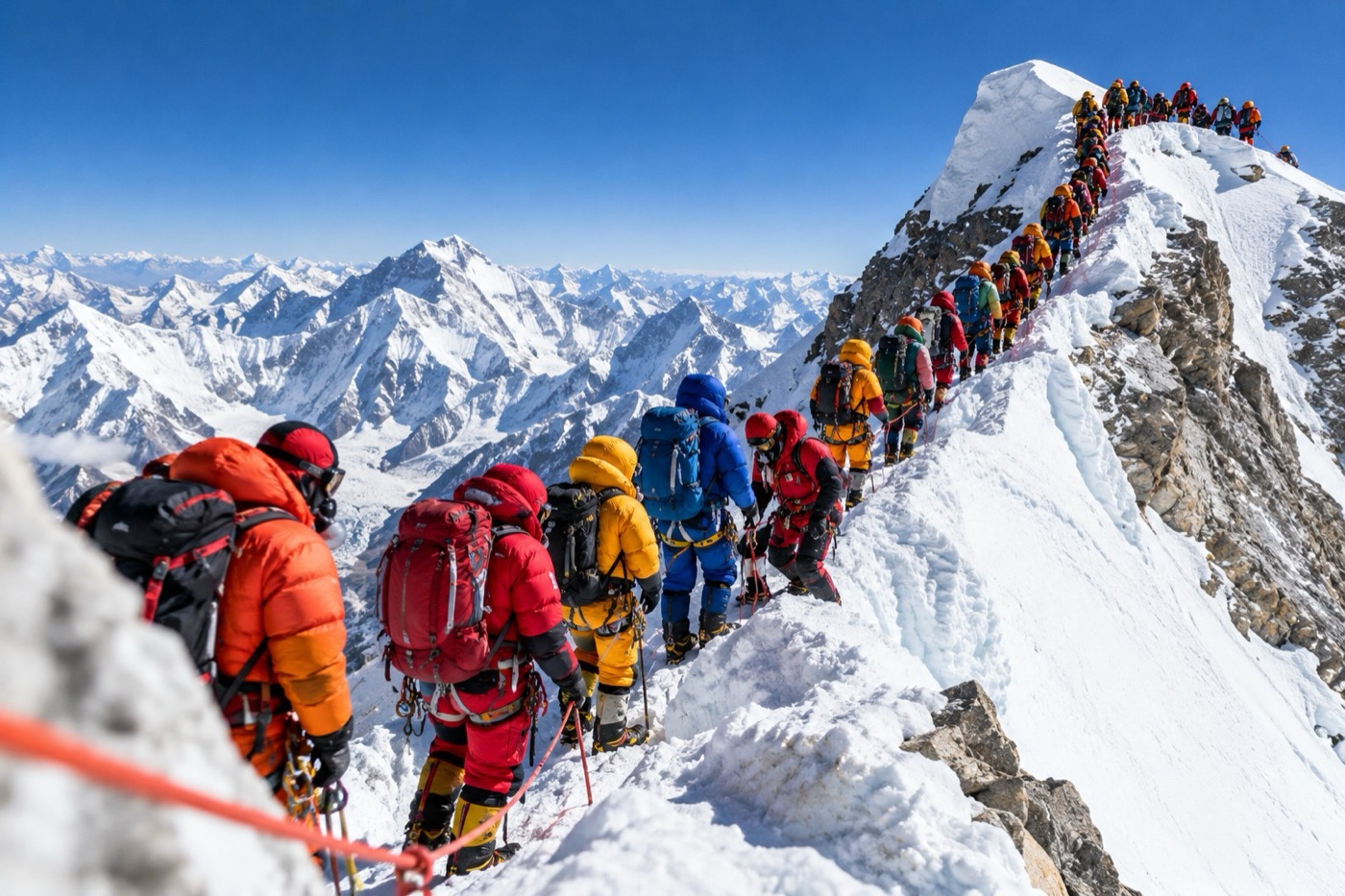
Mount Everest is the highest mountain in the world. For many climbers, reaching its top is a lifelong dream. But the journey can be extremely dangerous. There is very little oxygen, the weather can change quickly and climbers sometimes have to wait in long queues near the summit. Standing still in the freezing cold, high above the clouds, can be deadly.
Everest is in the Himalayas, on the border between Nepal and China. Many climbers set off from the Nepali side and pay large amounts of money for permits, equipment and professional support. Taking on experienced local guides is an important part of most expeditions.
Some people worry that Everest has become too popular. Tourists may try to climb it without enough experience, even when they have the money to book a trip. High mountains test skills such as breathing in thin air and judging the weather, and those skills take years to learn. If something goes wrong high on the mountain, guides and rescue teams end up in danger too. They may have to climb back into the same thin air and bad weather to bring somebody down.
In 2026, politicians in Nepal discussed stricter rules for people who want to climb Everest. One idea was that climbers should first have got to the top of another Nepali mountain higher than 7,000 metres. Other proposals dealt with better insurance and with the rubbish that expeditions leave behind on mountains.
These ideas were still being discussed as part of a new law, so they should not all be treated as rules already in force. Supporters believe that experience requirements could cut down the number of avoidable accidents. Critics worry that new restrictions would make climbing even more expensive and harder to organise.
Everest also brings important income to Nepal, including work for guides, porters and local businesses. Many families in the mountain areas live on what they earn during the short climbing season. The challenge is to keep climbing possible without putting visitors, workers and the mountain itself at unnecessary risk. Adventure may involve danger, but should there be a limit to how much danger people are allowed to buy?
Intermediate version
Reaching the summit of Mount Everest remains one of the world's most famous sporting achievements. Yet the mountain has also turned into a commercial destination, with climbers paying substantial sums for permits, equipment and organised expeditions. The question is whether the growing market for adventure has made an already dangerous activity unnecessarily risky. Everest, in other words, is no longer only a mountain. It is also a service with a price list.
Everest's extreme altitude creates serious difficulties. Oxygen levels are low, weather conditions are unpredictable and the safest opportunities to reach the summit may be very brief. When several expeditions set out on the same route during a suitable weather window, queues can build up in places where waiting is itself a danger. A climber held up for an hour near the top is burning through oxygen and body heat that cannot easily be replaced.
Nepal, whose mountain communities rely heavily on climbing tourism, has been looking at stricter rules. During 2026, lawmakers discussed measures including a requirement for Everest applicants to show that they had previously climbed a mountain above 7,000 metres in Nepal. Proposals also took in insurance, waste management and the responsibilities of expedition operators.
The distinction between a proposal and a law matters. Parliamentary discussions do not mean that every suggested restriction has already been brought in. Different lawmakers have backed different standards, and the final rules depend on how the legislative process turns out. Until a bill is passed, climbers and operators are planning around requirements that could still change.
Supporters believe stronger experience requirements could put off poorly prepared climbers and take some pressure off guides and rescuers. Critics may argue that previous climbs are no guarantee of good judgement. They also note that extra qualifying expeditions cost money, so only an even wealthier group of people could afford to climb Everest.
There are important local interests as well. International expeditions provide income for Nepali guides, transport providers and other businesses, often in areas with few other ways of making a living. Any new system has to weigh safety and environmental protection against the livelihoods of people who depend on the climbing season. Halving the number of permits would certainly ease the pressure on the mountain, but it would also halve somebody's wages.
The debate is ultimately about the difference between a challenging adventure and a commercial product. On Everest, the risks of that product are not confined to the paying customer. They are shared by everybody carrying the loads, fixing the ropes and coming to the rescue when a client runs into trouble.
Advanced version
Mount Everest occupies an uneasy position between an extraordinary mountaineering challenge and a global adventure industry. Its summit still demands exceptional endurance, but the commercial infrastructure built up around expeditions has fuelled concern about inexperienced climbers taking on the world's highest mountain with extensive paid assistance. Nepal's debate over tougher entry requirements reflects precisely that tension.
At extreme altitude, danger is not confined to dramatic storms or technical accidents. Thin air, fatigue and narrow weather windows can render delays life-threatening, while crowded sections of a route leave little room for individual judgement. Numbers compound every other hazard: what would be a minor inconvenience at sea level becomes, high on Everest, a question of how much oxygen is left in the cylinder. A poorly prepared climber adds to the pressure on guides, porters and rescue workers, who rarely have the option of turning back alone.
In 2026, Nepalese lawmakers considered revisions to tourism legislation that would impose more demanding qualifications on aspiring Everest climbers. One prominent proposal required applicants to have summited another mountain above 7,000 metres in Nepal. Other suggested changes concerned insurance, environmental responsibilities and the regulation of expedition companies. These measures formed part of a legislative process rather than a settled body of newly enforceable rules, a distinction easily lost once a headline announces that Everest has been closed to novices. Coverage that collapses the two risks misleading precisely the climbers any new rule is meant to protect.
There is a compelling argument for requiring demonstrable experience. Organised support cannot do away with the need for judgement, physical preparation and familiarity with high-altitude conditions. Climbing another mountain first is no guarantee of good judgement. Requiring extra expeditions could also make Everest more expensive and increase the travel involved. Rules intended to filter out the unprepared may end up filtering out the less wealthy. Competence, inconveniently, is harder to certify than altitude.
The economics weigh just as heavily. Mountaineering generates employment and revenue in regions with few alternative opportunities. Restrictions that sharply reduce visitor numbers would be felt first by guides and local communities, while rules that prioritise volume expose those same workers to avoidable danger. Responsible policy has to hold both considerations in view rather than treating climbers as the only parties with interests at stake. No version of the rules leaves every interest untouched; the real question is which trade-off can be defended.
The controversy illustrates a broader problem in adventure tourism. Paying for professional support can open up remarkable experiences to people who would never have reached them unaided, but no amount of money buys immunity from physical risk. Everest is simply the most dramatic illustration of a straightforward principle: the freedom to pursue a dream does not cancel the responsibility to consider who else bears its consequences. That holds well beyond the Himalayas, wherever difficulty itself has been packaged up and sold.
After you read
4True, false or not given5 statements
Choose T (true), F (false) or NG (the article does not say).
- Everest is on the border between Nepal and China.
The text says: "Everest is in the Himalayas, on the border between Nepal and China."
- All of the ideas that politicians discussed are already rules.
The text says they "should not all be treated as rules already in force".
- Guides and rescue teams may have to go back into bad weather to help a climber.
The text says they "may have to climb back into the same thin air and bad weather to bring somebody down".
- Most people who try to climb Everest reach the top.
The text does not say how many climbers reach the top.
- Supporters think that experience rules would make climbing cheaper.
Critics, not supporters, talk about cost; supporters believe the rules "could cut down the number of avoidable accidents".
5Vocabulary5 gaps
Complete the sentences with words from the box. Two words are not needed.
equipmentincomeinsuranceoxygenPermitsrubbishsummit
- are official papers that give you permission to climb.
- If a climber is hurt, can pay for the cost of a rescue.
- Reaching the means getting to the very highest point of the mountain.
- Many families in the mountain areas depend on the they earn from climbers.
- Bags of , such as empty food packets, are often left on the mountain.
6Verb forms5 gaps
Write the correct form of the verb in brackets.
- In 2026, politicians in Nepal stricter rules for climbers. (DISCUSS)
- Some people worry that Everest too popular. (BECOME)
- They may have to climb back into the thin air somebody down. (BRING)
- Other proposals with the problem of waste. (DEAL)
- Yesterday the guide his team up to the next camp. (LEAD)
7Language focusprepositions
Complete the sentences with words from the box. Two words are not needed. Small words go with certain verbs and nouns. Learn the whole phrase: pay for, worry about, live on, in the Himalayas.
aboutatforfrominonto
- Many young people are interested climbing high mountains.
- Many climbers pay a lot of money permits.
- Critics worry the cost of new rules.
- Visitors and workers should not be put risk without a good reason.
- Many families live what they earn during the short climbing season.
4True, false or not given5 statements
Choose T (true), F (false) or NG (the article does not say).
- Waiting in a queue near the summit can use up a climber's oxygen.
The text says a climber held up near the top "is burning through oxygen and body heat".
- All the lawmakers support the same experience standard.
The text says "Different lawmakers have backed different standards".
- Nepal will pass the bill before the next climbing season.
The text only says the final rules depend on how the process turns out, with no date.
- Critics think a previous climb proves that a climber has good judgement.
The text says critics argue that previous climbs "are no guarantee of good judgement".
- Fewer permits would help the mountain but would also reduce some people's pay.
The text says halving permits "would certainly ease the pressure" but "would also halve somebody's wages".
5Vocabulary6 gaps
Complete the sentences with words from the box. Two words are not needed.
altitudeapplicantscommercialconfinedhesitantlivelihoodsrumoursubstantial
- The company spent a amount of money on new equipment before the season began.
- Many climbers suffer headaches and dizziness because of the extreme .
- Only who can prove their experience will receive a permit.
- Closing the route would cost thousands of mountain families their .
- The effects of a bad decision are not to the climber who makes it.
- Several companies now run trips, charging clients a high price for guided ascents.
6Verb forms5 gaps
Write the correct form of the verb in brackets.
- By the time the storm arrived, the group the camp. (LEAVE)
- If the bill passes, new rules before next season. (INTRODUCE)
- Over the years, many more tourists to climb Everest. (TRY)
- Supporters suggest climbers to show proof of experience. (ASK)
- If the price of a permit doubled, fewer people able to afford it. (BE)
7Language focusprepositions
Complete the sentences with words from the box. Two words are not needed. Check the word before the gap. Verbs like rely, suffer and weigh take a fixed preposition, and so do nouns such as guarantee.
againstfromintoofonoverto
- Many guides rely the climbing season for most of their income.
- Some climbers suffer frostbite, even with the best clothing.
- Any new system has to weigh safety the interests of local workers.
- A famous name is no guarantee a safe trip.
- Problems high on the mountain are not limited the climbers themselves.
4True, false or not given5 statements
Choose T (true), F (false) or NG (the article does not say).
- The writer suggests that the 7,000-metre rule could favour richer climbers.
The text says rules to filter out the unprepared "may end up filtering out the less wealthy".
- Headlines saying Everest has been closed to novices are accurate.
The text says the measures were part of a legislative process, not "newly enforceable rules".
- Nepali guides have asked lawmakers to cut the number of permits.
The text does not report what guides have asked lawmakers to do.
- The writer implies that an earlier climb would not necessarily improve a climber's judgement.
The text says another climb first "is no guarantee of good judgement".
- Rules that limit visitor numbers and rules that favour volume would affect guides in the same way.
Fewer visitors would hit guides' income first, while volume would "expose those same workers to avoidable danger".
5Vocabulary6 gaps
Complete the sentences with words from the box. Two words are not needed.
alleviatecompounddemonstrablefuelledimmunityprioritiserenderundermine
- The leaked report speculation that the government would abandon the plan.
- Poor visibility will only the problems for climbers who are already short of oxygen.
- A single delay can an otherwise routine descent hazardous.
- The permit office wants evidence of experience, such as certificates, not just a verbal claim.
- Fame does not give a mountaineer from the effects of thin air.
- Operators that profit over safety are likely to attract tighter regulation.
6Word forms5 gaps
Use the word in brackets to make a word that fits the gap.
- Insurers are increasingly reluctant to cover climbers. (EXPERIENCE)
- Critics doubt the of rules that rely on a single earlier climb. (EFFECTIVE)
- Any attempt to the rules would need the support of local communities. (STRONG)
- Regulators are calling for greater about how many clients each company takes. (TRANSPARENT)
- The tourist board praised the of local guides who stayed with a struggling client. (DEDICATE)
7Language focusprepositions
Complete the sentences with words from the box. Two words are not needed. At this level, look for fixed expressions: an adjective plus a preposition (contingent on) or a longer phrase (at the expense of, in lieu of).
atbyfromofontowith
- Approval of the permit is contingent proof of prior high-altitude experience.
- The commercial interests of operators are often at odds the safety of their staff.
- Companies that cut costs the expense of safety invite tighter regulation.
- A rule this strict would be tantamount a ban for most amateurs.
- A cheaper package may offer extra oxygen in lieu a second guide.
Speak
8Talk about it3 questions
Discuss in pairs or small groups. Give reasons for your answers.
- Who should be able to decide how many climbers a mountain receives?
- Would you choose a less famous mountain for a better experience?
- What should a visitor owe the people who make a dangerous trip possible?
9Role-play: who should climb Everest?
Work in pairs. Read your card, then have the conversation. Swap roles and do it again.
Student A · a mountain guide
Nepal may ask climbers to prove their experience first. You think this is a good idea because rescues are dangerous for guides. Explain your worries and ask the climber about their experience.
Student B · a keen climber
You've saved for years to climb Everest, but you've never climbed a 7,000-metre mountain. You think the new rule is unfair. Explain why you should be allowed to go, and look for a compromise.
Useful phrases
- I'm worried about the risks for the guides.
- Have you ever climbed above 7,000 metres?
- I've been saving for this trip for years.
- That's not fair, because I'm very fit.
- What if I did a training course first?
- Let's find a solution we're both happy with.
Afterwards, tell the class: did the guide agree to take the climber, and what was the compromise?
Your words
Highlights0 saved
Highlights0 saved
Highlights0 saved
Was this lesson useful? Support johnplusnews on Ko-fi
Continue reading
Travel
What Happens When One of the World's Quietest Places Gets Easier to Visit?
Greenland now has three new airports and more visitors than ever, but tourism is still a small part of its economy. Some residents worry about what a rush of visitors could do to a quiet place with a fragile environment.
Society
The Couple Who Spent the Night Looking for a Stranger
A backpacker lost a wallet holding a month's money in Darwin in 1989. Two strangers visited four hostels to give it back, then disappeared.
Travel
Is Instagram Choosing Our Holidays?
A beautiful image can send you across the world. It can also send several thousand other people to the same railing.